Coordinating concurrent transmissions: A constant-factor - - PowerPoint PPT Presentation

coordinating concurrent transmissions
SMART_READER_LITE
LIVE PREVIEW

Coordinating concurrent transmissions: A constant-factor - - PowerPoint PPT Presentation

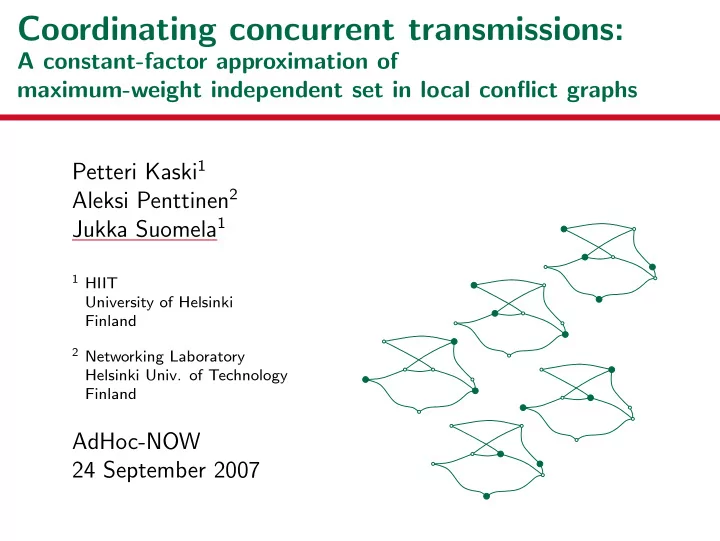
Coordinating concurrent transmissions: A constant-factor approximation of maximum-weight independent set in local conflict graphs Petteri Kaski 1 Aleksi Penttinen 2 Jukka Suomela 1 1 HIIT University of Helsinki Finland 2 Networking Laboratory


slide-1
SLIDE 1

Coordinating concurrent transmissions:

A constant-factor approximation of maximum-weight independent set in local conflict graphs Petteri Kaski1 Aleksi Penttinen2 Jukka Suomela1

1 HIIT

University of Helsinki Finland

2 Networking Laboratory

Helsinki Univ. of Technology Finland

AdHoc-NOW 24 September 2007

slide-2
SLIDE 2

Wireless communication links

2 / 14

slide-3
SLIDE 3

Interference — near-far effect

3 / 14

slide-4
SLIDE 4

Conflict graph

4 / 14

slide-5
SLIDE 5

Independent set in conflict graph

5 / 14

slide-6
SLIDE 6

Independent set in conflict graph

6 / 14

slide-7
SLIDE 7

Problems associated with conflict graph

Problems:

  • A. Given per-link weights,

find maximum-weight independent set = nonconflicting set of links

  • B. Given per-link data

transmission needs, find a minimum-length link schedule

(generalisation of fractional graph colouring)

1 2 time units 1 2 time units 1 2 time units 1 2 time units 1 2 time units 7 / 14

slide-8
SLIDE 8

Known properties

Problems:

  • A. max-weight independent set
  • B. min-length link schedule

Known properties:

◮ Approximation of A

implies approximation of B

(e.g., Young 2001, Jansen 2003)

◮ A and B hard to solve and

approximate in general graphs

(Lund–Yannakakis 1994, H˚ astad 1999, Khot 2001)

1 2 time units 1 2 time units 1 2 time units 1 2 time units 1 2 time units 8 / 14

slide-9
SLIDE 9

Assumptions on the problem structure

Define a new family of graphs: N-local conflict graphs Assumptions:

◮ bounded density of devices:

at most N devices in unit disk

◮ bounded range of interference:

interfering transmitter must be close to interfered receiver Non-assumptions:

◮ interference occurs if. . .

  • k
  • k

not ok not ok > N

  • k

9 / 14

slide-10
SLIDE 10

N-local conflict graphs: large family

Contains, for example:

◮ bipartite graphs ◮ cycles ◮ complete graph on

N2 vertices

◮ subgraphs of

N-local conflict graphs

◮ (N−1)-local conflict graphs

Generalisation of local graphs and civilised graphs

  • k
  • k

not ok not ok > N

  • k

10 / 14

slide-11
SLIDE 11

N-local conflict graphs: new family

Not contained in:

◮ bounded-degree graphs (proof: K1,n) ◮ bounded-density graphs (proof: Kn,n) ◮ planar graphs (proof: K3,3) ◮ disk graphs (proof: K3,3) ◮ bipartite graphs (proof: K3) ◮ graphs closed under

taking minors

(proof: split edges of a large clique)

  • k
  • k

not ok not ok > N

  • k

11 / 14

slide-12
SLIDE 12

Our results

Problems:

  • A. max-weight independent set
  • B. min-length link schedule

Assumptions:

◮ bounded density of devices ◮ bounded range of interference

Our results:

◮ A & B: (5 + ǫ)-approximation ◮ A & B: no PTAS

  • k
  • k

not ok not ok > N

  • k

12 / 14

slide-13
SLIDE 13

Algorithm sketch

Apply a shifting strategy

(Hochbaum–Maass 1985)

◮ Use a modular grid ◮ Try several locations ◮ Choose the best

Short links (within a grid cell):

◮ Exhaustive search for each cell

Long links (between grid cells):

◮ Find a large directed cut

2 2 2 2 2

senders receivers

1 1 1 1 1

13 / 14

slide-14
SLIDE 14

Summary

◮ N-local conflict graphs:

◮ bounded density of devices,

bounded range of interference

◮ Max-weight independent set,

min-length link schedule

◮ (5 + ǫ)-approximation, no PTAS ◮ Open problems: distributed,

coordinate-free algorithms?

http://www.hiit.fi/ada/geru jukka.suomela@cs.helsinki.fi

2 2 2 2 2

senders receivers

1 1 1 1 1

14 / 14