Convex Hull Representation Conversion: cddlib and lrslib Niklas - - PowerPoint PPT Presentation

convex hull representation conversion cddlib and lrslib
SMART_READER_LITE
LIVE PREVIEW

Convex Hull Representation Conversion: cddlib and lrslib Niklas - - PowerPoint PPT Presentation

Convex Hull Representation Conversion: cddlib and lrslib Niklas Pfister ETH Contents 1 Introduction Polytopes Minkowski-Weyl Theorem V- and H-Representation 2 Theoretical Algorithms Representation Conversion Problem Incremental Algorithm


slide-1
SLIDE 1

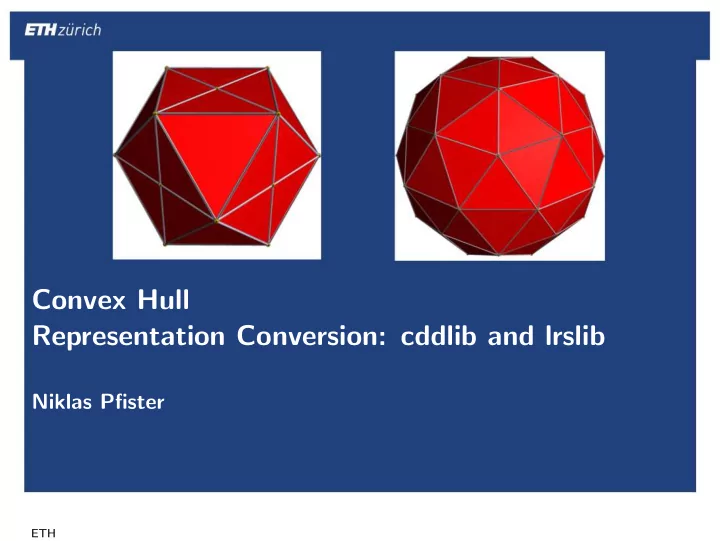
Convex Hull Representation Conversion: cddlib and lrslib

Niklas Pfister

ETH
slide-2
SLIDE 2

Contents

1 Introduction

Polytopes Minkowski-Weyl Theorem V- and H-Representation

2 Theoretical Algorithms

Representation Conversion Problem Incremental Algorithm Pivoting Algorithm

3 Implementations cddlib and lrslib

Input Implementation Details (cddlib) Examples GNU GMP Additional Functionality

4 References

ETH Niklas Pfister Student Seminar in Combinatorics: Mathematical Software October 21, 2014 2 / 24

slide-3
SLIDE 3

Polytopes

Definition (convex polytope/polyhedron)

Let A 2 Rm⇥d and b 2 Rm, then a convex polyhedron P corresponding to the pair (A, b) is defined as P := {x 2 Rd : Ax  b}. We call P a convex polytope if P is bounded.

ETH Niklas Pfister Student Seminar in Combinatorics: Mathematical Software October 21, 2014 3 / 24

slide-4
SLIDE 4

Polytopes

Example The square S given by S = {x 2 R2 : 1  x1  1, 1  x2  1} can be represented using the following (A, b) pair: A = B B @ 1 1 1 1 1 C C A, b = B B @ 1 1 1 1 1 C C A

−2 −1.5 −1 −0.5 0.5 1 1.5 2 −2 −1.5 −1 −0.5 0.5 1 1.5 2

ETH Niklas Pfister Student Seminar in Combinatorics: Mathematical Software October 21, 2014 4 / 24

slide-5
SLIDE 5

Minkowski-Weyl Theorem

Theorem (Minkowski-Weyl)

For a subset P of Rd, the following statements are equivalent: (i) P is a Polyhedron, i.e., there exist A 2 Rm⇥d and b 2 Rm such that P := {x 2 Rd : Ax  b}. (ii) P is finitely generated, i.e., there exist finitely many vectors vi’s and rj’s such that P = conv({v1, . . . , vs}) + cone({r1, . . . , rt}).

ETH Niklas Pfister Student Seminar in Combinatorics: Mathematical Software October 21, 2014 5 / 24

slide-6
SLIDE 6

Minkowski-Weyl Theorem

Remarks conv denotes the convex hull, i.e. conv({v1, . . . , vs}) := {x : x = X

i

aivi, kak1 = 1 and a 0} cone denotes the nonnegative hull, i.e. cone({r1, . . . , rt}) := {x : x = X

i

λiri, λi 0} (ii) can be equivalently written in matrix form: P is finitely generated, i.e., there exists V 2 Rd⇥s and R 2 Rd⇥t for some s and t such that P := {x : x = V µ + Rλ, µ 0, kµk1 = 1, λ 0}.

ETH Niklas Pfister Student Seminar in Combinatorics: Mathematical Software October 21, 2014 6 / 24

slide-7
SLIDE 7

V- and H-Representation

The Minkowski-Weyl theorem suggests the following definition:

Definition (H- and V-Representation)

A polyhedron has H-Representation if it is given in the form (i) (Halfspace-representation) A polyhedron has V-Representation if it is given in the form (ii) (Vertex-representation)

ETH Niklas Pfister Student Seminar in Combinatorics: Mathematical Software October 21, 2014 7 / 24

slide-8
SLIDE 8

V- and H-Representation

Example (continued) S is given in H-representation by S = {x 2 R2 : Ax  b}. S is given in V-representation by S = conv({(1, 1), (1, 1), (1, 1), (1, 1)}).

−2 −1.5 −1 −0.5 0.5 1 1.5 2 −2 −1.5 −1 −0.5 0.5 1 1.5 2

ETH Niklas Pfister Student Seminar in Combinatorics: Mathematical Software October 21, 2014 8 / 24

slide-9
SLIDE 9

V- and H-Representation

Question How can we convert between the two representations of a Polyhedron?

This problem of computing a (minimal) V-representation from an H-representation or vice versa is known as the representation conversion problem for polyhedra. It can be shown using the concept of dual polytopes that switching from the V-representation to the H-representation of a Polyhedron is essentially the same as switching from the V-representation to the H-representation. Therefore an algorithm describing one direction of the conversion will also give the other direction.

ETH Niklas Pfister Student Seminar in Combinatorics: Mathematical Software October 21, 2014 9 / 24

slide-10
SLIDE 10

Contents

1 Introduction

Polytopes Minkowski-Weyl Theorem V- and H-Representation

2 Theoretical Algorithms

Representation Conversion Problem Incremental Algorithm Pivoting Algorithm

3 Implementations cddlib and lrslib

Input Implementation Details (cddlib) Examples GNU GMP Additional Functionality

4 References

ETH Niklas Pfister Student Seminar in Combinatorics: Mathematical Software October 21, 2014 10 / 24

slide-11
SLIDE 11

Representation Conversion Problem

An important property of the representation conversion problem is that the size of the output is not easy to measure given the size of the input. For example the d-dimensional cube has 2d facets and 2d vertices. Consequently a good algorithm should be sensitive to the output size. Ideally bounded by a polynomial function of both output and input size. be light on the memory usage. Ideally the required memory is bounded by a polynomial of the input size. For the general representation problem no such algorithm exist. However restricted to special classes of polyhedra this is possible.

ETH Niklas Pfister Student Seminar in Combinatorics: Mathematical Software October 21, 2014 11 / 24

slide-12
SLIDE 12

Incremental Algorithm

Double Description Method Input: Matrix A 2 Rm⇥d. Output: Matrix R 2 Rd⇥n such that (A, R) are a DD pair, i.e. the columns of R generate C(A) := {x : Ax  0}.

General Step

Let K subset of row indices {1, 2, . . . , m} of A and let Ak the matrix

  • f the rows of A indexed by K. Assume (AK, R) is a DD pair.

If A = AK we are done. Else take i not in K and construct the DD pair (AK+i, R0).

ETH Niklas Pfister Student Seminar in Combinatorics: Mathematical Software October 21, 2014 12 / 24

slide-13
SLIDE 13

Incremental Algorithm

How can R0 be constructed?

ETH Niklas Pfister Student Seminar in Combinatorics: Mathematical Software October 21, 2014 13 / 24

slide-14
SLIDE 14

Incremental Algorithm

In what order should the rows be chosen?

ETH Niklas Pfister Student Seminar in Combinatorics: Mathematical Software October 21, 2014 14 / 24

slide-15
SLIDE 15

Pivoting Algorithm

ETH Niklas Pfister Student Seminar in Combinatorics: Mathematical Software October 21, 2014 15 / 24

slide-16
SLIDE 16

Contents

1 Introduction

Polytopes Minkowski-Weyl Theorem V- and H-Representation

2 Theoretical Algorithms

Representation Conversion Problem Incremental Algorithm Pivoting Algorithm

3 Implementations cddlib and lrslib

Input Implementation Details (cddlib) Examples GNU GMP Additional Functionality

4 References

ETH Niklas Pfister Student Seminar in Combinatorics: Mathematical Software October 21, 2014 16 / 24

slide-17
SLIDE 17

Input

Inputs for cddlib and lrslib are given in the following form for H-representations and V-representations respectively.

ETH Niklas Pfister Student Seminar in Combinatorics: Mathematical Software October 21, 2014 17 / 24

slide-18
SLIDE 18

Implementation Details

typedef st r u c t dd matrixdata ∗ dd MatrixPtr ; typedef st r u c t dd matrixdata { dd rowrange r o w s i z e ; dd rowset l i n s e t ; /∗ a subset

  • f

rows

  • f

l i n e a r i t y ( ie , g e n e r a t o r s

  • f

l i n e a r i t y space f o r V−r e p r e s e n t a t i o n , and equa tion s f o r H −r e p r e s e n t a t i o n . ∗/ dd colrang e c o l s i z e ; dd RepresentationType r e p r e s e n t a t i o n ; dd NumberType numbtype ; dd Amatrix matrix ; dd LPObjectiveType

  • b j e c t i v e ;

dd Arow rowvec ; } dd MatrixType ;

Listing 1: cdd MatrixPtr in cddtypes.h

ETH Niklas Pfister Student Seminar in Combinatorics: Mathematical Software October 21, 2014 18 / 24

slide-19
SLIDE 19

Implementation Details

void d d s e t g l o b a l c o n s t a n t s ( void )

initializes global constants such as dd zero and dd purezero

void d d f r e e g l o b a l c o n s t a n t s ( void )

frees the global constants again

dd MatrixPtr d d P o l y F i l e 2 M a t r i x ( f , dd ErrorType ∗ e r r )

read polyhedra data from stream f into matrixdata and return a pointer to it

dd PolyhedraPtr dd DDMatrix2Poly ( dd MatrixPtr matrix , dd ErrorType ∗ e r r )

store the representation given by matrix in a polyhedra data and generate the second representation of *poly

ETH Niklas Pfister Student Seminar in Combinatorics: Mathematical Software October 21, 2014 19 / 24

slide-20
SLIDE 20

Implementation Details

dd PolyhedraPtr dd DDMatrix2Poly2 ( dd MatrixPtr matrix , dd RowOrderType roworder , dd ErrorType ∗ e r r )

same as above with the extra argument roworder specifying the insertion order (eg. dd MaxCutoff, dd LexMin or dd RandomRow)

dd MatrixPtr d d C o p y I n e q u a l i t i e s ( dd PolyhedraPtr poly )

copy inequality representation pointed to by poly to matrixdata and return a pointer

dd MatrixPtr dd CopyGenerators ( dd PolyhedraPtr poly )

copy generator representation pointed to by poly to matrixdata and return a pointer

ETH Niklas Pfister Student Seminar in Combinatorics: Mathematical Software October 21, 2014 20 / 24

slide-21
SLIDE 21

Examples

example showing basic functionality (2-d cube) example demonstrating the importance of the ordering (8-d, 10-d cross polytope) cddlib vs lrslib example, i.e. very degenerate polytope (cddlib good) non degenerate polytope (lrslib good)

ETH Niklas Pfister Student Seminar in Combinatorics: Mathematical Software October 21, 2014 21 / 24

slide-22
SLIDE 22

GMP: Why is this useful?

cddlib and lrslib can both be compiled with the GNU GMP library. This allows the conversion of polytopes with rational representation to be converted exact without the use of approximation by floating points.

ETH Niklas Pfister Student Seminar in Combinatorics: Mathematical Software October 21, 2014 22 / 24

slide-23
SLIDE 23

Additional Functionality

Both libraries also contain an LP-solver to solve linear programming problems such as maximize c>x subject Ax  b

ETH Niklas Pfister Student Seminar in Combinatorics: Mathematical Software October 21, 2014 23 / 24

slide-24
SLIDE 24

References

Komei Fukuda, cddlib Reference Manual. 2008. Komei Fukuda, Frequently Asked Questions in Polyhedral

  • Computation. 2004.

Komei Fukuda, Lecture: Polyhedral Computation, Spring 2014. 2014. David Avis, User’s Guide for lrs - Version 4.2b. 2012.

ETH Niklas Pfister Student Seminar in Combinatorics: Mathematical Software October 21, 2014 24 / 24