Conventional Wisdom vs. Why Different? Quantifying the Effects Our - - PowerPoint PPT Presentation

conventional wisdom vs
SMART_READER_LITE
LIVE PREVIEW

Conventional Wisdom vs. Why Different? Quantifying the Effects Our - - PowerPoint PPT Presentation

Conventional Wisdom vs. Why Different? Quantifying the Effects Our Findings complex traffic model of Recent Protocol focus on web performance large range of RTTs Improvements to TCP: two-way congestion not Web Performance


slide-1
SLIDE 1

The UNIVERSITY of NORTH CAROLINA at CHAPEL HILL

Quantifying the Effects

  • f Recent Protocol

Improvements to TCP: Web Performance

Michele Weigle, Kevin Jeffay, and Don Smith MASCOTS 2003

2 The UNIVERSITY of NORTH CAROLINA at CHAPEL HILL

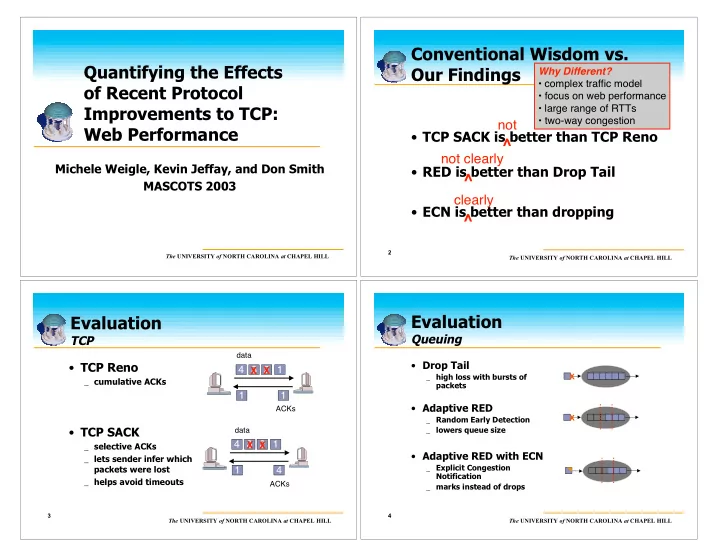
Conventional Wisdom vs. Our Findings

  • TCP SACK is better than TCP Reno
  • RED is better than Drop Tail
  • ECN is better than dropping

^

not

^

not clearly

^

clearly

Why Different?

  • complex traffic model
  • focus on web performance
  • large range of RTTs
  • two-way congestion

3 The UNIVERSITY of NORTH CAROLINA at CHAPEL HILL

Evaluation

TCP

  • TCP Reno

_ cumulative ACKs

  • TCP SACK

_ selective ACKs _ lets sender infer which packets were lost _ helps avoid timeouts

4 3 2 1 X 1 1 4 3 2 1 X 1 4

data ACKs data ACKs

X X

4 The UNIVERSITY of NORTH CAROLINA at CHAPEL HILL

Evaluation

Queuing

  • Drop Tail

_ high loss with bursts of packets

  • Adaptive RED

_ Random Early Detection _ lowers queue size

  • Adaptive RED with ECN

_ Explicit Congestion Notification _ marks instead of drops X X

slide-2
SLIDE 2

5 The UNIVERSITY of NORTH CAROLINA at CHAPEL HILL

Network Setup

10 Mbps

forward congested path reverse congested path

web clients web servers web servers web clients RTTs vary from 1 ms to 3.5 seconds

6 The UNIVERSITY of NORTH CAROLINA at CHAPEL HILL

Simulation Setup

  • ns-2

_ two-way web traffic

  • Bell Labs HTTP model

_ 250,000 request-response pairs _ offered loads of 50-105% of 10 Mbps link _ each TCP paired with each queuing mechanism

  • Main Performance Metric

_ HTTP response time - time between sending HTTP request and receiving HTTP response

  • no major differences below 80% load

New Requests per Second Offered Load (%) 7 The UNIVERSITY of NORTH CAROLINA at CHAPEL HILL

Drop Tail: Reno vs. SACK

80% and 105% load

No difference between Reno and SACK

8 The UNIVERSITY of NORTH CAROLINA at CHAPEL HILL

Drop Tail vs. Adaptive RED

80% and 105% load

80% load crossover point 105% load crossover point

Tradeoffs between Drop Tail and ARED

slide-3
SLIDE 3

9 The UNIVERSITY of NORTH CAROLINA at CHAPEL HILL

ARED vs. ARED+ECN

80% and 105% load

ECN beats dropping

10 The UNIVERSITY of NORTH CAROLINA at CHAPEL HILL

Drop Tail vs. ARED+ECN

80% and 105% load

105% load crossover point 80% load crossover point

Tradeoffs between Drop Tail and ARED+ECN

11 The UNIVERSITY of NORTH CAROLINA at CHAPEL HILL

Our Findings

For HTTP Traffic

  • No benefit to using SACK over Reno

_ not enough flows can take advantage of SACK

  • Complex tradeoffs exist when

comparing Drop Tail and ARED (even with ECN)

  • ARED with ECN performs better than

ARED with dropping

_ drops cause retransmissions, which only increases response times

The UNIVERSITY of NORTH CAROLINA at CHAPEL HILL

Quantifying the Effects

  • f Recent Protocol

Improvements to TCP: Web Performance

Michele Weigle, Kevin Jeffay, and Don Smith MASCOTS 2003

http://www.cs.unc.edu/Research/dirt/ http://www.cs.unc.edu/~mcweigle/