
Continuations
Michel Schinz 2007–05–04
Control flow of Web applications
The adder application
The following Scheme program asks for two numbers, and displays their sum – assuming the obvious definitions for prompt-int and display-int: (let ((n1 (prompt-int "n1="))) (let ((n2 (prompt-int "n2="))) (display-int "n1+n2=" (+ n1 n2)))) Its control flow is completely obvious...
3
control flow
The adder Web application
Let’s assume that we want to take our adder application and turn it into a Web application, with the requirement that every interaction happens on a separate page. That is, we want to use a first Web page to ask for the first number, a second page to ask for the second number, and a third one to display their sum. If we suppose that we have the proper primitives at our disposal, this should be trivial: (let ((n1 (web-prompt-int "n1="))) (let ((n2 (web-prompt-int "n2="))) (web-display-int "n1+n2=" (+ n1 n2)))) What about control flow?
4
Browser power
When interacting with a Web application, the user has some very powerful means to alter its flow of control:
- the “back” button can be used to go back to a previous
state,
- bookmarks can be used to take a snapshot of the
execution state,
- URL copying can be used to duplicate state.
5
Control flow comparison
6
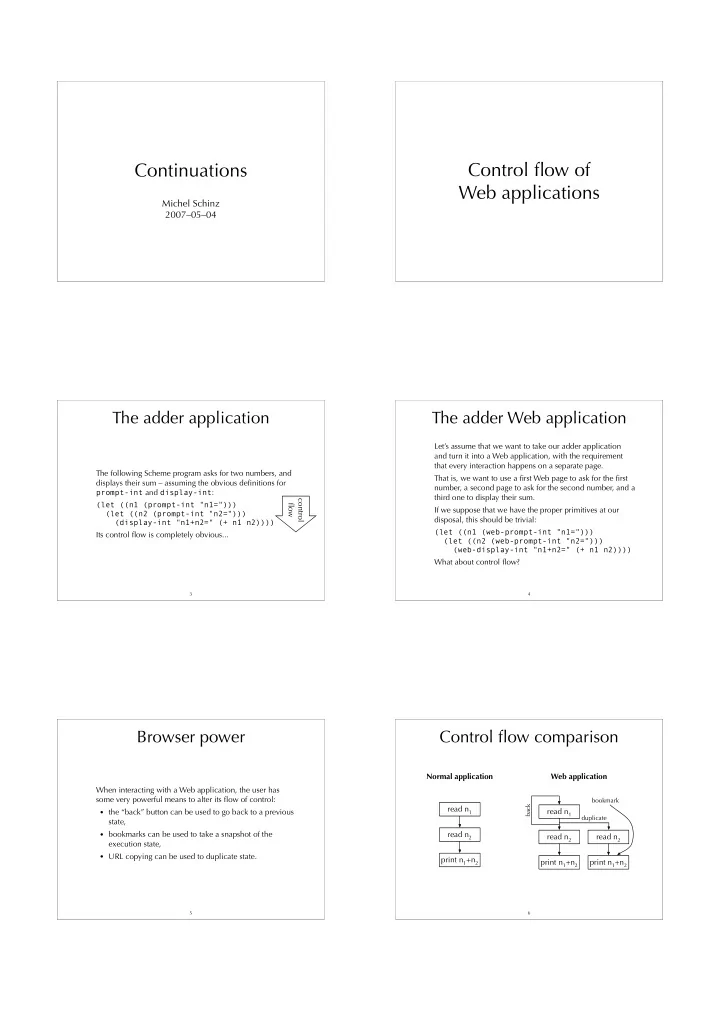
read n1 read n2 print n1+n2 Normal application Web application read n1 read n2 print n1+n2 read n2 print n1+n2
duplicate back bookmark