SLIDE 1
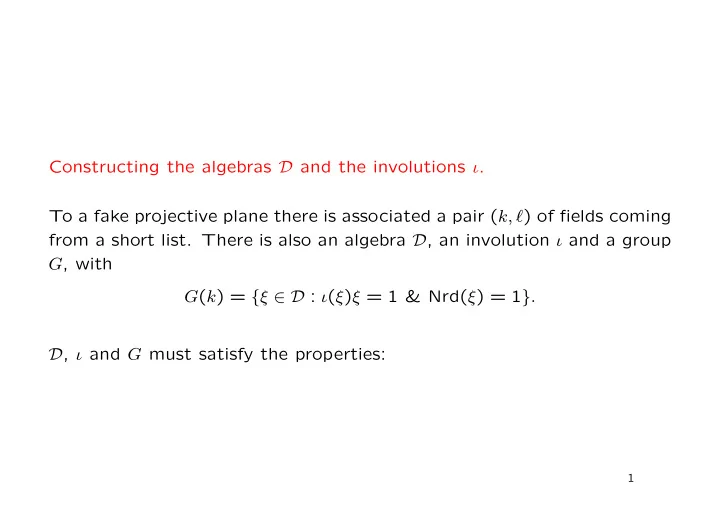
Constructing the algebras D and the involutions ι. To a fake projective plane there is associated a pair (k, ℓ) of fields coming from a short list. There is also an algebra D, an involution ι and a group G, with G(k) = {ξ ∈ D : ι(ξ)ξ = 1 & Nrd(ξ) = 1}. D, ι and G must satisfy the properties:
1
SLIDE 2
= SL(3, kv) for all v ∈ Vf \ T0 which split in ℓ,
= {g ∈ SL(3, kv(s)) : g∗Fvg = Fv} if v ∈ Vf does not split in ℓ,
- G(kv) is compact for v ∈ T0,
- G(kv) ∼
= SU(2, 1) for one archimedean place v on k, and
= SU(3) for the other archimedean place v on k (if k = Q). We know that T0 = ∅ if D = M3×3(ℓ), and that T0 is a specific singleton if D is a division algebra.
2
SLIDE 3
Corollary 6.6 in Chapter 10 of W. Scharlau “Quadratic and Hermitian Forms”: The above properties determine D and ι up to k-isomorphism or anti- isomorphism. Anti-isomorphism must be allowed here because given D, we can define an “opposite” algebra Dop whose elements xop are in 1-1 correspondence (xop ↔ x) with those of D, and in which for all x, y ∈ D and t ∈ ℓ, xop + yop = (x + y)op, txop = (tx)op, and xopyop = (yx)op.
3
SLIDE 4
Suppose that ℓ is a field and that m is a Galois extension of ℓ of degree 3, with Gal(m/ℓ) = ϕ. Fix some nonzero D ∈ ℓ, and form D = {a + bσ + cσ2 : a, b, c ∈ m}, which we can make into an associative algebra of dimension 9 over ℓ in which σ3 = D and σa = ϕ(a)σ for all a ∈ m. The centre of D is ℓ. We shall see in a moment that D has no non-trivial two-sided ideals — D is a central simple algebra.
4
SLIDE 5
There is an ℓ-algebra homomorphism Ψ : D → M3×3(m) such that Ψ(σ) =
1 1 D
and Ψ(a) =
a ϕ(a) ϕ2(a)
.
So if ξ = a + bσ + cσ2 ∈ D, then Ψ(ξ) =
a b c Dϕ(c) ϕ(a) ϕ(b) Dϕ2(b) Dϕ2(c) ϕ2(a)
.
5
SLIDE 6 The reduced norm Nrd(ξ) of ξ is det(Ψ(ξ)) = aϕ(a)ϕ2(a) + Dbϕ(b)ϕ2(b) + D2cϕ(c)ϕ2(c) − D(aϕ(b)ϕ2(c) + ϕ(a)ϕ2(b)c + ϕ2(a)bϕ(c)). Then Nrd : D → ℓ, and Nrd(ξη) = Nrd(ξ)Nrd(η) for all ξ, η ∈ D. An element ξ = a + bσ + cσ2 of D is invertible if and only if Nrd(ξ) = 0, in which case ξ−1 equals 1 Nrd(ξ)
- ϕ(a)ϕ2(a)−Dϕ(b)ϕ2(c)
- +
- Dcϕ2(c)−bϕ2(a)
- σ+
- bϕ(b)−cϕ(a)
- σ2
- .
6
SLIDE 7
(a) D ∼ = M3×3(ℓ), or (b) D is a division algebra. Case (a) holds if and only if D is the norm Nm/ℓ(η) of an element η of m.
- Proof. If D = Nm/ℓ(η), let
C =
η 1 1/ϕ(η)
.
7
SLIDE 8
Let θ0, θ1 and θ3 be basis for m over ℓ. Form Θ =
θ0 ϕ(θ0) ϕ2(θ0) θ1 ϕ(θ1) ϕ2(θ1) θ2 ϕ(θ2) ϕ2(θ2)
.
Then Θ−1 =
ζ0 ζ1 ζ2 ϕ(ζ0) ϕ(ζ1) ϕ(ζ2) ϕ2(ζ0) ϕ2(ζ1) ϕ2(ζ2)
,
where Trace(θiζj) = δij. J := ΘC. Then JΨ(ξ)J−1 has entries in ℓ. E.g., (JΨ(σ)J−1)ij = Trace(θiηϕ(ζj)). So ξ → JΨ(ξ)J−1 is a ℓ-linear algebra homomomorphism D → M3×3(ℓ). It is clearly injective, and so an isomorphism, as dimensions match.
8
SLIDE 9 If D is not equal to Nm/ℓ(η) for any η ∈ m, then Nrd(1 + bσ) = 1 + DNm/ℓ(b) and Nrd(1 + cσ2) = 1 + D2Nm/ℓ(c) cannot be zero for any b, c ∈ m. So any 1 + bσ or 1 + cσ2 is invertible. So any nonzero element of D is invertible, and D is a division algebra.
- Corollary. D is a central simple algebra over ℓ.
9
SLIDE 10
Suppose ℓ = k(s), where s2 = −κ ∈ k. We want an involution ι of the second kind on D. Assume m normal extension of k. The conjugation automorphism ex- tends to m. Then either ϕ(a) = ϕ(¯ a) for all a ∈ m OR ϕ(a) = ϕ2(¯ a) for all a ∈ m. Gal(m/k) is abelian in the first case, and non-abelian in the second case.
10
SLIDE 11
- Lemma. If Gal(m/k) is non-abelian, and if D ∈ ℓ satisfies D = D = 0,
then there is an involution of the second kind ι : D → D such that ι(σ) = σ and ι(a) = ¯ a for all a ∈ m. Explicitly, ι(a + bσ + cσ2) = ¯ a + ϕ(¯ b)σ + ϕ2(¯ c)σ2. Note that Ψ(ι(ξ)) = F −1Ψ(ξ)∗F for F =
D 1 1
.
11
SLIDE 12
In each of the five k = Q cases (a = 1, p = 5),...,(a = 23, p = 2), we can choose a field m as above, with Gal(m/k) non-abelian, and define D using D = p. In each of these cases, there is a β ∈ ℓ so that ¯ ββ = 2p. Then F = 1 2∆∗F0∆ for ∆ =
β 1 1 1 −1
.
If ι(ξ)ξ = 1 then (∆Ψ(ξ)∆−1)∗F0(∆Ψ(ξ)∆−1) = F0.
12
SLIDE 13 So if G(k) = {ξ ∈ D : ι(ξ)ξ = 1 and Nrd(ξ) = 1}, then ξ → ∆Ψ(ξ)∆−1 defines an injective homomorphism G(k) → SU(2, 1). In fact, G(kv) ∼ = G(R) ∼ = SU(2, 1) for the one archimedean place v
We can take β = 3 + i in the case (a = 1, p = 5), β = 2 + s for (a = 2, p = 3) and β = 2 for the other three cases.
13
SLIDE 14
In the 5 cases (k, ℓ) in which k = Q and ℓ = Q(s), we can define m = Q(s, Z), where Z satisfies P(Z) = 0 for a cubic monic P(X) ∈ Z[X]. s2 p P(X) ϕ(Z) −1 5 X3 − 3X2 − 2 (s + 3 − (4s + 1)Z + sZ2)/2 −2 3 X3 + X2 + 2X − 2 (2(s − 1) + (3s − 2)Z + sZ2)/4 −7 2 X3 + 3X2 + 3 −(3(s + 7) + (9s + 7)Z + 2sZ2)/14 −15 2 X3 − 3X − 3 (4s + (3s − 5)Z − 2sZ2)/10 −23 2 X3 − X − 1 (4s + (9s − 23)Z − 6sZ2)/46 In each case Gal(m/ℓ) = ϕ, and Gal(m/Q) is non-abelian. In the case (a = 7, p = 2), we shall use a different cyclic simple algebra, coming from a field m so that Gal(m/k) is abelian.
14
SLIDE 15
- Lemma. If Gal(m/k) is abelian, and if D ∈ ℓ satisfies ¯
DD = 1, then there is an involution ι0 : D → D of the second kind such that ι0(σ) = σ−1 and ι0(a) = ¯ a for all a ∈ m. Explicitly, ι0(a + bσ + cσ2) = ¯ a + ¯ Dϕ(¯ c)σ + ¯ Dϕ2(¯ b)σ2. It is easy to check that Ψ(ι0(ξ)) = Ψ(ξ)∗. For reasons explained on the next slide, we shall use the involution ι(ξ) = T −1ι0(ξ)T, where T ∈ m and ¯ T = T = 0. Then Ψ(ι(ξ)) = F −1Ψ(ξ)∗F for F =
T ϕ(T) ϕ2(T)
.
15
SLIDE 16
Embedding m in C, the images of T, ϕ(T) and ϕ2(T) are real because ϕ(T) = ϕ( ¯ T ) = ϕ(T). If T > 0, ϕ(T) > 0 and ϕ2(T) < 0, then F = ∆∗F0∆ for ∆ =
|T|1/2 |ϕ(T)|1/2 |ϕ2(T)|1/2
.
So ξ → ∆Ψ(ξ)∆−1 is an injective homomorphism G(k) → SU(2, 1). In the cases (a = 7, p = 2), C2, C10, C18 and C20, we define D = {a + bσ + cσ2 : a, b, c ∈ m, where σ3 = D and σxσ−1 = ϕ(x)} for the following m’s and D’s:
16
SLIDE 17
name m v0 D ϕ (a = 7, p = 2) Q(ζ7) 2 (3 + s)/4 ζ7 → ζ2
7
C2 k(ζ9) 2 (1 + √−15)/4 ζ9 → ζ4
9
C10 ℓ(W) 2 rU/2 W → 2 − W − W 2 C18 k(ζ9) 3 (r + 1 + 2ω)/3 ζ9 → ζ4
9
C20 k(ζ7) 2 (3 + √−7)/4 ζ7 → ζ2
7
In case C2, k = Q(r), where r2 = 5 and ℓ = k(ω), where ω = ζ3, In case C10, k = Q(r), where r2 = 2, ℓ = k(U), where U2 = (r + 1)U − 2, and W 3 − 3W + 1 = 0. In case C18, k = Q(r), where r2 = 6, and ℓ = k(ω), In case C20, k = Q(r) where r2 = 7, and ℓ = k(i).
17
SLIDE 18
Having chosen m as above, with Gal(m/k) abelian, the subfield {a ∈ m : ¯ a = a} has the form k(W), where W satisfies an equation Q(W) = 0 for some monic cubic Q(X) ∈ Z[X]. We choose T ∈ k(W) as follows: name W ϕ(W) T (a = 7, p = 2) ζ7 + ζ−1
7
W 2 − 2 W C2 ζ9 + ζ−1
9
2 − W − W 2 −2r + (r − 1)W + 2W 2 C10 W 2 − W − W 2 −r + (1 − r)W + W 2 C18 ζ9 + ζ−1
9
2 − W − W 2 3 − 3r + rW + rW 2 C20 ζ7 + ζ−1
7
W 2 − 2 2 + W − (4 + 3W + W 2)/r In the first and last cases, Q(X) = X3 + X2 − 2X − 1. In the other three cases, Q(X) = X3 − 3X + 1.
18
SLIDE 19 The above choice is made so that, in the four cases k = Q(r), where r2 = N (N = 5, 2, 6 or 7), and fixing a solution WR ∈ R of Q(X) = 0,
- embedding k(W) in R by mapping r to +
√ N and W to WR, the images of T, ϕ(T) and ϕ(T) DO NOT all have the same sign, and
- embedding k(W) in R by mapping r to −
√ N and W to WR, the images of T, ϕ(T) and ϕ(T) DO all have the same sign. This implies that G(kv) ∼ = SU(2, 1) for the archimedean valuation v corre- sponding to the first embedding, and G(kv) ∼ = SU(3) for the archimedean valuation v corresponding to the second embedding.
19
SLIDE 20
- Example. The case (a = 7, p = 2).
Let k = Q and ℓ = Q(s), where s2 = −7. Let m be the cyclotomic field Q(ζ), where ζ is a primitive 7-th root of 1. Let s = 1 + 2ζ + 2ζ2 + 2ζ4. Then s2 = −7. So ℓ ⊂ m. Now Gal(m/Q) is cyclic, generated by χ : ζ → ζ3, and ϕ = χ2 : ζ → ζ2 generates Gal(m/ℓ). Form the cyclic algebra D with this m and ϕ, and with D = 3 + s 4 . Notice that ¯ DD = 1. Let’s check that D is not the norm Nm/ℓ(η) of any element η of m.
20
SLIDE 21 The prime 2 splits in ℓ, as 2 = ρ¯ ρ for ρ = (1 − s)/2 ∈ oℓ. D = (3 + s)/4 equals −ρ/¯ ρ, so w(D) = +1 and ¯ w(D) = −1, where w ↔ ρoℓ and ¯ w ↔ ¯ ρoℓ. Alternatively, Q2 contains a square root s2 = 1+0×2+1×22+0×23+· · ·
- f −7, and vǫ(a + bs) = u2(a + ǫbs2), for ǫ = ±1, define two distinct
extensions to ℓ of the 2-adic valuation u2 on Q. Then v+(D) = 1 and v−(D) = −1. So w = v+ and ¯ w = v−. Magma verifies that ρom is prime. So w has a unique extension ˜ w to m. Then ˜ w(η) = ˜ w(ϕ(η)) = ˜ w(ϕ2(η)) ∈ Z for η ∈ m. If D = Nm/ℓ(η), then 1 = w(D) = ˜ w(D) = ˜ w(ηϕ(η)ϕ2(η)) = 3 ˜ w(η), a contradiction.
21
SLIDE 22
We choose T = ζ + ζ−1, and use the involution ι(ξ) = T −1ι0(ξ)T, where ι0(σ) = σ−1, and ι0(a) = ¯ a for a ∈ m. Then Ψ(ι(ξ)) = F −1Ψ(ξ)∗F for F =
T ϕ(T) ϕ2(T)
.
Embed m into C, mapping ζ to e2πi/7. Then T > 0, ϕ(T) = T 2 − 2 < 0 and ϕ2(T) = 1 − T − T 2 < 0. Let ∆ =
|ϕ2(T)|1/2 |ϕ(T)|1/2 |T|1/2
.
Then ∆∗F0∆ = −F, so g∗Fg = F iff ˜ g = ∆g∆−1 satisfies ˜ g∗F0˜ g = F0.
22
SLIDE 23 So far: for each of the 9 pairs (k, ℓ), we have defined
- a cyclic algebra D,
- an involution ι on D.
In each case, D is a division algebra. The proof: as in the case (a = 7, p = 2), using w(D) = 0 for the two extensions w of the v0 ∈ T0. Tricky case: C18. Here v0 is the one 3-adic valuation on k = Q(r), r2 = 6. This splits in ℓ, and the two extensions w of v0 ramify in m.
23
SLIDE 24
We need to find G(kv) for the various places v of k. We start from one of our nine (D, ι). If K is a field containing k, then by definition, G(K) = {ξ ∈ D ⊗k K : ιK(ξ)ξ = 1 and NrdK(ξ) = 1} (see §1.2 in [PY]). Because ι : D → D is k-linear, it induces a unique K-linear map ιK : D ⊗k K → D ⊗k K. It is an anti-automorphism. We can define NrdK using Ψ : D → M3×3(m). This induces ΨK : D ⊗k K → M3×3(m ⊗k K), and we set NrdK(ξ) = det(ΨK(ξ)). Then NrdK : D ⊗k K → ℓ ⊗k K, and it is multiplicative.
24
SLIDE 25 We also need the adjoint group ¯
- G. We can define this by setting
¯ G(K) = {α ∈ Autℓ(D ⊗k K) : ιK◦α = α◦ιK}. for any field K containing k. Here α ∈ Autℓ(D ⊗k K) means that α is an automorphism of the K-algebra D ⊗k K which is also ℓ-linear. Fact: ¯ G(k) ∼ = {ξ ∈ D : ι(ξ)ξ = 1}/{t1 : t ∈ ℓ & ¯ tt = 1}. This is because any automorphism of D is of the form α : η → ξηξ−1 for some invertible ξ ∈ D (Skolem-Noether Theorem). Then ι◦α = α◦ι means that ι(ξ)ξ = c1 for some c ∈ k. Let ξ′ = cξ/ Nrd(ξ). Then α(η) = ξ′ηξ′−1 for all η, and ι(ξ′)ξ′ = 1.
25
SLIDE 26
The form of G(kv) depends on whether or not v splits in ℓ = k(s). Recall that s2 = −κ for some κ ∈ k, and v splits in ℓ ⇔ ℓ embeds in kv ⇔ −κ has a square root in kv. For any field K containing k, (i) If ℓ ֒ → K, then ℓ ⊗k K ∼ = K ⊕ K. (ii) If ℓ ֒ → K, then ℓ ⊗k K ∼ = K(s), a field. In (i), the isomorphism is 1 ⊗ x + s ⊗ y → (x + ysK, x − ysK), where sK is the image of s under an embedding ℓ → K. In (ii), the isomorphism is 1 ⊗ x + s ⊗ y → x + ys.
26
SLIDE 27 Let D denote one of our 9 division algebras D.
- Proposition. If v ∈ Vf splits in ℓ, then either
(1) G(kv) ∼ = SL(3, kv), ¯ G(kv) ∼ = PGL(3, kv), and D ⊗ℓ kv ∼ = M3×3(kv), or (2) G(kv) and ¯ G(kv) are compact, and D ⊗ℓ kv is a division algebra, and (2) only happens for the one v ∈ T0. We heavily use the explicit form of these isomorphisms, so give some details of the proof.
27
SLIDE 28
As ℓ ⊂ kv, we can form D ⊗ℓ kv. The map ξ → (ξ, ι(ξ)op) is k-linear D → D ⊕ Dop, and so induces h : D ⊗k kv → (D ⊗ℓ kv) ⊕ (D ⊗ℓ kv)op, and we get the commutative diagram D ⊗k kv (D ⊗ℓ kv) ⊕ (D ⊗ℓ kv)op D ⊗k kv (D ⊗ℓ kv) ⊕ (D ⊗ℓ kv)op h h ιkv (x, yop) → (y, xop) and the map h is an isomorphism of kv-algebras.
28
SLIDE 29 We also get a commutative diagram D ⊗k kv (D ⊗ℓ kv) ⊕ (D ⊗ℓ kv)op ℓ ⊗k kv kv ⊕ kv h f Nrdkv (x, yop) → (Nrd(x), Nrd(y)) where f(1 ⊗k x + s ⊗k y) = (x + svy, x − svy), where sv ∈ ℓ is the image
So if ξ ∈ D ⊗k kv and h(ξ) = (x, yop), then ιkv(ξ)ξ = 1 ⇔ yx = 1, and Nrdkv(ξ) = 1 ⇔ Nrd(x) = Nrd(y) = 1.
29
SLIDE 30
- Corollary. If v splits in ℓ, then
G(kv) ∼ = {x ∈ D ⊗ℓ kv : Nrd(x) = 1}, {ξ ∈ D ⊗k kv : ιkv(ξ)ξ = 1} ∼ = (D ⊗ℓ kv)×. and ¯ G(kv) ∼ = (D ⊗ℓ kv)×/k×
v .
Note that D ⊗ℓ kv is a central simple algebra of dimension 9 over kv, and so is isomorphic to M3×3(kv) or is a division algebra.
30
SLIDE 31
Recall embedding Ψ : D → M3×3(m). Case a: the embedding ℓ ֒ → kv extends to an embedding m ֒ → kv. Then D
Ψ
− → M3×3(m) ֒ → M3×3(kv) induces isomorphisms D ⊗ℓ kv ∼ = M3×3(kv), G(kv) ∼ = SL(3, kv), and ¯ G(kv) ∼ = PGL(3, kv). Moreover {ξ ∈ D ⊗k kv : ιkv(ξ)ξ = 1} ∼ = GL(3, kv). So we get an embedding ξ → ξv of {ξ ∈ D : ι(ξ)ξ = 1} in GL(3, kv) which maps G(k) into SL(3, kv). Here ξv is the image of Ψ(ξ) in M3×3(kv).
31
SLIDE 32
Case b: When m = k(s, Z) does not embed in kv, then m ⊗ℓ kv ∼ = kv(Z) is a field which is a cubic Galois extension of kv, and D ⊗ℓ kv is the cyclic simple algebra {a + bσ + cσ2 : a, b, c ∈ kv(Z)}. When D = Nkv(Z)/kv(ηv) of some ηv ∈ kv(Z), D ⊗ℓ kv ∼ = M3×3(kv), the isomorphism induced by D
Ψ
− → M3×3(m) ֒ → M3×3(kv(s))
Jv · J−1
v
− → M3×3(kv(s)), where Jv = ΘCv for Cv =
ηv 1 1/ϕ(ηv)
and Θ =
θ0 ϕ(θ0) ϕ2(θ0) θ1 ϕ(θ1) ϕ2(θ1) θ2 ϕ(θ2) ϕ2(θ2)
,
and θ0, θ1, θ2 is a basis of m over ℓ.
32
SLIDE 33
We again have isomorphisms D ⊗ℓ kv ∼ = M3×3(kv), G(kv) ∼ = SL(3, kv), ¯ G(kv) ∼ = PGL(3, kv), and {ξ ∈ D ⊗k kv : ιkv(ξ)ξ = 1} ∼ = GL(3, kv). Again we have an embedding ξ → ξv of {ξ ∈ D : ι(ξ)ξ = 1} in GL(3, kv) mapping G(k) into SL(3, kv). Now ξv is the image of JvΨ(ξ)J−1
v
in M3×3(kv).
33
SLIDE 34
To see that D is a norm when v = v0 splits in ℓ, and m ֒ → kv, we use the following theorem from local class field theory (see Weil “Basic Number Theory”, pp. 225–226): Theorem. If K is a non-archimedean local field, and if L is a cyclic extension of K of degree n, then the image of L× under the norm map NL/K : L× → K× has index n in K×. When L is an unramified cyclic extension, then that image equals {x ∈ K× : v(x) ≡ 0 (mod n)}. If v = v0 splits in ℓ and m ֒ → kv, then by choice of D we have w(D) = 0 for both extensions w of v to ℓ. Moreover, neither w ramifies in m, as we see checking case by case. So the extension kv(Z) of kv = ℓw is unramified, and so Nkv(Z)/kv(ηv) = D for some ηv ∈ kv(Z), by the theorem.
34
SLIDE 35
If v = v0, then m ֒ → kv, by choice of m, and w(D) = 0 by choice of D, for both extensions w of v0 to ℓ. Assuming that w does not ramify in m, the theorem shows that D is not a norm. There is only one case when w ramifies: C18. Here k = Q(r), where r2 = 6, and v0 is the unique 3-adic valuation on k (3 ramifies in k). This splits in ℓ since 3 = (ω − 1)(¯ ω − 1). The extensions w and ¯ w corresponding to p = (ω − 1)oℓ and ¯ p both ramify in m = k(ζ9) because Nm/ℓ(ζ9 − 1) = ω − 1. In the C18 case, we carefully identify the index 3 subgroup of k×
v0 which
is the image of the norm map, and show that D is not in that image.
35
SLIDE 36 If D is not a norm, then D ⊗ℓ kv is a division algebra over the local field kv, and so G(kv) ∼ = {ξ ∈ D ⊗ℓ kv : Nrd(ξ) = 1} is compact. To see this, let ξ1, . . . , ξ9 be a basis for D ⊗ℓ kv, and let
- v = {t ∈ kv : |t|v ≤ 1}. Here |t|v = q−v(t)
v
. Then ov is compact, and hence so is S = {
tνξν : tν ∈ ov for all ν, and |tν|v = 1 for at least one ν}. Now Nrd(ξ) = 0 for all ξ = 0, since D ⊗ℓ kv is a division algebra. So there is a number m > 0 so that |Nrd(ξ)|v ≥ m for all ξ ∈ S. Now suppose that ξ =
ν tνξν satisfies Nrd(ξ) = 1. Let T = max{|tν|v : ν = 1, . . . , 9}. Then
cξ ∈ S for some c ∈ kv satisfying |c|v = 1/T. Hence |c|3
v = |Nrd(cξ)|v ≥ m.
Hence T = 1/|c|v ≤ 1/m1/3. So {ξ ∈ D ⊗ℓ kv : Nrd(ξ) = 1} is closed and bounded, and so compact.
36
SLIDE 37 G(kv) and ¯ G(kv) when v does NOT split in ℓ. For a basis ξ1, . . . , ξ9 of D over ℓ, setting h
ξν ⊗k xν +
(sξν) ⊗k yν
ξν ⊗ℓ (xν + syν) we get an isomorphism, and setting ˜ ι
ξν ⊗k xν +
(sξν) ⊗k yν
ι(ξν) ⊗ℓ (xν − syν) we get an involution of the second kind, and the commutative diagram D ⊗k kv D ⊗ℓ kv(s) D ⊗k kv D ⊗ℓ kv(s) h h ιkv ˜ ι
37
SLIDE 38
and also the commutative diagram D ⊗k kv D ⊗ℓ kv(s) ℓ ⊗k kv kv(s) h f
Nrdkv Nrd
where now f is the isomorphism 1 ⊗ x + s ⊗ y → x + sy.
38
SLIDE 39
- Corollary. If v does not split in ℓ, then
G(kv) ∼ = {ξ ∈ D ⊗ℓ kv(s) : ˜ ι(ξ)ξ = 1 & Nrd(ξ) = 1}. and ¯ G(kv) ∼ = {ξ ∈ D ⊗ℓ kv(s) : ˜ ι(ξ)ξ = 1}/{t1 : t ∈ kv(s) & ¯ tt = 1}. D ⊗ℓ kv(s) ∼ = M3×3(kv(s)) or D ⊗ℓ kv(s) is a division algebra. It is never a division algebra, as noted in §2.2 of [PY]. We can also see this using theorem about norms, and explicit calculations when v ramifies in m.
39
SLIDE 40
The isomorphism D ⊗ℓ kv(s) ∼ = M3×3(kv(s)) induces isomorphisms G(kv) ∼ = {ξ ∈ SL(3, kv(s)) : g∗F ′
vg = F ′ v},
¯ G(kv) ∼ = {g ∈ GL(3, kv(s)) : g∗F ′
vg = F ′ v}/{t1 : t ∈ kv(s) & ¯
tt = 1} and {ξ ∈ D ⊗k kv : ιkv(ξ)ξ = 1} ∼ = {g ∈ GL(3, kv(s)) : g∗F ′
vg = F ′ v}
for a suitable Hermitian F ′
v ∈ GL(3, kv(s)).
In particular, we have an embedding ξ → ξv of {ξ ∈ D : ι(ξ)ξ = 1} into {g ∈ GL(3, kv(s)) : g∗F ′
vg = F ′ v}.
40
SLIDE 41
The matrix F ′
v depends on whether or not m embeds in kv(s).
Case a: the embedding ℓ = k(s) ֒ → kv(s) extends to an embedding m ֒ → kv(s). Then D
Ψ
− → M3×3(m) ֒ → M3×3(kv(s)) induces the above isomorphisms, with F ′
v the image of F ∈ M3×3(m)
in M3×3(kv(s)). In particular, if v is an archimedean place of k, then ℓ does not embed in kv ∼ = R, but m = k(s, W) embeds in kv(s) ∼ = C. After a further conjugation by the matrix we called ∆ above, we may assume that F ′
v = F0, if k = Q, or that F ′ v = F0 for one v and F ′ v = I for the other v,
when k = Q(r).
41
SLIDE 42
Case b: the field m does not embed in kv(s). Then writing m = k(s, Z), m⊗ℓkv(s) is the field kv(s, Z), and D⊗ℓkv(s) is isomorphic to M3×3(kv(s)). As Ψ(ξ) is unitary with respect to a matrix F, JvΨ(ξ)J−1
v
is unitary with respect to F ′
v = J∗ v −1FvJ−1 v
= Θ∗−1C∗
v −1FvC−1 v
Θ−1, where Fv is the image of F ∈ M3×3(m) in M3×3(kv(s, Z)).
42