Consensus-Halving resource: the interval = [0,1] 0 1 agents 1 - - PowerPoint PPT Presentation

β–Ά
consensus halving
SMART_READER_LITE
LIVE PREVIEW

Consensus-Halving resource: the interval = [0,1] 0 1 agents 1 - - PowerPoint PPT Presentation

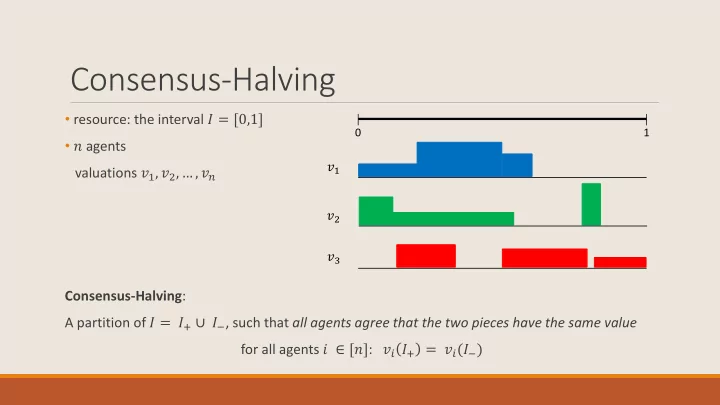
Consensus-Halving resource: the interval = [0,1] 0 1 agents 1 valuations 1 , 2 , , 2 3 Consensus-Halving : A partition of = + , such that all agents agree that the two


slide-1
SLIDE 1

Consensus-Halving

  • resource: the interval 𝐽 = [0,1]
  • π‘œ agents

valuations 𝑀1, 𝑀2, … , π‘€π‘œ Consensus-Halving: A partition of 𝐽 = 𝐽+ βˆͺ π½βˆ’, such that all agents agree that the two pieces have the same value for all agents 𝑗 ∈ [π‘œ]: 𝑀𝑗 𝐽+ = 𝑀𝑗(π½βˆ’)

1

𝑀1 𝑀2 𝑀3

slide-2
SLIDE 2

The Consensus-Halving Problem

Theorem [Hobby-Rice 1965, Simmons-Su 2003]: There always exists a Consensus-Halving using at most π‘œ cuts. Computational Problem: β€œCompute a Consensus-Halving that uses at most π‘œ cuts” Theorem [Filos-Ratsikas, Goldberg 2018-19]: Consensus-Halving is PPA-complete for piecewise-constant valuations. Theorem: Consensus-Halving is PPA-complete, even for 2-block uniform valuations.

𝑀1 𝑀2 𝑀3

slide-3
SLIDE 3

TFNP

The TFNP landscape

PPP PLS PPA PPAD

P

Directed Parity Argument

  • Brouwer
  • Nash

Potential Argument/Local Search

  • Local Max-Cut

Parity Argument

  • Borsuk-Ulam
  • Consensus-Halving

Pigeonhole Principle

slide-4
SLIDE 4

Single-block valuations: Positive Results

Theorem: Ξ΅-Consensus-Halving for single-block valuations can be solved in poly-time in the following cases:

  • Ξ΅ =

1 2

β†’ technique: greedy algorithm

  • 2π‘œ βˆ’ 𝑙 cuts allowed, for any constant 𝑙

β†’ technique: polynomial number of LPs

  • the maximum overlap number 𝑒 is constant

β†’ technique: dynamic programming

𝑀1 𝑀2 𝑀3