SLIDE 1
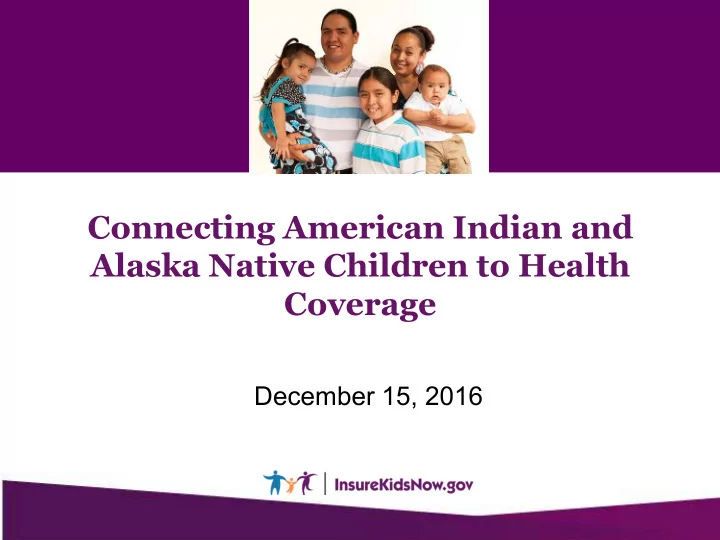
Connecting American Indian and Alaska Native Children to Health Coverage
December 15, 2016
SLIDE 2 Agenda
- Overview and Introductions
- Strategies to Enroll American Indian and Alaska Native
Families into Medicaid and CHIP
- Overview of Indian Health Service
- AI/AN Digital Engagement Strategies
- Connecting AI/AN Families to Health Coverage
- Campaign Resources
- Questions and Answers
SLIDE 3 Poll Question: Do you or your organization have
- utreach experience with AI/AN communities?
- a. Yes
- b. No
SLIDE 4
Strategies to Enroll American Indian and Alaska Native Families into Medicaid and CHIP
Kitty Marx Director of the Division of Tribal Affairs Centers for Medicare & Medicaid Services
SLIDE 5 Informational Bulletin
- On November 28, 2016, CMCS issued an
Informational Bulletin (CIB) https://www.medicaid.gov/federal-policy- guidance/federal-policy-guidance.html
- Identifies strategies states can employ, in concert
with Tribes and Indian health care providers.
- Outlines outreach and enrollment best practices for
assisters and others working in or with Tribal communities
SLIDE 6 ACA: Streamline Enrollment
- ACA contained provisions that simplified and
streamlined the enrollment and renewal process for Medicaid and CHIP.
- States are now required to implement streamlined
enrollment and renewal processes, greater outreach and availability of enrollment assistance, electronic data matching, and simplified verification procedures.
SLIDE 7 Tribal Barriers to Enrollment
- AI/ANs still encounter enrollment challenges due to
remote geographic locations, lack of access to reliable internet and phone service, distrust of government programs, language and health literacy barriers, and cultural differences.
- Enrollment in Medicaid and CHIP benefits AI/AN
individuals, their families and their communities.
SLIDE 8 State Enrollment Strategies
- On-line access to eligibility
- Outstation eligibility workers
- Medicaid Administrative Match
- Express Lane eligibility for children
- Presumptive eligibility
- Continuous eligibility
SLIDE 9 Enrollment Best Practices
- Many of the strategies and ideas for best practices
came from enrollment assisters who work with AI/ANs
- Varied Outreach Strategies
- Technology in Outreach
- Internal Technological Infrastructure
- Have Beneficiaries Renew to prevent a lapse in
Coverage
SLIDE 10 Cultural Competency and Working in Tribal Communities
- There are some cultural differences that are
important to understand in conducting outreach in Indian Country
- CIB summarizes things to remember and helpful
hints
- Culture Card developed by SAMSHA:
https://store.samhsa.gov/shin/content/SMA08- 4354/SMA08-4354.pdf.
SLIDE 11 Funding Opportunity for American Indian/Alaska Native Outreach
- Proposals due January 17, 2017
- Awards will be in the form of cooperative
agreements ranging in size from $250,000 to $500,000 over a two-year period
- Anticipated award date of May 17, 2017
- Learn more:
https://www.insurekidsnow.gov/initiatives/connecting
SLIDE 12
CMS Division of Tribal Affairs Resources
Bonnie Hillsberg Health Insurance Specialist Division of Tribal Affairs Centers for Medicare & Medicaid Services
SLIDE 13
CMS AI/AN Website
http://go.cms.gov/AIAN
SLIDE 14
Customizable Flyers
https://www.medicaid.gov/medicaid/outreach-tools/supporting-enrollment- efforts/index.html
SLIDE 15
AI/AN Specific Training Materials
SLIDE 16 How to Order Tribal Products
If this is your first time ordering, visit:
http://productordering.cms.hhs.gov
SLIDE 17 Useful Links
- Visit www.Medicaid.gov or visit
https://www.medicaid.gov/medicaid-chip-program- information/by-state/by-state.html and click on your state on the map for more information about each state’s Medicaid programs
- www.InsureKidsNow.gov
- http://go.cms.gov/AIAN
SLIDE 18
Thank you!
Bonnie Hillsberg Bonnie.Hillsberg@cms.hhs.gov Send questions and comments to tribalaffairs@cms.hhs.gov
SLIDE 19
Overview of the Indian Health Service
Carol Chicharello Acting Director Division of Business Office Enhancement Indian Health Service
SLIDE 20 Agency Overview
- Our Mission: To raise the physical, mental, social, and
spiritual health of American Indians and Alaska Natives to the highest level.
- Our Goal: To ensure that comprehensive, culturally
acceptable personal and public health services are available and accessible to American Indian and Alaska Native people.
- Our Foundation: To uphold the federal government's
- bligation to promote healthy American Indian and
Alaska Native people, communities, and cultures and to honor and protect the inherent sovereign rights of Tribes.
SLIDE 21 Priorities
Agency Priorities: Developed with input from staff and Tribes as a strategic framework to focus agency activities
- n priorities for changing and improving the IHS:
- Assessing Care
- Improving How We Deliver Services
- Addressing Behavioral Health Issues
- Strengthening Management
- Bringing Health Care Quality Expertise to IHS
- Engaging Local Resources
SLIDE 22 Health Care System Overview
- IHS Direct Health Care Services
- Tribally-operated Health Care Services
– Titles I and V of the Indian Self-Determination and Education Assistance Act provide Tribes the option to assume control and management of programs. – Today, over half of the IHS appropriation is administered by Tribes, primarily through self- determination contracts or self-governance compacts.
- Urban Indian health care services and resource centers
SLIDE 23 Profile
- Serves members of 567 federally-recognized Tribes
- 2.2 million American Indians and Alaska Natives
- Headquarters and 12 Area Offices: Alaska, Albuquerque,
Bemidji, Billings, California, Great Plains, Nashville, Navajo, Oklahoma City, Phoenix, Portland, Tucson
- 170 IHS and tribally-managed service units
- 34 urban programs
SLIDE 24 Challenges
The Indian health system faces a number of challenges, including:
- Populations growth and increased demand for
services
- Rising cost/medical inflation
- Difficulties recruiting and retaining medical providers
- Increased rates of chronic diseases
- Challenges in providing rural health care
- Aging facilities and outdated equipment
- Lack of sufficient resources to meet demand for
services
SLIDE 25 Outreach and Education
- Outreach, education, and enrollment has become a
function of the revenue cycle and has placed additional demands on staff in the field.
- Having health coverage means more options for our
- patients. Success stories have been posted on the IHS
Blog and by the Tribal Self-Governance Advisory Committee.
- IHS Headquarters ACA Efforts
– ACA Webpage, ACA Implementation Listserv, National Q&A Calls – National Indian Health Outreach and Education Initiative
SLIDE 26
Thank you!
Carol Chicharello Carol.Chicharello@ihs.gov
SLIDE 27
AI/AN Digital Engagement Strategies
Chawin ‘Win’ Reilly Tribal Healthcare Reform Outreach & Education Program Associate National Indian Health Board
SLIDE 28
Digital Engagement Strategies
SLIDE 29 Points to Consider
- Popular themes, images, and
trends
- Color matters in your designs
- Not all social media is the
same
- Trusted sources, peer to peer
- Engage American
Indians and Alaska Natives in your work
- Be authentic
- Dual approach
- Partner up!
SLIDE 30
NIHB Resources: Toolkits
www.Nihb.org/TribalHealthReform Resources-> Outreach and Education Materials
SLIDE 31 Enrollment Basics
Why should AI/AN care about enrolling into Medicaid and CHIP?
- Inform AI/AN that Medicaid and CHIP counts as minimal essential
coverage to meet the Affordable Care Act requirements
- Even after enrolling into programs like Medicaid and CHIP, the
consumer and their family can continue to go to their preferred I/T/U for services
- AI/AN do not have to pay premiums or enrollment fees; and if they
use an ITU or Purchased/Referred Care (PRC), will not have to pay any cost sharing, such as deductibles or copayments.
- It provides the AI/AN more choices; they are able to continue their
care at their preferred I/T/U or chose to go outside the I/T/U system for care
- Brings third-party resources into your community, which can provide
more resources for your I/T/Us
SLIDE 32
Thank you!
Chawin ‘Win’ Reilly WReilly@nihb.org
SLIDE 33
Southcentral Foundation Connects Families to Health Coverage
Katherine A. Anderson Manager of Patient Accounts Southcentral Foundation
SLIDE 34
Southcentral Foundation Overview
Our Mission is working together with the Native Community to achieve wellness through health and related services. We operate in the Southcentral Region of Alaska and in multiple community health centers throughout the state.
SLIDE 35 Rural Outreach
dedicated to rural
– Travels to 12 rural communities – Connected over 250 customer owners to coverage in 2016
SLIDE 36 Increasing Enrollment
In 2016, SCF took on multiple initiatives and partnerships to implement tools to help increase Medicaid enrollment. Outreach efforts included: – Rural outreach
- Twelve community healthcare clinics
– Local events and focused incentive-based events – Conducted targeted projects – Increased resources in SCF Pediatrics Clinic
SLIDE 37 How SCF Increased Enrollment
Rural outreach
- Contacted the twelve (12) community healthcare clinics
- Clinics advertised Family Health Resources (FHR)
- Incorporated outreach activity at local health fairs
- Informational brochures
- Rewarded customer-owners that completed a Medicaid
application with incentives
- Results were reported in monthly Contract Health meetings
- Increase in payer mix
- Testimonies
SLIDE 38 How SCF Increased Enrollment
Local events and focused incentive-based events
- Participated in newly acquired SCF clinic grand
- penings
- Established a travel schedule based on customer-
- wner needs in Contract Health Clinics (CHC)
- Based incentive items on geographic locations
- Example: Universal gift cards
SLIDE 39 How SCF Increased Enrollment
Conducted targeted projects
- Local community outreach
- Beans Café
- Covenant House
- Renewal project
- 3 Full-Time Equivalents (FTE) to contact customer-
- wners due for Medicaid renewals
- Rural Anchorage Service Unit (RASU)
- 2 FTEs, 1 to regularly visit RASU clinics
SLIDE 40 How SCF Increased Enrollment
Increased resources in SCF Pediatrics Clinic
- Assigned 2 FTEs to Pediatrics Clinic
- Ran daily appointment schedule
- Identified Indian Health Service customer-owners
with no current health insurance
- Connected with customers prior to appointment
- Determined eligibility
- Completed Medicaid applications
- Processed temporary benefits, if applicable
SLIDE 41 Building Relationships & Trust
In an effort to expand opportunities to enroll in health coverage for Alaska Natives and American Indians, SCF Benefits Enrollment built relationships with several
- rganizations in Anchorage. These included homeless
shelters, soup kitchens, and youth homes.
- Regularly visit each organization to enroll individuals:
– Without coverage – With high medical needs – Without transportation
SLIDE 42 Resources & Tools
Implemented an internal auditing & tracking tool to aid in Medicaid enrollment and retention. This tool:
- Allows SCF to identify training needs for staff
- Accurately tracks households and application types
- Tracks renewal dates
- Can identify resource needs based on location
SLIDE 43
Results
In 2016, SCF increased FHR presence throughout the state. Outreach efforts provided information to 4,494 customer-owners and, of those contacted, 2,946 submitted an application.
SLIDE 44
Thank you!
Katherine A. Anderson kaanderson@SouthcentralFoundation.com
SLIDE 45
Connecting Kids to Coverage National Campaign Resources
SLIDE 46 Additional Campaign Materials
Customizable Posters/Palmcards, Videos, Tip Sheets
- Informational Webinars
- “Campaign Notes”
eNewsletter
- Ready-Made Articles, Radio
Scripts
- Digital Media Tools
- TV & Radio PSAs
(forthcoming)
SLIDE 47 Digital Media Tools
Graphics & Guide
Banners
SLIDE 48 Examples of Material Topics
- Year-round Enrollment
- Oral Health
- Vision
- Teens
- Sports
SLIDE 49
Customizable Materials
Posters, flyers, palmcards and tear pads Learn how to request material customization here: https://www.insurekidsnow.gov/downloads/library/print/materialscustomizationguide- english.pdf
SLIDE 50 Outreach and Enrollment Best Practices
- Outreach Video Library
- https://www.insurekidsnow.gov/webinars-
videos/video/index.html
- Webinar Archive
- https://www.insurekidsnow.gov/webinars-
videos/webinars/index.html
SLIDE 51 Keep in Touch With the CKC Campaign
- Follow us @IKNGov
- Engage with the Campaign on social media
- Re-tweet, share or tag messages using the hashtags
#Enroll365, #KidsEnroll, #Medicaid and #CHIP
- Sign up for eNewsletters here:
- https://www.insurekidsnow.gov/newsletter/subscribe/i
ndex.html
- Email us at: ConnectingKids@cms.hhs.gov
SLIDE 52
Questions?
SLIDE 53
Thank you!