Congruence Modulo Operation: Question: What is 12 mod 9? Answer: - - PowerPoint PPT Presentation

congruence
SMART_READER_LITE
LIVE PREVIEW

Congruence Modulo Operation: Question: What is 12 mod 9? Answer: - - PowerPoint PPT Presentation

Congruence Modulo Operation: Question: What is 12 mod 9? Answer: 12 mod 9 3 or 12 3 (mod 9) ( ) Number Theory for Cryptography 12 is congruent to 3 modulo 9 Definition: Let a , r , m (where is the set of


slide-1
SLIDE 1

Number Theory for Cryptography

密碼學與應用

海洋大學資訊工程系 丁培毅 丁培毅

Congruence

 Modulo Operation:

 Question: What is 12 mod 9?  Answer: 12 mod 9  3 or 12  3 (mod 9)

( ) “12 is congruent to 3 modulo 9”

 Definition: Let a, r, m   (where  is the set of all  Definition: Let a, r, m   (where  is the set of all

integers) and m  0. We write

a  r (mod m) if m divides a – r (i e m | a-r)

a  r (mod m) if m divides a r (i.e. m | a r)

m is called the modulus

r is called the remainder

r is called the remainder

a = q ꞏ m + r 0  r < m

 Example: a = 42 and m=9

2

 Example: a = 42 and m=9

42 = 4 ꞏ 9 + 6 therefore 42  6 (mod 9)

G t t C Di i Greatest Common Divisor

 GCD of a and b is the largest positive integer  GCD of a and b is the largest positive integer

dividing both a and b d( b) ( b)

 gcd(a, b) or (a,b)  ex. gcd(6, 4) = 2, gcd(5, 7) = 1

g ( , ) , g ( , )

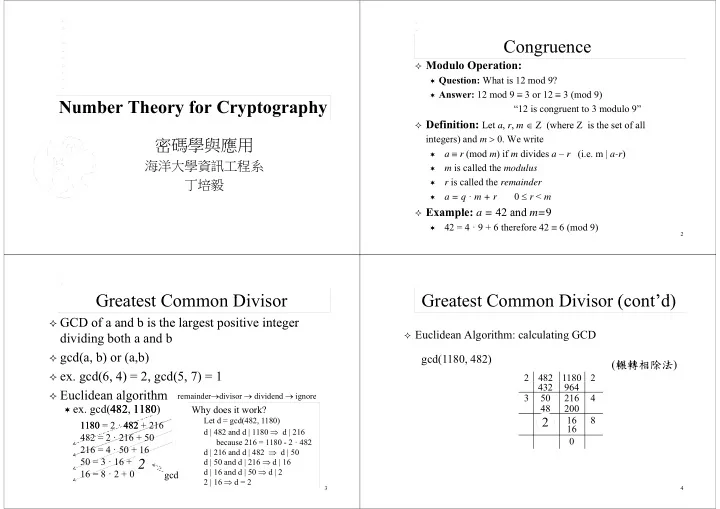
 Euclidean algorithm

 ex gcd(482

482 1180 1180)

Why does it work?

remainderdivisor  dividend  ignore  ex. gcd(482

482, 1180 1180)

Why does it work?

Let d = gcd(482, 1180) d | 482 and d | 1180  d | 216

1180 1180 = 2 ꞏ 482 482 + 216 482 = 2 ꞏ 216 + 50

because 216 = 1180 - 2 ꞏ 482 d | 216 and d | 482  d | 50 d | 50 and d | 216  d | 16

482 = 2 ꞏ 216 + 50 216 = 4 ꞏ 50 + 16 50 = 3 ꞏ 16 + 22

3

| | | d | 16 and d | 50  d | 2 2 | 16  d = 2

50 3 16 2 16 = 8 ꞏ 2 + 0 gcd

2

G t t C Di i ( t’d) Greatest Common Divisor (cont’d)

 Euclidean Algorithm: calculating GCD

1180 482 2 2

gcd(1180, 482) (輾轉相除法)

964 432 200 48 50 4 3 216 200 48 2 8 16 16

2

4

slide-2
SLIDE 2

G t t C Di i ( t’d) Greatest Common Divisor (cont’d)

 Def: a and b are relatively prime: gcd(a, b) = 1  Theorem: Let a and b be two integers, with at least one

  • f a, b nonzero, and let d = gcd(a,b). Then there exist
  • f a, b nonzero, and let d gcd(a,b). Then there exist

integers x, y, gcd(x, y) = 1 such that a ꞏ x + b ꞏ y = d

 Constructive proof: Using Extended Euclidean Algorithm to  Constructive proof: Using Extended Euclidean Algorithm to

find x and y

216 = 1180 1180 - 2 ꞏ 482 482

d = 2 d = 2 = 50 - 3 ꞏ 16

16 = 216 - 4 ꞏ 50 50 = 482 - 2 ꞏ 216

= (482 - 2 ꞏ 216) - 3 ꞏ (216 - 4 ꞏ 50) = • • • • = 1180 1180 ꞏ (-29) + 482 482 ꞏ 71

5

( ) a x b y

E t d d E lid Al ith Extended Euclidean Algorithm

Let gcd(a, b) = d g ( , )

 Looking for s and t, gcd(s, t) = 1 s.t. a ꞏ s + b ꞏ t = d  When d = 1 t  b-1 (mod a)  When d 1, t  b

(mod a)

1180 1180 = 2 ꞏ 482 482 + 216

a = q1 ꞏ b + r1

Ex. 1180 1180 - 2 ꞏ 482 = 216 482 = 2 ꞏ 216 + 50

a q1 b + r1 b = q2 ꞏ r1 + r2

 482 - 2 ꞏ (1180 - 2 ꞏ 482) = 50

  • 2 ꞏ 1180 + 5 ꞏ 482 = 50

216 = 4 ꞏ 50 + 16

q2

1 2

r1 = q3 ꞏ r2 + r3

    2 1180 5 482 50 (1180 - 2 ꞏ 482) - 4 ꞏ (-2 ꞏ 1180 + 5 ꞏ 482) = 16 50 = 3 ꞏ 16 + 2

r2 = q4 ꞏ r3 + d

  9 ꞏ 1180 - 22 ꞏ 482 = 16 4 (-2 1180 + 5 482) = 16 ( 2 1180 + 5 482)

6

r3 = q5 ꞏ d + 0

(-2 ꞏ 1180 + 5 ꞏ 482) - 3 ꞏ (9 ꞏ 1180 - 22 ꞏ 482) = 2

  • 29 ꞏ 1180 + 71 ꞏ 482 = 2

G t t C Di i ( t’d) Greatest Common Divisor (cont’d)

 The above proves only the existence of integers x and y

d = a ꞏ x + b ꞏ y Z

 How about gcd(x, y)?

d a x + b y d = gcd(a, b)  1 = a/d ꞏ x + b/d ꞏ y If gcd(x y) = r r  1 then If gcd(x, y) = r , r  1 then r | x and r | y  r | a/d ꞏ x + b/d ꞏ y which means that r | 1 i.e. r = 1 ¶ gcd(x, y) = 1 ¶ Note: gcd(x, y) = 1 but (x, y) is not unique d + b ( k b) + b ( +k )

7

e.g. d = a x + b y = a (x-kꞏb) + b (y+kꞏa) when k increases, x-kꞏb decreases and become negative

G t t C Di i ( t’d) Greatest Common Divisor (cont’d)

L d( b) d( ) d( ) d( b) 1 Lemma: gcd(a,b) = gcd(x,y) = gcd(a,y) = gcd(x,b) = 1   a, b, x, y s.t. 1 = a x + b y pf: () following the previous theorem

() let d = gcd(a b) d  1

(

)

g p

() let d = gcd(a, b), d  1

 d | a and d | b  d | a x + b y  d = 1 = 1

8

similarly, gcd(a, y)=1, gcd(x, b)=1, and gcd(x, y)=1

slide-3
SLIDE 3

O ti d d Operations under mod n

 Proposition:

Let a,b,c,d,n be integers with n  0, suppose , , , , g , pp a  b (mod n) and c  d (mod n) then a + c  b + d (mod n) ( ) a - c  b - d (mod n) a ꞏ c  b ꞏ d (mod n))

  • pf. a = k1 n + b

c = k2 n + d a c b d (mod n))

 Proposition:

 (a+c) = (k1+k2) n + (b+d)  a+c  b+d (mod n)

 Proposition:

Let a,b,c,n be integers with n  0 and gcd(a,n) =1. If a ꞏ b  a ꞏ c (mod n) then b  c (mod n)

9

If a b  a c (mod n) then b  c (mod n)

O ti d d Operations under mod n

 What is the multiplicative inverse of a (mod n)?

T

  •  What is the multiplicative inverse of a (mod n)?

i.e. a ꞏ a-1  1 (mod n) or a ꞏ a-1 = 1 + k ꞏ n

gcd(a, n) = 1   s and t such that a ꞏ s + n ꞏ t = 1  a-1  s (mod n)

This expression also

  • Extended Euclidean Algo.

p implies gcd(a,n)=1.

 a ꞏ x  b (mod n), gcd(a, n) = 1, x  ?

b

  • 1

b ( d )

Are there any solutions?  a ꞏ x  b (mod n), gcd(a, n) = d  1, x  ?

x  b ꞏ a 1  b ꞏ s (mod n) if d | b (a/d) ꞏ x  (b/d) (mod n/d) gcd(a/d,n/d) = 1 x0  (b/d) ꞏ (a/d)-1 (mod n/d)

10

 there are d solutions to the equation a ꞏ x  b (mod n): x0, x0+(n/d), ... , x0+(d-1)ꞏ(n/d) (mod n)

M t i i i d d Matrix inversion under mod n

 A square matrix is invertible mod n if and only if  A square matrix is invertible mod n if and only if

its determinant and n are relatively prime

 ex: in real field R

  • 1

a b d -b 1 d c = a

  • c

ad - bc

In a finite field Z (mod n)? we need to find the inverse for ad-bc (mod n) in order to calculate the inverse of the ( ) matrix

  • 1

a d b  d -b (ad – bc)-1 (mod n)

11

d c a

  • c

Group

 A group G is a finite or infinite set of elements and a  A group G is a finite or infinite set of elements and a

binary operation  which together satisfy

1 Closure:  a b G a  b = c G 封閉性

  • 1. Closure:  a,b G

a  b = c G 封閉性

  • 2. Associativity:  a,b,c G (a  b)  c = a  (b  c) 結合性

3 Identit :  a G 1  a a  1 a 單位元素

  • 3. Identity:  a G

1  a = a  1 = a 單位元素

  • 4. Inverse:  a G

a  a-1 = 1 = a-1  a 反元素

b li 交換群

means g  g  g  …  g

 Abelian group 交換群

 a,b G a  b = b  a

 Cyclic group G of order m: a group defined by an  Cyclic group G of order m: a group defined by an

element g  G such that g, g2, g3, …. gm are all distinct elements in G (thus cover all elements of G) and gm = 1

12

*

elements in G (thus cover all elements of G) and g = 1, the element g is called a generator of G. Ex: Zn (or Z/nZ)

slide-4
SLIDE 4

G ( t’d) Group (cont’d)

 The order of a group: the number of elements in a group G, denoted

g p g p , |G|. If the order of a group is a finite number, the group is said to be a finite group, note g|G| = 1 (the identity element).

 The order of an element g of a finite group G is the smallest power

m such that gm = 1 (the identity element), denoted by ordG(g) size of Z is n

 ex: Zn: additive group modulo n is the set {0, 1, …, n-1}

binary operation: + (mod n)

g ( y ), y

G(g)

size of Zn is n, g+g+…+g  0 (mod n)

binary operation: (mod n) identity: 0 inverse: -x  n-x (mod n) Algorithm

* size of Zn is (n),

( )

* *

 ex: Zn: multiplicative group modulo n is the set {i:0in, gcd(i,n)=1}

binary operation:  (mod n) id i 1

13

g(n)  1 (mod n)

identity: 1 inverse: x-1 can be found using extended Euclidean Algorithm

Ri  Ring m

 Definition: The ring m consists of

 The set m = {0, 1, 2, …, m-1}  The set m

{0, 1, 2, …, m 1}

 Two operations “+ (mod m)” and “ (mod m)”

for all a b   such that they satisfy the for all a, b  m such that they satisfy the properties on the next slide

 Example: m = 9 9 = {0, 1, 2, 3, 4, 5, 6, 7, 8}

p

9

{ }

6 + 8 = 14  5 (mod 9) 6  8 = 48  3 (mod 9)

14

( )

P ti f th i  Properties of the ring m

 Consider the ring m = {0, 1, …, m-1}

Co s de e g

m

{0, , …, m }

 The additive identity “0”: a + 0  a (mod m)  The additive inverse of a: -a = m – a s t a + (-a)  0 (mod m)  The additive inverse of a: a

m a s.t. a + ( a)  0 (mod m)

 Addition is closed i.e if a, b  m then a + b  m  Addition is associative (a + b) + c  a + (b + c) (mod m)  Addition is associative (a + b) + c  a + (b + c) (mod m)  Addition is commutative a + b  b + a (mod m)

M lti li ti id tit “1” 1 ( d )

might or might not e ist

 Multiplicative identity “1”: a  1  a (mod m)  The multiplicative inverse of a exists only when gcd(a,m) = 1

and denoted as a-1 s t a-1  a  1 (mod m) might or might not exist and denoted as a s.t. a  a  1 (mod m)

 Multiplication is closed i.e. if a, b  m then a  b  m  M ltiplication is associati e (  b) 

 (b  ) (mod )

15

 Multiplication is associative (a  b)  c  a  (b  c) (mod m)  Multiplication is commutative a  b  b  a (mod m)

S k th i  Some remarks on the ring m

 A ring is an Abelian group under addition and an

Abelian semigroup under multiplication.. Abelian semigroup under multiplication..

 A semigroup is defined for a set and an associative

binary operator. No other restrictions are placed on a semigroup; thus a semigroup need not have an identity element and its elements need not have inverses within the semigroup.

16

slide-5
SLIDE 5

S k th i  ( t’d) Some remarks on the ring m (cont’d)

R hl ki i i th ti l t t i

 Roughly speaking a ring is a mathematical structure in

which we can add, subtract, multiply, and even sometimes di id (A i i hi h l t h lti li ti

  • divide. (A ring in which every element has multiplicative

inverse is called a field.)

 Example: Is the division 4/15 (mod 26) possible?

In fact, 4/15 mod 26  4  15-1 (mod 26)

1

Does 15-1 (mod 26) exist ? It exists only if gcd(15, 26) = 1.

1

15-1  7 (mod 26) therefore, 4/15 mod 26  4  7  28  2 mod 26

17

Some remarks on the group  and  * Some remarks on the group m and m

 The modulo operation can be applied whenever we want

in Z in Zm (a + b) (mod m)  [(a (mod m)) + ((b mod m)) ] (mod m) * in Zm (a  b) (mod m)  [(a (mod m))  ((b mod m)) ] (mod m) ( ) ( ) [( ( )) (( )) ] ( ) ab (mod m)  (a (mod m))b (mod m)

?

 Question? ab (mod m)  a (b mod m) (mod m)

18

 Question? a (mod m)  a (

) (mod m)

E ti ti i  Exponentiation in m

E l

8 (

d )

 Example: 38 (mod 7)  ? 38 (mod 7)  6561 (mod 7)  2 since 6561  937  7 + 2

  • r
  • r

38 (mod 7)  34  34 (mod 7)  32  32  32  32 (mod 7)  (32 (mod 7))(32 (mod 7))(32 (mod 7))(32 (mod 7)) ( ( )) ( ( )) ( ( )) ( ( ))  2  2  2  2 (mod 7)  16 (mod 7)  2  The cyclic group  * and the modulo arithmetic is of  The cyclic group m and the modulo arithmetic is of

central importance to modern public-key cryptography. In practice the order of the integers involved in PKC are In practice, the order of the integers involved in PKC are in the range of [2160 , 21024]. Perhaps even larger.

19

Exponentiation in  (cont’d) Exponentiation in m (cont d)

 How do we do the exponentiation efficiently?  How do we do the exponentiation efficiently?  31234 (mod 789) many ways to do this

d 1234 ti lti li ti d th l l t i d

  • a. do 1234 times multiplication and then calculate remainder
  • b. repeat 1234 times (multiplication by 3 and calculate remainder)

c repeated log 1234 times (square multiply and calculate

  • c. repeated log 1234 times (square, multiply and calculate

remainder)

  • ex. first tabulate

32  9 (mod 789) 332  4592  18 3512  7322  93 34  92  81 364  182  324 31024  932  759 38 812 249 3128 3242 39 38  812  249 3128  3242  39 316  2492  459 3256  392  732 1234 = 1024 + 128 + 64 + 16 + 2 (10011010010)2

20

1234 1024 128 64 16 2 (10011010010)2 31234  3(1024+128+64+16+2)  (((759 • 39) • 324) • 459) • 9  105 (mod 789)

slide-6
SLIDE 6

E ti ti i  ( t’d) Exponentiation in m (cont’d)

y ( d )

calculate xy (mod m) where y = b0 ꞏ 22 + b1 ꞏ 2 + b2

 Method 1: 2

x ) (

2

b

x

2

b

x

4

x ) (

1

b

) (

b

 

1 2

) (

2 b b

x x

 Method 1:

) (

square square

) ( ) (

 

) (

 Method 2: b

x

2

) (

b

x

1

2 2ꞏ

) (

b b

x

2

b

x

1

b

x

 Method 2:

 

x ) ( ) (

square square

21

square and multiply log y times

Exponentiation in  (cont’d) Exponentiation in m (cont d)

M th d 1

1234 = 1024 + 128 + 64 + 16 + 2 (10011010010)2 31234

30+2(1+2(0+2(0+2(1+2(0+2(1+2(1+2(0+2(0+2(1))))))))))

Method 1:

31234  30+2(1+2(0+2(0+2(1+2(0+2(1+2(1+2(0+2(0+2(1))))))))))

 9 • 92(0+2(0+2(1+2(0+2(1+2(1+2(0+2(0+2(1)))))))))  9 • 812(0+2(1+2(0+2(1+2(1+2(0+2(0+2(1))))))))  9 • 2492(1+2(0+2(1+2(1+2(0+2(0+2(1)))))))  9 • 459 • 459 2(0+2(1+2(1+2(0+2(0+2(1))))))

2(1 2(1 2(0 2(0 2(1)))))

 9 • 459 • 18 2(1+2(1+2(0+2(0+2(1)))))  9 • 459 • 324 • 3242(1+2(0+2(0+2(1))))  9 • 459 • 324 • 39 • 392(0+2(0+2(1)))  9 • 459 • 324 • 39 • 392(0 2(0 2(1)))  9 • 459 • 324 • 39 • 7322(0+2(1))

 9 • 459 • 324 • 39 • 932 (1)

22

 9 • 459 • 324 • 39 • 759 mod 789

E ti ti i  ( t’d) Exponentiation in m (cont’d)

1234 1024 + 128 + 64 + 16 + 2 (10011010010)

M th d 2

1234 = 1024 + 128 + 64 + 16 + 2 (10011010010)2 31234  30+2(1+2(0+2(0+2(1+2(0+2(1+2(1+2(0+2(0+2(1))))))))))

 (3• 32(0+2(1+2(0+2(1+2(1+2(0+2(0+2(1)))))))))2

Method 2:

(3 3 )

 (3•(32(1+2( 0+2(1+2(1+2(0+2(0+2(1))))))))2)2  (3•((3•32( 0+2(1+2(1+2(0+2(0+2(1)))))))2)2)2

( (( ) ) )

 (3•((3•(32(1+2(1+2(0+2(0+2(1))))))2)2 )2)2  (3•((3•((3•32(1+2(0+2(0+2(1)))))2)2 )2)2)2  (3•((3•((3•(3•32(0+2(0+2(1))))2 )2)2 )2)2)2  (3•((3•((3•(3•(32(0+2(1)))2 )2)2)2 )2)2)2  (3•((3•((3•(3•((32(1))2 )2)2)2 )2 )2)2)2  (3•((3•((3•(3•((3 ( )) ) ) ) ) ) ) )

 (3•((3•((3•(3•(((31)2 )2 )2)2)2 )2 )2)2)2

23

Chi R i d Th (CRT) Chinese Remainder Theorem (CRT)

  ij{1 2

k} gcd(r r ) 1 0  m  r

  ij{1,2,…k}, gcd(ri, rj) = 1, 0  mi  ri

Is there an m that satisfies simultaneously the following t f ti ? set of congruence equations? m  m1 (mod r1)

ex: m  1 (mod 3) ( d )

 m2 (mod r2)

  • • •

 2 (mod 5)  3 (mod 7) Note: gcd(3 5) = 1

 mk (mod rk)

Note: gcd(3,5) = 1 gcd(3,7) = 1 gcd(5,7) = 1

 韓信點兵: 三個一數餘一, 五個一數餘二, 七個一數

餘三 請問隊伍中至少有幾名士兵?

g ( , )

24

餘三, 請問隊伍中至少有幾名士兵?

slide-7
SLIDE 7

Chi R i d Th (CRT) Chinese Remainder Theorem (CRT)

 first solution:

n = r1 r2 ꞏ ꞏ ꞏ rk zi = n / ri zi n / ri  si Zri s.t. si ꞏ zi  1 (mod ri) (since gcd(zi, ri) = 1)

k *

m   zi ꞏ si ꞏ mi (mod n)

 ex:

i=1 k Unique solution in Zn? 1 2 3

 ex: m1=1, m2=2, m3=3

r1=3, r2=5, r3=7 n = 3 ꞏ 5 ꞏ 7 z1=35, z2=21, z3=15 s1=2 s2=1 s3=1 35 ꞏ 2 + 3 (-23) = 1

25

s1 2, s2 1, s3 1 m  35ꞏ2ꞏ1 + 21ꞏ1ꞏ2 + 15ꞏ1ꞏ3  157  52 (mod 105) 35 2 + 3 (-23) = 1

Chi R i d Th (CRT) Chinese Remainder Theorem (CRT)

 Uniqueness:  Uniqueness:

  • 1. If there exists m'Zn ( m) also satisfies the

i k l i h previous k congruence relations, then i, m'-m0 (mod ri).

  • 2. This is equivalent to i, ri | m'– m

3 i j gcd(r r ) = 1  r r r | m' m

  • 3. i,j, gcd(ri, rj) = 1  r1 r2…rk | m – m

m' m + k r r r m + k n m' = m + k ꞏ r1, r2…rk = m + k ꞏ n m'Zn for all k  0

26

contradiction!

Chi R i d Th (CRT) Chinese Remainder Theorem (CRT)

 second solution:  second solution:

Ri = r1 r2 ꞏ ꞏ ꞏ ri-1  1 ( d ) ( i d( ) 1)

*

 ti Zri s.t. ti ꞏ Ri  1 (mod ri) (since gcd(Ri, ri) = 1) m1 = m1

^ *

satisfies the first i-1 congruence relations

1 1

mi = mi-1 + Ri ꞏ (mi - mi-1) ꞏ ti (mod Ri+1) i  2 m = mk

^ ^ ^ ^

m1=1, m2=2, m3=3

m mk Note that mi  m1 (mod r1) ( d )

^

m1 1, m2 2, m3 3 r1=3, r2=5, r3=7 R2=3, R3=15, R4=105 2 1

 m2 (mod r2)

  • • •

m (mod r )

ex: m1  1 m2  1+3ꞏ(2-1)ꞏ2=7 ^ ^ ^ t2=2, t3=1

27

 mi (mod ri)

m  m3  7+15ꞏ(3-7)ꞏ1  -53  52 (mod 105) ^

I t l M l C l l ti Incremental Manual Calculation

m  1 (mod 3)  2 (mod 5)  3 (mod 7) m  1 (mod 3)  2 (mod 5) m  7 (mod 15)  3 (mod 7)  3 (mod 7)  m1  1 (mod 3) satisfying the 1st eq ^  3 ꞏ (-3) + 5 ꞏ 2 = 1  m1  1 (mod 3) … satisfying the 1 eq.

inverse of 3 (mod 5) inverse of 5 (mod 3)

 m2  2 ꞏ 3 ꞏ (-3) + 1 ꞏ 5 ꞏ 2  15 1 7 ( 2) 1 ^ m1 m2

inverse of 15 (mod 7)

^  -8  7 (mod 15) …. satisfying first 2 eqs.  15 ꞏ 1 + 7 ꞏ (-2) = 1  m3  3 ꞏ 15 ꞏ 1 + 7 ꞏ 7 ꞏ (-2) ^

inverse of 7 (mod 15)

 -53  52 (mod 105)

3

( )

28

m2 m3 ^ ( ) … satisfying all 3 eqs.

slide-8
SLIDE 8

Chi R i d Th (CRT) Chinese Remainder Theorem (CRT)

 special case:

p

x  m (mod r1)  m (mod r2) • • •  mn (mod rn)  x  m (mod r1 r2 • • • rn)

 i

i ht f th d l ti

every step satisfies one

 insight of the second solution:

l t ^ x  m1 (mod r1) 1 ^ ^

  • • •

2 R = r

y p more equation

let m1 = m1 ^ general solution of x must be m1+ k R2 for some k step m1+ r1 ^ m1 ^ r1 2r1 R2 = r1 m1 is the only solution for x in ZR2 * x  m1 (mod r1)  m2 (mod r2) general solution of x must be m1+ k R2 for some k 2 m2+ r2r1 ^ m2 ^

  • • •

r2r1 2r2r1 R3 = r2r1 m2 (mod r2) step 2 let m2  m1+ k* R2 (mod R3) where k*= t2(m2- m1) and t2 R2  1 (mod r2) ^ ^

^

m2+ r2r1 m2

2 1 2 1

m is the only solution for x in Z*

29

^ general solution of x must be m2 + k R3 for some k m2 is the only solution for x in ZR3

Chi R i d Th (CRT) Chinese Remainder Theorem (CRT)

Applications: solve x2  1 (mod 35) Applications: solve x

1 (mod 35)

 35 = 5 ꞏ 7

* i fi f( *) 0 ( d 35)

 x* satisfies f(x*)  0 (mod 35) 

x* satisfies both f(x*)  0 (mod 5) and f(x*)  0 (mod 7)

Proof: () p | f(x*), q | f(x*), and gcd(p,q)=1 imply that p ꞏ q | f(x*) i.e. f(x*)  0 (mod p ꞏ q) ( ) () f(x*) = k ꞏ p ꞏ q implies that f( *) (k ) (k ) i f( *) 0 ( d )

30

f(x*) = (k ꞏ p) ꞏ q = (k ꞏ q) ꞏ p i.e. f(x*)  0 (mod p)  0 (mod q)

Chi R i d Th (CRT) Chinese Remainder Theorem (CRT)

 since 5 and 7 are prime, we can solve

p , x2  1 (mod 5) and x2  1 (mod 7) far more easily than x2  1 (mod 35)

Why?

y ( )

 x2  1 (mod 5) has exactly two solutions: x  1 (mod 5)  x2  1 (mod 7) has exactly two solutions: x  1 (mod 7)  x

1 (mod 7) has exactly two solutions: x 1 (mod 7)

 put them together and use CRT, there are four solutions

 x

1 (mod 5) 1 (mod 7)  x 1 (mod 35)

 x  1 (mod 5)  1 (mod 7)  x  1 (mod 35)  x  1 (mod 5)  6 (mod 7)  x  6 (mod 35) 

4 ( d 5) 1 ( d 7) 29 ( d 35)

 x  4 (mod 5)  1 (mod 7)  x  29 (mod 35)  x  4 (mod 5)  6 (mod 7)  x  34 (mod 35)

31

M tl b t l Matlab tools

format rat format long format rat format long matrix inverse inv(A) matrix determinant det(A) p = q d + r r = mod(p, d) or r = rem(p, d) q = floor( p / d ) d( b) g = gcd(a, b) g = a s + b t [g, s, t] = gcd(a, b) factoring factor(N) factoring factor(N) prime numbers < N primes(N) test prime isprime(p) mod exponentiation * powermod(a,b,n) find primitive root * primitiveroot(p) * ([ ] [ ])

32

crt * crt([a1 a2 a3...], [m1 m2 m3...]) (N) * eulerphi(N)

slide-9
SLIDE 9

Fi ld Field

 Field: a set that has the operation of addition  Field: a set that has the operation of addition,

multiplication, subtraction, and division by nonzero elements Also the associative commutative and

  • elements. Also, the associative, commutative, and

distributive laws hold.

 Ex Real numbers complex numbers  Ex. Real numbers, complex numbers,

rational numbers, integers mod a prime are fields

 Ex. Integers, 22 matrices with real entries are not fields  Ex. GF(4) = {0, 1, , 2}

 0 + x = x  x + x = 0  1 ꞏ x = x

  • Addition and multiplication are commutative and

associative, and the distributive law x(y+z)=xy+xz h ld f ll

33  1 ꞏ x = x   + 1 = 2

holds for all x, y, z

  • x3 = 1 for all nonzero elements

G l i Fi ld Galois Field

 Galois Field: A field with finite element, finite field  For every power pn of a prime, there is exactly one  For every power p of a prime, there is exactly one

finite field with pn elements, GF(pn), and these are the only finite fields the only finite fields.

 For n > 1, {integers (mod pn)} do not form a field.

 Ex. p ꞏ x  1 (mod pn) does not have a solution

(i.e. p does not have multiplicative inverse) ( p p )

34

H t t t GF( n)? How to construct a GF(pn)?

 Def: Z2[X]: the set of polynomials whose coefficients  Def: Z2[X]: the set of polynomials whose coefficients

are integers mod 2

 ex 0 1 1+X3+X6  ex. 0, 1, 1+X +X …  add/subtract/multiply/divide/Euclidean Algorithm:

ll ffi i t d 2 process all coefficients mod 2

 (1+X2+X4) + (X+X2) = 1+X+X4

bitwise XOR

3 2 3 4  (1+X+X3)(1+X) = 1+X2+X3+X4  X4+X3+1 = (X2+1)(X2+X+1) + X long division

b itt can be written as X4+X3+1  X (mod X2+X+1)

35

H t t t GF(2n)? How to construct GF(2n)?

2  Define Z2[X] (mod X2+X+1) to be {0, 1, X, X+1}

 addition, subtraction, multiplication are done mod X2+X+1  f(X)  g(X) (mod X2+X+1)

 if f(X) and g(X) have the same remainder when divided by X2+X+1 2  or equivalently  h(X) such that f(X) - g(X) = (X2+X+1) h(X)  ex. XꞏX = X2  X+1 (mod X2+X+1)

if l b h G (4) b f

 if we replace X by , we can get the same GF(4) as before  the modulus polynomial X2+X+1 should be irreducible

Irreducible: polynomial does not factor into polynomials

  • f lower degree with mod 2 arithmetic

36

  • ex. X2+1 is not irreducible since X2+1 = (X+1)(X+1)
slide-10
SLIDE 10

H t t t GF( n)? How to construct GF(pn)?

 Z [X] is the set of polynomials with coefficients mod p  Zp[X] is the set of polynomials with coefficients mod p  Choose P(X) to be any one irreducible polynomial mod

p of degree n (other irreducible P(X)’s would result to p of degree n (other irreducible P(X) s would result to isomorphisms)

 Let GF(pn) be Z [X] mod P(X)  Let GF(p ) be Zp[X] mod P(X)  A

l t i Z [X] d P(X) t b f th f

 An element in Zp[X] mod P(X) must be of the form

a0 + a1 X + … + an-1 Xn-1 each a are integers mod p and have p choices hence each ai are integers mod p, and have p choices, hence there are pn possible elements in GF(pn)

 multiplicative inverse of any element in GF(pn) can be

37

 multiplicative inverse of any element in GF(p ) can be

found using extended Euclidean algorithm(over polynomial)

GF(28) GF(28)

 AES (Rijndael) uses GF(28) with irreducible polynomial

X8 X4 X3 X 1 X8 + X4 + X3 + X + 1

 each element is represented as

b7 X7 + b6 X6 + b5 X5 + b4 X4 + b3 X3 + b2 X2 + b1 X + b0

each bi is either 0 or 1

 elements of GF(28) can be represented as 8-bit bytes

b7b6b5b4b3b2b1b0 b7b6b5b4b3b2b1b0

 mod 2 operations can be implemented by XOR in H/W

38

GF( n) GF(pn)

 Definition of generating polynomial g(X) is

parallel to the generator in Z : parallel to the generator in Zp:

 every element in GF(pn) (except 0) can be expressed

f (X) as a power of g(X)

 the smallest exponent k such that g(X)k1 is pn -1

 Discrete log problem in GF(pn):

 given h(X), find an integer k such that

h(X)  g(X)k (mod P(X))

39

 believed to be very hard in most situations

Recursive GCD Recursive GCD

01 int gcd(int p, int q) // assume p >= q 02 { 03 int ans; 04 05 if (p % q == 0) (p q ) 06 ans = q; 07 else 08 ans = gcd(q, p % q); 01 int gcd(int p, int q) g (q, p q); 09 10 return ans; 11 } 02 { 03 int r = p%q; if ( ) 11 } 04 if (r == 0) 05 return q; 06 t d( )

40

06 return gcd(q, r); 07 }

slide-11
SLIDE 11

Recursive Extended GCD Recursive Extended GCD

 Given a>b0, find g=GCD(a,b) and x, y s.t. a x + b y = g

where |x|b+1 and |y|a+1

 Let a = q b + r, b>r0  (q b + r) x + b y = g

b ( )  b (q x + y) + r x = g  b y' + r x = g, where y' = q x + y

 This means that if we can find y' and x satisfying b y' + (a%b) x = g  This means that if we can find y' and x satisfying b y' + (a%b) x = g

then x and y = y' – q x = y' – (a/b) x satisfies a x + b y = g Note that in this way r will eventually be 0 Note that in this way r will eventually be 0

01 void extgcd(int a, int b, int *g, int *x, int *y) { // a > b >=0 02 if (b == 0) 03 * * 1 * 03 *g = a, *x = 1, *y = 0; 04 else { 05 extgcd(b, a%b, g, y, x);

41

06 *y = *y - (a/b)*(*x); 07 } 08 }