
SLIDE 1
CONGESTION MANAGEMENT PROCESS UPDATE
COMMITTEE MEETINGS JUNE 4th, 2018
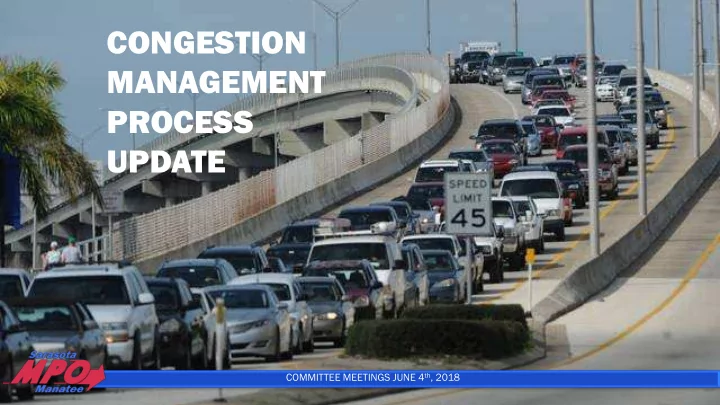
CONGESTION MANAGEMENT PROCESS UPDATE COMMITTEE MEETINGS JUNE 4 th - - PowerPoint PPT Presentation
CONGESTION MANAGEMENT PROCESS UPDATE COMMITTEE MEETINGS JUNE 4 th , 2018 Congestion Management Process TASK 1 1. Review of existing goals, objectives, and strategies 2. Identification of existing data sources Public Involvement 3.
COMMITTEE MEETINGS JUNE 4th, 2018
Bicycle, Pedestrian, Trails Advisory Committee Technical Advisory Committee Public Involvement
Saras asota M a Manat atee M MPO Goals ls & & FHWA Nati tional l Goal als Existi ting g CM CMP Ad Advan ance ced Traf affic c Management Sy System Mast ster P Plan
Traffic Message Channel (TMC) look up tables
width and median)
pedestrians
Minnesota
measures
data, public road mileage data, state and national highway system data
data and factors
Ave vera rage T Travel S l Speed Defin init itio ion Average travel speed can be obtained from detector data, vehicle probe data, or through
individual network link. Average travel speed is a metric easily understood by travelers. Reportin ing Pe Perio iod Speed can be reported for the peak period, off peak, or daily average. Appropriat iate l level f for A Applic icat atio ion This measure could be reported for facilities, corridors, and systemwide. Federal al G Guid idan ance The FHWA planning factor to increase mobility of people and freight can be measured through average travel speed. Person H Hou
Defin init itio ion Vehicle delay is calculated as the product of directional hourly volume and the difference between travel time at a threshold speed and travel time at the observed speed. The resulting vehicle delay is multiplied by a vehicle occupancy factor to arrive at person hours
Reportin ing Pe Perio iod Person hours of delay can be reported for the peak period, daily, or annually. Appropriat iate l level f for A Applic icat atio ion This measure could be reported at points, facilities, corridors, and systemwide. Federal al G Guid idan ance The FHWA planning factor to increase mobility of people can be measured through person hours of delay.
Leve vel o l of Travel T l Time R Reliabili lity ( (LOTTR) Defin init itio ion LOTTR is a metric for measuring the travel time reliability of the system. LOTTR is a ratio of the 80th percentile travel time to the 50th percentile travel time for all vehicles. This measure is applied for the NHS separately for Non-Interstates and Interstates. Reportin ing Pe Perio iod Four time periods: AM Peak, Midday, PM Peak, and Weekend Appropriat iate l level f for A Applic icat atio ion The LOTTR measure is calculated for each directional road segment (for example, eastbound is one segment and westbound is another segment). Federal al G Guid idan ance The worst ratio of the 4 time periods represents the roadway section. Above 1.50 in
unreliable. Tru ruck T Tra ravel T Time R Reli liability ( (TTTR)
Defin init itio ion
TTTR is a metric for measuring truck travel time reliability on the Interstate system. It is a ratio of the 95th percentile travel time to the 50th percentile travel time - this measure is applied for the NHS Interstates.
Repor
Period
Five time periods: AM Peak, Midday, PM Peak, Overnight, and Weekend
Appropriate l level f for A Application
The TTTR measure is calculated for each directional road segment (for example, eastbound is one segment and westbound is another segment)
Fede deral al G Guidan ance
The worst ratio of the 5 reporting periods is selected to represent the roadway section. The worst time period TTTR value is multiplied by the segment length.
76.0% 82.0%
72.5% 78.5% Most Conservative Least Conservative
Range
75.0% 70.0% Adopted Target
70.0% 76.0% Most Conservative Least Conservative
Range
50.0% Adopted Target