Concurrency: Locks Questions answered in this lecture: Review - - PDF document

concurrency locks
SMART_READER_LITE
LIVE PREVIEW

Concurrency: Locks Questions answered in this lecture: Review - - PDF document

10/17/16 UNIVERSITY of WISCONSIN-MADISON Computer Sciences Department CS 537 Andrea C. Arpaci-Dusseau Introduction to Operating Systems Remzi H. Arpaci-Dusseau Concurrency: Locks Questions answered in this lecture: Review threads and mutual


slide-1
SLIDE 1

10/17/16 1

Concurrency: Locks

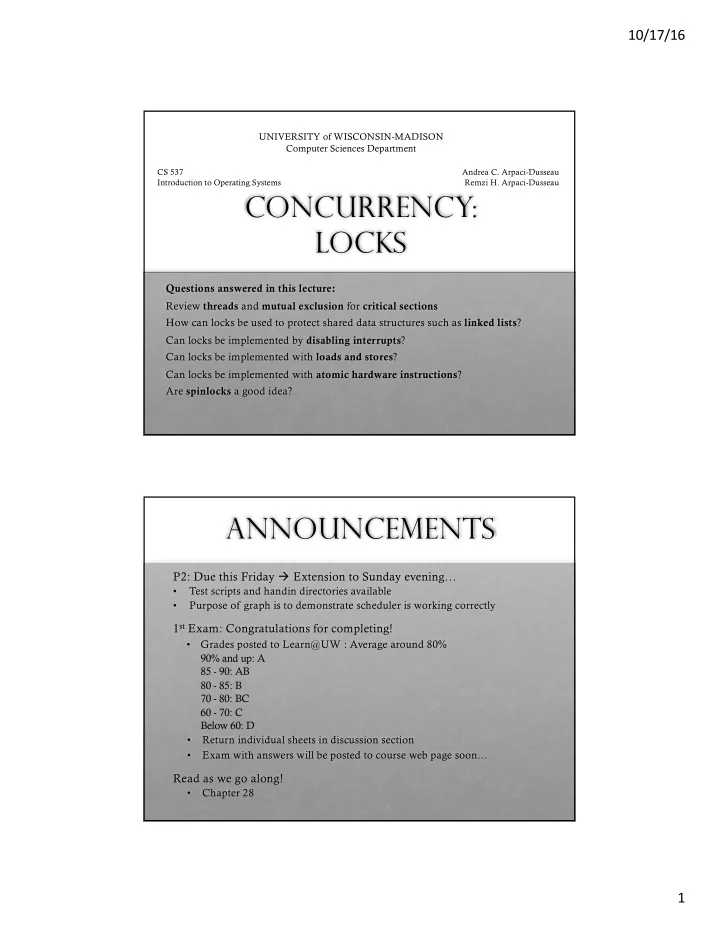
Questions answered in this lecture: Review threads and mutual exclusion for critical sections How can locks be used to protect shared data structures such as linked lists? Can locks be implemented by disabling interrupts? Can locks be implemented with loads and stores? Can locks be implemented with atomic hardware instructions? Are spinlocks a good idea?

UNIVERSITY of WISCONSIN-MADISON Computer Sciences Department

CS 537 Introduction to Operating Systems Andrea C. Arpaci-Dusseau Remzi H. Arpaci-Dusseau

Announcements

P2: Due this Friday à Extension to Sunday evening…

  • Test scripts and handin directories available
  • Purpose of graph is to demonstrate scheduler is working correctly

1st Exam: Congratulations for completing!

  • Grades posted to Learn@UW : Average around 80%

90% and up: A 85 - 90: AB 80 - 85: B 70 - 80: BC 60 - 70: C Below 60: D

  • Return individual sheets in discussion section
  • Exam with answers will be posted to course web page soon…

Read as we go along!

  • Chapter 28
slide-2
SLIDE 2

10/17/16 2 CPU 1 CPU 2

running thread 1 running thread 2

RAM

PageDir A PageDir B

PTBR PTBR CODE HEAP

Virt Mem (PageDir B)

IP IP SP SP

Review: Which registers store the same/different values across threads? CPU 1 CPU 2

running thread 1 running thread 2

RAM

PageDir A PageDir B

PTBR PTBR CODE HEAP

Virt Mem (PageDir B)

IP IP SP SP STACK 1 STACK 2

All general purpose registers are virtualized à each thread given impression of own copy

slide-3
SLIDE 3

10/17/16 3

Review: What is needed for CORRECTNESS?

Balance = balance + 1; Instructions accessing shared memory must execute as uninterruptable group

  • Need group of assembly instructions to be atomic

mov 0x123, %eax add %0x1, %eax mov %eax, 0x123

critical section

More general: Need mutual exclusion for critical sections

  • if process A is in critical section C, process B can’t

(okay if other processes do unrelated work)

Other Examples

Consider multi-threaded applications that do more than increment shared balance Multi-threaded application with shared linked-list

  • All concurrent:
  • Thread A inserting element a
  • Thread B inserting element b
  • Thread C looking up element c
slide-4
SLIDE 4

10/17/16 4

Shared Linked List

Void List_Insert(list_t *L, int key) { node_t *new = malloc(sizeof(node_t)); assert(new); new->key = key; new->next = L->head; L->head = new; } int List_Lookup(list_t *L, int key) { node_t *tmp = L->head; while (tmp) { if (tmp->key == key) return 1; tmp = tmp->next; } return 0; }

typedef struct __node_t { int key; struct __node_t *next; } node_t; Typedef struct __list_t { node_t *head; } list_t; Void List_Init(list_t *L) { L->head = NULL; }

What can go wrong? Find schedule that leads to problem?

Linked-List Race

Thread 1 Thread 2 new->key = key new->next = L->head new->key = key new->next = L->head L->head = new L->head = new

Both entries point to old head

Only one entry (which one?) can be the new head.

slide-5
SLIDE 5

10/17/16 5 head

T1’s node

  • ld

head n3 n4

T2’s node

Resulting Linked List

[orphan node]

Locking Linked Lists

Void List_Insert(list_t *L, int key) { node_t *new = malloc(sizeof(node_t)); assert(new); new->key = key; new->next = L->head; L->head = new; } int List_Lookup(list_t *L, int key) { node_t *tmp = L->head; while (tmp) { if (tmp->key == key) return 1; tmp = tmp->next; } return 0; }

typedef struct __node_t { int key; struct __node_t *next; } node_t; Typedef struct __list_t { node_t *head; } list_t; Void List_Init(list_t *L) { L->head = NULL; }

How to add locks?

slide-6
SLIDE 6

10/17/16 6

Locking Linked Lists

typedef struct __node_t { int key; struct __node_t *next; } node_t; Typedef struct __list_t { node_t *head; } list_t; Void List_Init(list_t *L) { L->head = NULL; }

How to add locks?

typedef struct __node_t { int key; struct __node_t *next; } node_t; Typedef struct __list_t { node_t *head; pthread_mutex_t lock; } list_t; Void List_Init(list_t *L) { L->head = NULL; pthread_mutex_init(&L->lock, NULL); }

One lock per list – Fine if add to OTHER lists concurrently pthread_mutex_t lock;

Locking Linked Lists : Approach #1

Void List_Insert(list_t *L, int key) { node_t *new = malloc(sizeof(node_t)); assert(new); new->key = key; new->next = L->head; L->head = new; } int List_Lookup(list_t *L, int key) { node_t *tmp = L->head; while (tmp) { if (tmp->key == key) return 1; tmp = tmp->next; } return 0; }

Consider everything critical section Pthread_mutex_lock(&L->lock); Pthread_mutex_unlock(&L->lock); Pthread_mutex_lock(&L->lock); Pthread_mutex_unlock(&L->lock); Can critical section be smaller?

slide-7
SLIDE 7

10/17/16 7

Locking Linked Lists : Approach #2

Void List_Insert(list_t *L, int key) { node_t *new = malloc(sizeof(node_t)); assert(new); new->key = key; new->next = L->head; L->head = new; } int List_Lookup(list_t *L, int key) { node_t *tmp = L->head; while (tmp) { if (tmp->key == key) return 1; tmp = tmp->next; } return 0; }

Critical section small as possible Pthread_mutex_lock(&L->lock); Pthread_mutex_unlock(&L->lock); Pthread_mutex_lock(&L->lock); Pthread_mutex_unlock(&L->lock);

Locking Linked Lists : Approach #3

Void List_Insert(list_t *L, int key) { node_t *new = malloc(sizeof(node_t)); assert(new); new->key = key; new->next = L->head; L->head = new; } int List_Lookup(list_t *L, int key) { node_t *tmp = L->head; while (tmp) { if (tmp->key == key) return 1; tmp = tmp->next; } return 0; }

What about Lookup()? Pthread_mutex_lock(&L->lock); Pthread_mutex_unlock(&L->lock); Pthread_mutex_lock(&L->lock); Pthread_mutex_unlock(&L->lock); If no List_Delete(), locks not needed

slide-8
SLIDE 8

10/17/16 8

Implementing Synchronization

Build higher-level synchronization primitives in OS

  • Operations that ensure correct ordering of instructions across threads

Motivation: Build them once and get them right

Monitors Semaphores Condition Variables Locks Loads Stores Test&Set Disable Interrupts

Lock Implementation Goals

Correctness

  • Mutual exclusion
  • Only one thread in critical section at a time
  • Progress (deadlock-free)
  • If several simultaneous requests, must allow one to proceed
  • Bounded waiting (starvation-free)
  • Must eventually allow each waiting thread to eventually enter

Fairness Each thread waits in some defined order Performance CPU is not used unnecessarily (e.g., spinning) Fast to acquire lock if no contention with other threads

slide-9
SLIDE 9

10/17/16 9

Implementing Synchronization

To implement, need atomic operations Atomic operation: No other instructions can be interleaved Examples of atomic operations

  • Code between interrupts on uniprocessors
  • Disable timer interrupts, don’t do any I/O
  • Loads and stores of words
  • Load r1, B
  • Store r1, A
  • Special hw instructions
  • Test&Set
  • Compare&Swap

Implementing Locks: W/ Interrupts

Turn off interrupts for critical sections

Prevent dispatcher from running another thread Code between interrupts executes atomically Void acquire(lockT *l) { disableInterrupts(); } Void release(lockT *l) { enableInterrupts(); }

Disadvantages?? Only works on uniprocessors Process can keep control of CPU for arbitrary length Cannot perform other necessary work

slide-10
SLIDE 10

10/17/16 10

Implementing Synchronization

To implement, need atomic operations Atomic operation: No other instructions can be interleaved Examples of atomic operations

  • Code between interrupts on uniprocessors
  • Disable timer interrupts, don’t do any I/O
  • Loads and stores of words
  • Load r1, B
  • Store r1, A
  • Special hw instructions
  • Test&Set
  • Compare&Swap

Implementing LOCKS: w/ Load+Store

Code uses a single shared lock variable Boolean lock = false; // shared variable void acquire(Boolean *lock) { while (*lock) /* wait */ ; *lock = true; } void release(Boolean *lock) { *lock = false; } Why doesn’t this work? Example schedule that fails with 2 threads?

slide-11
SLIDE 11

10/17/16 11

Race Condition with LOAD and STORE

*lock == 0 initially Thread 1 Thread 2 while(*lock == 1) ; while(*lock == 1) ; *lock = 1 *lock = 1 Both threads grab lock! Problem: Testing lock and setting lock are not atomic

Demo

Main-thread-3.c Critical section not protected with faulty lock implementation

slide-12
SLIDE 12

10/17/16 12

Peterson’s Algorithm

Assume only two threads (tid = 0, 1) and use just loads and stores

int turn = 0; // shared across threads – PER LOCK Boolean lock[2] = {false, false}; // shared – PER LOCK Void acquire() { lock[tid] = true; turn = 1-tid; while (lock[1-tid] && turn == 1-tid) /* wait */ ; } Void release() { lock[tid] = false; }

Example of spin-lock

Different Cases: All work

Lock[0] = true; turn = 1; while (lock[1] && turn ==1) ;

Only thread 0 wants lock initially In critical section

Lock[1] = true; turn = 0; while (lock[0] && turn == 0) lock[0] = false; while (lock[0] && turn == 0) ;

slide-13
SLIDE 13

10/17/16 13

Different Cases: All work

Lock[0] = true; turn = 1; while (lock[1] && turn ==1) ;

Thread 0 and thread 1 both try to acquire lock at same time

Lock[1] = true; turn = 0; while (lock[0] && turn == 0) Finish critical section lock[0] = false; while (lock[0] && turn == 0) ;

Different Cases: All Work

Lock[0] = true; turn = 1; while (lock[1] && turn ==1)

Thread 0 and thread 1 both want lock

Lock[1] = true; turn = 0; while (lock[0] && turn == 0) ;

slide-14
SLIDE 14

10/17/16 14

Different Cases: All Work

Lock[0] = true; turn = 1; while (lock[1] && turn ==1) while (lock[1] && turn ==1) ;

Thread 0 and thread 1 both want lock;

Lock[1] = true; turn = 0; while (lock[0] && turn == 0)

Peterson’s Algorithm: Intuition

Mutual exclusion: Enter critical section if and only if

Other thread does not want to enter OR Other thread wants to enter, but your turn (only 1 turn)

Progress: Both threads cannot wait forever at while() loop

Completes if other process does not want to enter Other process (matching turn) will eventually finish

Bounded waiting (not shown in examples)

Each process waits at most one critical section (because turn given to other)

Problem: doesn’t work on modern hardware (doesn’t provide sequential consistency due to caching)

slide-15
SLIDE 15

10/17/16 15

Implementing Synchronization

To implement, need atomic operations Atomic operation: No other instructions can be interleaved Examples of atomic operations

  • Code between interrupts on uniprocessors
  • Disable timer interrupts, don’t do any I/O
  • Loads and stores of words
  • Load r1, B
  • Store r1, A
  • Special hw instructions
  • Test&Set
  • Compare&Swap

xchg: atomic exchange,

  • r test-and-set

// xchg(int *addr, int newval) // ATOMICALLY return what was pointed to by addr // AT THE SAME TIME, store newval into addr int xchg(int *addr, int newval) { int old = *addr; *addr = newval; return old; }

Need hardware support static inline uint xchg(volatile unsigned int *addr, unsigned int newval) { uint result; asm volatile("lock; xchgl %0, %1" : "+m" (*addr), "=a" (result) : "1" (newval) : "cc"); return result; }

slide-16
SLIDE 16

10/17/16 16

LOCK Implementation with XCHG

typedef struct __lock_t { int flag; } lock_t; void init(lock_t *lock) { lock->flag = ??; } void acquire(lock_t *lock) { ????; // spin-wait (do nothing) } void release(lock_t *lock) { lock->flag = ??; }

int xchg(int *addr, int newval)

XCHG Implementation

typedef struct __lock_t { int flag; } lock_t; void init(lock_t *lock) { lock->flag = 0; } void acquire(lock_t *lock) { while(xchg(&lock->flag, 1) == 1) ; // spin-wait (do nothing) } void release(lock_t *lock) { lock->flag = 0; }

Example of spin-lock

slide-17
SLIDE 17

10/17/16 17

DEMO: XCHG

Critical section protected with our lock implementation!! Main-thread-5.c

Break

slide-18
SLIDE 18

10/17/16 18

Other Atomic HW Instructions

int CompareAndSwap(int *addr, int expected, int new) { int actual = *addr; if (actual == expected) *addr = new; return actual; }

void acquire(lock_t *lock) { while(CompareAndSwap(&lock->flag, ?, ?) == ?) ; // spin-wait (do nothing) } Example of spin-lock

Other Atomic HW Instructions

int CompareAndSwap(int *ptr, int expected, int new) { int actual = *addr; if (actual == expected) *addr = new; return actual; }

void acquire(lock_t *lock) { while(CompareAndSwap(&lock->flag, 0, 1) == 1) ; // spin-wait (do nothing) }

slide-19
SLIDE 19

10/17/16 19

Lock Implementation Goals

Correctness

  • Mutual exclusion
  • Only one thread in critical section at a time
  • Progress (deadlock-free)
  • If several simultaneous requests, must allow one to proceed
  • Bounded (starvation-free)
  • Must eventually allow each waiting thread to enter eventually

Fairness Each thread waits in some determined ordered Performance CPU is not used unnecessarily

spin spin spin spin

Basic Spinlocks are Unfair

A B 20 40 60 80 100 120 140 160 A B A B A B

lock lock unlock lock unlock lock unlock lock unlock

Scheduler is independent of locks/unlocks

slide-20
SLIDE 20

10/17/16 20

Fairness: Ticket Locks

Idea: reserve each thread’s turn to use a lock. Each thread spins until their turn. Use new atomic primitive, fetch-and-add: int FetchAndAdd(int *ptr) { int old = *ptr; *ptr = old + 1; return old; } Acquire: Grab ticket; Wait while not thread’s ticket != turn Release: Advance to next turn

1 2 3 4 5 6 7

A lock(): B lock(): C lock(): A unlock(): B runs A lock(): B unlock(): C runs C unlock(): A runs A unlock(): C lock():

Ticket Lock ExampLE

Ticket Turn

slide-21
SLIDE 21

10/17/16 21

1 2 3 4 5 6 7

A lock(): gets ticket 0, spins until turn = 0 àruns B lock(): gets ticket 1, spins until turn=1 C lock(): gets ticket 2, spins until turn=2 A unlock(): turn++ (turn = 1) B runs A lock(): gets ticket 3, spins until turn=3 B unlock(): turn++ (turn = 2) C runs C unlock(): turn++ (turn = 3) A runs A unlock(): turn++ (turn = 4) C lock(): gets ticket 4, runs

Ticket Lock ExampLE

Ticket Lock Implementation

typedef struct __lock_t { int ticket; int turn; } void lock_init(lock_t *lock) { lock->ticket = 0; lock->turn = 0; } void acquire(lock_t *lock) { int myturn = FAA(&lock->ticket); while (lock->turn != myturn); // spin } void release (lock_t *lock) { FAA(&lock->turn); }

slide-22
SLIDE 22

10/17/16 22

Ticket Lock

typedef struct __lock_t { int ticket; int turn; } void lock_init(lock_t *lock) { lock->ticket = 0; lock->turn = 0; }

void acquire(lock_t *lock) { int myturn = FAA(&lock->ticket); while(lock->turn != myturn) yield(); // spin } void release (lock_t *lock) { lock->turn++; }

FAA() used in textbook à conservative Try this modification in Homework simulations

Spinlock Performance

Fast when…

  • many CPUs
  • locks held a short time
  • advantage: avoid context switch

Slow when…

  • one CPU
  • locks held a long time
  • disadvantage: spinning is wasteful
slide-23
SLIDE 23

10/17/16 23

spin spin spin spin spin

CPU Scheduler is Ignorant

A B 20 40 60 80 100 120 140 160 C D A B C D

lock unlock lock

CPU scheduler may run B instead of A even though B is waiting for A

Ticket Lock with Yield()

typedef struct __lock_t { int ticket; int turn; } void lock_init(lock_t *lock) { lock->ticket = 0; lock->turn = 0; } void acquire(lock_t *lock) { int myturn = FAA(&lock->ticket); while(lock->turn != myturn) yield(); } void release (lock_t *lock) { FAA(&lock->turn); }

Remember: yield() voluntarily relinquishes CPU for remainder of timeslice, but process remains READY

slide-24
SLIDE 24

10/17/16 24

spin spin spin spin spin

A B 20 40 60 80 100 120 140 160 C D A B C D

lock unlock lock

A 20 40 60 80 100 120 140 160 A B

lock unlock lock

no yield: yield:

Yield Instead of Spin

Spinlock Performance

Waste…

Without yield: O(threads * time_slice) With yield: O(threads * context_switch)

So even with yield, spinning is slow with high thread contention Next improvement: Block and put thread on waiting queue instead of spinning