Concluding remarks Keith Ellis - Fermilab "From a long view of - - PowerPoint PPT Presentation

concluding remarks
SMART_READER_LITE
LIVE PREVIEW

Concluding remarks Keith Ellis - Fermilab "From a long view of - - PowerPoint PPT Presentation

Concluding remarks Keith Ellis - Fermilab "From a long view of the history of mankind - seen from, say, ten thousand years from now - there can be little doubt that the most significant event of the 19th century will be judged as Maxwell's


slide-1
SLIDE 1

Concluding Talk- Keith Ellis

Concluding remarks

Keith Ellis - Fermilab

1

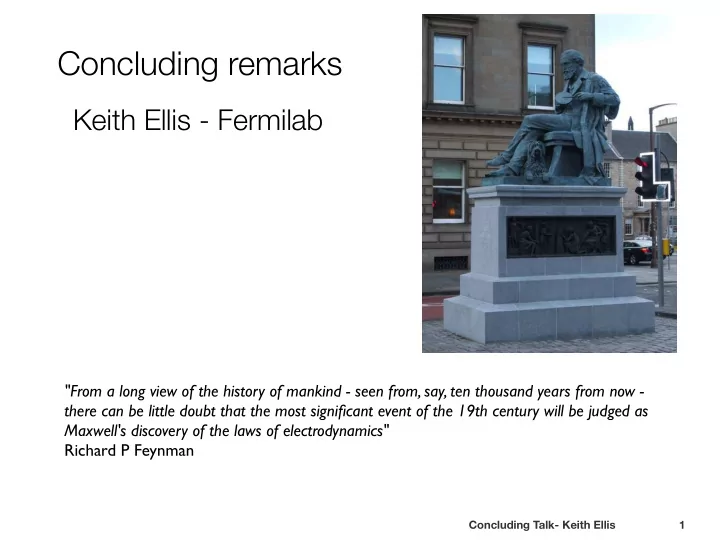
"From a long view of the history of mankind - seen from, say, ten thousand years from now - there can be little doubt that the most significant event of the 19th century will be judged as Maxwell's discovery of the laws of electrodynamics" Richard P Feynman

slide-2
SLIDE 2

Concluding Talk- Keith Ellis

Maxwell and Aberdeen

Aberdeen had two universities King’s College, established in 1495 by papal bull and Marischal College established 1593, a protestant institution, for the training of post- reformation clergy. Maxwell was professor in Aberdeen at Marischal College (1856-1860) Worked on the stability of Saturn’s rings.

2

slide-3
SLIDE 3

Concluding Talk- Keith Ellis

Seven TeV Ladder

The huge dynamic range

  • f SM processes that are

accessible at the LHC in this run. Scale is in femtobarns -a good couple of weeks for the LHC Branching ratios to

  • bserved final states are

not included. In the V+jet channels lots

  • f theoretical work left to

do.

3

slide-4
SLIDE 4

Concluding Talk- Keith Ellis

Diboson physics

Important test of the gauge structure of the electroweak theory close relationship in many channels WW,ZZ, γγ to the Higgs search where appropriate, the Branching ratio into a single flavour of lepton has been included. Photon cross sections defined with a minimum cut All of the processes will be accessed with the data sample of this year.

4

slide-5
SLIDE 5

Concluding Talk- Keith Ellis

Adding in the SM Higgs boson

For WW, mH=160GeV For γ γ, mH=120GeV For ZZ, mH=185GeV

5

Controlling (irreducible) backgrounds is the major issue for Higgs searches

slide-6
SLIDE 6

Concluding Talk- Keith Ellis

Standard Model Higgs - bad news

No convincing sign of the Higgs boson so far. Excluding the standard model requires more than 95%cl (5 σ?). Exclusion limits may not hold for a fermiophobic Higgs. You don’t get to stop at 1 (ie σ= σSM)!

6

Sharma LP2011 Nisati LP2011

slide-7
SLIDE 7

Concluding Talk- Keith Ellis

Standard Model Higgs boson - Good news

Three components of the Higgs field have been

  • bserved already - they are

the longitudinal modes of the W,Z Exclusion limits are so far not in disagreement with limits from precision electroweak data. Were the Standard model Higgs boson to be found in the piece of the low mass region that is not excluded at 95% cl, there would be many modes to study- good news for LHC.

7 Excluded by LHC (& Tevatron) at 95% cl

Excluded by LEP (&Tevatron)

slide-8
SLIDE 8

Concluding Talk- Keith Ellis

The Maxwellian Heritage The standard model is based on the principle of local gauge invariance.

Full standard model is based on SU(3)xSU(2)xU(1)

8

slide-9
SLIDE 9

Concluding Talk- Keith Ellis

The Higgs Model

The Higgs model transcends the Maxwellian paradigm. Introduces a new field coupled to the weak interactions by a gauge coupling, but with self interactions given by a new non-gauge interaction of strength λ. Longitudinal mode (Goldstone boson) scattering Higgs boson tames the bad high energy behaviour of WW scattering.

9

slide-10
SLIDE 10

Concluding Talk- Keith Ellis

Higgs scenarios with smaller cross sections relative to SM.

Composite Higgs: pseudo-Goldstone

boson from a strongly-coupled sector at higher mass.

Top Yukawa and Coupling to Vector bosons both reduced with respect to the standard model. Therefore cross sections are reduced with respect to the Standard model couplings. Observation of the scattering of longitudinal modes is extremely challenging at the LHC@14TeV.

10

Contino et al, arXiv:1002.1011

slide-11
SLIDE 11

Concluding Talk- Keith Ellis

Interference in Higgs→WW production.

For various reasons only diagrams (c) and (d) contribute. Separating out the Breit Wigner for the Higgs we can isolate the real and imaginary parts. If we integrate about the resonance the real part is odd and will vanish, (if no other dependence on s) the imaginary part that remains is proportional to the width.

11

slide-12
SLIDE 12

Concluding Talk- Keith Ellis

Higgs interference

Interference can be O(±10%) and depends on the scales in the problem, mt,MW,MH Much of the effect is non-resonant. If we try and restrict to the resonant region by cutting on the transverse mass of the final state we remove the interference. Atlas cuts include a transverse mass cut and show very little negative interference for low mass. We recommend ATLAS style transverse mass cut should adopted for Higgs searches.

12 Campbell, Ellis, Williams, arXiv:1107.5569

n 0.75 mH < MT < mH, w

slide-13
SLIDE 13

Loops and legs (circa 2007)

1 2 3 4 2-legs 3-legs 4-legs 5-legs 6-legs 7-legs

Loops

QCD beta

function anomalous dimensions, form factors

pp →

W/Z+1jet, e+e-→ 3jets pp → W/Z+2jet, e+e-→ 3jets

slide-14
SLIDE 14

Loops and legs - 2011

Loops

pp →W/Z

+1jet e+e-→ 3jets pp → W/Z+2jet, ttbar+1jets, H+2jets W+W-+jet, e+e-→ 4 jets pp → W/Z+3jet, ttbar+2jets, W+W±+jet, e+e-→ 5 jets pp → W+4jet , Z+4jet

1 2 3 4 2-legs 3-legs 4-legs 5-legs 6-legs 7-legs

pp →H

(2 loop)

slide-15
SLIDE 15

Concluding Talk- Keith Ellis

NLO revolution: Ingredients

Application of unitarity to the calculation of one loop diagrams. Improvements in traditional techniques for Passarino-Veltman reduction. Generation of one loop integrand by parametric fit, (in dimensions) Automatic procedures for generation of graphs and the consequent integrands. Automatic procedures for the generation of counterterms to implement the real virtual subtraction. Tabulation and numerical implementation of all integrals.

15

Denner, Dittmaier... Bern, Dixon, Kosower,..Britto, Cachazo, Feng... Ossola, Pittau,Papadopoulos.....Giele, Kunszt, Melnikov,... Stelzer, Long....Nogueira... Glesiberg, Krauss.., Frederix.... VanOldenborgh...RKE, Zanderighi.....

slide-16
SLIDE 16

Concluding Talk- Keith Ellis

NLO revolution: Recent successes

16

Bern et al, arXiv:1108.2229

Frixione,Hirschi,Maltoni,Pittau,Torrielli, (unpublished) Wjj invariant mass NLO + parton shower

slide-17
SLIDE 17

Concluding Talk- Keith Ellis

MadLoop & AMC@NLO

The dream of automatic NLO calculations is becoming a reality. Based on a Feynman diagram technique, supplemented by OPP reduction and FKS subtraction. It remains to be seen how the computing time will scale with the number of legs, and what practical limitations of this approach will be. Ideally one would like an special interface to the cases where the corrections are known analytically. Will allow a detailed examination of low multiplicity cases that have so far

  • nly been treated approximately, (eg

beyond the resonant approximation).

17

slide-18
SLIDE 18

Concluding Talk- Keith Ellis

Still MAD after all these years...the anatomy of a successful software project.

1992: Murayama, Watanabe,Hagiwara: Helas Libraries for Helicity Amplitudes. 1994: Stelzer and Long, Madgraph: Automatic generation of tree level amplitudes. 2002: Maltoni and Stelzer, Madevent: Generation of events, integration over phase space. 2007: Madgraph 4, Alwall, Demin, Visscher, Frederix, Herquet, Maltoni, Plehn, Rainwater, Stelzer : extension to BSM models, web interface 2010 MadDipole, Frederix, Gehrmann, Greiner: Automatic generation

  • f Catani Seymour dipoles.

Madgraph V, Alwall,Herquet,Maltoni,Mattelaer,Stelzer..., Python implementation, extension of capabilities for number of external Legs 2011 Madloop.... 2011 MadFKS.... 2011 AMC@NLO...

18

The benefits of open source!
slide-19
SLIDE 19

Concluding Talk- Keith Ellis

MCFM (Monte Carlo for FeMtobarn processes)

MCFM represents a unified approach to NLO corrections. http://mcfm.fnal.gov (v6.0, May 2011)

  • J. M. Campbell, R. K. Ellis, C. Williams (main authors)

(R. Frederix, F. Maltoni, F. Tramontano, S. Willenbrock, ....) Next-to-leading order parton-level predictions. Cross sections and differential distributions. Standard Model processes with vector boson+jets, photons,top quarks, Higgs. Decays of unstable particles are included, maintaining spin correlations. One-loop amplitudes calculated from scratch or taken from the literature. Public code used a proving ground for other approaches. Cited by more than 300 experimental papers.

19

Campbell, Ellis,Williams

slide-20
SLIDE 20

Concluding Talk- Keith Ellis

MCFM: a NLO parton level generator

20

Vector Bosons pp→W/Z Vector Bosons pairs pp→γγ, Wγ, Zγ, WW, WZ, ZZ Vector Bosons +jets pp→W/Z+1jet, W/Z+2jets, W/Zb, Wc, W/Zbb Top pp→ttbar, tX(s-and t-channel), tW Higgs pp→WH,ZH,H,H+1jet,H+2jets (g-fusion+VBF)

All spin correlations in the decays of Bosons taken into account

slide-21
SLIDE 21

Concluding Talk- Keith Ellis

New Processes in MCFM v6.0 and v6.1

Higgs boson production in association with 2 jets (infinite top mass limit); Single top production calculated in a four-flavor scheme; Top pair production with decay; Production of massive quarks, in association with a W-boson; Photon fragmentation functions, with inclusion of the γγ, Wγ, Zγ processes; Wγ and Zγ processes including radiation from final lepton lines and anomalous couplings; Photon + jet production; Vector boson pair processes, glue-glue initiated loop contributions.

21

slide-22
SLIDE 22

Concluding Talk- Keith Ellis

MCFM Example: W+2 jet exclusive events

22

Campbell, Martin,Williams, arXiv:1105.4594

Contributing processes all calculated with MCFM at NLO NLO prediction for mJJ using CDF cuts

slide-23
SLIDE 23

Concluding Talk- Keith Ellis

Wjj results from the Tevatron.

Analysis is a by product of diboson search in the Wjj channel. Diboson signal is necessary prerequisite to get in the game (Atlas not there yet). Both collaborations need to analyze and publish the full data sets.

23

CDF sees an excess,.. whereas D0 sees none

slide-24
SLIDE 24

Concluding Talk- Keith Ellis

Comparison of CDF and D0 results (by CDF and D0)

DZero p-value for excluding 3.1pb cross section signal is 3.3σ or 5.10-4 Cross sections above 1.9pb are excluded at 95%CL

24

Comparing fitted cross sections σ(DZero)=0.4+0.8-0.4 pb which is consistent with zero within 0.5 σ σ(CDF)=3.1+0.8-0.8 pb with significance of excess 3.3 σ Values of cross sections are 2.5 σ apart having a 0.6% probability

slide-25
SLIDE 25

Concluding Talk- Keith Ellis

Top quark mass

Why would one want to measure the top quark mass? As a fundamental parameter of the standard model?? As an input to precision electroweak calculations? As an input parameter in a Monte Carlo program? It is important to remember that the top quark mass is a scheme and scale dependent quantity. With the metric provided by the standard model Higgs bounds, the top quark is well known compared to the W-mass. In normal units, Tevatron combination mt=173.2±0.9GeV, mw=80.420±0.031GeV, W-mass is much better known.

δmw=40MeV, δmt=1GeV.

25

80.3 80.4 80.5 155 175 195 mH [GeV] 114 300 1000

mt [GeV] mW [GeV]

68% CL Δα LEP1 and SLD LEP2 and Tevatron

July 2011

slide-26
SLIDE 26

Concluding Talk- Keith Ellis

Top quark mass

The physical amplitude cannot have a pole at the top quark mass; colour conservation forbids it. Therefore any measurement that relies on the fact that perturbative amplitude has such a pole is not controlled by short distance physics. Measurement of the mass of a coloured

  • bject (the top quark) by examination of

the colour neutral decay products is inherently ambiguous by ΛQCD and these remains true even if the top quark decays before hadronization.

26

slide-27
SLIDE 27

Concluding Talk- Keith Ellis

Top quark mass

They two common masses for the top quark (pole mass and MSbar mass) differ by of order 8 GeV!

27

In many ways the measurement of the top quark mass, is similar to the measurement of the b-quark mass from B-hadron decays. It is important to have measurements that are based on short distance physics,that are interpretable in different renormalization schemes. Most current measurements do not belong to that class.

slide-28
SLIDE 28

Concluding Talk- Keith Ellis

Alternative top quark measurements

By the end of the year both major LHC experiments will have 106 produced top quark pairs It is appropriate to consider new methods. For example, the spectrum of charged leptons from top decay is sensitive to the mass of the top. At a hadron collider we can look at the charged lepton pT distribution.

28

Lepton transverse momentum spectrum shape for mt=165,170,175

slide-29
SLIDE 29

Concluding Talk- Keith Ellis

Lepton pT measurement

CDF arXiv:1101.4926 Treatment based on Pythia, partially upgraded to “NLO” by including initial state radiation. Hence theoretical treatment is not as good as it could be, and since it does not yet include higher orders, nnot sensitive to the top mass renormalization scheme. mt=176.9 ±8.0 (stat) ± 2.7 (syst)

29

slide-30
SLIDE 30

Concluding Talk- Keith Ellis

Top quark measurement from total cross section

Attempt to use the total cross section measurement to determine which mass we are dealing with. Parton distribution and scale uncertainties included in coloured bands. Measurement of the cross section requires specification of mass for Monte Carlo

30

slide-31
SLIDE 31

Concluding Talk- Keith Ellis

ttbar Asymmetry

31

Order for asymmetry calculation αs2 αs3 αs4 αs5 αs6 ttbar

  • 5%

? ? ?

Kuhn, Rodrigo

ttbar +1jet,pT>20

  • 7.7% -1.8%

?

Melnikov, Schulze Dittmaier, Uwer and Weinzierl

ttbar+2jets, pT>20

  • 10.3% -4.6%

Bevilacqua, Czakon, Papadopoulos, Worek

CDF result 0.15±0.05, 5.3fb -1 D0 result 0.196±0.065, 5.4fb-1

Experimental results are intriguing, but unfortunately statistically limited.

Melnikov and Schulze (arXIv:1004.3284) have an argument that the tt asymmetry should not be subject to large uncertainties

slide-32
SLIDE 32

Concluding Talk- Keith Ellis

Radiation zeros (Wγ production)

Consider the scattering scalar1(p1)+scalar2(p2) -> scalar3(p3)+γ(q) Photon emission amplitude is A very beautiful interference effect, sensitive to the magnetic moment κ of the W boson. Standard model κ=1.

32

Brown, Sahdev and Mikaelian, 1979

slide-33
SLIDE 33

Concluding Talk- Keith Ellis

Treatment of Wγ requires the inclusion of all diagrams. The separation into ISR and FSR is not a gauge invariant concept. In a theoretical calculation we can drop diagram (d), if we insist that the lν has exactly the mass of the W, (the narrow width approximation). The difference between the full calculation and the narrow width is big, for standard photon cuts. One does not have the liberty to rescale diagram (d) independently (as I think was done in Atlas publication arXiv:1106.1592).

33

slide-34
SLIDE 34

Concluding Talk- Keith Ellis

We can compare our NLO prediction (basic kinematic cuts) with a 10 GeV isolated photon with that reported by CMS

Need a cut on transverse mass

  • f system to observe SM

radiation zero (black curve). Otherwise final state radiation (blue curve) obscures radiation zero.

34

σNLO(pp → Wγ + X) × BR(W → ν) = 51.2+2.3

−3.5 pb

σCMS(pp → Wγ+X)×BR(W → ν) = 55.9±5.0 (stat)±5.0 (sys)±6.1 (lumi) pb

slide-35
SLIDE 35

Concluding Talk- Keith Ellis

Atlas treatment

MCFM contains the full NLO calculation, including radiation from the final state. The Atlas publication arXiv:1106.1592, contains an attempt to include final state radiation using a separate code. One does not have the liberty to rescale diagram final state radiation diagram independently The differing treatment of diagrams in a gauge set most likely violates gauge invariance.

35

Results from arXiv:1106.1592

MCFM results without theoretical errors (±5%).

slide-36
SLIDE 36

Concluding Talk- Keith Ellis

Maxwell’s grave

36

Maxwell is buried at the NW end of roofless old kirk in the old graveyard SE of Parton Church, near Dumfries

Photo: Richard Ball

slide-37
SLIDE 37

Concluding Talk- Keith Ellis

NNLO: The new frontier

37

12.5 25 37.5 50 1995 1998 2001 2004 2007 2010

Papers with NNLO in title

slide-38
SLIDE 38

Concluding Talk- Keith Ellis

Top:NNLO

Motivations: Scale dependence is dominant error at LHC Top quark asymmetry Standard candle for gg flux at the Tevatron. The components of a NNLO calculation are:- 2-loop virtual corrections (VV) 1-loop virtual with an extra parton (RV) Two emiited partons (RR)

38

VV RV RR

(VV)- known completely for numerically qqbar, leading colour for gg:- RV Soft current now known RR complete Expectation is that the quark-quark component will be complete this year (including asymmetry)

slide-39
SLIDE 39

Concluding Talk- Keith Ellis

Fermilab Future

39

slide-40
SLIDE 40

Concluding Talk- Keith Ellis

Energy Frontier

Although Tevatron will shut down on Sept 30th 2011, we are not abandoning the energy frontier. Tevatron analysis will continue for many years. The LHC (accelerator and detectors) is the biggest investment in HEP made by the US since the 70’s. We will exploit it fully. LPC Physics center located at Fermilab. Contributions continue to be made in R&D for future machines, ILC, CLIC, Muon collider, LHC energy doubler.

40

slide-41
SLIDE 41

Concluding Talk- Keith Ellis

Intensity Frontier:Neutrinos

ν Standard model: Pattern of neutrino masses and mixings. MINOS, Noνa, LBNE ν beyond the standard model: the search for sterile neutrinos and anomalous interactions. Short baseline: MiniBoone-MicroBoone Long-baseline: MINOS, Noνa Neutrino physics measurements as a probe of nuclear structure and support of oscillation experiments Dedicated experiment: Minerνa

41

Noνa building and 15KTon detector schematic

slide-42
SLIDE 42

g-2 sensitivity

Concluding Talk- Keith Ellis

Intensity Frontier: Rare processes

g-2: anomalous magnetic moment of the muon x20 statistics Mu2e: direct muon to electron conversion - huge sensitivity to NP:Single event sensitivity below 10-16 SeaQuest: nuclear physics Drell-Yan process to study the structure of the nucleon in the nuclear environment.

42

g-2 sensitivity

slide-43
SLIDE 43

Concluding Talk- Keith Ellis

Program for the next decade

LBNE - Long baseline neutrino experiment (baseline 1200km) to South Dakota Neutrino mass spectrum (mass hierarchy) Matter-Antimatter symmetry Neutrino anti-neutrino differences Project X - Megawatts of continuous beam a world-leading facility for the intensity frontier >2MW to LBNE Kaon experiments Rare muon decay experiments Applications to spallation targets and ADS (sub-critical nuclear reactor, accelerator driven) Front end for muon collider or neutrino factory.

43

slide-44
SLIDE 44

Concluding Talk- Keith Ellis

Conclusions

No sacred cows were slaughtered in Mumbai. But the cattle are in the barn, bleating quietly. For some of them the end may well be nigh. The fun at the LHC has begun and an understanding of QCD is a fundamental part of it. We will progress faster if we Make software public Increase experiment -theorist communication before publication. Enjoy the ride!

44