Computing and Global Health Lecture 2, Surveillance Winter 2015 - - PowerPoint PPT Presentation

computing and global health lecture 2 surveillance
SMART_READER_LITE
LIVE PREVIEW

Computing and Global Health Lecture 2, Surveillance Winter 2015 - - PowerPoint PPT Presentation

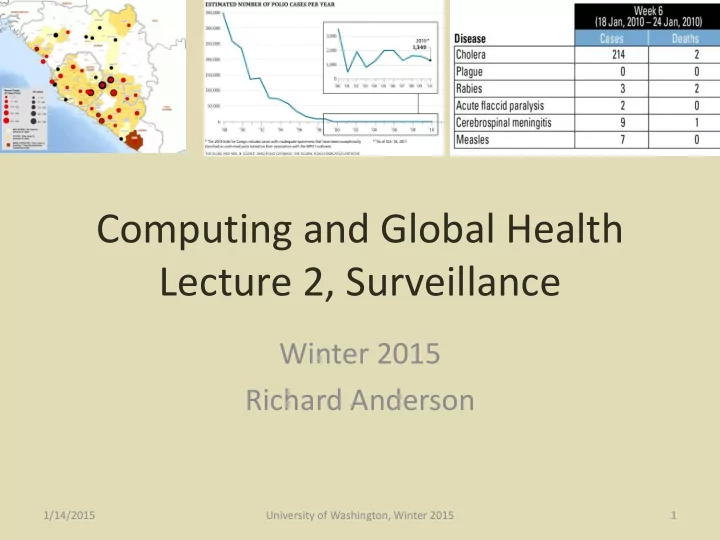
Computing and Global Health Lecture 2, Surveillance Winter 2015 Richard Anderson 1/14/2015 University of Washington, Winter 2015 1 Todays topics Surveillance problem Issues Health Information systems HISP/DHIS2

slide-1
SLIDE 1

Computing and Global Health Lecture 2, Surveillance

Winter 2015 Richard Anderson

1/14/2015 University of Washington, Winter 2015 1

slide-2
SLIDE 2

Today’s topics

  • Surveillance problem
  • Issues
  • Health Information systems
  • HISP/DHIS2
  • Approaches to last mile data collection

1/14/2015 University of Washington, Winter 2015 2

slide-3
SLIDE 3

Readings and Assignments

  • Homework 1

– Design a national immunization equipment monitoring system

  • Readings

– DHIS2 for Ghana – Health worker personas – Lancet Health

1/7/2015 University of Washington, Winter 2015 3

slide-4
SLIDE 4

Assignment 2

  • Develop requirements for a software tool to

support the district manager in aggregating facility reports and submitting them to the national level.

– Select one of your three countries as a target

  • You may choose the most appropriate

level/approach for the requirements

1/14/2015 University of Washington, Winter 2015 4

slide-5
SLIDE 5

Nicaragua Case Study

  • Strong national

epidemiology department

  • Second poorest country

in the Americas (GDP per capita $4500)

  • Population 5.8 million

1/14/2015 University of Washington, Winter 2015 5

slide-6
SLIDE 6

Nicaragua Health System

  • SILAIS (district health
  • ffice), Hospital, Health

center, Health post

  • Health post, staffed by
  • ne or two people
  • Weekly meetings of

health post staff at health center

1/14/2015 University of Washington, Winter 2015 6

slide-7
SLIDE 7

Facility reporting

  • Monthly reporting of

disease

– Roughly 60 diseases listed – Age buckets and gender

  • Separate immunization

reporting

  • Additional reporting from

hospitals

  • Health Post -> Health

Center -> Silais -> National

1/14/2015 University of Washington, Winter 2015 7

slide-8
SLIDE 8

Data use

  • Strong culture of data use
  • All health centers visited

had recent graphs of health data

  • Staff expressed

understanding of data and awareness of how it can be used

  • Policy and training to

support data use

1/14/2015 University of Washington, Winter 2015 8

slide-9
SLIDE 9

National Level

  • Well established national

reporting

– Procedures for data collection and use in place – Run by epidemiologists

  • Remote reporting by

radio

– Gradually being phased out

  • Custom surveillance

software (running on Windows 3.1 in 2010)

1/14/2015 University of Washington, Winter 2015 9

slide-10
SLIDE 10

Dengue Surveillance

  • Mosquito born disease of

growing importance

– Breakbone fever – Highly seasonal

  • Case tracking

– Early warning of outbreaks – Mitigation (e.g., mosquito control) – 2009 Nicaragua introduced a Frontline SMS reporting system

1/14/2015 University of Washington, Winter 2015 10

slide-11
SLIDE 11

Nicaragua Summary

  • Relatively successful surveillance system

– Procedures appear to work – Understanding of use of data

  • Multiple different reporting systems in place as of 2010

with out of date technology

  • Country faces challenges of low income and remote

areas

  • Strengths

– Strong public health system – Small country – Improving infrastructure

1/14/2015 University of Washington, Winter 2015 11

slide-12
SLIDE 12

Surveillance

  • Collect aggregate health data at national level
  • Not associated with the individual
  • Health statistics, not data for treatment of

individuals

1/14/2015 University of Washington, Winter 2015 12

slide-13
SLIDE 13

Routine surveillance vs. Surveys

Country surveillance

  • Routine submission with a

fixed period

  • Goal of complete coverage
  • Data collection and entry one
  • f many tasks by workers
  • Small amount of data per form
  • Limited resources for training,

implementation, and supervision

NGO led survey

  • Single instance
  • Goal of statistical

significance through sampling

  • Data collection by dedicated

workers

  • Complex data collection
  • Large amount of data

1/14/2015 University of Washington, Winter 2015 13

slide-14
SLIDE 14

Challenges

  • Standard problems associated with surveys

– Statistical significance – Form design – Data errors

  • ICTD Problems

– Peripheral Data Collection – Health information systems for developing countries

1/14/2015 University of Washington, Winter 2015 14

slide-15
SLIDE 15

ALERTS

  • 12/20/04 06:58 am Team Access

recalls batch # 2434-FG78.

  • 12/20/04 04:15 am Facility 21 reports

an adverse event from its latest shipment of Didanosine.

  • 12/20/04 00:35 am Facility 5, please

provide a count of batch# 2435-FH95.

Last 24 hours

KEY PERFORMANCE INDICATORS Percent of critical items available within the 100% SCMS system. Percent of non-critical items re-supplied 99% within 30 days. Average number of commodities provided 150 per program. Percentage of emergency orders per month. 3% Number of patients receiving services through SCMS:

  • Care and support

72,000

  • Palliative care

15,000

  • ART

60,000 Number of sites with deliveries within 7 days: 20 MAP

ALERT (3of 6)

Last 24 hours

ALL CRS FHI FUTU RE CAR E

CRS NO SHORTAGE SHORTAGE STOCKOUT ORDER VOLUME DELIVERY PERFORMANCE

Dashboard

User ID: 20125 Name: Kayode Emeagwali Role: Team Access Country Administrator

More

TRACK AND TRACE Enter Order Number

Search

AFRICAN

CRS CRS CRS

5 8 10 12 14 15 24 26 27 28 29 30

5 10 15 20 25 30 35 JAN-FEB MAR-APR MAY-JUN JUL-AUG SEP-OCT NOV-DEC Average Actual Delivery Days Average Requested Delivery Days

DATE # OF DAYS

2 3 5 8 9 15 3 3 6 5 10 13 2 5 8 10 12 13 3 4 6 12 14 19 10 20 30 40 50 60 70 JAN-FEB MAR-APR MAY-JUN JUL-AUG SEP-OCT NOV-DEC

ORDER VOLUME (in thousands)

CARE FUTURE FHI CRS

DATE

2005 2005 ALL CRS FHI FUT URE CAR E OTH ER

ALL ARV DRUG SUPPLY COLOR KEY

30 DAY 60 DAY 90 DAY

30 DAY SITES ARV SITES PARTNER SITES PARTNER SITES ARV DRUG SUPPLY FORECAST Select a date range Select a program

What if the information you needed to make any decision was easy to access?

slide-16
SLIDE 16

Forms

1/14/2015 University of Washington, Winter 2015 16

slide-17
SLIDE 17

Forms

1/14/2015 University of Washington, Winter 2015 17

slide-18
SLIDE 18

forms

1/14/2015 University of Washington, Winter 2015 18

slide-19
SLIDE 19

forms

1/14/2015 University of Washington, Winter 2015 19

slide-20
SLIDE 20

Key Issues

  • Why collect data
  • What are indicators
  • Institutional challenges

– Pressure of Data collection from the top

  • Practical challenge

– Reporting takes too long

  • Getting data to be used
  • Data at the facility level
  • Processes in data reporting
  • Role of technology for data collection

1/14/2015 University of Washington, Winter 2015 21

slide-21
SLIDE 21

Why collect data ?

  • External

– Donors, Global bodies, Research

  • Global program goals

– Elimination of Polio – need to know all suspected cases (AFP): polioeradication.org

  • Strengthen country programs
  • Allocate resources
  • Address specific problems

1/14/2015 University of Washington, Winter 2015 22

slide-22
SLIDE 22

What are indicators?

  • Measurable variable to assess underlying

variable

– Attendance at church to measure religiosity

  • How to measure quality of immunization

– Percentage of kids receiving 3rd dose of BCG

  • Issues

– Standardization – Denominators – Indicator growth

1/14/2015 University of Washington, Winter 2015 23

slide-23
SLIDE 23

Institutional challenges

  • Indicators established at the central level
  • Data collected at the facility
  • Pressure from Donors to collect domain

specific data

– Explosion of data required – Development of parallel information systems

1/14/2015 University of Washington, Winter 2015 24

slide-24
SLIDE 24

Data Latency

  • Data registration and collection latency
  • Data reporting and capturing latency
  • Data transmission latency
  • Data processing and analysis latency
  • Data feedback and dissemination latency

1/14/2015 University of Washington, Winter 2015 25

slide-25
SLIDE 25

Data use

  • Everybody wants this to happen
  • Requires lots of work to make this happen
  • Organizational and political

1/14/2015 University of Washington, Winter 2015 26

Information use maturity model 1. Technically working information system, emphasizing data completeness 2. Information system characterized by analysis, use and feedback of data 3. Information system shows evidence of impact on decision-making

slide-26
SLIDE 26

If no one uses data, its probably wrong

1/14/2015 University of Washington, Winter 2015 27

slide-27
SLIDE 27

Facility environment

  • Differences in scale between different types

– Hospital: Administrative staff, multiple doctors – Health Center: Small number of doctors – Health post: one or two health workers

  • Data kept in registers

– Dozens of different registers

1/14/2015 University of Washington, Winter 2015 28

slide-28
SLIDE 28

Data Flow Today

1/14/2015 University of Washington, Winter 2015 29

slide-29
SLIDE 29

Processes

  • Data entry
  • Data submission
  • Data approval
  • Data aggregation

1/14/2015 University of Washington, Winter 2015 30

slide-30
SLIDE 30

Role of information and communication technology

  • Data entry
  • Data transport
  • Aggregation
  • Storage
  • Use

1/14/2015 University of Washington, Winter 2015 31

slide-31
SLIDE 31

Data reporting technologies

  • Web forms
  • eMail
  • Feature phone
  • Smart Phone
  • SMS
  • Paper to Digital

1/14/2015 University of Washington, Winter 2015 32

slide-32
SLIDE 32

Health Information Systems

1/14/2015 University of Washington, Winter 2015 33

slide-33
SLIDE 33

2x2 Architecture Grid (Lubinski)

1/14/2015 University of Washington, Winter 2015 Page 34

Global Common Architecture

  • Requirements
  • Standards
  • Guidelines
  • etc.

Country Specific Architecture Global Common Solutions Country Specific Solutions

  • Software
  • Hardware
  • Services
  • etc.

Services in global context Products in global context Products in country context Services in country context 1 2 3 4

slide-34
SLIDE 34

Data Sources Integrated Health Information System Policies, Resources and Processes

Census Civil Registration Population Surveys Individual Records Service Records Resource Records

HIS Actors Using Evidence for Decision Making

Senior Country Official National Public Health Official International M&E Officer District Health Manager Senior Country Official Facility Health Officer Civil Society

Integrated Data Repository Extract and Integrate Data

Allocated Length-Of-Stay Utilization 100 200 300 400 500 600 700 Patients Status 143 221 412 574 325 172 68 145 25% 50% 75% 100% 125% 150% 175% 200% Allocated Length-Of-Stay Utilization 100 200 300 400 500 600 700 Patients Status 143 221 412 574 325 172 68 145 25% 50% 75% 100% 125% 150% 175% 200%

Dashboard, Reports, Queries, Events & Alerts

Routine and Non-Routine Data Collection Activities

Conceptual HIS Framework

1/14/2015 University of Washington, Winter 2015 35

slide-35
SLIDE 35

General Problem

  • Information system integration

– Parallel systems – Uniform system

  • Enterprise architecture

– But countries are not companies

1/14/2015 University of Washington, Winter 2015 36

slide-36
SLIDE 36

Integrated health data reporting

  • National issues
  • Stake holder conflicts

1/14/2015 University of Washington, Winter 2015 37

slide-37
SLIDE 37

Data reporting architectures

Web based PC based

1/14/2015 University of Washington, Winter 2015 38

slide-38
SLIDE 38

PC Applications are not dead yet!

10/27/2011 University of Michigan 39

CCEM: Cold Chain Equipment Manager Microsoft access software for managing inventory of vaccine cold chain equipment

slide-39
SLIDE 39

HISP

  • Health Information System Program

– University of Oslo, Norway – Informatics Program with global ties – Manages DHIS2 software – Focus on Action Research

1/14/2015 University of Washington, Winter 2015 40

slide-40
SLIDE 40

DHIS2

  • District Health Information System 2
  • Open source software for health system data

reporting

– Submit monthly reports – View data

  • Design allows customization at country level

1/14/2015 University of Washington, Winter 2015 41

slide-41
SLIDE 41

HISP History

  • Initiated in post apartheid South Africa

– Improve public health system – Activist led – Scandinavian participatory design and action research

  • Open source application built on top of MS Access for South Africa
  • Introduction to other countries

– Mozambique, India, Vietnam, Cuba – Technical and political challenges

  • Transition for DHIS 1.4 to DHIS 2.0
  • Development of University Programs
  • Establishment of HISP India to support state wide rollout in India
  • Adoption of DHIS2 in multiple countries as national HIS

1/14/2015 University of Washington, Winter 2015 42

slide-42
SLIDE 42

DHIS2 Deployments

1/14/2015 University of Washington, Winter 2015 43

slide-43
SLIDE 43

DHIS2 concepts and data models

  • Data elements: atomic units (but can be

disaggregated by dimensions age/sex)

  • Data set: collection of data elements
  • Period: Dates (with periodicity)
  • OrgUnit: Location
  • Indicators

1/14/2015 University of Washington, Winter 2015 44

slide-44
SLIDE 44

1/14/2015 University of Washington, Winter 2015 45

slide-45
SLIDE 45

1/14/2015 University of Washington, Winter 2015 46

slide-46
SLIDE 46

Open Source

  • HISP Oslo manages DHIS2 as a global, open

source project

  • BSD License
  • Distributed development

– India, Vietnam, Norway

  • Strong emphasis in developing country

capacity

– DHIS2 Academy

1/14/2015 University of Washington, Winter 2015 47

slide-47
SLIDE 47

HISP Case Study

1/14/2015 University of Washington, Winter 2015 48

slide-48
SLIDE 48

HISP Case studies

1/14/2015 University of Washington, Winter 2015 49

slide-49
SLIDE 49

Health Information Systems

  • Challenges

– Collection of irrelevant data – Poor data quality – Poor timeliness of reporting – Parallel and duplicate data collection – Low information usage and poor feedback

  • Donor driven reporting

– Lack of requested data elements in national reporting – Development of parallel reporting systems

1/14/2015 University of Washington, Winter 2015 50

slide-50
SLIDE 50

DHIMS

  • 2007: Roll out of District

Health Information Management System

  • 2008: Health Metrics

Network (HMN), framework for integrated HIS

  • 2011: Implementation
  • f DHIMS2 in DHIS2

1/14/2015 University of Washington, Winter 2015 51

slide-51
SLIDE 51

DHIMS2 vs. DHIMS

  • Centralization of expertise

– Greater expertise needed, but can be centralize

  • Improved data flow and reporting speed
  • Increased access to information

– No longer restricted to a local database

  • Consistent national deployment

– Avoid inconsistent development in different areas

  • Substantial capacity development

1/14/2015 University of Washington, Winter 2015 52

slide-52
SLIDE 52

Why Open Source?

1/14/2015 University of Washington, Winter 2015 53

slide-53
SLIDE 53

Last mile data reporting

1/14/2015 University of Washington, Winter 2015 54

slide-54
SLIDE 54

Internet

1/14/2015 University of Washington, Winter 2015 55

slide-55
SLIDE 55

Feature phone

1/14/2015 University of Washington, Winter 2015 56

slide-56
SLIDE 56

Smart phone / ODK

1/14/2015 University of Washington, Winter 2015 57

slide-57
SLIDE 57

SMS

1/14/2015 University of Washington, Winter 2015 58

slide-58
SLIDE 58

SMS Wheel

1/14/2015 University of Washington, Winter 2015 59

slide-59
SLIDE 59

Paper to Digital

1/14/2015 University of Washington, Winter 2015 60