Computer Science: Who Cares? Computer Graphics (1970s): The - - PowerPoint PPT Presentation

computer science who cares
SMART_READER_LITE
LIVE PREVIEW

Computer Science: Who Cares? Computer Graphics (1970s): The - - PowerPoint PPT Presentation

Computer Science: Who Cares? Computer Graphics (1970s): The Evolution of the Software One department, at one university Professional Several faculty, a few more students $5,000,000 grant from ARPA Changes to the practice


slide-1
SLIDE 1

1

The Evolution of the Software Professional

Changes to the practice and culture of software engineering over the last 35 years

Chris Wilcox Colorado State University

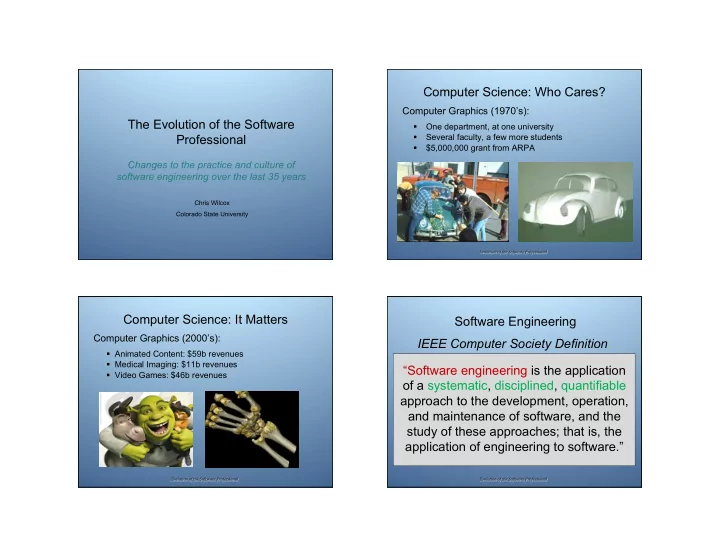
Computer Science: Who Cares?

Computer Graphics (1970’s):

§ One department, at one university § Several faculty, a few more students § $5,000,000 grant from ARPA

Evolution ¡of ¡the ¡Software ¡Professional ¡

Computer Science: It Matters

Computer Graphics (2000’s):

§ Animated Content: $59b revenues § Medical Imaging: $11b revenues § Video Games: $46b revenues

Evolution ¡of ¡the ¡Software ¡Professional ¡

Software Engineering IEEE Computer Society Definition: “Software engineering is the application

  • f a systematic, disciplined, quantifiable

approach to the development, operation, and maintenance of software, and the study of these approaches; that is, the application of engineering to software.”

Evolution ¡of ¡the ¡Software ¡Professional ¡

slide-2
SLIDE 2

2

Game Changers in Our Profession

#1) The fast and ubiquitous access to the accumulated knowledge of humanity:

§ Internet Infrastructure, Internet Content § Cisco thinks 8.7 billion in 2012

Evolution ¡of ¡the ¡Software ¡Professional ¡

Game Changers in Our Profession

#2) The evolution of fast, powerful, inexpensive, yet reliable hardware and software systems.

§ 1978: Intel, 8086, 16-bit, 10 Mhz, 29K transistors § 2014: nVidia Tegra, 64-bit, 2.5 Ghz, 1G transistors

Evolution ¡of ¡the ¡Software ¡Professional ¡

Game Changers in Our Profession

#3) Object Oriented Programming

§ 1978: Fortran, Pascal, Cobol, C becoming popular § 2014: Ada, C++, Java, Python, Perl, etc.

Evolution ¡of ¡the ¡Software ¡Professional ¡

Game Changers in Our Profession

#4) Evolving Development Environments

§ 1978: Card Reader, VT100 Terminal, Vi or Emacs § 2014: DevStudio, Eclipse, GitHub, Amazon Cloud

Evolution ¡of ¡the ¡Software ¡Professional ¡

slide-3
SLIDE 3

3

Game Changers in Our Profession

#5) Software Engineering Advances

§ 1978: Waterfall Model, Source Control (maybe!) § 2014: Agile Practices, Test Driven Development

Evolution ¡of ¡the ¡Software ¡Professional ¡

Digital Magic

#6) Other advances in technology:

§ Transistors (Small, Cheap, Fast Electronics) § Lasers (Optical Media) § Charge-Coupled Devices (Digital Imaging) § Flat Panel Displays (Awesome Output) § Fiber Optics (Lightspeed Communications) § Flash Memory (Portable Data) § Mobile Communications (1G/2G/3G/4G/5G)

Evolution ¡of ¡the ¡Software ¡Professional ¡

Digital Magic

#6) Other advances in technology:

§ 1940’s: Transistors (Small, Cheap, Fast Electronics) § 1950’s: Lasers (Optical Media) § 1960’s: Charge-Coupled Devices (Digital Imaging) § 1960’s: Flat Panel Displays (Awesome Output) § 1970’s: Fiber Optics (Lightspeed Communications) § 1980’s: Flash Memory (Portable Data) § 1980’s: Mobile Communications (1G/2G/3G/4G/5G)

Evolution ¡of ¡the ¡Software ¡Professional ¡

Success Factors in this Profession

§ You must know programming,

  • perating systems, software

engineering, etc. § In addition, you must develop expertise that is specific to the domain in which you work § You must be able to communicate your own ideas and understand those of others. § You must have the ability to change and evolve along with technology.

Evolution ¡of ¡the ¡Software ¡Professional ¡

slide-4
SLIDE 4

4

Inevitability of Change

Evolution ¡of ¡the ¡Software ¡Professional ¡