Computational Peeling Art Design Hao Liu, Xiao-Teng Zhang, Xiao-Ming - - PowerPoint PPT Presentation

computational peeling art design
SMART_READER_LITE
LIVE PREVIEW

Computational Peeling Art Design Hao Liu, Xiao-Teng Zhang, Xiao-Ming - - PowerPoint PPT Presentation

Computational Peeling Art Design Hao Liu, Xiao-Teng Zhang, Xiao-Ming Fu, Zhi-Chao Dong, Ligang Liu University of Science and Technology of China Peeling art design Popular art form Peeling art examples Yoshihiro Okadas method Peeling art

slide-1
SLIDE 1

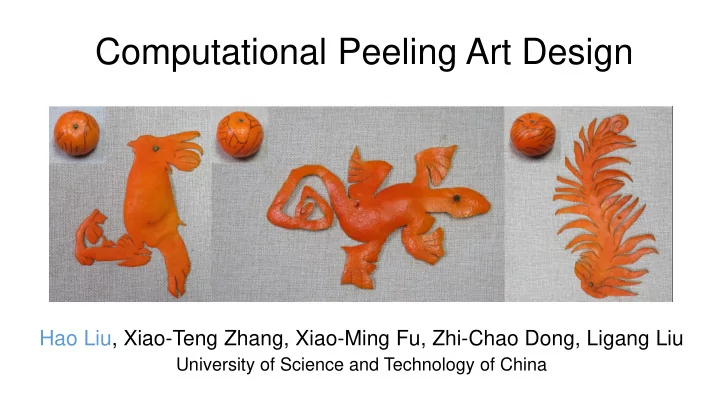
Computational Peeling Art Design

Hao Liu, Xiao-Teng Zhang, Xiao-Ming Fu, Zhi-Chao Dong, Ligang Liu

University of Science and Technology of China

slide-2
SLIDE 2

Peeling art design

slide-3
SLIDE 3

Popular art form

slide-4
SLIDE 4

Peeling art examples

slide-5
SLIDE 5

Yoshihiro Okada’s method

slide-6
SLIDE 6

Peeling art design problem

slide-7
SLIDE 7

Challenges of the computational method

  • Non-trivial to optimize the similarity
  • Unsuitable input shape
slide-8
SLIDE 8

Existing work: cut generation

  • Minimum spanning tree method [Chai et al. 2018; Sheffer 2002;

Sheffer and Hart 2002]

  • Mesh segmentation approaches [Julius et al. 2005; Lévy et al.

2002; Sander et al. 2002, 2003; Zhang et al. 2005; Zhou et al. 2004]

  • Simultaneous optimization [Li et al. 2018; Poranne et al.2017]
  • Variational method [Sharp and Crane 2018]
slide-9
SLIDE 9

Existing work: cut generation

  • Minimum spanning tree method [Chai et al. 2018; Sheffer 2002;

Sheffer and Hart 2002]

  • Mesh segmentation approaches [Julius et al. 2005; Lévy et al.

2002; Sander et al. 2002, 2003; Zhang et al. 2005; Zhou et al. 2004]

  • Simultaneous optimization [Li et al. 2018; Poranne et al.2017]
  • Variational method [Sharp and Crane 2018]

unfolded shapes ≠ input shapes

slide-10
SLIDE 10

Our approach

Cut generation

slide-11
SLIDE 11

Key idea

Cut generation Difficult Mapping computation Easy

slide-12
SLIDE 12

𝑆 𝑇𝑛 = Φ(𝑇) Input 𝑇

min 𝐹𝑗𝑡𝑝 𝑇𝑛, 𝑇 + 𝑥𝐹𝑡ℎ𝑠(𝑆)

Mapping computation

Φ

Two goals:

  • 1. Low isometric distortion
  • 2. Area of 𝑆 approaches zero
slide-13
SLIDE 13
  • ARAP distortion metric [Liu et al. 2008]

Isometric energy

𝐹𝑗𝑡𝑝 𝑇𝑛, 𝑇 =

𝑗=1 𝑂𝑔

𝐵𝑠𝑓𝑏 𝑔

𝑗 ||𝐾𝑗 − 𝑆𝑗||𝐺 2

𝑆𝑗 is an orthogonal matrix

slide-14
SLIDE 14
  • Our novel rank-one energy

𝐹𝑡ℎ𝑠 𝑆 = 𝑗=1

𝑂𝑆𝑔 𝐵𝑠𝑓𝑏 𝑢𝑗 ||𝐾𝑗 − 𝐶𝑗||𝐺 2

𝐶𝑗 is a rank one matrix

Shrink energy

||𝐾𝑗||𝐺

2

det 𝐾𝑗 rank-one Input

  • Other choices
  • Frobenius energy

||𝐾𝑗||𝐺

2

  • Determinant energy

det 𝐾𝑗

slide-15
SLIDE 15

Local-global solver

min 𝐹𝑗𝑡𝑝 𝑇𝑛, 𝑇 + 𝑥𝐹𝑡ℎ𝑠(𝑆)

𝑡𝑢. 𝜖𝑆 = 𝜖𝑇𝑛 and 𝑤𝑛, 𝑤𝑆 ∈ 𝑁

𝐹𝑗𝑡𝑝 𝑇𝑛, 𝑇 =

𝑗=1 𝑂𝑔

𝐵𝑠𝑓𝑏 𝑔

𝑗 ||𝐾𝑗 − 𝑆𝑗||𝐺 2

𝑆𝑗 = 𝑉𝑗𝑊

𝑗 𝑈

𝐶𝑗 = 𝑉𝑗𝑒𝑗𝑏𝑕 𝜏𝑗, 0 𝑊

𝑗 𝑈

𝐹𝑡ℎ𝑠 𝑆 =

𝑗=1 𝑂𝑆𝑔

𝐵𝑠𝑓𝑏 𝑢𝑗 ||𝐾𝑗 − 𝐶𝑗||𝐺

2

𝑤𝑏𝑠𝑗𝑏𝑐𝑚𝑓𝑡 𝜀𝑤𝑙 𝑗𝑜 tangent space 𝑤𝑙

𝑜𝑓𝑥 = 𝑄(𝑤𝑙 + 𝜀𝑤𝑙)

Local step: Global step:

𝜀𝑤𝑙 𝑗𝑜 𝐺

𝑘 𝑗𝑡 𝜀𝑤𝑙 𝑘 = 𝐺 𝑙 𝑘 𝑈𝐺 𝑙 𝑤𝜀𝑤𝑙

slide-16
SLIDE 16

Some details

stalk locations Representations of M

slide-17
SLIDE 17

Suitable input

slide-18
SLIDE 18

Unsuitable input

slide-19
SLIDE 19

Almost cover Mapping Process Interaction Process

Iterative interaction

Cut Generation Final resulting cut

Iterative design

slide-20
SLIDE 20

Interaction place

Prune and Decompose Unfold 𝑇𝑛 and 𝑆

slide-21
SLIDE 21

Interaction 1: shape augmentation

slide-22
SLIDE 22

Interaction 2: part deletion

slide-23
SLIDE 23

Interaction 3: angle augmentation

slide-24
SLIDE 24

Interaction 4: curvature reduction

slide-25
SLIDE 25

Interaction 5: pre-processing

Unprocessed high distortion Processed low distortion Input Input with specify area

slide-26
SLIDE 26

Interaction 5: pre-processing

Input with specify area Unprocessed: high distortion Processed: low distortion Align to initialize

slide-27
SLIDE 27

Cut generation

Resulting cut Mapped shape Simplify boundary

slide-28
SLIDE 28

Real peeling

slide-29
SLIDE 29

Real design

slide-30
SLIDE 30

Real peeling

slide-31
SLIDE 31

Experiments

slide-32
SLIDE 32

Shapes designed by Yoshihiro Okada

slide-33
SLIDE 33

Comparison to Yoshihiro Okada

Okada’s Ours Dove Eagle Shrimp

slide-34
SLIDE 34
slide-35
SLIDE 35

Our results

slide-36
SLIDE 36
slide-37
SLIDE 37
slide-38
SLIDE 38
slide-39
SLIDE 39
slide-40
SLIDE 40
slide-41
SLIDE 41

More results

slide-42
SLIDE 42

Conclusion

  • A computational tool for peeling art design and construction.
  • Unsuitable input 2D shapes are rectified by an iterative process.
slide-43
SLIDE 43

Limitations: conservation principle

User input

Interaction many times also cannot keep posture

slide-44
SLIDE 44

Thank you