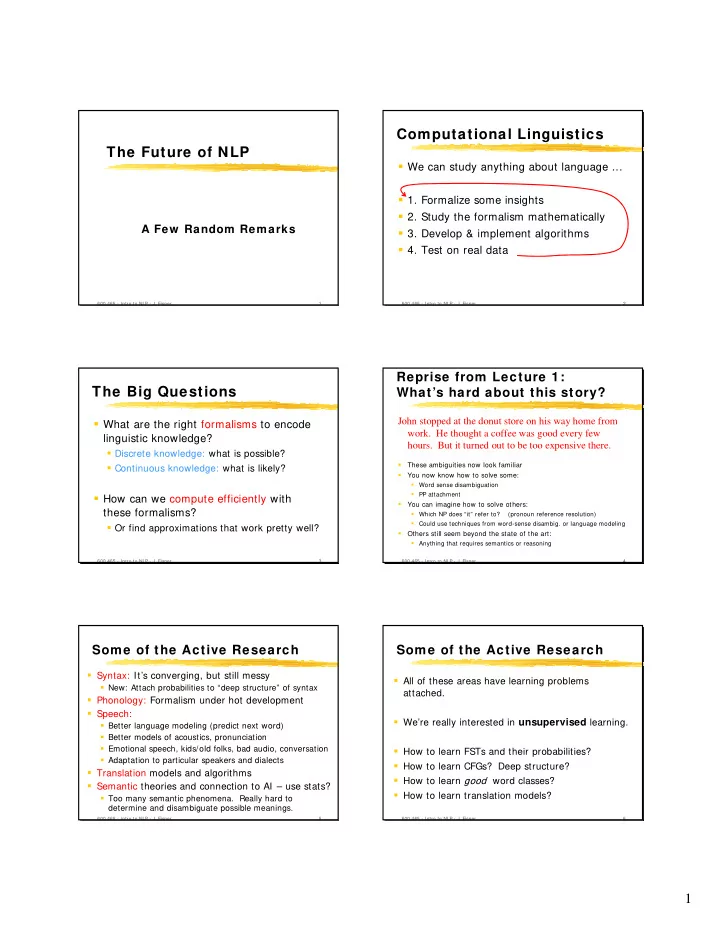

SLIDE 1
1
600.465 - Intro to NLP - J. Eisner 1
The Future of NLP
A Few Random Remarks
600.465 - Intro to NLP - J. Eisner 2
Computational Linguistics
We can study anything about language ...
- 1. Formalize some insights
- 2. Study the formalism mathematically
- 3. Develop & implement algorithms
- 4. Test on real data
600.465 - Intro to NLP - J. Eisner 3
The Big Questions
What are the right formalisms to encode
linguistic knowledge?
Discrete knowledge: what is possible? Continuous knowledge: what is likely?
How can we compute efficiently with
these formalisms?
Or find approximations that work pretty well?
600.465 - Intro to NLP - J. Eisner 4
Reprise from Lecture 1: What’s hard about this story?
- These ambiguities now look familiar
- You now know how to solve some:
- Word sense disambiguation
- PP attachment
- You can imagine how to solve others:
- Which NP does “it” refer to? (pronoun reference resolution)
- Could use techniques from word-sense disambig. or language modeling
- Others still seem beyond the state of the art:
- Anything that requires semantics or reasoning
John stopped at the donut store on his way home from
- work. He thought a coffee was good every few
- hours. But it turned out to be too expensive there.
600.465 - Intro to NLP - J. Eisner 5
Some of the Active Research
Syntax: It’s converging, but still messy
New: Attach probabilities to “deep structure” of syntax
Phonology: Formalism under hot development Speech:
Better language modeling (predict next word) Better models of acoustics, pronunciation Emotional speech, kids/old folks, bad audio, conversation Adaptation to particular speakers and dialects
Translation models and algorithms Semantic theories and connection to AI – use stats?
Too many semantic phenomena. Really hard to determine and disambiguate possible meanings.
600.465 - Intro to NLP - J. Eisner 6