
SLIDE 1
Compressive Sensing Take 2
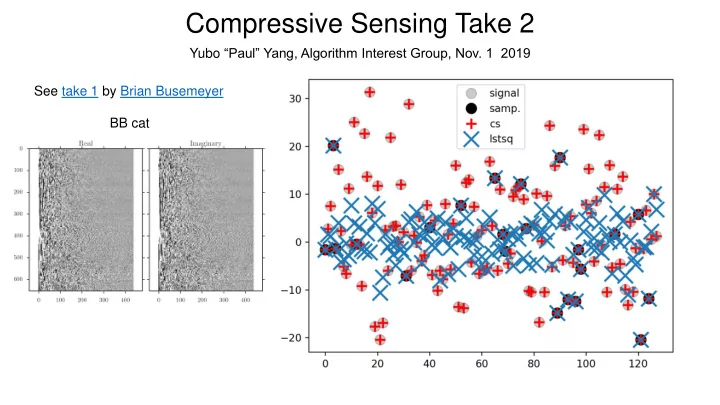
Yubo “Paul” Yang, Algorithm Interest Group, Nov. 1 2019 See take 1 by Brian Busemeyer BB cat
Compressive Sensing Take 2 Yubo Paul Yang, Algorithm Interest Group, - - PowerPoint PPT Presentation
Compressive Sensing Take 2 Yubo Paul Yang, Algorithm Interest Group, Nov. 1 2019 See take 1 by Brian Busemeyer BB cat What is compressive (compressed) sensing? Compressive sensing is a signal processing technique to reconstruct sparse
Yubo “Paul” Yang, Algorithm Interest Group, Nov. 1 2019 See take 1 by Brian Busemeyer BB cat
Compressive sensing is a signal processing technique to reconstruct sparse signal from few samples. It solves a system of underdetermined linear equations by imposing sparsity as a constraint.
when len(y) ≪ len(x) by minimizing the number of non-zero entries in x. solve
Goal: use y with a small length to recover x Strategy: minimize the L1-norm of x
In practice, constructing the A matrix can be tricky. Signal in time domain, use Fourier transform as A matrix.
𝑧 𝑢 =
𝑜=1 𝑜𝑡𝑗𝑜
sin(2𝜌 𝑜 𝑢) Toy problem: reconstruct a sum of sine waves Number of samples needed for perfect reconstruction is determined by signal sparsity in “good” basis. perfect reconstruction
sample density signal density perfect reconstruction large error in reconstruction
converged reconstruction but error converges roughly at the same transition sample density as before! Reconstruction is robust up to 5% white noise. Reconstruction noise does increase with more noise.
Signal reconstruction while under-sampling (lower average freq. than Nyquist-Shannon) Image reconstruction single-pixel camera fast MRI Digital to analog conversion Map Born-Oppenheimer potential energy surface using phonon directions!
In the spirit of Halloween, let us attempt a reconstruction of the Shepp-Logan phantom. 2D images, use wavelet transform as A matrix. pywt package provides forward and inverse transforms
My attempt: spooky?
Accurate frequency after a few MD time steps Same problem as our practical application I velocity-velocity correlation is sparse in Fourier space
Compressive sensing is a powerful method for signal reconstruction. Works whenever your problem is connected to a sparse representation by a linear transform. It has already found many applications in many fields!