SLIDE 1
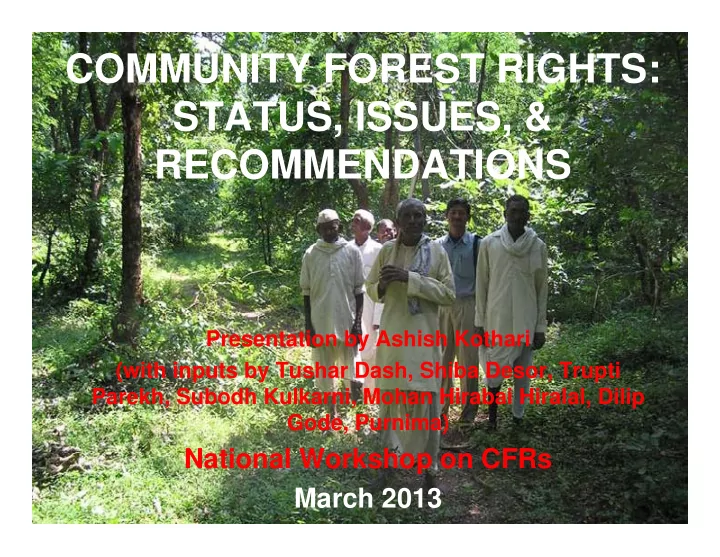
COMMUNITY FOREST RIGHTS: STATUS ISSUES & STATUS, ISSUES, & RECOMMENDATIONS RECOMMENDATIONS
Presentation by Ashish Kothari (with inputs by Tushar Dash, Shiba Desor, Trupti Parekh, Subodh Kulkarni, Mohan Hirabai Hiralal, Dilip Gode, Purnima)
N ti l W k h CFR National Workshop on CFRs March 2013
SLIDE 2 STATUS OF CFR IN THE STATES AS ON 31st December, 2012 (MOTA)
St t N f N f it E t t f State No of community claims No of community titles issued Extent of forest land in acres
A dh P d h 6 714 2 106 Andhra Pradesh 6,714 2,106 Assam 5,193 860 Chhattisgarh 4,736 775 Gujarat 8,723 1,608 Karnataka 2,917 53 Kerala 1395 4 Kerala 1395 4 Madhya Pradesh 13,125 Not available Maharashtra 5 041 1033 3 77 776 25 Maharashtra 5,041 1033 3,77,776.25 Odisha 3,304 879 55,251.65 Rajasthan 346 53 4,19.53 T i 2 6 9 Tripura 277 55 56.79 Uttar Pradesh 1,135 814 West Bengal 7,824 108 50.29
SLIDE 3 ISSUES WITH THE MoTA MONTHLY REPORTS MONTHLY REPORTS
- Dependent on poor/incorrect reporting by states;
now improving under MoTA-UNDP project
- Most of the reported community forest rights are
development facilities; no disaggregation between Sec 3(1) and Sec 3(2); now sought by MoTA Sec 3(1) and Sec 3(2); now sought by MoTA
- Area covered by CFR claims is not available for
many states many states
SLIDE 4 Some stories of success…
- Mostly where civil society organisations have facilitated
- Some places, pro-active help by revenue/forest officials
- Helpful government circulars/orders at district
(Gadchiroli Mah) state (Odisha MP MoTA on CFRs) (Gadchiroli, Mah), state (Odisha, MP, MoTA on CFRs) and national level (2012)
- Experience exchange through national CFR
Learning/Advocacy Network (also some state networks) Learning/Advocacy Network (also some state networks)
SLIDE 5
Maharashtra
(Dec 2012) (Dec 2012)
CFR claims: 4955 CFR claims: 4955 Accepted: 2745 Titled: 1571 Titled: 1571 Area: 705869 acres Highest in India, but mostly in 2 districts, g , y , and mostly conditional
SLIDE 6
ODISHA
Over 10,000 self-initiated community , y forests
Claims: 5391, over ~ 2,50,035.93 acres Approved: 2908, over ~ 2,25,332.84 acres Titled: >972, over 57,794.47 acres
Recently issued titles in Recently issued titles in Kandhamal reflect customary/traditional boundaries; many other titles have illegal conditions
SLIDE 7
Other states…
Several thousand accepted in Andhra, over ~1 lakh acres (but mostly conditional, restricted to JFM boundaries, or titled to VSS) Almost 2000 CFR titles in Gujarat, including Shoolpaneshwar Sanctuary (area 3,00,000 acres?)
381 claims over 126 998 381 claims over 126,998 acres accepted, Baiga chak, Madhya P d h(b t diti l Pradesh(but conditional & titled to VSS)
SLIDE 8 JHARKHAND JHARKHAND
CFR ST OTFD
West Singhbhum Godda Claims and Titles West Singhbhum, Godda, Khunti
- Many of the CFR titles are
Titles Claims filed at 3571 147
- Many of the CFR titles are
for development facilities
Gram Sabha Number 542 10
titles issued to each individual household Number
given 542 10
that since CNTA/SPTA laws have already laws have already recorded rights, progress
SLIDE 9
Biligiri Rangaswamy Temple Sanctuary & (illegal) Tiger Reserve Karnataka & (illegal) Tiger Reserve, Karnataka
25 CFR titles to Soliga, over ~25,000 ha (>half of sanctuary); community-based wildlife/tiger conservation plan process initiated
SLIDE 10
MOSTLY, THOUGH, CFR IMPLEMENTATION HAS BEEN EXTREMELY WEAK; BEEN EXTREMELY WEAK; IN MANY STATES, NOT MOVED AT ALL MOVED AT ALL
Total potential area: >75 m. acres Accepted/titled: <1 m acres Accepted/titled: <1 m.acres
SLIDE 11 PROBLEMS WITH CFR PROCESS
(with exceptions) (with exceptions)
- Inadequate awareness and training
- Poor facilitation by govt depts (e.g. in providing
evidences) incl. Tribal/Social Welfare Depts
- Use of different formats for CFR claims
- Use of different formats for CFR claims
- Undue influence of or reliance on Forest Department
- Lack of clarity in verification and mapping process
- Lack of clarity in verification and mapping process
- Artificial restrictions on extent of claims (e.g. JFM), or
titles to inappropriate institutions (VSS/Panchayat) titles to inappropriate institutions (VSS/Panchayat)
- Titles with improper or illegal conditions (e.g. IFA)
SLIDE 12 RIGHTS TO PROTECT, CONSERVE, MANAGE COMMUNITY FOREST MANAGE COMMUNITY FOREST RESOURCES
Mi i S ti 3(1)i i M TA CFR f t ( dd d i 2012 R l )
- Missing Section 3(1)i in MoTA CFR format (added in 2012 Rules)
- Management/protection rights not recognized in many CFR titles
SLIDE 13 RIGHTS OF HABITAT FOR PTGs & PRE- AGRICULTURE COMMUNITIES AGRICULTURE COMMUNITIES
No clarity on ‘habitat’ rights (e g No clarity on habitat rights (e.g. do they include non-forest lands?); National Workshop (2010) recommendations ignored Niyamgiri-Sacred hill of
Guda Raija-Habitat rights of Chuktia-Bhunjia, Odisha &
Niyamgiri Sacred hill of Dongrias, Odisha
Chuktia Bhunjia, Odisha & Chhattisgarh
2012 amended No move in most states re. PTG habitat rights 2012 amended rules: PVTG claims to be filed before gram sabhas recogni ing
Maria in Bhamragarh & Kolam in Yavatmal have made habitat claims, Mah.
g sabhas, recognizing floating nature of their gram sabhas
SLIDE 14 TRADITIONAL RESOURCE ACCESS OF NOMADIC COMMUNITIES
(Mankirdias, Gujjars, Maldharis, Raikas, Dhangars …)
- No nomadic/seasonal pastoral
community has yet got CFR rights
- No mechanism to assist their claims
in multiple gram sabhas in multiple gram sabhas
FRA d d l FRA amended rules: DLC to facilitate claim filing by pastoralists, transhumants and transhumants and nomadic communities
SLIDE 15
RIGHTS ON SHIFTING CULTIVATION LANDS CULTIVATION LANDS
mostly being treated as IFRs (e.g. Tripura); rest of jh l d th j tifi bl b t t d b f t jhum lands can then unjustifiably be treated by forest dept as ‘encroachment’
SLIDE 16
RIGHTS OF OTHER TRADITIONAL FOREST DWELLERS (OTFD) FOREST DWELLERS (OTFD)
So far a few accepted only in Gadchiroli dist So far, a few accepted only in Gadchiroli dist, Maharashtra, some in Jharkhand; everywhere else, very few claims, none accepted , y , p Some states (AP, Guj), process not started Problems of >interpretation of OTFD eligibility tti id >getting evidence >non-acceptance of claims by gram sabhas
SLIDE 17 FOREST VILLAGES FOREST VILLAGES
Conversion to revenue villages and recognition
- f their CFRs unclear: no central guidance till
recently (broad procedure now in Amended Rules) Unsurveyed/unrecorded (so-called ‘unauthorised’) settlements: poor identification, no claims process
SLIDE 18 RIGHTS IN PROTECTED AREAS AREAS
- CFR recognised in v. few protected areas
g p
- CWH Guidelines not finalised; no
guidelines on co-existence guidelines on co existence
- FRA/WLPA 2006 violated in recent buffer
notifications notifications
SLIDE 19 ILLEGAL RELOCATION: WITHOUT FRA IMPLEMENTATION, NOT OFFERING OPTION OF STAYING ON WITH RIGHTS
(e.g. Simlipal, Achanakmar, Tadoba, Sariska, Melghat Tiger Reserves) Reserves)
CTH relocation protocol doesn’t define ‘inviolate’, ignores crucial FRA issues
Ambadiha relocation site relocation site (from Simlipal TR) Family moving from Tadoba TR, 2012
SLIDE 20 Notification of buffer areas in tiger reserves (Ajay Dubey Case)
- Filed PIL in 2011 seeking implementation of Tiger
Conservation Plan Case goes to Supreme Court temporary tourism ban is put
- Case goes to Supreme Court, temporary tourism ban is put
- n India’s 41 Tiger reserve areas
- Committee on Tourism is constituted to frame new guidelines
- n tourism
- Despite objections from committee members, new guidelines
finalized which violate provisions in FRA, and PESA, p , , threatening rights and livelihoods of forest communities with illegal relocation Supreme Court makes interim decision to lift tourism ban
- Supreme Court makes interim decision to lift tourism ban,
however objections to guidelines are yet to be addressed.
The tiger reserve area has expanded to 41 tiger reserves (TR), covering an area g g ( ) g
- f around 63874.68 sq.km. with 35123.95 sq.km. of core/CTH and 28750.73
sq.km. of buffer in 17 tiger States. This amounts to 2% of the country’s geographical area
SLIDE 21 FRA violation in diversion of forest land for mining dams forest land for mining, dams, industries, etc
Vedanta- Niyamgiri
- MoEF circular (30.7.09) requires state govts to comply with
POSCO
( ) q g p y FRA & seek gram sabha consent for diversion of forest land
- But mostly violated by states and MoEF; 200,000 ha forest
diverted without FRA process diverted without FRA process
- Exemption for linear projects (roads, railway/ transmission
lines); over-riding powers with Cabinet Committee on Investments Investments
SLIDE 22 After FRA, key to decision making on
Other violations of CFRs…
decision making on forests is with gram sabha, then why is all this happening?
Forest dept operations (plantations, coupe felling, jatropha) on Forest dept operations (plantations, coupe felling, jatropha) on community land without consultation / consent community land, without consultation / consent Continued operation by industries (e.g. paper mills) on CFR- C resist coupe felling in Baiga Chak (MP) claimed lands … CFRs used to stop paper mill lease in Vidarbha (Mah) or protest it in Narmada/Dangs (Gujarat), resist coupe felling in Baiga Chak (MP)
SLIDE 23 POST-TITLE GOVERNANCE & MANAGEMENT & MANAGEMENT
Lack of clarity regarding:
FRA amended rules:
y g g
- Protection/management rights of
CFR (what specific powers with
Gram Sabha to integrate conservation plan with working plan of FD with modifications as
GS?)
- Role of forest department (still
modifications as considered necessary by GS Committee
enforcement?) M t f CFR ki
confusion: How are differences between FD and Gram Sabha to be resolved?
- Management of CFR vs working
plan/management plans of the FD (what is the relationship?)
Sabha to be resolved? ‘Modifications’ are to be made in GS plan, or Working Plan?
FD (what is the relationship?)
SLIDE 24 POST-TITLE GOVERNANCE & MANAGEMENT & MANAGEMENT
Lack of clarity regarding: Lack of clarity regarding:
C f i h
FRA amended rules:
- Convergence of various schemes
(how to ensure?) Growing experience of
Convergence to be ensured extending all
convergence on ground, due to pro-active Collectors / civil society
extending all relevant schemes
t i ht h ld
pro active Collectors / civil society
to rights-holders
SLIDE 25 CONFLICTING LAWS, POLICIES AND PROGRAMS POLICIES AND PROGRAMS
- Imposition of JFM (e.g. Odisha, Maharashtra JFM resolutions)
- Climate change programmes (Green India Mission / REDD /
Biofuels): no clear directions on centrality of CFRs
Land Acquisition Act / Forest Conservation Act:
ti d
- Land Acquisition Act / Forest Conservation Act: continued
take-over of lands without FRA completion & gram sabha consent
- Mines & Minerals Act: no central role of gram sabhas
g
- Wild Life (Protection) Act: protected areas ignore CFR rights; PA
notification does not require GS consultation/consent
- Indian Forest Act: continues to operate in CFRs?
- State panchayat/NTFP/PESA laws, still operating
St t PESA l ( R j th ) t di t FRA
- State PESA rules (e.g. Rajasthan) contradict FRA
SLIDE 26 Rights without benefits?
Transit permit powers still with FD till recently (new Rules give FD till recently (new Rules give them to gram sabha) MFP nationalisation (of some
- r many species) continues in
ll t t hi d all states; ownership under PESA/FRA of all MFP, not transferred (tendu rights to gram transferred (tendu rights to gram
sabhas in Vidarbha, Maharashtra)
Issue of sustainability of harvest/use of several species
SLIDE 27 Key recommendations Key recommendations
Combining:
- Recommendations of National Workshops on CFRs,
2011, 2012, 2013
- Report of MoEF/MoTA Jt. Committee on FRA, 2010
- Recommendations of NAC, 2010
- Inputs from communities / movements / NGOs
SLIDE 28
Recommendations
Overall implementation Overall implementation National FRA Council (on lines of NREGS Council), with National FRA Council (on lines of NREGS Council), with independent role of monitoring/guiding implementation, facilitating social audits, grievance redressal For immediate action: process of reviewing & monitoring state action plans with civil society involvement (and urgent action plans, with civil society involvement (and urgent correction where action plans violate/undermine FRA) Similar independent monitoring, grievance redressal, & social audit processes at state and district/taluka level, linked to (but not under) SLMC DLC SDLC: composition must include not under) SLMC, DLC, SDLC: composition must include gram sabha committee representatives, independent civil society with experience on forest rights issues
SLIDE 29
Recommendations
Overall implementation
SLMC DLC SDLC t t bli di l SLMC, DLC, SDLC reports: suo moto public disclosure Any committees set up under FRA (e g CWH) must be Any committees set up under FRA (e.g. CWH) must be disclosed to gram sabhas in affected areas, and put into public domain When is process ‘complete’? Who will certify? Needs clarification and guidance cannot be left to state decision; no clarification and guidance, cannot be left to state decision; no artificial deadlines for ‘completion’ of process Clarification on municipal areas needed (withdrawing earlier MoTA letter stating FRA not applicable)
SLIDE 30 Recommendations
Implementation: pre-claims/claims/recognition phase
- CFR awareness and training: produce simple material for mass
distribution, sub-divisional level training programmes esp. on new R l i i b d t f t i i Rules, ongoing programmes; increase budgets for training; consolidated database of state/district circulars
- Mass circulation of claim forms for Section 3(1)i (with clarification
that if already filed, need not be filed again)
- Pro-active facilitation of claims, evidence gathering, mapping,
inter village coordination: set up teams of officials and civil society inter-village coordination: set up teams of officials and civil society to assist villages; instructions to district collectors to prepare files for each village
SLIDE 31 Recommendations
Implementation: pre-claims/claims/recognition phase
- Special mechanism for nomadic communities (Joint meeting of
p ( g FRCs across migratory path, to receive claims? Habitat rights across migratory path? DLC responsibility in 2012 Rules) Cl id li PTG h bit t i ht h t th h t
- Clear guidelines on PTG habitat rights: what they mean, how to
claim (see recommendations of national workshop on PTGs, 2010; DLC responsibility in 2012 Rules; MoTA should ask for reporting on DLC actions on this; processes to help map trad. territories or recognise maps already existing)
- Guidance that jhum/shifting cultivation rights should be CFRs &
- Guidance that jhum/shifting cultivation rights should be CFRs &
not IFRs
- Continued violations by officials, e.g. artificial restrictions on
extent of claims (e.g. JFM/VP boundaries), rejection by SDLCs: threaten prosecution of some cases to set an example
SLIDE 32 Recommendations
Implementation: titles post title management Implementation: titles, post-title management
- No conditions in titles, other than relevant to FRA; titles to gram
sabha, not VSS/subsection of village; titles should mention area: specific letters to states that are repeatedly defaulting
- MFP/NTFP denationalisation with minimum support price and/or
working capital support:
- repeal contradictory state laws or guidelines (with interim
repeal contradictory state laws or guidelines (with interim arrangement for continued state support where gram sabha empowerment in process) stop state monopol control and ro alties (as in amended r les)
- stop state monopoly control and royalties (as in amended rules)
- learn lessons from experiences of existing co-ops on
sustainability, equity, governance
- warn officials/agencies openly defying Act
- urgently budget for minimum support prices
SLIDE 33 Recommendations
Implementation: titles, post-title management
Instr ctions that Working Plans and Management Plans sho ld
- Instructions that Working Plans and Management Plans should
incorporate and be modified on basis of gram sabha plans, and get gram sabha consent (new Rules language not fully clear)
- Clarification to be issued to states that gram sabha planning
process is independent: cannot be under FD, and not done through JFM scheme (several state action plans propose this)
- Forest Dept/other depts to give all records to gram sabhas who
have got title, with continuing responsibility to support where required/requested by gram sabha required/requested by gram sabha
- Transfer of budgets currently with FD (incl. CAMPA) for forest
management to gram sabhas; not to JFM committees G bh FR itt d t b NREGS th
- Gram sabha FR committees empowered to be NREGS or other
scheme implementors
SLIDE 34 Recommendations
Protected areas / Critical Wildlife & Tiger Habitats
- Critical Wildlife/Tiger Habitats: knowledge-based, democratic processes,
respecting rights, stressing co-existence, minimising relocation: guidelines should be urgently finalised based on civil society inputs given last year
- Tiger reserve buffer notifications: widespread violation of FRA, MoTA should
independently review and intervene in SC
- Stop relocation till FRA rights recognition complete; option of staying on with
full rights has to be clearly communicated/ensured; relocation package should have compensation for community rights that are given up; MoTA to set up investigation team to look at FRA violations in past/ongoing relocations and recommend/take action
- Monitor and report FRA implementation in PAs (incl. Tiger Reserves); also
monitor conservation outcomes
SLIDE 35 Recommendations
Governance reforms (where CFR vested, at village/cluster level)
- Village level Gram Sabha committees empowered similar to FD,
with penal powers and building of skills for various roles on with penal powers and building of skills for various roles on management/protection/sustainable use: need clear guidelines on this? Schemes for building capacity (financial, technical, managerial, research/monitoring) help in ensuring women’s central involvement) research/monitoring), help in ensuring women s central involvement)
- FD transformed into service agency (technical guidance, capacity-
building, monitoring, support): urgent deliberations by MoTA & MoEF t t k d i i f h (i l di h i to take decision on process of change (including change in training/IFS curriculum)
- Village-level and village-cluster level (federations at
g g ( landscape/cultural levels) planning by/with Gram Sabhas: resource support by MoTA/state depts
SLIDE 36 Recommendations
External use of CFRs
- Denial/inaction on claims in areas targeted for mining etc.
- Gram sabha consent for any external use of forest land
- Plantations
- Coupe felling
Non forest se
Continued violation of FRA MoEF 2009 circular and MoTA Continued violation of FRA, MoEF 2009 circular, and MoTA 2012 circulars/letter: MoTA should institute independent investigation into forest diversion to check compliance, and t k ti i t i l ti d f li f l tt t take action against violations and for compliance of letter to MoEF re. FAC, video-recording, etc.
SLIDE 37 Recommendations
Governance reforms (at landscape/state levels)
- Taluka/District level agencies (Govt representatives, GS
committees, NGOs, political representatives, other experts)…replacing
FDA FDAs
- Joint management committees (not like JFM, but genuine
power-sharing) for PA-buffer landscapes/Biosphere power sharing) for PA buffer landscapes/Biosphere Reserves/ other conservation landscapes
- State level council (FD, GS/federations, NGOs, other experts)
All these with functions/powers to:
– Facilitate planning at landscape/larger levels Monitor forest/wildlife conservation and use act on violations – Monitor forest/wildlife conservation and use, act on violations – Ensure convergence of schemes/programmes/departments towards conservation and livelihood security
SLIDE 38 Recommendations
Governance reforms (at national level)
- Harmonisation of various Acts with FRA
IFA WLPA FCA Bi di A t
- IFA, WLPA, FCA, Biodiv. Act
- state laws/rules/circulars on MFP/PESA/JFM /
revenue lands)
- harmonise gram sabha definition in all laws
(including panchayat laws)
- Immediate action on state rules formulated in violation of FRA e g
- Immediate action on state rules formulated in violation of FRA, e.g.
PESA rules, Village Forest rules
- Review of National Forest Policy in view of FRA and PESA, with
t f i ht d it b d ( l ith greater focus on rights and community-based governance (along with conservation) For legal/policy reforms, MoTA/MoEF should set up committee to review and recommend specific changes / additions to laws and policies
SLIDE 39 URGENT request…
MoTA should hold consultations with civil society, regionally and national, along with y g y g
- ther ministries (MoEF, MoRD, MoPR)
and state govt agencies g g
SLIDE 40 Next steps/strategies
Critique of state action plans: state partners to give inputs based on Madhu’s note, CFRLA to consolidate state-wise and at national level Detailing of recommendations on new institutions we are suggesting (national/state/district/taluka monitoring etc) Pressure on MoEF re. FRA implementation and gram sabha consent for forest diversion (including on linear projects decision HP for forest diversion (including on linear projects decision, HP exemption): public hearing at some sites, political lobbying through MPs/MLAs, national people’s tribunal (Nov?), briefing note on FCA- FRA (KV) case studies RTI applications (CSD) FRA (KV), case studies, RTI applications (CSD) FRA implementation re. forest Working Plans (esp. commercial
- rientation to be changed): take one or two cases like Baiga chak, do
public hearing, take up collectively; input to reformulation of WP code
SLIDE 41 Next steps/strategies
Self-assessment of civil society processes rel. to gram sabha empowerment p State consultations:
- Mah. nomadic communities: ANTHRA
- Mah. tendu: VNCS/VLF
N th Chh tti h CFR O f I di
- North Chhattisgarh CFR: Oxfam India
National consultations National consultations
- PTGs / habitat rights (later in 2013): Vasundhara and others
- Post-title governance & management (incl. NTFP): ATREE &
Post title governance & management (incl. NTFP): ATREE &
- thers
- FRA and PAs: Kalpavriksh & others
SLIDE 42
Contacts
CFR Learning and Advocacy Network http://www.fra.org.in/new/ p // a o g / e / Kalpavriksh: Kalpavriksh: neema.pb@gmail.com d hib @ il desor.shiba@gmail.com Vasundhara tushardash01@gmail com tushardash01@gmail.com, tushar@vasundharaorissa.org