
SLIDE 1
Community ¡Discovery ¡in ¡Dynamic ¡ Networks ¡via ¡non-‑nega6ve ¡matrix ¡ factoriza6on
¡Niloufar ¡Afsariardchi ¡
Supervisor: ¡Mark ¡Coates ¡ McGill ¡University ¡ March ¡15,2011 ¡
1 ¡
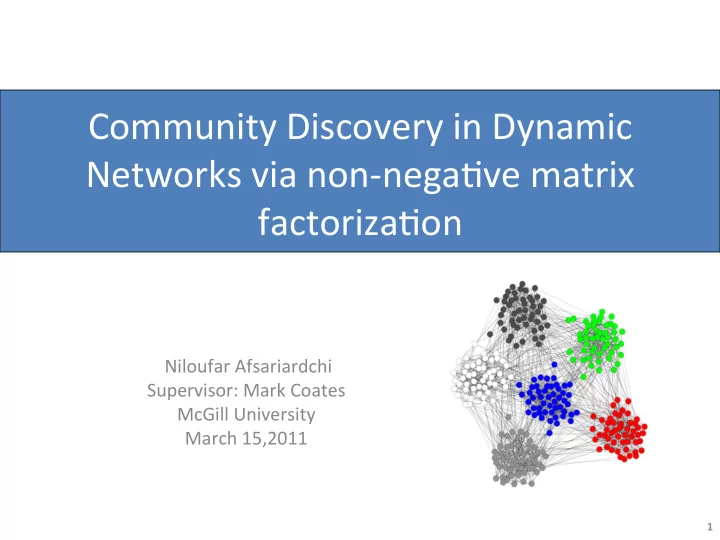
Community Discovery in Dynamic Networks via non-nega6ve - - PowerPoint PPT Presentation
Community Discovery in Dynamic Networks via non-nega6ve matrix factoriza6on Niloufar Afsariardchi Supervisor: Mark Coates McGill University March 15,2011 1
¡Niloufar ¡Afsariardchi ¡
Supervisor: ¡Mark ¡Coates ¡ McGill ¡University ¡ March ¡15,2011 ¡
1 ¡
2 ¡
Why ¡Dynamic ¡Clustering? ¡ ¡
§ Recommenda6on ¡Systems ¡ § Detec6ng ¡anomalies ¡ § Studying ¡dynamic ¡features ¡
networks ¡
3 ¡
Social ¡Networks: ¡Facebook ¡
4 ¡
5 ¡
§ V: ¡image ¡database ¡(nxm, ¡m ¡facial ¡image ¡each ¡has ¡n ¡pixel ¡) ¡ § W: ¡Basis ¡images ¡(nxK) ¡ § H: ¡ ¡Encoding ¡(Kxm) ¡
=
K k kj ik ij ij
1
* ¡Illustra6on ¡from ¡Daniel ¡D. ¡Lee ¡and ¡H. ¡Sebas6an ¡Seung ¡(2001). ¡"Algorithms ¡for ¡Non-‑nega6ve ¡Matrix ¡Factoriza6on". ¡ Advances ¡in ¡Neural ¡Informa6on ¡Processing ¡Systems ¡13: ¡Proceedings ¡of ¡the ¡2000 ¡Conference. ¡MIT ¡Press. ¡pp. ¡556–562 ¡
p(i,j) ¡≈ ¡ ¡p(i|c1)p(j|c1) ¡ ¡+p(i|c2)p(j|c2) ¡
p(i,j) ¡ c2 ¡ c1 ¡
§ V ¡ ¡: ¡Matrix ¡of ¡observa6on ¡ § ¡ ¡ ¡ ¡ ¡: ¡Probability ¡of ¡par6cipa6on ¡of ¡node ¡i ¡in ¡k-‑th ¡community ¡ § ¡ ¡ ¡ ¡ ¡: ¡Probability ¡of ¡individual ¡i ¡to ¡be ¡airacted ¡by ¡k-‑th ¡community ¡
¡ ¡ ¡ ¡
ki
h
ik
w
=
K k kj ik ij ij
1
A ¡ B ¡
§ MAP ¡es6ma6on ¡ § Maximizing ¡ ¡likelihood ¡ ¡func6on ¡with ¡ ¡ ¡Poisson ¡distribu6on ¡ ¡= ¡ ¡minimizing ¡KL-‑divergence ¡
¡ ¡ ¡coordinate ¡decent ¡
* *
7 ¡
ij
ij
Poiss ¡
T T .
T T
8 ¡
§ Consider ¡ ¡ ¡ ¡ ¡ ¡ ¡ ¡s ¡as ¡prior ¡of ¡each ¡community ¡ and ¡ ¡ ¡ ¡ ¡ ¡ ¡ ¡ ¡ ¡ ¡ ¡ ¡as ¡hyperparameters ¡ ¡ ¡ § Bayesian ¡NMF ¡Model ¡ § Log ¡priors ¡can ¡be ¡wriien ¡as: ¡
9 ¡
k
β
b a,
10 ¡
¡ § We ¡can ¡rewrite ¡the ¡likelihood ¡func6on, ¡ § The ¡objec6ve ¡func6on ¡we ¡want ¡to ¡minimize, ¡ ¡
11 ¡
12 ¡
W H
V
t t
W H
t
V
1 1 + + t t
W H
1 + t
V
Dir Poiss Poiss Poiss
t
Half Normal
1 + t
Half Normal
Half Normal
§ Parameter ¡inference ¡using ¡mul6plica6ve ¡update ¡rules ¡ § Point ¡es6ma6on ¡to ¡find ¡the ¡maximum ¡of ¡likelihood ¡ func6on ¡ § Replacing ¡ ¡ ¡ ¡ ¡ ¡. ¡We ¡have, ¡ ¡
13 ¡
) W | P(W log ) W | P(W log ) V | , H , P(W log ) H , L(W log
1
t 1
t t t t t t t
+ + = β
α α µ − = 1
14 ¡
¡ § 128 ¡nodes ¡ § 4 ¡clusters ¡of ¡32 ¡nodes ¡ § Average ¡degree ¡=16 ¡ § Zout= ¡2,3,4 ¡ § Alpha=0.9 ¡
¡
¡ § Dynamic ¡part: ¡3 ¡nodes ¡from ¡each ¡cluster ¡leave ¡their ¡original ¡cluster ¡ and ¡join ¡other ¡cluster ¡
15 ¡
0 ¡ 1 ¡ 2 ¡ 3 ¡ 4 ¡ 5 ¡ 6 ¡ 7 ¡ 2 ¡ 3 ¡ 4 ¡ 5 ¡ 6 ¡ Detected ¡number ¡of ¡clusters ¡vs. ¡real ¡ number ¡of ¡clusters ¡ ¡ Detected ¡ number ¡of ¡ clusters ¡ ¡
¡ § 300 ¡nodes ¡ § Average ¡degree=16 ¡ § Alpha=0.9 ¡ § Changing ¡number ¡of ¡ ¡ ¡clusters ¡ ¡
16 ¡
Ques6ons? ¡
17 ¡