Community Benefits Agreements and Health Impact Assessments to - - PowerPoint PPT Presentation

community benefits agreements and health impact
SMART_READER_LITE
LIVE PREVIEW

Community Benefits Agreements and Health Impact Assessments to - - PowerPoint PPT Presentation

Community Benefits Agreements and Health Impact Assessments to Promote Environmental Justice: The Gordie Howe International Bridge American Public Health Association Annual Meeting | November 6, 2019 Natalie Sampson, 1 Simone Sagovac, 2 Angela


slide-1
SLIDE 1

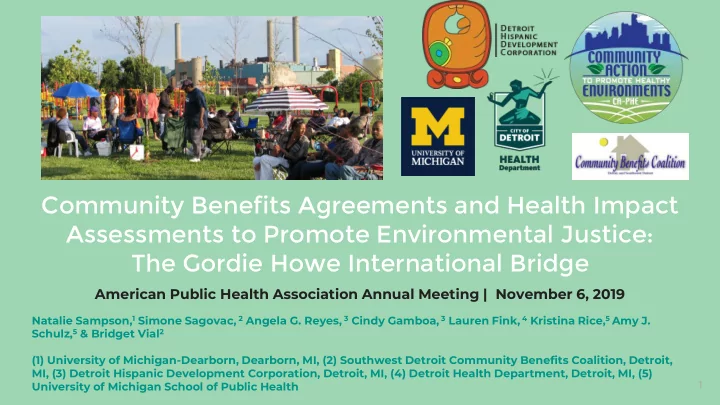
Community Benefits Agreements and Health Impact Assessments to Promote Environmental Justice: The Gordie Howe International Bridge

American Public Health Association Annual Meeting | November 6, 2019

Natalie Sampson,1 Simone Sagovac, 2 Angela G. Reyes, 3 Cindy Gamboa, 3 Lauren Fink, 4 Kristina Rice,5 Amy J. Schulz,5 & Bridget Vial2 (1) University of Michigan-Dearborn, Dearborn, MI, (2) Southwest Detroit Community Benefits Coalition, Detroit, MI, (3) Detroit Hispanic Development Corporation, Detroit, MI, (4) Detroit Health Department, Detroit, MI, (5) University of Michigan School of Public Health

1

slide-2
SLIDE 2

No Conflicts of Interest to Disclose

2

slide-3
SLIDE 3

BRIDGE IMPACT AREA

3

slide-4
SLIDE 4

Schulz, A., Mentz, G., Sampson, N., Ward, M., Anderson, R., deMajo, R., Israel, B., Lewis, T., Wilkins, D. (2016) Social and physical environments and the distribution of risk: A case example from Detroit. DuBois Review, 13(2), 285-304. doi:10.1017/S1742058X1600016

WHY COMMUNITY BENEFITS?

4

slide-5
SLIDE 5

Community Organizing and Advocacy for Benefits and Reduced Burdens 2008 2016-2017: Bridge to a Healthy Community Survey 2018: Health Impact Assessment Survey 2016: $48m community benefits approved 2019: HIA Report Released

Photo: Khloe Johnson holds a sign. (Max Ortiz, The Detroit News) 5

slide-6
SLIDE 6

$48m Community Benefits

  • 200 Optional Home relocations
  • 200 Home retrofits – windows & air filtration
  • Health Impact Assessments
  • 3 new Air Monitor stations & 1 upgrade for Black Carbon
  • Mobile Air Monitoring unit
  • Indoor Air monitoring program
  • Job training funds for citywide programs

6

slide-7
SLIDE 7

Three phases of GHIB Health Impact Assessment

7

slide-8
SLIDE 8
  • Survey conducted by trained

bilingual community residents

  • Questions on: environment,

health, neighborhood & recommendations for decision-makers

  • Resident input on survey
  • Preliminary results discussed

at community meetings

8

slide-9
SLIDE 9

9

70%

felt their neighborhood was a good place to live

slide-10
SLIDE 10

66%

Indicated

  • utdoor air

quality was a top concern

slide-11
SLIDE 11

Other resident concerns

76 75 61 60 57

Traffic congestion making it hard to get places. Clogged sewers or standing water in the streets. Vibration from trucks or construction damaging property. Road dust. Loss of property value. 10 20 30 40 50 60 70 80

Percent Reporting

slide-12
SLIDE 12

Self-reported asthma was greater for those residing near heavily trafficked roadways in all age groups.

12

slide-13
SLIDE 13

13

Among children in our sample living ≤500 feet from heavily trafficked roads, 16.3% reported to have asthma. In U.S., estimated child asthma prevalence is 8.4%*

* 2017 National Health Interview Survey

slide-14
SLIDE 14

HIA Recommendations (selected)

  • Enforce anti-idling
  • rdinance
  • Move truck routes
  • Spatial & vegetative buffers
  • Extend home mitigation –

filters, windows, relocation

14

slide-15
SLIDE 15

Takeaways

  • Connecting community

benefits and HIAs

  • Challenges and
  • pportunities of diverse

partnerships

15

slide-16
SLIDE 16

Thank you. Questions?

ghib@detroitmi.gov

Support for the GHIB HIA comes from:

RO1ES022616 P30ES017885

16