Community-Acquired Pneumonia In U.S., influenza and pneumonia 8 th - - PDF document

community acquired pneumonia
SMART_READER_LITE
LIVE PREVIEW

Community-Acquired Pneumonia In U.S., influenza and pneumonia 8 th - - PDF document

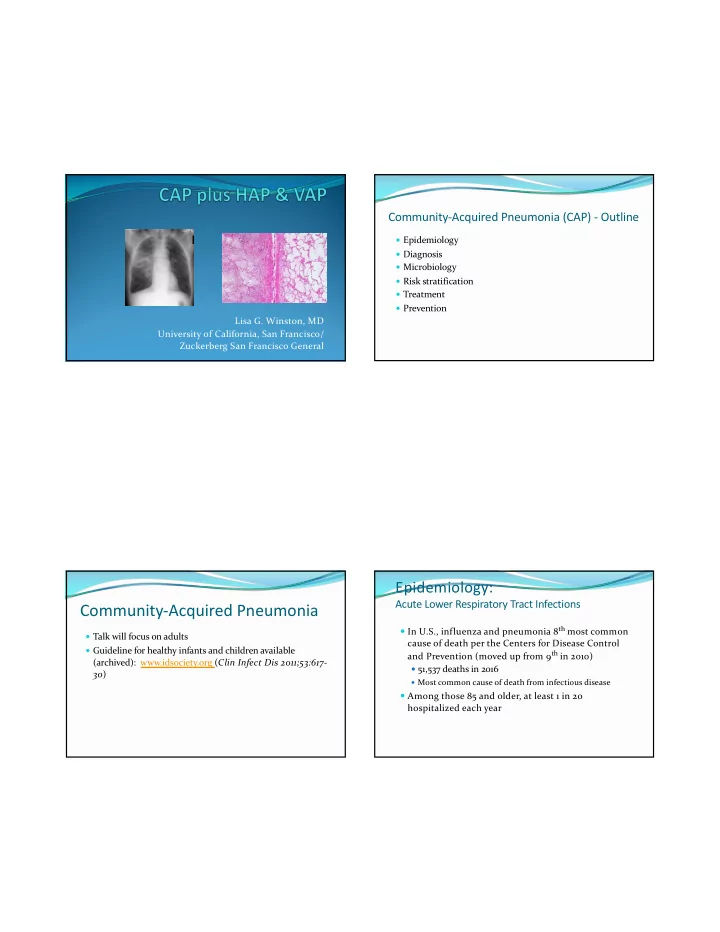
Community-Acquired Pneumonia (CAP) - Outline Epidemiology Diagnosis Microbiology Risk stratification Treatment Prevention Lisa G. Winston, MD University of California, San Francisco/ Zuckerberg San Francisco General


slide-1
SLIDE 1

Lisa G. Winston, MD University of California, San Francisco/ Zuckerberg San Francisco General

Community-Acquired Pneumonia (CAP) - Outline

— Epidemiology — Diagnosis — Microbiology — Risk stratification — Treatment — Prevention

Community-Acquired Pneumonia

— Talk will focus on adults — Guideline for healthy infants and children available

(archived): www.idsociety.org (Clin Infect Dis 2011;53:617- 30)

Epidemiology:

Acute Lower Respiratory Tract Infections

— In U.S., influenza and pneumonia 8th most common cause of death per the Centers for Disease Control and Prevention (moved up from 9th in 2010)

— 51,537 deaths in 2016

— Most common cause of death from infectious disease

— Among those 85 and older, at least 1 in 20 hospitalized each year

slide-2
SLIDE 2

Epidemiology:

Acute Lower Respiratory Tract Infections

— Inpatient mortality rate: may be influenced by coding

— From 2003 – 2009, mortality rate for principal diagnosis

pneumonia decreased from 5.8% to 4.2%

— More patients coded with principal diagnosis sepsis or

respiratory failure and secondary diagnosis pneumonia

—

Using all codes, little change in mortality rate Lindenauer et al, JAMA 2012;307:1405-13

— Outpatient mortality < 1%; about 80% of CAP treated in

  • utpatient setting

Diagnosis

— Chest radiograph – needed in all cases?

— Avoid over-treatment with antibiotics — Differentiate from other conditions — Specific etiology, e.g. tuberculosis — Co-existing conditions, such as lung mass or pleural

effusion

— Evaluate severity, e.g. multilobar

— Unfortunately, chest physical exam not sensitive or specific and significant variation between observers

Arch Intern Med 1999;159:1082-7

Microbiological Investigation

— Sputum Gram stain and culture

— 30-40% patients cannot produce adequate sample — Most helpful if single organism in large numbers — Usually unnecessary in outpatients — Culture (if adequate specimen): antibiotic sensitivities — Limited utility after antibiotics for most common

  • rganisms

Microbiological Investigation - Inpatients

— Blood cultures x 2 before antibiotics

— Blood cultures positive in 5 – 14% of hospitalized patients — Severe disease most important predictor

— Consider evaluation for Legionella

— Urinary antigen test for L. pneumophila serogroup 1 (70-90%) — Culture with selective media

— Pneumococcal urinary antigen test

— Simple, takes apx. 15 minutes — In adults, sensitivity 50-80%, specificity ~90% but specificity

poor in children, possibly due to carriage

slide-3
SLIDE 3

IDSA/ATS Guidelines for CAP in Adults; CID 2007:44(Suppl 2)

Microbiological Investigation - Inpatients

— Other studies as clinically indicated, e.g. influenza — Multiplex PCR systems, e.g. BioFire — Serology not typically used clinically but may be useful for public health — Bronchoscopy perhaps for fulminant course, unresponsive to conventional therapy, or for specific pathogens (e.g. Pneumocystis)

Other diagnostics?

— Biomarkers - procalcitonin

— Procalcitonin is produced in response to endotoxin and

endogenous mediators released in the setting of bacterial infections

— Rises in bacterial infections much more than, e.g., viral infections

  • r inflammatory states

— Rises and falls quickly

— Procalcitonin-guided treatment in acute respiratory infections seems to decrease antibiotic exposure and might improve outcomes, particularly in the ICU — Decreased antibiotic exposure was not seen in large ED RCT

New Engl J Med 2018;379:236-249 Lancet Infect Dis 2018;18:95-107

Etiology – historical data

— Clinical syndrome and CXR not reliably predictive

— Streptococcus pneumoniae 20-60% — Haemophilus influenzae 3-10% — Mycoplasma pneumoniae up to 10% — Chlamydophila pneumoniae up to 10% — Legionella up to 10% — Enteric Gram negative rods up to 10% — Staphylococcus aureus up to 10% — Viruses up to 10% — No etiologic agent 20-70%

slide-4
SLIDE 4

CAP Surveillance Study

— Adults hospitalized with CAP at 5 hospitals in Chicago and Nashville — Extensive diagnostic testing done via culture, serology, antigen testing, and molecular diagnostics — A pathogen was detected in only 38% of patients with specimens available

— Viruses 62% — Bacteria 29% — Bacteria and virus 7% — Fungus or mycobacteria 2%

NEJM 2015;373:415-27

Typical vs. Atypical

— Typical

— Visible on Gram stain,

grows in routine culture

— Susceptible to beta lactams — S. pneumoniae, H.

influenzae

— Atypical

— Not visible on Gram stain,

special culture techniques

— Not treated with beta

lactams

— M. pneumoniae, C.

pneumoniae, Legionella

X X

  • S. pneumoniae

—Risk factors

Extremes of age Alcoholism COPD and/or smoking Nursing home residence Influenza Injection drug use Airway obstruction HIV infection

Legionella

— Think about with severe disease, high fever, hyponatremia, markedly elevated LDH, CNS abnormalities — Fluoroquinolone or azithromycin drug of choice; usual rx 14-21 days — Risk factors: Older age Smoking Immune compromise, cell mediated Travel Renal disease Liver disease Diabetes Malignancy

slide-5
SLIDE 5

Mycoplasma pnuemoniae

— Common cause respiratory infections in children/young adults

— Pneumonia relatively uncommon

— Epidemics in close quarters — May have sore throat, nausea, vomiting, hemolytic anemia, rash — Treatment with doxycycline, macrolide, or fluoroquinolone

— Rising rate of macrolide resistance – U.S. 8.2%; China 90% Pediatr Infect Dis J 2012;31:409-11

  • Outpatient vs. inpatient?
  • Cost
  • Patient satisfaction
  • Safety

Risk Stratification Risk Stratification

— Outpatient vs. inpatient?

— Pneumonia Patient Outcomes Research Team

(PORT) study (Fine et al, NEJM 1997;336:243-250)

— Prediction rule to identify low risk patients with CAP — Stratify into one of 5 classes

— Class I: age < 50, none of 5 co-morbid conditions, apx.

normal VS, normal mental status

— Class II-V: assigned via a point system

Risk Stratification

—Mortality < 1% for classes I, II —Low risk patients hospitalized more than

necessary

—Caveats:

— Does not take into account social factors

slide-6
SLIDE 6

Pneumonia Severity Index Calculator

https://www.mdcalc.com/psi-port-score-pneumonia- severity-index-cap Age and sex; resident of nursing home {yes/no} Comorbid diseases {yes/no}: renal disease, liver disease, CHF, cerebrovascular disease, neoplasia Physical exam {yes/no}: altered mental status, SBP < 90, temp < 35 or >=40, RR>=30, HR>=125 Labs/studies {yes/no}: pH<7.35, PO2<60 or Sat<90, Na<130, HCT<30, gluc>250, BUN>30, pleural eff

Patient #1

— 60 year-old man with diabetes presents with fever and

  • dyspnea. Positive PORT items include HR=130, Na=129,

glucose=300.

— Should this patient be hospitalized?

Please vote:

  • 1. Yes
  • 2. No

Pneumonia Severity Index Results

Risk Class Score Mortality Low I < 51 0.1% Low II 51 - 70 0.6% Low III 71 - 90 0.9% Medium IV 90 - 130 9.5% High V > 130 26.7%

Hospitalization is recommended for class IV and V. Class III should be based on clinical judgment.

Class: IV Score: 100

Patient #2

55 year-old woman with no other risk factors? Hospitalization? Please vote:

  • 1. Yes
  • 2. No

Class : II Score : 45 Mortality : 0.1%

slide-7
SLIDE 7

Patient #3

92 year-old man with no other risk factors? Hospitalization? Please vote:

  • 1. Yes
  • 2. No

Class : IV Score : 92 Mortality : 9.5%

Patient #4

20 year-old woman with SBP < 90 and a pleural effusion? Hospitalization? Please vote:

  • 1. Yes
  • 2. No

Class : II Score : 40 Mortality : 0.6%

Other Scoring Systems

—CURB-65 (British Thoracic Society)

— Has only 5 variables, compared with 20 for

Pneumonia Severity Index

—Severe Community Acquired Pneumonia (SCAP)

— Has 8 variables

—SMART-COP

— Used for predicting need for mechanical ventilation

  • r vasopressors

Clinical Infectious Diseases; March 1, 2007 Supplement 2 Update in progress: projected spring 2019

slide-8
SLIDE 8

Is coverage of “atypical” organisms important?

— In Europe, amoxicillin commonly used as a

single drug with data supporting a short course (3 days in responding patients)

— Some studies show no benefit of empirical

atypical coverage on survival or clinical efficacy in hospitalized patients

el Moussaoui et al, BMJ 2006;332:1355 - 62 Shefet et al, Arch Intern Med 2005;165:1992-2000 JAMA 2014;311(21):2199-2208

  • V.A. retrospective, cohort study of patients 65 and older

hospitalized with pneumonia 2002-2012

  • 31,863 patients treated with azithromycin compared with

31,863 propensity matched patients with no exposure

  • 90 day mortality significantly lower 17.4% vs. 22.3%, O.R. 0.73
  • Myocardial infarct significantly higher 5.1% vs. 4.4%, O.R. 1.17

NEJM 2015;372:1312-23

  • Cluster-randomized trial in 7 hospitals in the Netherlands with rotating strategies
  • Adults with CAP not requiring ICU
  • Beta-lactam alone (656 patients) vs. beta-lactam plus macrolide (739 patients)
  • vs. fluoroquinolone alone (888 patients)
  • Primary outcome 90-day mortality: beta-lactam monotherapy non-inferior to
  • ther strategies
  • No difference in length of stay or complications

Outside the ICU…we love doxycycline

— Adult inpatients June 2005 – December 2010 — Compared those who received ceftriaxone + doxycycline to those who received ceftriaxone alone — 2734 hospitalizations: 1668 no doxy, 1066 with doxy — Outcome: CDI within 30 days of doxycycline receipt — CDI incidence 8.11 / 10,000 patient days in those receiving ceftriaxone alone; 1.67 / 10,000 patient days in those who received ceftriaxone and doxycycline

Doernberg et al, Clin Infect Dis 2012;55:615-20

slide-9
SLIDE 9

Empirical Treatment: IDSA/ATS Consensus Guidelines

Outpatient treatment

— Previously healthy, no antibiotics in 3 months

— Macrolide (1st choice) or — Doxycycline

— Co-morbid conditions or antibiotics within 3 months (select a different class)

— Respiratory fluoroquinolone: moxifloxacin, gemifloxacin,

  • r levofloxacin (750 mg)

— Beta-lactam (especially high dose amoxicillin) plus a

macrolide (1st choice) or doxycycline

Empirical Treatment: IDSA/ATS Consensus Guidelines

Inpatient treatment, non-ICU

  • Respiratory fluoroquinolone or
  • Beta-lactam (cefotaxime, ceftriaxone,

ampicillin; consider ertapenem) plus a macrolide (1st choice) or doxycycline

Empirical Treatment: IDSA/ATS Consensus Guidelines

Inpatient treatment, ICU

  • Beta-lactam (cefotaxime, ceftriaxone, or

ampicillin-sulbactam) plus

  • Azithromycin or a respiratory

fluoroquinolone

ØFor penicillin allergy: respiratory fluoroquinolone + aztreonam

Empirical Treatment: IDSA/ATS Consensus Guidelines

For suspected Pseudomonas aeruginosa:

  • Antipneumococcal, antipseudomonal beta-lactam

(piperacillin-tazobactam, cefepime, imipenem, or meropenem) plus either ciprofloxacin or levofloxacin (750 mg) Or

  • The above beta-lactam plus an aminoglycoside and either

azithromycin or a respiratory fluoroquinolone ØFor penicillin allergy: substitute aztreonam for the beta- lactam

Suspect with structural lung disease (e.g. bronchietasis), frequent steroid use, prior antibiotic therapy

slide-10
SLIDE 10

Empirical Treatment: IDSA/ATS Consensus Guidelines

Inpatient therapy, concern for community methicillin-resistant Staphylococcus aureus (MRSA):

ØAdd vancomycin or linezolid to regimen you would select otherwise *Consider for patients admitted to the ICU –

  • btain Gram strain of respiratory specimen

(sputum or tracheal aspirate)

What about steroids?

Lancet 2015: http://dx.doi.org/10.1016/S0140-6736(14)62447-8

  • Randomized, double blind trial in Switzerland
  • 785 adult inpatients received 50 mg prednisone daily x 7 days or placebo
  • Primary outcome clinical stability: 3.0 days prednisone vs. 4.4 days placebo,

p<.0001

  • Time to hospital discharge 6 days prednisone vs. 7 days placebo, p=.01
  • No difference complications except slightly higher in-hospital hyperglycemia

with prednisone

Questions re study

— 2911 patients assessed to randomize 802 — Why was length of stay so long?

— 4% prednisone and 6% placebo admitted to ICU — Death from any cause 4% prednisone and 3% placebo

What about steroids?

— Multicenter, double-blind, RCT at 3 hospitals in Spain — Adults with severe CAP (75% in ICU) — Methylprednisolone 0.5 mg/kg q 12h x 5 days (n=61) vs. placebo (n=59)

— Recruited 2004 – 2012

— Primary outcome: treatment failure (composite) 13% vs. 31%, P=.02

— Mortality 10% vs. 15%, P=.37 JAMA 2015;313(7):677-86

slide-11
SLIDE 11

What about steroids?

— Systematic review and meta-analysis of steroids for patients hospitalized with CAP — Included 13 RCTs with 2005 patients total

— Both studies on previous slides included

— Outcomes:

— Possible 2.8% reduction in mortality — 5% reduction mechanical ventilation — 1 day decrease hospital stay — 3.5% increase in hyperglycemia requiring treatment Ann Intern Med 2015;163(7):519-28

What about steroids?

—At least 2 multicenter trials in progress with data

anticipated

— ESCAPe: patients with severe CAP, VA hospitals,

methylprednisolone

— Study completed

— CAPE_COD: patients with severe CAP, French hospitals,

hydrocortisone

— Recruitment in progress

https://clinicaltrials.gov/

Length of Therapy

— 7 – 10 days had been standard for most

patients but probably not necessary

— Shorter course with azithromycin or high dose

levofloxacin

— Meta-analysis that patients with mild to moderate disease

can be treated with 7 days or less Li et al. Am J Med. 2007;120(9):783-90

Switch to Oral Therapy

— Reduces costs, shortens length of stay, may reduce complications — As soon as improving clinically, able to take POs, GI tract functioning

— Usually within 3 days; no need to observe in hospital

— Narrow spectrum agent if organism identified (usually S. pneumoniae) — Empirical therapy: macrolide, doxycycline, antipneumococcal fluoroquinolone, or combination therapy

slide-12
SLIDE 12

Prevention

There are steps patients and providers can take….

Prevention

— Vaccination

— Influenza vaccine — Pneumococcal vaccines

— Smoking cessation

— Smoking, with or without COPD, is a significant

risk factor

Am J Respir Crit Care Med 2005;171:388-416

slide-13
SLIDE 13

The HCAP Gap

Clin Infect Dis 2009;49(12):1868-74

  • The concept of HCAP has been removed – why?
  • Increasing evidence that most patients with HCAP are

not at high risk for resistant pathogens

  • Other features besides exposure to the healthcare

system may be important

  • May be covered by new CAP guidelines

Practical tips for HCAP

— Most patients with “HCAP” can be treated like CAP — Consider expanded initial therapy if

— Severely ill — History of resistant organism or other risk factors such as

extensive antibiotic exposure — Knowledge of local flora/resistance patterns is helpful — If using expanded therapy, prioritize microbiologic

diagnosis

— De-escalate based on results

2016 guidelines: take home points for both HAP and VAP

— Perform microbiologic testing – preferred over empirical

therapy

— Obtain non-invasively – expectorated, induced sputum,

endotracheal aspirate

— BAL, mini-BAL, protected-brush specimens not recommended

— Not recommended for decision to initiate therapy

— Procalcitonin — C-reactive protein — CPIS score

— Most patients should be treated for 7 days

slide-14
SLIDE 14

2016 guidelines: initial treatment

  • f HAP (based on very low quality evidence)

— Use local pathogen and antibiotic resistance data — Cover MRSA in selected patient

— Prior IV antibiotics within 90 days — > 20 of S. aureus isolates on unit are MRSA — High risk of mortality

— Cover Pseudomonas aeruginosa

— Double coverage of P. aeruginosa with risk factors

— Prior IV antibiotics within 90 days — High risk for mortality

2016 guidelines: initial treatment

  • f HAP (based on very low quality evidence)

— Not at high risk of mortality and no risk factors increasing

likelihood of MRSA (cover MSSA and P. aeruginosa)

— One of the following: — Piperacillin-tazobactam 4.5 g IV q 6h — Cefepime 2 g IV q 8h — Levofloxacin 750 mg IV daily — Imipenem 500 mg IV q 6h — Meropenem 1 g IV q 8h

2016 guidelines: initial treatment

  • f HAP (based on very low quality evidence)

— Not at high risk of mortality but increased risk of MRSA:

— Piperacillin-tazobactam 4.5 g IV q 6h — Cefepime 2 g IV q 8h — Levofloxacin 750 mg IV daily — Imipenem 500 mg IV q 6h — Meropenem 1 g IV q 8h — Aztreonam 2 g IV q 8h

PLUS

— Vancomycin 15 mg/kg IV q 8h-12h (goal trough 15 – 20) OR — Linezolid 600 mg IV q 12h

2016 guidelines: initial treatment

  • f HAP (based on very low quality evidence)

— High risk of mortality or IV antibiotics with 90 days:

— Antipsuedomonal beta lactam: piperacillin-tazobactam,

cefepime, ceftazidime, aztreonam, imipenem, meropenem PLUS

— A second antipseudomonal antibiotic: levofloxacin,

ciprofloxacin, amikacin, gentamicin, tobramycin PLUS

— Vancomycin or linezolid

slide-15
SLIDE 15

2016 guidelines: initial treatment

  • f VAP (based on very low quality evidence)

— Use local pathogen and antibiotic resistance data — Do not treat ventilator-associated tracheobronchitis with

antibiotics

— Cover S. aureus, P. aeruginosa, and other Gram-negative bacilli

in all empirical regimens

— Cover MRSA with vancomycin or linezolid when > 10 – 20% of S.

aureus isolates in unit are MRSA — Use two antipseudomonal antibiotics if

  • Prior IV antibiotic use within 90 days
  • Septic shock
  • ARDS preceding VAP
  • 5 or more days of hospitalization preceding VAP
  • > 10% of Gram negative

isolates resistant to planned monotherapy

  • Susceptibility rates

unknown

ZSFG / SF VAMC HAP and VAP antibiotic guideline: initial therapy

— Mild HAP: ceftriaxone or ertapenem or levofloxacin — Severe HAP (e.g. high O2 requirement, cavitary disease):

vancomycin plus cefepime or piperacillin/tazobactam

— VAP, intubated < 5 days without complications (e.g.

multifocal or cavitary disease): ceftriaxone or ertapenem or levofloxacin

— VAP, intubated > 5 days or complicated: vancomycin plus

cefepime or piperacillin/tazobactam