Common Sense Addition Computing Computing Explained by Hurwicz - - PowerPoint PPT Presentation

common sense addition
SMART_READER_LITE
LIVE PREVIEW

Common Sense Addition Computing Computing Explained by Hurwicz - - PowerPoint PPT Presentation

Common Sense Addition Towards Precise . . . Hurwicz Optimism- . . . Common Sense Addition Computing Computing Explained by Hurwicz Let Us Apply Hurwicz . . . Optimism-Pessimism Acknowledgments Home Page Criterion Title Page Bibek


slide-1
SLIDE 1

Common Sense Addition Towards Precise . . . Hurwicz Optimism- . . . Computing ∆ Computing ∆ Let Us Apply Hurwicz . . . Acknowledgments Home Page Title Page ◭◭ ◮◮ ◭ ◮ Page 1 of 11 Go Back Full Screen Close Quit

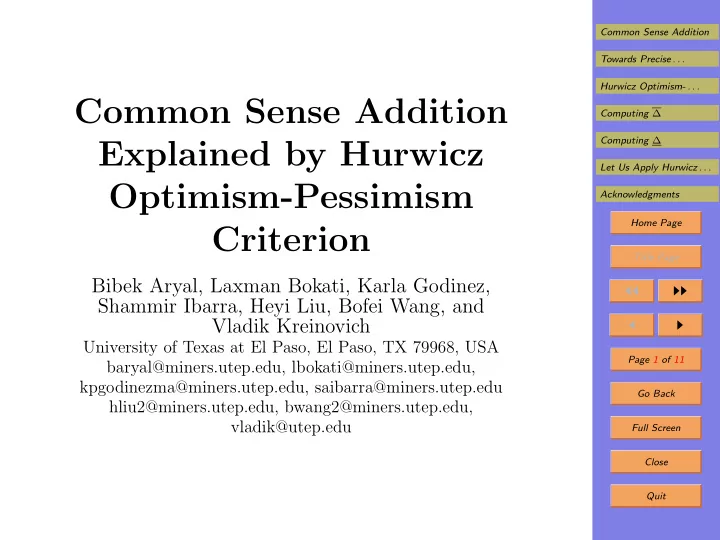
Common Sense Addition Explained by Hurwicz Optimism-Pessimism Criterion

Bibek Aryal, Laxman Bokati, Karla Godinez, Shammir Ibarra, Heyi Liu, Bofei Wang, and Vladik Kreinovich

University of Texas at El Paso, El Paso, TX 79968, USA baryal@miners.utep.edu, lbokati@miners.utep.edu, kpgodinezma@miners.utep.edu, saibarra@miners.utep.edu hliu2@miners.utep.edu, bwang2@miners.utep.edu, vladik@utep.edu

slide-2
SLIDE 2

Common Sense Addition Towards Precise . . . Hurwicz Optimism- . . . Computing ∆ Computing ∆ Let Us Apply Hurwicz . . . Acknowledgments Home Page Title Page ◭◭ ◮◮ ◭ ◮ Page 2 of 11 Go Back Full Screen Close Quit

1. Common Sense Addition

  • Suppose that we have two factors that affect the accu-

racy of a measuring instrument.

  • One factor leads to errors ±10%.
  • This means that the resulting error component can

take any value from −10% to +10%.

  • The second factor leads to errors of ±0.1%.
  • What is the overall error?
  • From the purely mathematical viewpoint, the largest

possible error is 10.1%.

  • However, from the common sense viewpoint, an engi-

neer would say: 10%.

slide-3
SLIDE 3

Common Sense Addition Towards Precise . . . Hurwicz Optimism- . . . Computing ∆ Computing ∆ Let Us Apply Hurwicz . . . Acknowledgments Home Page Title Page ◭◭ ◮◮ ◭ ◮ Page 3 of 11 Go Back Full Screen Close Quit

2. Common Sense Addition (cont-d)

  • A similar common sense addition occurs in other situ-

ations as well.

  • For example:

– if we have a car that weight 1 ton = 1000 kg, – and we place a coke can that weighs 0.35 kg in the car, – what will be now the weight of the car?

  • Mathematics says 1000.35 kg, but common sense clearly

says: still 1 ton.

  • How can we explain this common sense addition?
slide-4
SLIDE 4

Common Sense Addition Towards Precise . . . Hurwicz Optimism- . . . Computing ∆ Computing ∆ Let Us Apply Hurwicz . . . Acknowledgments Home Page Title Page ◭◭ ◮◮ ◭ ◮ Page 4 of 11 Go Back Full Screen Close Quit

3. Towards Precise Formulation of the Problem

  • We know that the overall measurement error ∆x is

equal to ∆x1 + ∆x2, where: – the value ∆x1 can take all possible values from the interval [−∆1, ∆1], and – the value ∆x2 can take all possible values from the interval [−∆2, ∆2].

  • What can we say about the largest possible value ∆ of

the absolute value |∆x| of the sum ∆x = ∆x1 + ∆x2?

  • Let us describe this problem in precise terms.
  • For every pair (x1, x2), let π1(x1, x2) denote x1 and let

π2(x1, x2) stand for x2.

  • Let ∆1 > 0 and ∆2 > 0 be two numbers.
  • Without losing generality, we can assume ∆1 ≥ ∆2.
slide-5
SLIDE 5

Common Sense Addition Towards Precise . . . Hurwicz Optimism- . . . Computing ∆ Computing ∆ Let Us Apply Hurwicz . . . Acknowledgments Home Page Title Page ◭◭ ◮◮ ◭ ◮ Page 5 of 11 Go Back Full Screen Close Quit

4. Towards Precise Formulation (cont-d)

  • By S, let us denote the class of all possible sets

S ⊆ [−∆1, ∆1] × [−∆2, ∆2] for which π1(S) = [−∆1, ∆1] and π2(S) = [−∆2, ∆2].

  • We are interested in the value

∆(S) = max{|∆x1 + ∆x2| : (∆x1, ∆2) ∈ S}.

  • Here, S is the actual (unknown) set.
  • We do not know what is the actual set S, we only know

that S ∈ S.

  • For different sets S ∈ S, we may get different ∆(S).
  • The only thing we know about ∆(S) is that

∆(S) ∈ [∆, ∆], where: ∆ = min

S∈S ∆(S),

∆ = max

S∈S ∆(S).

  • Which value ∆ from this interval should we choose?
slide-6
SLIDE 6

Common Sense Addition Towards Precise . . . Hurwicz Optimism- . . . Computing ∆ Computing ∆ Let Us Apply Hurwicz . . . Acknowledgments Home Page Title Page ◭◭ ◮◮ ◭ ◮ Page 6 of 11 Go Back Full Screen Close Quit

5. Hurwicz Optimism-Pessimism Criterion

  • Often, we do not know the value of a quantity, we only

know the interval of its possible values.

  • In such situations, decision theory recommends using

Hurwicz optimism-pessimism criterion.

  • Namely, we select the value α·∆+(1−α)·∆ for some

α ∈ [0, 1].

  • A usual recommendation is to use α = 0.5.
  • Let us see what will be the result of applying this cri-

terion to our problem.

slide-7
SLIDE 7

Common Sense Addition Towards Precise . . . Hurwicz Optimism- . . . Computing ∆ Computing ∆ Let Us Apply Hurwicz . . . Acknowledgments Home Page Title Page ◭◭ ◮◮ ◭ ◮ Page 7 of 11 Go Back Full Screen Close Quit

6. Computing ∆

  • For every set S ∈ S, from |∆x1| ≤ ∆1 and |∆x2| ≤ ∆2,

we conclude that |∆x1 + ∆x1| ≤ ∆1 + ∆2.

  • Thus always ∆(S) ≤ ∆1 + ∆2 and hence,

∆ = max ∆(S) ≤ ∆1 + ∆2.

  • Let us take S0 = {(v, (∆2/∆1)·v) : v ∈ [−∆1, ∆1]} ∈ S.
  • For S0, we have ∆x1 + ∆x2 = ∆x1 · (1 + ∆2/∆1).
  • Thus in this case, the largest possible value ∆(S0) of

∆x1 + ∆x2 is equal to ∆(S0) = ∆1 · (1 + ∆2/∆1) = ∆1 + ∆2.

  • So, ∆ = max ∆(S) ≥ ∆(S0) = ∆1 + ∆2.
  • Hence, ∆ = ∆1 + ∆2.
slide-8
SLIDE 8

Common Sense Addition Towards Precise . . . Hurwicz Optimism- . . . Computing ∆ Computing ∆ Let Us Apply Hurwicz . . . Acknowledgments Home Page Title Page ◭◭ ◮◮ ◭ ◮ Page 8 of 11 Go Back Full Screen Close Quit

7. Computing ∆

  • For every S ∈ S, since π1(S) = [−∆1, ∆1], we have

∆1 ∈ π1(S).

  • Thus, there exists a pair (∆1, ∆x2) ∈ S corresponding

to ∆x1 = ∆1.

  • For this pair, we have

|∆x1 + ∆x2| ≥ |∆x1| − |∆x2| = ∆1 − |∆x2|.

  • Here, |∆x2| ≤ ∆2, so |∆x1 + ∆x2| ≥ ∆1 − ∆2.
  • Thus, for each S ∈ S, the largest possible value ∆(S)
  • f |∆x1 + ∆x2| cannot be smaller than ∆1 − ∆2:

∆(S) ≥ ∆1 − ∆2.

  • Hence, ∆ = min

S∈S ∆(S) ≥ ∆1 − ∆2.

slide-9
SLIDE 9

Common Sense Addition Towards Precise . . . Hurwicz Optimism- . . . Computing ∆ Computing ∆ Let Us Apply Hurwicz . . . Acknowledgments Home Page Title Page ◭◭ ◮◮ ◭ ◮ Page 9 of 11 Go Back Full Screen Close Quit

8. Computing ∆ (cont-d)

  • Take S0 = {(v, −(∆2/∆1) · v) : v ∈ [−∆1, ∆1]} ∈ S.
  • For S0, we have ∆x1 + ∆x2 = ∆x1 · (1 − ∆2/∆1).
  • Thus in this case, the largest possible value ∆(S0) of

∆x1 + ∆x2 is equal to ∆(S0) = ∆1 · (1 − ∆2/∆1) = ∆1 − ∆2.

  • So, ∆ = min

S∈S ∆(S) ≥ ∆(S0) = ∆1 − ∆2.

  • Thus, ∆ ≤ ∆1 − ∆2.
  • Hence, ∆ = ∆1 − ∆2.
slide-10
SLIDE 10

Common Sense Addition Towards Precise . . . Hurwicz Optimism- . . . Computing ∆ Computing ∆ Let Us Apply Hurwicz . . . Acknowledgments Home Page Title Page ◭◭ ◮◮ ◭ ◮ Page 10 of 11 Go Back Full Screen Close Quit

9. Let Us Apply Hurwicz Criterion

  • Let us apply Hurwicz criterion with α = 0.5 to the

interval [∆, ∆] = [∆1 − ∆2, ∆1 + ∆2].

  • Then, we get ∆ = 0.5 · ∆ + 0.5 · ∆ = ∆1.
  • For example, for ∆1 = 10% and ∆2 = 0.1%, we get

∆ = 10%, in full accordance with common sense.

  • In other words, Hurwicz criterion explains the above-

described common-sense addition.

slide-11
SLIDE 11

Common Sense Addition Towards Precise . . . Hurwicz Optimism- . . . Computing ∆ Computing ∆ Let Us Apply Hurwicz . . . Acknowledgments Home Page Title Page ◭◭ ◮◮ ◭ ◮ Page 11 of 11 Go Back Full Screen Close Quit

10. Acknowledgments This work was supported in part by the National Science Foundation grant HRD-1242122 (Cyber-ShARE Center).