Commissioning of VUV-MPPCs for MEG II Liquid Xenon Detector W. - - PowerPoint PPT Presentation

commissioning of vuv mppcs for meg ii liquid xenon
SMART_READER_LITE
LIVE PREVIEW

Commissioning of VUV-MPPCs for MEG II Liquid Xenon Detector W. - - PowerPoint PPT Presentation

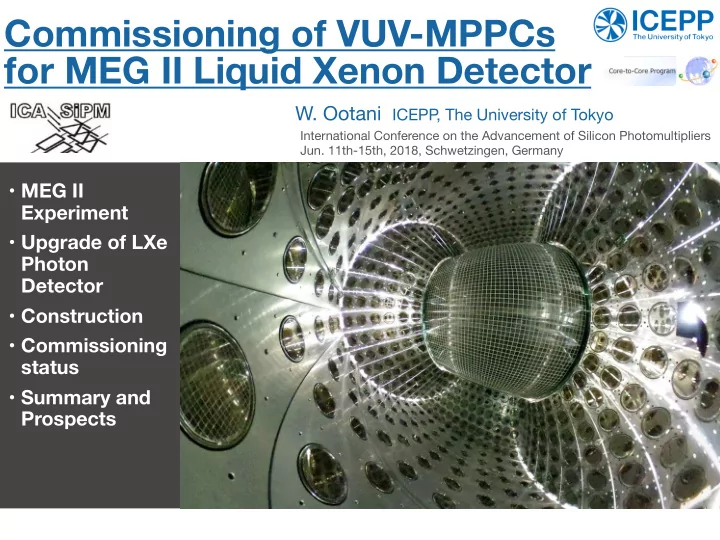
Commissioning of VUV-MPPCs for MEG II Liquid Xenon Detector W. Ootani ICEPP , The University of Tokyo International Conference on the Advancement of Silicon Photomultipliers Jun. 11th-15th, 2018, Schwetzingen, Germany MEG II Experiment


slide-1
SLIDE 1
  • MEG II

Experiment

  • Upgrade of LXe

Photon Detector

  • Construction
  • Commissioning

status

  • Summary and

Prospects

Commissioning of VUV-MPPCs for MEG II Liquid Xenon Detector

International Conference on the Advancement of Silicon Photomultipliers

  • Jun. 11th-15th, 2018, Schwetzingen, Germany
  • W. Ootani ICEPP

, The University of Tokyo

slide-2
SLIDE 2

W.Ootani, “Commissioning of VUV-MPPCs for MEG II LXe Detector”, International Conference on the Advancement of Silicon Photomultipliers

  • Experimental search for lepton flavour violating decay μ+→e+γ as an

unambiguous evidence of BSM physics

  • Current bound: !(μ+→e+γ) < 4.2×10⁻¹³ (90%C.L.) (MEG in 2016)
  • MEG upgrade (MEG II) with a projected sensitivity of 6×10-14 in preparation.
  • MEG II detectors with significantly improved performance
  • Much higher resolutions and efficiencies for both photon and positron detectors
  • Twice or higher μ intensity, fully exploiting world’s most intense DC μ-beam at PSI up to

~108 μ+ beam

2

MEG II Experiment

μ+ γ e+

beam @ PSI ~7x10⁷ μ/s 900! LXe " detector #$ drift chamber + timing counter Radiative decay counter (BG identification) Upgrades from MEG: x2 beam rate x2 detector resolution and efficiency

slide-3
SLIDE 3

W.Ootani, “Commissioning of VUV-MPPCs for MEG II LXe Detector”, International Conference on the Advancement of Silicon Photomultipliers

  • LXe as a detector medium
  • High stopping power X0 = 2.77cm
  • High light yield 75% of NaI(Tl)
  • Fast (τ=45ns for e/γ)
  • LXe scintillation light readout by

photosensors surrounding LXe active volume

MEG: PMT(×846) →MEG II: SiPM(×4092) + PMT(×668)

  • Reconstruction
  • Energy: sum of SiPM/PMT charges
  • Position: SiPM/PMT charge distribution
  • Time: average SiPM/PMT time
  • All channels are readout by waveform

digitiser.

  • Pileup reduction
  • Particle ID

3

MEG LXe Photon Detector

  • 900ℓ LXe (~2.7ton) scintillation detector to

measure 52.8MeV-photon from μ→eγ

slide-4
SLIDE 4

W.Ootani, “Commissioning of VUV-MPPCs for MEG II LXe Detector”, International Conference on the Advancement of Silicon Photomultipliers

4

LXe Detector Upgrade for MEG II

2” PMT

MPPC

(12×12mm2)

  • Highly granular scintillation readout
  • 216 × PMTs(2-inch) on γ-entrance face are replaced with 4092 × MPPCs

(139mm2 each)

  • γ-entrance face (0.92m2) covered by total active sensor area of 0.57m2
  • Energy and position resolutions will be improved by a factor of two.
  • γ-detection efficiency will also be improved by ~10% because MPPC is much

thinner than PMT.

  • Modified PMT layout for better response to acceptance edge events
slide-5
SLIDE 5

W.Ootani, “Commissioning of VUV-MPPCs for MEG II LXe Detector”, International Conference on the Advancement of Silicon Photomultipliers

5

MEG (MC) MEG II (MC)

(MC) (MC)

slide-6
SLIDE 6

W.Ootani, “Commissioning of VUV-MPPCs for MEG II LXe Detector”, International Conference on the Advancement of Silicon Photomultipliers

  • VUV-sensitive MPPC developed for

MEG II in collaboration with Hamamatsu Photonics K.K.

  • Model S10943-4372
  • Active area: 139mm2
  • Discrete array of four independent sensor

chips (5.95×5.85mm2 each)

  • 50μm pixel pitch
  • Metal quench resistor (only 20% change at

LXe temp~165K)

  • PDE > 15% for LXe scintillation light (λ=175nm)
  • Gain > 5×10⁵ (four chips connected in series)
  • Low cross talk / low after-pulsing
  • Operational with over-voltage up to 7V

6

VUV-sensitive MPPC

第 章 液体キセノンガンマ線検出器のアップグレード この のうち が の有感領域となるわけだが、これは にしては 大きな面積である。 の大面積化に伴う欠点は2つある。1つ目はダークノイズレートの増大であ る。しかし においては常温に比べてダークノイズレートは5桁ほど小さくなるので、我々の用途 では問題とはならない。2つ目の問題は波形の変化である。面積が大きくなるとそれぞれのピクセルと 並列に並ぶ静電容量が大きくなり、波形の時定数が大きくなってしまう。波形の時定数を抑えるために を直列接続で読み出す。 研究開発の結果、以上の要件を満たす素子 我々は 型と呼んでいる 、および 型をもとに 個量 産したプロトタイプ素子 が開発された 。 プロトタイプ素子 図 に完成したプロトタイプ素子を示す。

図 プロトタイプ素子

ピクセルサイズは である。素子としての性能を向上するため、アフターパルスの抑制がなされ ており、またクエンチング抵抗にはポリシリコン抵抗よりも温度係数の小さい金属抵抗を用いている。 この素子では我々の用途に特化したパッケージが採用されている。パッケージのサイズは であり、その上に のチップが4つ乗っている。それぞれのチップは独立に読み出せるように なっている。素子は保護のために真空紫外光に透明なクオーツでできた窓で覆われている。クオーツの窓 と素子の間は密封されておらず、液体キセノンが入り込めるような構造をしている。このようなデザイン を用いると、クオーツの屈折率 と液体キセノンの屈折率 が十分近いため反射による損失を 抑えることができる。 真空紫外光への感度 この素子の最たる特徴は真空紫外光への感度である。市販の が真空紫外光に感度がないのはシ リコン結晶での真空紫外光の減衰長が 程度と極めて短いため、光子が有感領域に到達できないから である。そのため有感領域の前に存在する保護層を除去するほか、コンタクトレイヤーを薄くする等の改 良を加えることで、真空紫外光への感度が実現された。キセノンのシンチレーション光に対する を 図 に示す。真空紫外光に対する十分な が確認できている。

が膨大になってしまうことのほかに、ケーブルを通じた熱流入が増えてしまうという問題点もある。

Hamamatsu S10943-4372

slide-7
SLIDE 7

W.Ootani, “Commissioning of VUV-MPPCs for MEG II LXe Detector”, International Conference on the Advancement of Silicon Photomultipliers

  • PDE measured in a small

laboratory setup in LXe

  • Am-241 spot α-source on W-wire

(φ100um, gold-plated) as a fixed spot light source

  • PDE = (measured # of

photoelectrons)/(expected # of photons)

  • Uncertainty in estimation of

expected # of photons impinging MPPC (Wph, gain, cross-talk, after-pulsing, effect of reflection)

  • PDE > 15%

7

PDE

Am-241 MPPC VUV-black coating W-wire Am-241 spot source on W- wire 2 4 6 8 [V]

  • ver

V 0.05 0.1 0.15 0.2 0.25 0.3 PDE

Preliminary

slide-8
SLIDE 8

W.Ootani, “Commissioning of VUV-MPPCs for MEG II LXe Detector”, International Conference on the Advancement of Silicon Photomultipliers

  • Correct knowledge of angular dependence of PDE is required especially for position

reconstruction

  • Angular dependence of PDE was measured in a dedicated setup with gaseous Xe at room temp
  • Larger than expected from Fresnel reflection
  • Consistent result obtained observed also in LXe with the detector, but still with larger uncertainty
  • For VUV light, charge carrier is generated in contact layer within 5nm from top surface
  • Very thin dead layer in contact layer could cause additional angular dependence

8

Angular Dependence of PDE

5cm ~5cm trigger channel rotation axis ! photons alpha path length ~9mm MPPC rod

↑operation with Vbd+5V

in gaseous Xe

Preliminary

Large systematics due to limited acceptance Relevant for experiment

Preliminary

Relative PDE (normalised to θ=0)

slide-9
SLIDE 9

W.Ootani, “Commissioning of VUV-MPPCs for MEG II LXe Detector”, International Conference on the Advancement of Silicon Photomultipliers

  • Correct knowledge of angular dependence of PDE is required especially for position

reconstruction

  • Angular dependence of PDE was measured in a dedicated setup with gaseous Xe at room temp
  • Larger than expected from Fresnel reflection
  • Consistent result obtained observed also in LXe with the detector, but still with larger uncertainty
  • For VUV light, charge carrier is generated in contact layer within 5nm from top surface
  • Very thin dead layer in contact layer could cause additional angular dependence

8

Angular Dependence of PDE

5cm ~5cm trigger channel rotation axis ! photons alpha path length ~9mm MPPC rod

↑operation with Vbd+5V

in gaseous Xe

Preliminary

Large systematics due to limited acceptance Relevant for experiment

Preliminary

Relative PDE (normalised to θ=0)

GXe × LXe

Preliminary

GXe vs. LXe PDE ratio (measured/expected)

slide-10
SLIDE 10

W.Ootani, “Commissioning of VUV-MPPCs for MEG II LXe Detector”, International Conference on the Advancement of Silicon Photomultipliers

  • Construction completed

→Detector now in commissioning phase

9

Construction

Cabling for ~5000 sensors is not an easy task…

4092×MPPC 668×PMT Installed in PSI πE5 Cryogenics/vacuum piping Cabling Photosensor installation

slide-11
SLIDE 11

W.Ootani, “Commissioning of VUV-MPPCs for MEG II LXe Detector”, International Conference on the Advancement of Silicon Photomultipliers

  • Detector commissioning in progress
  • System check
  • LXe transfer to detector vessel
  • LXe purification
  • Photosensor calibration
  • Detector calibration
  • Not quite ready for full commissioning
  • Limited number of readout electronics channels. Full electronics will be ready in

2019

  • Suffering higher noise than expected after installed in beam area. Still under

investigation

10

Commissioning

slide-12
SLIDE 12

W.Ootani, “Commissioning of VUV-MPPCs for MEG II LXe Detector”, International Conference on the Advancement of Silicon Photomultipliers

  • Precise alignment of MPPCs is crucial because of significantly

improved position resolution down to a few mm

  • Target alignment precision <0.5mm
  • Multiple redundant methods
  • 3D survey with 3D-camera and laser tracker at room temp.
  • Position sensor to measure displacement/deformation of inner LXe vessel
  • X-ray survey to measure sensor position in LXe from outside detector vessel

11

MPPC Alignment

  • uter

cryostat inner cryostat (filled with LXe) vacuum wire position sensors are attached to the

  • uter cryostat.

wire pull out length is measured

Survey by 3D camera Inner vessel position sensor

slide-13
SLIDE 13

W.Ootani, “Commissioning of VUV-MPPCs for MEG II LXe Detector”, International Conference on the Advancement of Silicon Photomultipliers

  • 2D-positions (z & Φ) of MPPCs in LXe are directly measured

with collimated X-ray

  • MPPCs are scanned by slit beam of 2×30mm2 at MPPC
  • Scan in two directions (Z & Φ)

X-ray Survey

moving stage & rotator X-ray beam

MPPCs 15mm

57Co source +

collimator X-ray (124, 132 keV)

57Co in slit collimator

12

slide-14
SLIDE 14

W.Ootani, “Commissioning of VUV-MPPCs for MEG II LXe Detector”, International Conference on the Advancement of Silicon Photomultipliers

  • Preliminary results from first measurement
  • Clear rate variation for each scanned MPPC
  • MPPC position extracted from rate distribution
  • Validation by checking intervals of MPPCs mounted on the same PCB slab
  • Expected: 15.07mm (tolerance within ±0.05mm)
  • Measured: 15.05±0.01mm (mean)
  • Consistent with expectation
  • Resolution estimated as 0.4mm, meeting the requirement
  • Detailed analysis in progress to extract all MPPC positions

X-ray Survey

15mm Background (cosmic-rays)

Distance[mm] 13 14 15 16 17 Channels 10 20 30 40 50 60

Distance from the next MPPC

Preliminary

13

MPPC mounted on PCB slab Measured intervals

  • f adjacent MPPCs
slide-15
SLIDE 15

W.Ootani, “Commissioning of VUV-MPPCs for MEG II LXe Detector”, International Conference on the Advancement of Silicon Photomultipliers

  • Various calibration/monitoring methods employed in LXe detector
  • LED: visible photon
  • Alpha source (241Am spots on W-wire): 5.5MeV-α
  • As a spot light source with constant intensity→abs. calib. of photosensor eff.
  • Easily discriminated from γ-ray events with pulse shape (ex. charge/amplitude)
  • Cosmic ray: ≲O(GeV)
  • Charge Exchange (CEX): π-p→π0n, π0→γγ (55, 83, 129MeV -γ)
  • Cockcroft-Walton proton accelerator: 7Li(p,γ)8Be (14.8, 17.6MeV- γ),

11B(p,γ)12C(4.4, 11.6, 16.1MeV-γ)

  • AmBe source: 4.4MeV-γ
  • Neutron generator: 58Ni(n,γ)59Ni (9MeV-γ)

Calibration/Monitoring

α PMT MPPC

scintilation photons

(not to scale)

Alpha spot sources on W-wire

h0

Entries 2011 Mean 6.751 Std Dev 2.057

2 4 6 8 10 12 20 40 60 80 100 120 140

h0

Entries 2011 Mean 6.751 Std Dev 2.057

QAratio − − −

α/γ discrimination by pulse shape Charge/amplitude

α γ

14

Photosensor calib.

slide-16
SLIDE 16

W.Ootani, “Commissioning of VUV-MPPCs for MEG II LXe Detector”, International Conference on the Advancement of Silicon Photomultipliers

15

Photosensor Calibration

U D T B

Dead channel map

  • unstable
  • dead
  • Signal check
  • MPPC: dead (9ch)
  • PMT dead(9ch), unstable(6ch)

→Effect on detector performance expected to be negligible (at least for MPPC)

  • Photosensor calibration, with more attention on MPPC
  • Gain
  • PDE
slide-17
SLIDE 17

W.Ootani, “Commissioning of VUV-MPPCs for MEG II LXe Detector”, International Conference on the Advancement of Silicon Photomultipliers

  • Currently, the most crucial issue is “noise”
  • Current noise level is larger than expected from lab. measurement
  • Low frequency noise (~O(MHz)), which is coherent over the readout channels (for both MPPC and PMT)
  • Coherent noise will directly influence the detector performance
  • Need to reduce by a factor of 2-4 to reach ~1% level energy resolution
  • Work in progress to reduce noise
  • Hunting for noise source
  • It seems that significant part of the noise comes from new readout electronics
  • Noise filtering for both hardware and software

16

Noise

Common mode chokes ADC filter & OFS filter

Modified waveDREAM board with noise filters 𝛿

  • 5 ∼ 5

e readout

[sec]

0.8 − 0.6 − 0.4 − 0.2 −

6 −

10 ×

[V]

0.3 − 0.25 − 0.2 − 0.15 − 0.1 − 0.05 − 0.05 0.1

MPPC sum WF

Black : Pedestal Red : Signal (x 1/100) MPPC sum waveform

Coherent low-freq. noise in sum waveform for MPPC

slide-18
SLIDE 18

W.Ootani, “Commissioning of VUV-MPPCs for MEG II LXe Detector”, International Conference on the Advancement of Silicon Photomultipliers

11/30 12/07 12/14 12/21 0.9 0.92 0.94 0.96 0.98 1 1.02 1.04 1.06 1.08 1.1

MPPC global change MPPC global change

* : 1 p.e. peak Line : Fixed LED charge

MPPC Gain History (All channel average)

  • Gain calibration using LED
  • Single photoelectron charge for low-level LED light
  • Average gain: 8×10⁵ at over-voltage of 7V
  • Sensor-by-sensor variation at same over-voltage: 5%
  • Long term stability
  • Observed slight variation, which is consistent with variation of LXe

temperature

  • 17

Gain

200 400 600 800 1000 1200

3

10 × 100 200 300 400 500 600 700 800

hGain

Gain @ 54V mean : 8.2 x 10⁵

Gain distribution at bias voltage of 54V Preliminary MPPC charge distribution for LED light 1p.e. 2p.e. Gain history (average)

Average gain history Gain distribution at Vbias = 54V MPPC charge distribution for LED light

Preliminary

slide-19
SLIDE 19

W.Ootani, “Commissioning of VUV-MPPCs for MEG II LXe Detector”, International Conference on the Advancement of Silicon Photomultipliers

  • Correlated noise measured from spectrum with low intensity

LED light

  • Production lot dependence observed
  • Need careful calibration/correction

18

Correlated Noise

MPPC S/N

Crosstalk & after pulse vs. MPPC serial

Cross-talk and after-pulsing at over-voltage of 7V

~Probability

0.5

Lot dependence of pulse shape

A B C D

Preliminary

slide-20
SLIDE 20

W.Ootani, “Commissioning of VUV-MPPCs for MEG II LXe Detector”, International Conference on the Advancement of Silicon Photomultipliers

  • MPPC PDE measured using α-spot source (Am-241)
  • PDE = (measured # of photoelectrons)/(expected # of photons)
  • Average PDE of 18% at over-voltage of 7V (preliminary, incl. CT and AP)
  • Lower than lab. measurement, probably due to non-optimal light yield

and/or analysis parameters

19

Photon Detection Efficiency (PDE)

0.05 0.1 0.15 0.2 0.25 0.3 0.35 20 40 60 80 100 120 140 160 180 200 220

hqe

Distribution of PDE measured for all MPPCs

5 10 15 20 66 68 70 72 74 76 78 80 82 84 86 0.5 1 1.5 2 2.5 3 3.5 4

hMPPCCharge0

Detected # of p.e. from alpha source

  • ne bin

= one MPPC

20 MPPCs 22 MPPCs

Distribution of average # of p.e. for alpha events (@ over-voltage of 7V,

  • incl. cross-talk and after-pulsing)

PDE measured for all MPPCs Average # of p.e. for MPPCs near alpha source

slide-21
SLIDE 21

W.Ootani, “Commissioning of VUV-MPPCs for MEG II LXe Detector”, International Conference on the Advancement of Silicon Photomultipliers

  • Background photons near signal energy (~50MeV) from radiative

muon decays successfully observed

  • Not ready for serious reconstruction due to the limited number of readout

electronics channels (~25%) and unexpectedly larger noise

  • Significant improvement of imaging performance is obvious just from event

displays

20

First Observation of ~50MeV Photons

Event display

Typical γ event Energy : ~45 MeV Conversion depth : ~2cm

# of p.e. (log scale)

Gamma waveform of one MPPC

MPPC readout area

slide-22
SLIDE 22

W.Ootani, “Commissioning of VUV-MPPCs for MEG II LXe Detector”, International Conference on the Advancement of Silicon Photomultipliers

  • Background photons near signal energy (~50MeV) from radiative

muon decays successfully observed

  • Not ready for serious reconstruction due to the limited number of readout

electronics channels (~25%) and unexpectedly larger noise

  • Significant improvement of imaging performance is obvious just from event

displays

20

First Observation of ~50MeV Photons

Event display

Typical γ event Energy : ~45 MeV Conversion depth : ~2cm

# of p.e. (log scale)

Gamma waveform of one MPPC

MPPC readout area

slide-23
SLIDE 23

W.Ootani, “Commissioning of VUV-MPPCs for MEG II LXe Detector”, International Conference on the Advancement of Silicon Photomultipliers

  • Pileup photon can also be clearly resolved thanks to higher

granularity

21

Pileup Photon

  • a
slide-24
SLIDE 24

W.Ootani, “Commissioning of VUV-MPPCs for MEG II LXe Detector”, International Conference on the Advancement of Silicon Photomultipliers

  • Significantly improved performance of MEG LXe photon

detector with high-granularity scintillation readout by VUV- MPPCs

  • Detector construction completed and commissioning is in

progress.

  • Calibration of VUV-MPPCs
  • Gain, PDE, correlated noise, alignment,…
  • Larger noise than expected. Under investigation.
  • First observation of photon around signal energy (~50MeV) at in-beam test at

full μ-beam intensity

  • The detector has just been filled with LXe again after PSI

accelerator shutdown

  • First thermal cycle. VUV-MPPCs can survive?
  • Detector calibration with monochromatic photon around signal

energies planned this year, but full detector calibration will be done in 2019 after delivery of full readout electronics

  • Production of MEG II physics data will start in 2019

22

Summary and Perspectives

slide-25
SLIDE 25

International Conference on New Photo-detectors (PD18)

Nov 27th-29th, 2018, University of Tokyo, Tokyo, Japan

The 5th in a series of PD conference

PD07@Kobe, Japan; PD09@Matsumoto, Japan; PhotoDet12@Orsay, France, PhotoDet15@Moscow, Russia

Scope

Recent progress and new ideas on photo- detectors (SiPM, APD, PMT,…)

Readout techniques

Applications

First bulletin will come soon. Please mark it on your calendar!

slide-26
SLIDE 26

W.Ootani, “Commissioning of VUV-MPPCs for MEG II LXe Detector”, International Conference on the Advancement of Silicon Photomultipliers

24

Thank you for your attention!