
SLIDE 1
Combined cognitive-physical interventions using exergames to prevent further cognitive decline in dementia
Esther Karssemeijer, Marcel Olde Rikkert, Roy Kessels
Department of Geriatric Medicine, Radboudumc, Nijmegen, The Netherlands
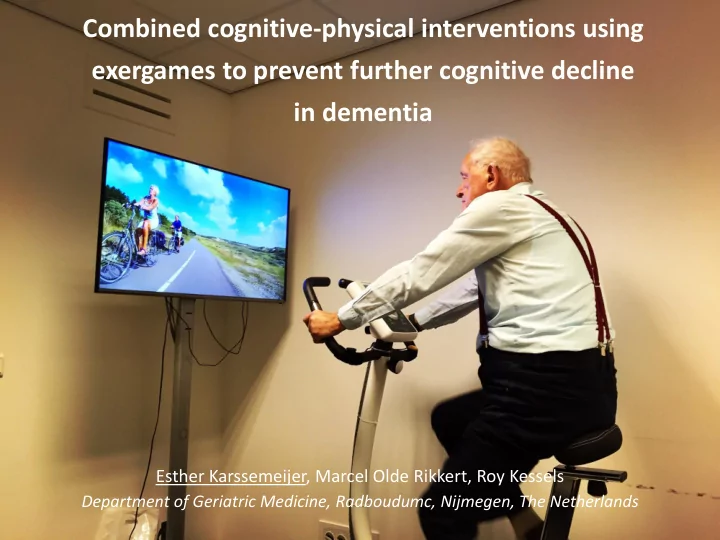
Combined cognitive-physical interventions using exergames to prevent - - PowerPoint PPT Presentation
Combined cognitive-physical interventions using exergames to prevent further cognitive decline in dementia Esther Karssemeijer, Marcel Olde Rikkert, Roy Kessels Department of Geriatric Medicine, Radboudumc, Nijmegen, The Netherlands CONFLICT OF
Esther Karssemeijer, Marcel Olde Rikkert, Roy Kessels
Department of Geriatric Medicine, Radboudumc, Nijmegen, The Netherlands
¹ Stern (2012), ² Ott (1995)
¹ ²
1. Physical activity (PA) as a non-pharamacological intervention 2. Combining cognitive-physical training 3. Exergames 4. Our research design 5. Use of exergames for patients with dementia
³ Angevaren et al. (2008), 4 Colcombe et al. (2006), 5 Erickson et al. (2011), 6 Nokia et al. (2016), 7 Lista et al. (2010)
7
7
8 Livingston et al. (2017)
8
Recommendations9 Physical inactivity (<3 MET) Sedentary behaviour (<1.5 MET) 150 min/week RISK!10
9 WHO (2010), 10 Ekelund et al. (2016)
Cell proliferation Cell survival 12
11 Shatil et al. (2013), 12 Olson et al. (2006), 13 Zhu et al. (2016)
What is the overall effect
14 Karssemeijer et al. (2017)
studies)
attention (3 studies)
(ADL) (4 studies)
1687 records screening 1597 excluded based on title/abstract 90 full text screening 80 excluded 10 studies included
14 Karssemeijer et al. (2017)
15 Oh en Yang (2010), 16 Stanmore et al. (2017)
17 Karssemeijer et al. (2017)
Exergaming (N=27) Single (N=28) Active control (N=28) M Age (years) (SD) 78.4 (7.0) 80.7 (6.4) 79.5 (4.3) M MMSE (SD) 22.7 (3.5) 22.6 (3.4) 22.3 (2.9) N Drop-out (%) 1 (4%) 4 (14%) 4 (14%) N Adherence-rate (%) low (< 50%) moderate (50-70%) high (> 70%) 1 (3.7%) 2 (7.4%) 24 (89%) 3 (10.7%) 6 (21.4%) 19 (68%) 4 (14.3%) 1 (3.6%) 23 (82.1%) M Rating (1-10) (SD) 7.7 (1.0) 8.4 (0.9) 8.3 (0.8) M Duration (SD) 31 (7.3) 31 (7.3) 30
“Exercise gives me a pleasent feeling.” “My loved one got more fit and cheerful due to training.” “My loved one got more active and social.” “Going to the training was a nice
some time for myself.” “Sometimes I did not feel like exercising, but afterwards I was glad I did it.” “Next training I would like to cycle through my home town.”
1. Personalized 2. Accompanied by a trained (family) caregiver 3. Use of exergames at home and in clinical settings a. feasibility studies are needed
18 Manera et al. (2017)