
SLIDE 1
COGS 121
HCI Programming Studio
Spring 2016
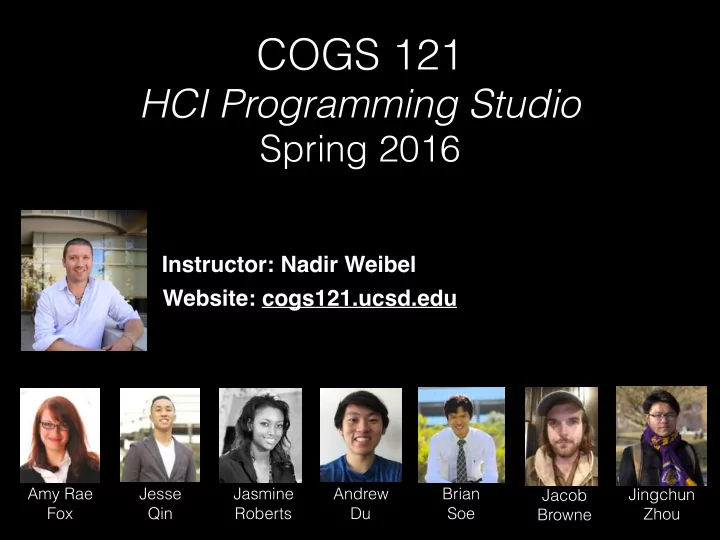
Instructor: Nadir Weibel
Amy Rae Fox Jesse Qin Jasmine Roberts Andrew Du Brian Soe
Website: cogs121.ucsd.edu
Jingchun Zhou Jacob Browne
COGS 121 HCI Programming Studio Spring 2016 Instructor: Nadir - - PowerPoint PPT Presentation
COGS 121 HCI Programming Studio Spring 2016 Instructor: Nadir Weibel Website: cogs121.ucsd.edu Amy Rae Jesse Jasmine Andrew Brian Jingchun Jacob Fox Qin Roberts Du Soe Zhou Browne HCI Programming Studio Cognitive Science 121 is
Instructor: Nadir Weibel
Amy Rae Fox Jesse Qin Jasmine Roberts Andrew Du Brian Soe
Website: cogs121.ucsd.edu
Jingchun Zhou Jacob Browne
COGS: 120 - Interaction Design + CSE : 8B - Intro/Computer Sci. Java (II) OR CSE : 11 - Intr/Computer Sci&Obj-Ori:Java
Cognitive Science 121 is the second course in the HCI sequence, focusing on interaction architectures, programming techniques, and cognitive and computational principles for designing effective systems.
Schedule
Work
Logistics
DELPHI guest
Design Lecture Tuesdays 2:00p-3:20pm, HSS 1330 Fundamental concepts, theories and principles Tech Lecture Thursdays 2:00p-3:20pm, HSS 1330 Tools, technologies and techniques for implementing web-based applications Studios Hands-on practice and collaboration, supported by TAs (1) Fridays, 1:00pm-1:50pm, HSS 1346, Andrew Du & Jingchun Zhou (2) Fridays, 1:00pm-1:50pm, CSE 2154, Brian Soe & Jacob Browne (3) Fridays, 2:00pm-2:50pm, HSS 1346, Jasmine Roberts & Jingchun Zhou (4) Fridays, 2:00pm-2:50pm, CSE 2154, Jesse Qin & Jacob Browne
Weeks 1 - 5 Design lectures: Fundamentals of UX design + In-Class activities Tech lectures: Technologies + Group Assignments Studios: Quizzes + Group assignments Weeks 6-10 Lectures: Presentations & Design Critiques Studios: Quizzes & Final Project activities Finals Week Final Project Presentations
—> do weekly readings —> attend design lectures —> attend tech lectures —> attend studio section … for real —> bring an internet-connected device to each class —> take quizzes in studio section —> work collaboratively in a group —> 5 assignments (1 individual + 4 group) —> 1 group project —> active participation in design critiques
Designing the User Interface: Strategies for Effective Human- Computer Interaction (5th Edition) Ben Shneiderman & Catherine Plaisant & Maxine Cohen & Steven Jacobs (2016) Designing with the Mind in Mind, Second Edition: Simple Guide to Understanding User Interface Design Guidelines, Jeff Johnson (2014) Design for Information: An Introduction to the Histories, Theories, and Best Practices Behind Effective Information Visualizations by Isabel Meirelles (2013) Interactive Data Visualization for the Web by Scott Murray (2013) Mining the Social Web: Data Mining Facebook, Twitter, LinkedIn, Google+, GitHub, and More Matthew A. Russell (2013)
Readings are listed on website - read before design lecture —> tested by quiz in Friday studio
All readings are available through the UCSD Library -- see the course website for the link
Conceptual grounding in the literature and practical guidance for implementation
rapidly changing.
increasingly need today is to be able to quickly locate relevant current material on the web
provided
resources they discover in the piazza discussion forum
Convey the fundamentals of user interface design for web-based systems, and facilitate the linking between models of human cognition and user interface design
usability for interactive systems information design visual design accessibility design principles …and more
Give you hands-on practice with design and prototyping techniques
in-class design activities
Learn to implement some of the discussed design concepts as part
social media APIs & SDKs (e.g. Facebook, Twitter) https://developers.facebook.com/ https://dev.twitter.com/ data visualization libraries http://d3js.org/ Share practical expertise and frameworks for better managing groups, and delivering team programming efforts
project management processes, agile pm processes, agile programming processes
Jesse Qin Jasmine Roberts Andrew Du Brian Soe
Review and assistance with topics covered in each week’s lecture In-class time to work on assignments and group project Help with design & technical questions Weekly quiz on reading and lecture content
Help you to be successful & facilitate group work
in Thursday lecture.
programming environment
single members of the team.
from TAs in Friday Studio.
per minute thereafter.
Google Form that will be made available by your TA.
Assignment 4 will bootstrap your projects and will be the first deliverable for your final project team. Assignments will be iterative and will build upon each other
Design & build an interactive web application using data from the UCSD DELPHI project http://delphi.ucsd.edu/
Apply design & technical learning Using design principles, programming techniques and technologies learned in lectures and through assignments Work in agile teams Practicing agile PM & programming techniques to collaborate on design & programming, leveraging & improving the skills of each team member Regular (iterative) Progress Deliverables each week in accordance with milestones to ensure regular progress is being made and feedback can be delivered
balance of skills in programming and design
available to them during weekly Studio and office hours.
and present their final product during the assigned final exam time for the course during finals week
asked to assess the contributions of each member of the team
ask the class for feedback, which will be given during the design critique
(1) a slide demonstrating progress since last week, focusing on the milestone topic (2) summary of collaboration within the group, (3) one thing that has been solved over the last week that might benefits the other groups (4) four questions they would like classmates to address in giving feedback (rubric).
(for Tuesday's presentation) or Wednesday night (for Thursday's presentations) by 11.59pm.
summary of critiques and feedback from the class.
describing the technical implementation of the project.
assigned lecture period, demonstrating their progress focusing on the milestone topic for the week (e.g. project idea, data flow, information architecture, visual design)
to the presenters, guided by the presenter’s rubric questions, using the TopHat web application
realtime online discussion.
How can we scale an intimate design studio experience to a class of 80+ students?
Weekly Quizzes 20% Assignments 1-4 30% Attendance 10% Final Project 40%
Please review the course website for full instructions on grading criteria for each assignment and the projects and for submission instructions
Email — UCSD Addresses only We will use your official UCSD e-mail address, as registered in TritonLink. Announcements & Discussion — Piazza http://piazza.com/ucsd/spring2016/cogs121 Avoid email… post your questions on Piazza We will try to maintain a few hour turnaround time on piazza questions. (no guarantees for email!) Subscribe to these forums so that you automatically receive forum posts as an e- mail. Official source of information — Course website http://cogs121.ucsd.edu Assignments, lecture slides, detailed schedule, readings grading policies… etc. In case of emergency… If you need to communicate with the Cogs 121 staff please always use the prefix[COGS 121] in your email subjects. There are two distributions lists for this class: Use cogs121@hci.ucsd.edu if you need to reach all the instructors. Use cogs121-ta@hci.ucsd.edu if you need to reach only TA and tutors.
A platform that will help us create an active learning environment
https://tophat.com/
$24 dollars for the quarter (but hey you don’t have to purchase textbooks!) Registration for Tophat should be done by Friday check Piazza for the “course join code”
A survey platform that will help us make productive, balanced groups
Expect an email from the system to your UCSD email by Friday. MUST RESPOND BY SUNDAY AT MIDNIGHT.
No Assigned Readings Thursday Lecture: Project management & being an efficient team + start Assignment 0 Friday Studio : all studios in HSS 1346 - Assignment 0 (no quiz) TODO
see Amy after class