ClubMac Database Presentation Presented by Ron Brunet Spreadsheet - - PowerPoint PPT Presentation

clubmac database presentation
SMART_READER_LITE
LIVE PREVIEW

ClubMac Database Presentation Presented by Ron Brunet Spreadsheet - - PowerPoint PPT Presentation

ClubMac Database Presentation Presented by Ron Brunet Spreadsheet vs. Database Software Definitions Uses for spreadsheet software Uses for database software Spreadsheet Software A modern spreadsheet file consists of multiple


slide-1
SLIDE 1

ClubMac Database Presentation

Presented by Ron Brunet

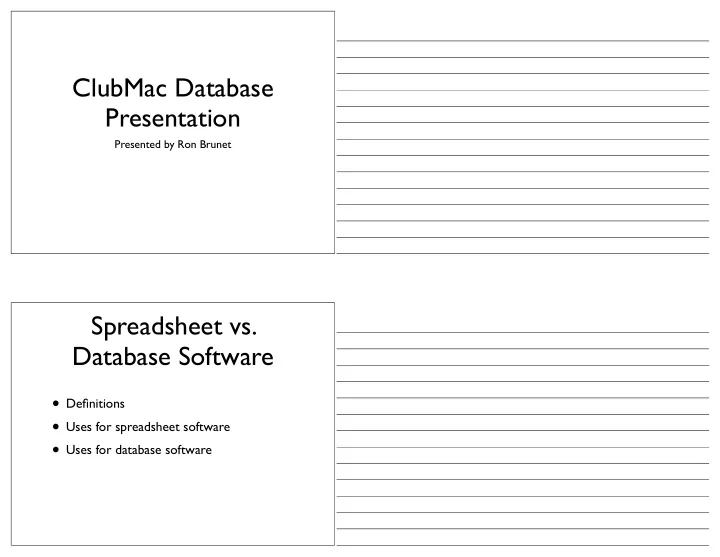
Spreadsheet vs. Database Software

  • Definitions
  • Uses for spreadsheet software
  • Uses for database software
slide-2
SLIDE 2

Spreadsheet Software

  • A modern spreadsheet file consists of multiple

worksheets that make up one workbook, with each file being one workbook.

  • A cell on one sheet is capable of referencing cells on
  • ther, different sheets, whether within the same

workbook or even, in some cases, in different workbooks.

Spreadsheet Software

  • Spreadsheets share many principles and traits of

databases, but spreadsheets and databases are not the same thing.

  • A spreadsheet is essentially just one table, whereas a

database is a collection of many tables

slide-3
SLIDE 3

Spreadsheet Software

  • While it is true that a workbook that contains three

sheets is indeed a file containing multiple tables that can interact with each other, it lacks the relational structure of a database.

  • Spreadsheets and databases are interoperable—

sheets can be imported into databases to become tables within them, and database queries can be

exported into spreadsheets for further analysis.

Spreadsheet Software

  • A formula identifies the calculation needed to place

the result in the cell it is contained within.

  • Spreadsheets usually contain a number of supplied

functions, such as arithmetic operations (for example, summations, averages and so forth), trigonometric functions, statistical functions, and so

  • forth. In addition there is often a provision for user-

defined functions

slide-4
SLIDE 4

Database Software

  • A database is a structured collection of data. The

data are typically organized to model relevant aspects of reality (for example, the availability of rooms in hotels), in a way that supports processes requiring this information (for example, finding a hotel with vacancies).

  • The term database is correctly applied to the data

and their supporting data structures, and not to the database management system (DBMS). The database data collection with DBMS is called a database system.

Database Software

  • Database software allows you to organize

information (data). This helps users keep track of lists of things, sort the information by categories and find data that fits specific criteria.

  • The telephone directory is one example of a
  • database. Database software also helps users

manage product inventories, customer accounts, library holdings and even websites.
slide-5
SLIDE 5

Database Types

  • A basic database that keeps all of your field names

and data in the same file is a flat file database. You create flat file databases to manage all of your information about a particular topic or list.

  • However, if your databases hold related information

about several topics or lists, you should create a relational database. It is more flexible and powerful than a flat file. It allows you to store the fields for a customer's name and address in a separate file from the one that you use to store the customer's purchase history. A common field such as the customer's ID number links the databases.

Creating a Database

  • Sketch your design on paper before you start. This

will give you a guide to go by as you construct it on the computer.

  • Use tutorials on the Filemaker website )http://

www.filemaker.com/) and others like Lynda.com (http://www.lynda.com/).

  • Use templates supplied with the program or

download from the internet.

slide-6
SLIDE 6

Example Databases

  • A flat file database used for managing student

information in for a school guidance office.

  • A relational database for managing a school

Advanced Placement (AP) program.

  • Examples of some templates.

Database Resources

  • http://www.filemaker.com/products/filemaker-pro/12/resources.html/
  • http://www.Lynda.com/
  • http://www.vtc.com/products/FileMaker-Pro-11-Beginner-Tutorials.htm
  • http://filemakerfree.com/index.html
  • http://www.briandunning.com/filemaker-pro/
  • http://filemaker.suisolutions.com/products/
  • http://www.filemakertoday.com/com/forumdisplay.php/7-FileMaker-Pro-and-the-Web
  • http://info.filemaker.com/US-en-FM12-iOS-Platform-LP

.html?source=S6

  • http://www.easyfreeware.com/freeware/filemaker.html