Clinical Trials in OSA Samuel T. Kuna, MD Department of Medicine - - PDF document

clinical trials in osa
SMART_READER_LITE
LIVE PREVIEW

Clinical Trials in OSA Samuel T. Kuna, MD Department of Medicine - - PDF document

2/13/2018 24th ANNUAL ADVANCES IN SLEEP APNEA AND SNORING February 16-17, 2018 Grand Hyatt on Union Square San Francisco, California Clinical Trials in OSA Samuel T. Kuna, MD Department of Medicine Center for Sleep and Circadian


slide-1
SLIDE 1

2/13/2018 1

Clinical Trials in OSA

24th ANNUAL ADVANCES IN SLEEP APNEA AND SNORING February 16-17, 2018 Grand Hyatt on Union Square • San Francisco, California

Samuel T. Kuna, MD

Department of Medicine Center for Sleep and Circadian Neurobiology University of Pennsylvania and Sleep Medicine Section Crpl Michael J. Crescenz VAMC Philadelphia, PA

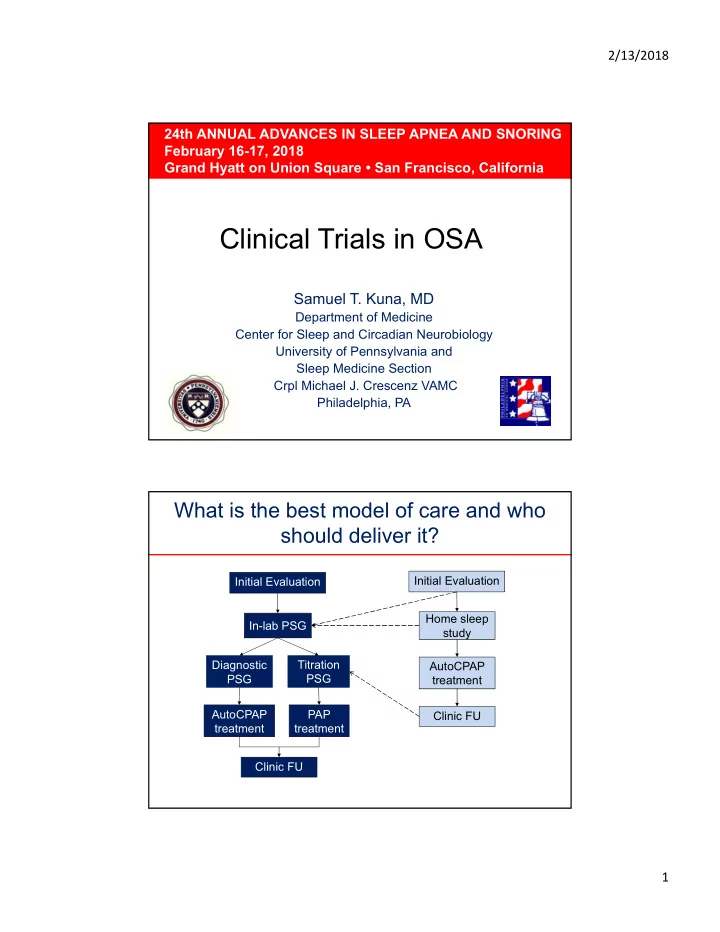
AutoCPAP treatment AutoCPAP treatment In-lab PSG Home sleep study PAP treatment Clinic FU Titration PSG

What is the best model of care and who should deliver it?

Diagnostic PSG Initial Evaluation Initial Evaluation Clinic FU

slide-2
SLIDE 2

2/13/2018 2

Clinic F/U In-lab PSG AHI < 15 AHI < 15 In-lab PSG CPAP titration Home APAP titration In-lab (split night) polysomnogram Home sleep study Set home CPAP to APAP titration

Veterans Sleep Apnea Treatment Trial

CPAP adherence Functional Outcomes Medical Care Cost Sleep Clinic Evaluation Set home CPAP to PSG CPAP titration Kuna et al. AJRCCM 183:1238-44, 2011

Mean (SD) of FOSQ total score by treatment group at baseline and month 3 in subjects initiated on CPAP

Kuna et al. AJRCCM 183:1238-44, 2011

slide-3
SLIDE 3

2/13/2018 3

Endpoint Home adjusted mean change1 (n=105) In-lab adjusted mean change1 (n=96) Adjusted difference in mean changes (SE) P-value2 Lower bound of 90% CI for difference in mean changes

FOSQ total score 1.79 1.79 0.04 (0.33) 0.99

  • 0.54

1 Adjusted mean changes and adjusted differences in mean changes were estimated as site-

total sample-size weighted values controlling for treatment group differences in mean pre- treatment values

2 P-value from Type II sum of squares estimated by way of ANCOVA. To produce site

weighted comparisons the ANCOVA model included main effects for type of study (home vs in-lab), site, as well as the pre-treatment baseline value of the outcome measure.

Change in FOSQ score from baseline to month 3 between groups

Hypothesis: Ho: H-L  -1.0 vs. Ha: H-L  -1.0

Kuna et al. AJRCCM 183: 1238-1244, 2011.

Kuna et al. AJRCCM 2011; 183:1238-44 Endpoint Home adjusted mean1 (n=113) In-Lab adjusted mean1 (n=110) Adjusted difference in mean (SE)1 P-value2 Lower bound of 90% CI for difference in means
Mean CPAP (hr/day) 3.49 2.92 0.55 (0.32) 0.085 +0.03

1 Adjusted means and adjusted differences in means were estimated as site-total-sample-

size weighted values controlling.

2 P-value from Type II sum of squares estimated by way of analysis of covariance. To

produce site weighted comparisons the ANCOVA model included main effects for type of study (home vs in-lab) and site.

Mean CPAP adherence from baseline to month 3 between groups

Hypothesis: Ho: H-L  -0.75 vs. Ha: H-L  -0.75

Kuna et al. AJRCCM 183: 1238-1244, 2011.

Kuna et al. AJRCCM 2011; 183:1238-44

slide-4
SLIDE 4

2/13/2018 4 Home testing In-Lab testing

Variable N Mean P-value N Mean P-value ESS score 95

  • 2.6 ± 5.2

<0.0001 84

  • 2.9 ± 4.4

<0.0001 PVT lapses 90

  • 0.1 ± 3.4

0.77 85

  • 0.5 ± 4.0

0.26 SF-12 (phys) 91 1.1 ± 7.8 0.18 82 1.6 ± 9.0 0.10 SF-12 (mental) 91 2.5 ± 8.6 0.008 82 3.0 ± 10.2 0.009 CES-D 96

  • 1.4 ± 5.6

0.013 84

  • 2.2 ± 6.4

0.004

Change in secondary endpoints within treatment arm from baseline to month 3 in subjects initiated on CPAP

Kuna et al. AJRCCM 183: 1238-1244, 2011.

Kuna et al. AJRCCM 2011; 183:1238-44 Endpoint Home adjusted mean change1 In-Lab adjusted mean change1 Adjusted difference in mean changes ± SE P-value2 ESS score

  • 2.79
  • 2.66
  • 0.14 ± 0.61

0.82 PVT (transformed lapses)

  • 0.29
  • 0.24
  • 0.05 ± 0.47

0.91 SF-12 physical score 0.91 1.91

  • 1.00 ± 1.23

0.42 SF-12 mental health score 2.91 2.52 0.38 ± 1.35 0.78 CES-D

  • 1.56
  • 1.97

0.40 ± 0.87 0.64

1 Adjusted mean changes and adjusted differences in mean changes were estimated as site-total-sample-size weighted values controlling for treatment group differences in mean pre treatment baseline values. 2 P-value from Type II sum of squares estimated by way of analysis of covariance. To produce site weighted comparisons the ANCOVA model included main effects for type of study (home versus in-lab), site, as well as the pre treatment baseline value of the outcome measure.

Change from baseline to month 3 in subjects initiated on CPAP

Kuna et al. AJRCCM 183: 1238-1244, 2011.

Kuna et al. AJRCCM 2011; 183:1238-44

slide-5
SLIDE 5

2/13/2018 5

  • Mulgrew et al. Diagnosis and initial management of OSA

without polysomnography: A randomized validation study. Ann Intern Med. 2007;146:157-66.

  • Berry et al. Portable monitoring and autotitration versus

polysomnography for the diagnosis and treatment of sleep

  • apnea. Sleep. 2008;31:1423-31.
  • Rosen et al. A multi-site randomized trial of portable sleep

studies and PAP autotitration versus laboratory-based PSG for the diagnosis and treatment of OSA: The HomePAP

  • study. Sleep 2012; 35:757-67.
  • Antic et al. A randomized controlled trial of nurse-led care

for symptomatic moderate-severe obstructive sleep apnea. Amer J Respir Crit Care Med. 2009;179:501-8.

Patient-centered outcome research testing ambulatory management of OSA

Baseline assessment Diagnostic PSG

(n = 406)

Level 2

(n = 136)

Level 1

(n = 135)

Level 3

(n = 135)

4-mo follow-up

(n = 98)

4-mo follow-up

(n = 103)

4-mo follow-up

(n = 109)

Laboratory PSG or limited-channel sleep studies for OSA

Chai-Coetzer et al. Ann Intern Med 2017; 166:332-240

slide-6
SLIDE 6

2/13/2018 6

Chai-Coetzer et al. Ann Intern Med 2017; 166:332-240

Laboratory PSG or limited-channel sleep studies for OSA Alternate methods of titrating CPAP

To eliminate hypopneas, snoring and flow limitation BMI, AHI, and Neck Circumference with domestic adjustment

360 patients with suspected OSA Diagnostic PSG

AHI  30; ESS  12

Manual in-lab titration

(n = 107)

Home autoadjust

(n = 106)

Predicted formula

(n = 115) One night at home with AutoSet-T. Repeat x2 prn Masa et al. AJRCCM 2004; 170:1218-1224

Outcome measures following 12 weeks CPAP treatment: In-lab PSG (AHI), ESS, FOSQ, SF-36, EuroQOL

slide-7
SLIDE 7

2/13/2018 7

Autoadjusted vs fixed CPAP for OSA: a multicentre, randomised equivalence trial

Bloch KE et al. Thorax 2018;73:174–184

Apnea-hypopnea index CPAP use

Autoadjusted vs fixed CPAP for OSA: a multicentre, randomised equivalence trial

Bloch KE et al. Thorax 2018;73:174–184

Epworth Sleepiness Scale Functional Outcome of Sleep

slide-8
SLIDE 8

2/13/2018 8 195 patients with newly diagnosed OSA (AHI ≥ 15) Randomized (n=139) Usual care

(n=53)

3 month Visit (n=52) Web-based access + $$ incentive (n=40) Web-based access (n=46) 3 month Visit (n=45) 3 month Visit (n=39)

Does giving patients access to their PAP data improve treatment use?

Kuna ST et al. Sleep 2015; 38: 1229-36

1 2 3 4 5 6 7

Weeks

2.0 3.0 4.0 6.0 7.0

Mean (SD) hours of use per week over 3 months

Average hours of use per week

5.0 8 9 10 11 12 Web only Web + $$ Usual care 1 2 3 4 5 2.0 3.0 4.0 6.0 7.0

Mean (SD) hours of use per week over 3 months

Average use per week (hr)

5.0

Kuna ST et al. Sleep 2015; 38: 1229-36

slide-9
SLIDE 9

2/13/2018 9

AutoCPAP treatment AutoCPAP treatment In-lab PSG Home sleep study CPAP treatment Clinic FU Split PSG

The emerging paradigm: HSAT, autoCPAP with remote monitoring and videoconferencing

Diagnostic PSG Phone or video teleconference Store and forward

  • f wireless data

Store and forward Phone or video teleconference Initial In-person Long term management Phone or video teleconference

  • 155 patients with OSA recruited from primary care practices
  • High diagnostic likelihood of moderate to severe OSA

based on a screening questionnaire, ODI-3% ≥ 16 events/hr, ESS ≥ 8

  • Randomized to management at the primary care practice or

the sleep center

  • Community-based nurse and PCP physician participated in

a 6-hour education program on OSA and its management

  • Community-based nurses received 5 days of in-service

training with specialist nurses at the sleep center

Primary care practice vs sleep center management of OSA

Chai-Coetzer et al. JAMA. 2013;309(10):997-1004

slide-10
SLIDE 10

2/13/2018 10 Adjusted difference in mean change 0.13 Lower bound of 1-Sided 95% CI

  • 1.5

Change in Epworth score at 6 months

Chai-Coetzer et al. JAMA. 2013;309(10):997-1004

Primary care practice vs sleep center management of OSA

Primary Care Specialist Sleep Center Chai-Coetzer et al. JAMA. 2013;309(10):997-1004

No difference in secondary outcomes at 6 months

Primary care practice vs sleep center management of OSA

slide-11
SLIDE 11

2/13/2018 11

Conclusions

  • Functional outcomes and CPAP use with

ambulatory management of patients with OSA is not clinically inferior to that with in-laboratory management

  • Management and outcomes are improved using a

type 3 rather than a type 4 portable monitor

  • Application of telehealth, HST, and autoCPAP with

wireless monitoring is enabling patient access to care without traveling to a sleep center

  • Emerging evidence that non-MD healthcare

providers can manage patients with OSA