
1
Statistical NLP
Spring 2011
Lecture 11: Classification
Dan Klein – UC Berkeley
Classification
Automatically make a decision about inputs
Example: document → category Example: image of digit → digit Example: image of object → object type Example: query + webpages → best match Example: symptoms → diagnosis …
Three main ideas
Representation as feature vectors / kernel functions Scoring by linear functions Learning by optimization
2
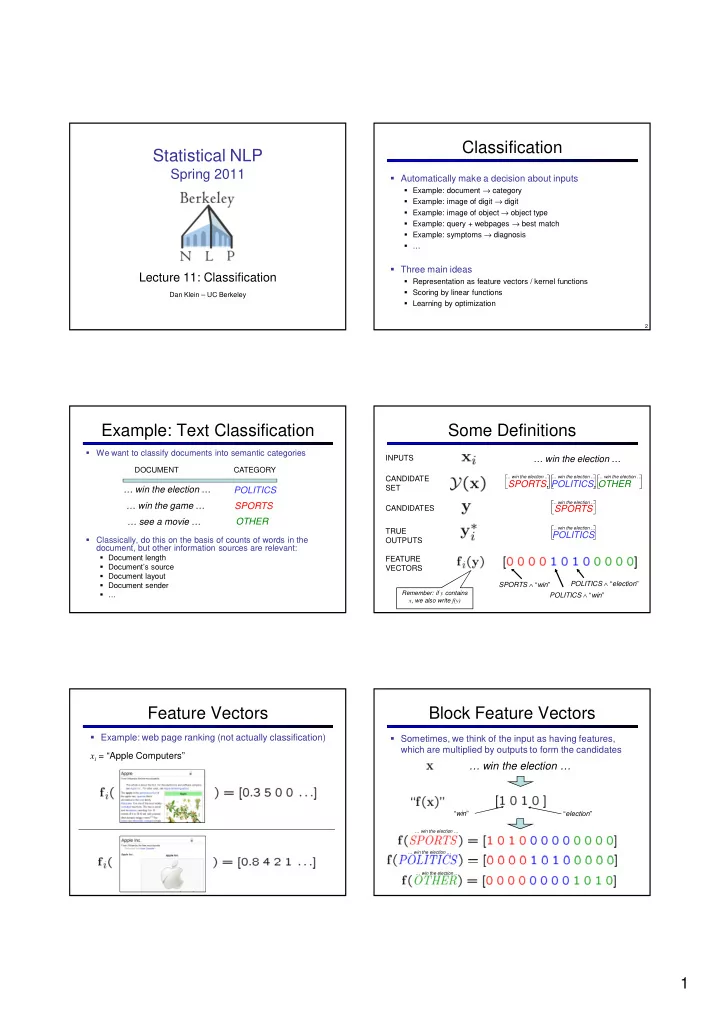
Example: Text Classification
We want to classify documents into semantic categories Classically, do this on the basis of counts of words in the document, but other information sources are relevant:
Document length Document’s source Document layout Document sender …
… win the election … … win the game … … see a movie … SPORTS POLITICS OTHER
DOCUMENT CATEGORY
Some Definitions
INPUTS CANDIDATES FEATURE VECTORS
… win the election …
CANDIDATE SET
SPORTS ∧ “win” POLITICS ∧ “election” POLITICS ∧ “win”
TRUE OUTPUTS
Remember: if y contains x, we also write f(y)
SPORTS, POLITICS, OTHER
… win the election … … win the election … … win the election …
SPORTS
… win the election …
POLITICS
… win the election …
Feature Vectors
Example: web page ranking (not actually classification) xi = “Apple Computers”
Block Feature Vectors
Sometimes, we think of the input as having features, which are multiplied by outputs to form the candidates
… win the election …
“win” “election”
… win the election … … win the election … … win the election …