Classical vs prototype model of categorization Classical model - - PowerPoint PPT Presentation

classical vs prototype model of categorization
SMART_READER_LITE
LIVE PREVIEW

Classical vs prototype model of categorization Classical model - - PowerPoint PPT Presentation

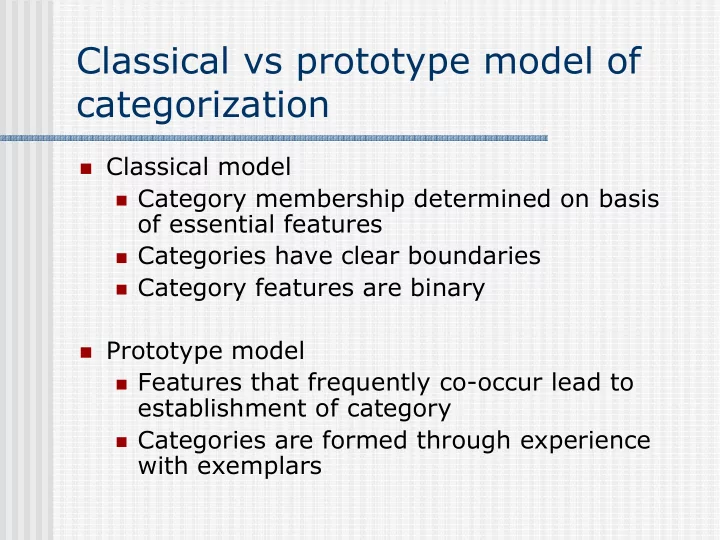
Classical vs prototype model of categorization Classical model Category membership determined on basis of essential features Categories have clear boundaries Category features are binary Prototype model Features that


slide-1
SLIDE 1

Classical vs prototype model of categorization

Classical model

Category membership determined on basis

  • f essential features

Categories have clear boundaries Category features are binary

Prototype model

Features that frequently co-occur lead to

establishment of category

Categories are formed through experience

with exemplars

slide-2
SLIDE 2

Prototype theory

1.

Certain members of a category are prototypical – or instantiate the prototype

2.

Categories form around prototypes; new members added on basis of resemblance to prototype

3.

No requirement that a property or set of properties be shared by all members

4.

Features/attributes generally gradable

5.

Category membership a matter of degree

6.

Categories do not have clear boundaries

slide-3
SLIDE 3

Prototype theory

1.

Certain members of a category are prototypical – or instantiate the prototype

Category members are not all equal a robin is a prototypical bird, but we may not want to say it is the prototype, rather it instantiates (manifests) the prototype or ideal -- it exhibits many of the features that the abstract prototype does “It is conceivable that the prototype for dog will be unspecified for sex; yet each exemplar is necessarily either male or female.” (Taylor)

slide-4
SLIDE 4

2.

Categories form around prototypes; new members can be added on the basis of resemblance to the prototype Categories may also be extended on the basis

  • f more peripheral features

axe for guitar house for apartment

Prototype theory

slide-5
SLIDE 5

3.

No requirement that a property or set of properties be shared by all members -- no criterial attributes

  • Category where a set of necessary and sufficient

attributes can be found is the exception rather than the rule

  • Labov household dishes experiment
  • Necessary that cups be containers, not sufficient since

many things are containers

  • Cups can’t be defined by material used, shape, presence
  • f handles or function

Prototype theory

slide-6
SLIDE 6

Prototype theory

Wittgenstein’s examination of game

  • Generally necessary that all games be amusing, not

sufficient since many things are amusing

  • Board games, ball games, card games, etc. have

different objectives, call on different skills and motor routines

  • categories normally not definable in terms
  • f necessary and sufficient features
slide-7
SLIDE 7

What about mathematical categories like odd or

even numbers? Aren’t these sharply defined?

(Armstrong et al. < Taylor) Subjects asked to assign

numbers a degree of membership to the categories odd number or even number 3 had a high degree of membership, 447 and 91 had a lower degree (all were rated at least ‘moderately good’)

Prototype theory

slide-8
SLIDE 8

Prototype theory

Expert vs. folk categories

Intuition that some categories are not fuzzy

  • Odd/even numbers, species designations, legal terms
  • Expert categories are defined in precise way by select people
  • (McCrone)

“We may believe that our brains are swollen with facts about the history of the Roman Empire or the geography of Latin america but such schoolbook learning takes up only a few shelves in a mind stuffed with knowledge about the minute details of everyday living”

Folk categories are based on experience and characterized by

prototype

slide-9
SLIDE 9

Prototype theory

Some categories can be both expert

and folk

  • Ex. Adult - has a precise legal definition
  • Normally we categorize adults based on

physical and behavioral attributes

slide-10
SLIDE 10

4.

Features generally gradable Prototypicality is recursive-- (features or attributes are categories too)

  • the very attributes on whose basis membership in a

category is determined are more often than not themselves prototype categories.

Binary feature - property that can be judged as either present or absent

  • rare - even dead or alive, true or false, male or

female, left or right have some gray area

Prototype theory

slide-11
SLIDE 11

Prototype theory

Most features are in some way gradable note even the notion of gradable is gradable--

some categories are much more gradable than

  • thers like tall as opposed to dead

Some neurons are on or off, some have variable

  • utputs. Often they have thresholds. What it

takes to make the cell fire is gradable.

Visual receptor cells fire in response to correct input Edge detectors give variable response

slide-12
SLIDE 12

Bad input good input intermediate

slide-13
SLIDE 13

light edge contour claw cat texture fur sound [miaU] color pitch frequency purrr

slide-14
SLIDE 14

5.

Category membership a matter of degree

  • (Rosch) Subjects asked to what extent items

belonged to a category (rate 1-7)

  • Ex. Furniture
  • Chair, sofa, couch, table (~1)
  • Lamp, stool, piano (~3)
  • Ashtray, fan, telephone (~7)

Prototype theory

slide-15
SLIDE 15

Membership a matter of co-occurrence of

features

Prototypes have more co-occuring

features, features with high cue validity (conditional probability

Frequency of encountering probably not a

factor

Do we encounter tables and chairs more

frequently than mirrors and clocks?

Prototype theory

slide-16
SLIDE 16
  • Hedges
  • Phrases that signal a qualification of the

truth of some claim

  • Par excellence, loosely speaking, strictly

speaking, in that, as such

  • Ex. Par excellence picks out central members
  • f category

1.

A robin is a bird par excellence

2.

?A turkey is a bird par excellence.

Prototype theory

slide-17
SLIDE 17

Loosely/strictly speaking pick out extend or tighten the category respectively:

1.

?Loosely speaking, a chair is a piece of

furniture

2.

Loosely speaking, a telephone is a piece of furniture

1.

?Strictly speaking, beans are vegetables.

2.

Strictly speaking, rhubarb is a vegetable.

Prototype theory

slide-18
SLIDE 18

In that spells out reasons for assigning an entity to a category when it shares only more peripheral attributes of that category.

1.

*He killed Alice in that he murdered her.

2.

He killed alice in that he did nothing to keep her alive.

3.

She’s a friend of mine in that I’ve known her for years, but we’re really not that close.

Prototype theory

slide-19
SLIDE 19

6.

Categories do not have clear boundaries

Examples from Labov

Prototype theory

slide-20
SLIDE 20

Prototypes can be ideal case or typical case

(stereotype)

(Lakoff) consider the prototypical husband vs

the ideal husband.

Prototype theory

slide-21
SLIDE 21

Prototype theory

Prototype logic Stereotyping - chunking

Attributing properties of the prototype

to anything assigned to the category

  • Is Reno east or west of San Diego?
  • REM
  • Sociocultural stereotypes
slide-22
SLIDE 22

Prototype theory

Prototype model is consistent with associative

model of cognition

Hebbian learning – the more things co-occur,

the stronger their representations are connected

Prototypes inhere in strong connections between

category and features.

features have different degrees of centrality

for the category

  • Head shape > meow > tail > chase mice

Members possess different patterns of

features

slide-23
SLIDE 23

Prototype theory

[miaU] Cat

slide-24
SLIDE 24

Categories - who decides?

Embodied theory of meaning- categories

are not pre-formed and waiting for us to behold them. Our need for categories drives what categories we will have

Basic level categories - not all categories

have equal status. The basic level category has demonstrably greater psychological significance.

slide-25
SLIDE 25

Basic level category

Basic level category

Based on our optimal interaction with the environment

  • 1. Highest level at which a single mental image can represent

the entire category

Chair, screwdriver, dog (basic) Furniture, tool, animal (superordinate)

slide-26
SLIDE 26

Basic level category

2.Highest level at which category members have similarly perceived overall shapes.

cat, but not animal, hammer, but not tool

3.Highest level at which a person uses similar motor actions for interacting with category members

Separate motor programs for interacting with chair, bed, table, but not for interacting with furniture.

slide-27
SLIDE 27

Basic level category

Basic level terms are used in subordinate

categories claw hammer, tack hammer