CIS 111: Overview CIS 111: Overview Instructor: Julie Thornton - - PowerPoint PPT Presentation

cis 111 overview cis 111 overview
SMART_READER_LITE
LIVE PREVIEW

CIS 111: Overview CIS 111: Overview Instructor: Julie Thornton - - PowerPoint PPT Presentation

CIS 111: Overview CIS 111: Overview Instructor: Julie Thornton Instructor E-mail: juliet@ksu.edu Office Hours (N231): 10:00-12:00 Th ** Teaching Assistant: Cody Narber TA E-mail: cgnarber@ksu.edu Office Hours (N227): 12:30-2:30 W Th ** **or


slide-1
SLIDE 1

CIS 111: Overview CIS 111: Overview

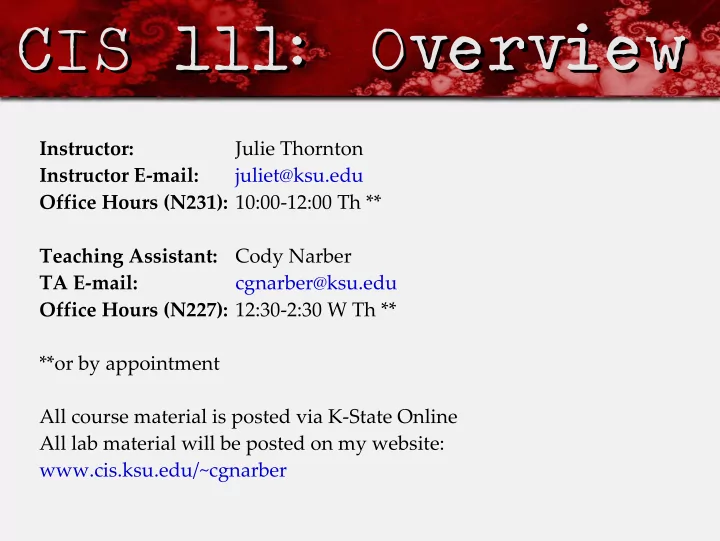
Instructor: Julie Thornton Instructor E-mail: juliet@ksu.edu Office Hours (N231): 10:00-12:00 Th ** Teaching Assistant: Cody Narber TA E-mail: cgnarber@ksu.edu Office Hours (N227): 12:30-2:30 W Th ** **or by appointment All course material is posted via K-State Online All lab material will be posted on my website: www.cis.ksu.edu/~cgnarber

slide-2
SLIDE 2

CIS 111: Syllabus CIS 111: Syllabus

The full syllabus can be found on K-State Online. Be sure to read it. Key Points of Interest:

  • Textbook
  • Prerequisite
  • Material to be covered
  • Attendance
  • Projects – 8 (Exams – 2)
  • Grading Scale
  • Academic Honesty
slide-3
SLIDE 3

Java/ BlueJ Java/ BlueJ

Java can be downloaded at: http://java.sun.com/ BlueJ can be downloaded at: http://bluej.org/

  • Make sure to install Java before BlueJ.
  • A more in-depth installation and user guide can be found on K-State

Online.

slide-4
SLIDE 4

First Program First Program

Your first program: Hello World!

public class Hello { public static void main(String [] args) { System.out.println(“Hello World!”); } }

  • What does each line of code mean?
  • What do the quotes do for us?
  • What do the braces {} do?
slide-5
SLIDE 5

Comments Comments

Comment – is a section of code that the computer will ignore. They are used to enhance the readability of one's code. Single line: //Anything following the slashes is ignored by the compiler Multi-line: /* Anything sandwiched between the slash/stars is ignored. Like this line, hurray! */ Comments are used primarily to describe code that directly precedes or directly follows them.

slide-6
SLIDE 6

Display Sample Display Sample

Write a program that displays: This program should contain a single class (called Signal) with a main

  • method. (You should have a comment block at the top of your code)
slide-7
SLIDE 7

Sample Program Sample Program

Solution to last Slide

/** * Displays an image of an object and it's "signal" * * @author Cody Narber */ public class Signal { public static void main(String [] args) { System.out.println(" > <"); System.out.println(" > <"); System.out.println("> > __ < <"); System.out.println("> > {__} < <"); System.out.println("> > || < <"); System.out.println(" > ++ <"); System.out.println(" > (__) <"); System.out.println(" (__)"); System.out.println(" (____)"); } }

slide-8
SLIDE 8

Test Your Skills Test Your Skills

Write a program that displays: This program should contain a single class (called Lab1) with a main

  • method. (You should have a comment block at the top of your code)
slide-9
SLIDE 9

Homework Homework

  • Complete Project 1: posted under Week 1 (Due Thursday @ 5:00 PM)
  • Read all material posted under Week 1 (if not done already)
  • Watch all tegrity lectures that are posted under Week 2