Circular City Economies Resilient Cities 2018, Bonn, Germany - - PowerPoint PPT Presentation

circular city economies
SMART_READER_LITE
LIVE PREVIEW

Circular City Economies Resilient Cities 2018, Bonn, Germany - - PowerPoint PPT Presentation

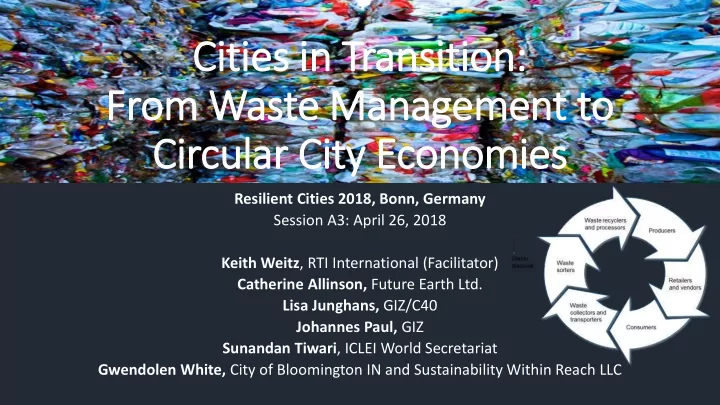
Cities in Transition: : From Waste Management to Circular City Economies Resilient Cities 2018, Bonn, Germany Session A3: April 26, 2018 Keith Weitz , RTI International (Facilitator) Catherine Allinson, Future Earth Ltd. Lisa Junghans, GIZ/C40


slide-1
SLIDE 1

Cities in Transition: : From Waste Management to Circular City Economies

Resilient Cities 2018, Bonn, Germany Session A3: April 26, 2018 Keith Weitz, RTI International (Facilitator) Catherine Allinson, Future Earth Ltd. Lisa Junghans, GIZ/C40 Johannes Paul, GIZ Sunandan Tiwari, ICLEI World Secretariat Gwendolen White, City of Bloomington IN and Sustainability Within Reach LLC

slide-2
SLIDE 2

01 – HOW BIG IS THE PROBLEM? 02 – WHY SHOULD WE CARE? 03 – WHAT ARE THE SOLUTIONS? 04 – HOW HAVE OTHERS DONE IT? 05 – HOW CAN I DO IT?

slide-3
SLIDE 3

Introduction

  • Waste represents inefficiency, which translates to economic loss and

significant environment and health impacts. Cities spend millions of Euro collecting and managing waste and it is one of the largest items in city

  • budgets. The current budget for the NY Department of Sanitation is more

than $1.6 billion Euro.

  • Policies and programs to reduce the amount of waste generated are a

priority, and turning waste that is generated into resource streams can generate revenues, create jobs and reduce impacts.

  • Transitioning from traditional waste management to a circular city

economy is a complex endeavor in which cities must navigate technology, political, economic, environmental, and socio-cultural aspects.

  • In this session our panelists will exchange knowledge, best practices,

technologies and innovative solutions to challenges facing cities as they transition to a circular city economy.

slide-4
SLIDE 4

How big is the problem and why should we care?

Source: World Economic Forum. 2018. Circular Economy in Cities Evolving the model for a sustainable urban future

slide-5
SLIDE 5

Source: Ellen MacArthur Foundation

Circular economy aims to maximize material reuse and recycling and minimize consumption

  • f finite resources and

leakage of outputs to the environment. “keep molecules in play…”

slide-6
SLIDE 6

Keith Weitz has more than 25 years of waste and materials management experience at RTI

  • International. Mr. Weitz works

with governments, NGOs, industries and stakeholders to understand the opportunities and challenges that cities face as they strive to improve waste management and implement a circular economy.

slide-7
SLIDE 7

Leads development of data and tools to support decisionmakers. The MSW DST was built at the request of cities to help them to better understand tradeoffs and impacts with respect to cost, energy, and environmental Impacts

Increase Revenue Increase Recycling Decrease Environmental Impacts Decrease Cost

slide-8
SLIDE 8

Panelists

  • Catherine Allinson is director of Future Earth Ltd., an independent project management and engagement

company specializing in the facilitation of urban sustainability and resource management, climate change mitigation and adaptation and human well-being for resilience. Catherine leads the UK Foreign and Commonwealth Office Smart Sustainable Cities initiative.

  • Lisa Junghans is a climate finance and urban resilience expert at GIZ and currently working in the C40

Cities Finance Facility, which facilitates access to finance for climate change mitigation and resilience projects in urban areas by translating cities’ sustainability priorities into bankable investment proposals. Lisa has experience in the fields of urban planning, climate change adaptation and finance.

  • Johannes Paul is a geologist and environmental engineer with more than 30 years of waste sector

experience working for various public, private sector and academic institutions in Germany, Canada, USA and Asia and currently is advisor to the GIZ global Sustainable Waste Management and Circular Economy

  • project. Johannes is involved in several research and development projects that relate to environmental

policy and circular economy with focus on waste management, marine litter and sectoral climate mitigation.

  • Sunandan Tiwari is Senior Program Manager of the Global Projects team at the ICLEI World Secretariat.

Sunandan has more than 20 years of experience as an ecologist and development specialist across a spectrum of sectors straddling the urban and rural domains. Has worked extensively on urban climate change adaptation and resilience building, including climate financing, biodiversity management, and sustainable urban development issues.

  • Gwendolen White is Chair of the City of Bloomington, Indiana, Commission on Sustainability and founder
  • f Sustainability Within Reach LLC, a sustainability consulting firm specializing in sustainability reporting,

sustainability strategy development, and assurance preparedness. She is a CPA, Global Reporting Initiative (GRI) Certified Trainer, and has experience in academia and public accounting. Gwen is author of Sustainability Reporting: Getting Started, 2nd Edition, published by Business Expert Press.
slide-9
SLIDE 9
slide-10
SLIDE 10
slide-11
SLIDE 11
slide-12
SLIDE 12

Technology alone will not get us to a circular economy. Technical solutions need to be coupled with viable and sustainable financial models, governance and institutional capacity, environmental protection, and socio- cultural change. Data and information available to city

  • fficials for making investment

decisions is often limited and can be conflicting with respect to solutions, leading to project failures.

slide-13
SLIDE 13

Source: Geyer R, Jambeck JR., Law KL. (2017) Production, use, and fate of all plastics ever made. In Sci Adv.

The fate of all plastics ever made (per 2015) shows a largely linear system

  • f make-take-

dispose. How do we better close this loop?

slide-14
SLIDE 14

Plastics can be transformed into new products, but…

slide-15
SLIDE 15

Ease of recycling for plastics waste

Easily melted and remolded multiple times without degradation of plastic quality Rarely recycled due to a limited market Less commonly recycled due to a limited but growing recycling market Rarely recycled due to concerns around leaching

Some types of plastic are more easily recycled than others.

slide-16
SLIDE 16

Source: Resource Recycling News, 2018

A major importer of recyclables, China has implemented import bans and stringent contamination requirements that many existing recycling programs and infrastructure are not designed to respond to. The impact on recycling rates has been immediate and significant. How can the circular economy be made resilient?

slide-17
SLIDE 17

Producers and retailers are making commitments that will reduce the amount of waste generated and increase the reusability and recyclability of their products. What is our role as consumers?

slide-18
SLIDE 18

Source: Ellen MacArthur Foundation

slide-19
SLIDE 19

THANK YOU!

Keith Weitz RTI International kaw@rti.org