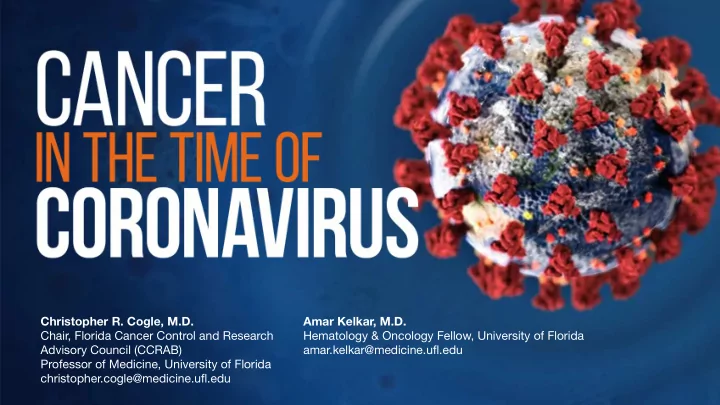
Christopher R. Cogle, M.D. Amar Kelkar, M.D. Chair, Florida Cancer - - PowerPoint PPT Presentation

christopher r cogle m d amar kelkar m d chair florida
SMART_READER_LITE
LIVE PREVIEW

Christopher R. Cogle, M.D. Amar Kelkar, M.D. Chair, Florida Cancer - - PowerPoint PPT Presentation

Christopher R. Cogle, M.D. Amar Kelkar, M.D. Chair, Florida Cancer Control and Research Hematology & Oncology Fellow, University of Florida Advisory Council (CCRAB) amar.kelkar@medicine.ufl.edu Professor of Medicine, University of Florida


slide-1
SLIDE 1

Christopher R. Cogle, M.D. Chair, Florida Cancer Control and Research Advisory Council (CCRAB) Professor of Medicine, University of Florida christopher.cogle@medicine.ufl.edu Amar Kelkar, M.D. Hematology & Oncology Fellow, University of Florida amar.kelkar@medicine.ufl.edu

slide-2
SLIDE 2

CONTENTS

  • Coronavirus 101
  • Cancer and COVID-19
  • Cancer Treatment
  • Prevention & Control of COVID-19
  • Questions & Answers

2

slide-3
SLIDE 3

WHAT ARE CORONAVIRUSES?

  • “corona” = crown
  • Origin estimated circa 2400-3300 BC
  • Coronavirus genera
  • alpha: cats, dogs, humans, bats, pigs
  • beta: humans, bats, camels, mice, hedgehogs
  • gamma: beluga whales, birds
  • delta: birds

3

slide-4
SLIDE 4

WHAT ARE CORONAVIRUSES?

  • Many cause “common cold”
  • But also caused:
  • SARS in 2002-2003
  • MERS on 2012
  • COVID-19 in 2019-2020

4

slide-5
SLIDE 5

WHAT IS COVID-19?

  • Common:
  • Fever
  • Cough
  • Shortness of Breath
  • 5 out of 6 have mild to moderate symptoms and recover.
  • 1 out of 6 develop pneumonia and multi-organ system failure.
  • First cases seen in Wuhan, China in December 2019
  • Human-to-human transmission
  • Spread by “droplets” not “aerosol”
  • Hand to Face (mouth, nose, eyes)

World Health Organization: Q&A on coronaviruses (COVID-19)

5

slide-6
SLIDE 6

1.Prolonged (10-30 minutes) and close contact (within 6 feet) with someone who has active symptoms (fever, cough, shortness of breath) or about to develop symptoms. 2.Hand touches droplets. 3.Hand touches face (mouth, nose, eyes).

HOW TO CATCH COVID-19

6

slide-7
SLIDE 7

COVID-19 RISK FACTORS FOR SEVERE DISEASE

Ø Older age (especially

  • ver 70 years-old)

Ø Lowered immune system

  • Under study:
  • Hypertension
  • ACE and ARB inhibitors
  • Males
  • Heart disease
  • Stroke
  • Cancer

Onder et al. JAMA. Published online March 23, 2020. doi:10.1001/jama.2020.4683

7

slide-8
SLIDE 8

1.Always know where your hands are and clean them often. 2.Don’t touch your face. Wear a

simple mask to prevent face touching. 3.Distance yourself. But call, videochat, or instant message your social circle.

3 HANDS-DOWN RULES TO LIVE BY

8

slide-9
SLIDE 9

WHEN TO GET HELP FOR CANCER PATIENTS

Call Your Doctor Get Tested for COVID-19 Go to the Hospital

  • Fever
  • Cough
  • Weakness or fatigue
  • Diarrhea
  • Dehydration
  • Someone COVID-19 positive

at home

  • Worsening cancer or

treatment symptoms

  • Fever
  • Cough
  • Shortness of breath
  • Neutropenic or

Transplant & Fever

9

slide-10
SLIDE 10

WHERE TO GET TESTED

  • County Health Departments
  • Drive-Thru T

est Sites (need referral from your doctor)

  • Avoid hospitals unless experiencing shortness of breath
  • The FDA has not approved any direct-to-consumer tests, yet.

10

slide-11
SLIDE 11

WHAT IF I OR SOMEONE I LIVE WITH HAS SYMPTOMS OF COVID-19?

  • Isolate within the home
  • If possible, stay in a separate room
  • r bathroom
  • Put a mask on the symptomatic

person at home if they need to be around others

  • Everyone must clean hands several

times a day

11

slide-12
SLIDE 12

WHY IS MY DOCTOR DELAYING MY TREATMENT NOW?

12

You or a close contact have COVID-19 Post-surgical treatment that can be temporarily delayed with low-risk Treatment with high-risk of weakening immune system Alternative treatment option by mouth is available Long-term treatment that can be temporarily delayed with low-risk

slide-13
SLIDE 13

WHY IS MY DOCTOR NOT DELAYING MY TREATMENT NOW?

  • Disease with high-risk of progression or

death in the next 2-4 weeks without therapy

  • No treatment alternatives that can be given

by mouth

  • Time-sensitive surgery
  • Symptoms uncontrollable by oral

medications

  • Life-threatening complication of disease

13

slide-14
SLIDE 14

WHAT OTHER STRATEGIES IS MY ONCOLOGIST USING TO PROTECT ME?

  • Reducing medication dosage
  • Lengthening time to start next cycle
  • T

elehealth visits

  • Switching injection to oral drug
  • Home health care

14

slide-15
SLIDE 15

WHAT DO I DO FOR RUNNY NOSE?

  • Monitor symptoms for development
  • f
  • cough,
  • fever, or
  • shortness of breath
  • Self-isolate in your home

15

slide-16
SLIDE 16

WHAT DO I DO FOR NAUSEA OR VOMITING?

Continue your usual management with anti-nausea and anti-vomiting medications

16

slide-17
SLIDE 17

WHAT DO I DO FOR DIARRHEA?

  • Call your oncologist to see if additional

testing is needed

  • Monitor symptoms for development of

cough, fever, or shortness of breath

  • Continue your usual management with anti-

diarrhea medications if this is part of your cancer plan and your symptoms have not changed

17

slide-18
SLIDE 18

EXERCISE & NUTRITION

  • Continue daily exercise goals
  • Try to prioritize exercises inside the

home

  • Avoid communal places like gyms
  • Try to maintain a balanced diet – there

is no need to change your nutritional plan due to COVID-19

  • Try to shop at low-volume times or ask

people you live with to go shopping to reduce your exposure to potentially sick individuals

18

slide-19
SLIDE 19

COVID-19 TREATMENTS

  • SOLIDARITY Clinical Trial
  • First patient March 28, 2020
  • Randomized treatments:

Ø Chloroquine and hydroxychloroquine Ø Lopinavir and ritonavir Ø Lopinavir, ritonavir, and interferon-beta Ø Remdesivir

19

https://doi.org/10.1186/ISRCTN83971151

slide-20
SLIDE 20

CORONAVIRUS VACCINES

  • 48 vaccines in

development

  • 2 vaccines currently

being tested in humans

  • Started March 16, 2020

20

World Health Organization: Landscape of COVID-19 candidate vaccines

slide-21
SLIDE 21

RATIONAL HOPE

  • Practice caution, not fear
  • Wave to your neighbors
  • Video and phone calls with loved ones
  • Be respectful to the service workers – grocery employees,

food and delivery workers, police officers, firefighters, military, etc.

  • Trust your doctors and clinics

21

slide-22
SLIDE 22

COMMON QUESTIONS

  • Can I play with my kids?
  • Can I go through the Bojangles drive-through?
  • Do hormone therapies weaken the immune system?
  • Should I suspend treatment in the middle of a course of

therapy?

  • Should I delay cancer surveillance scans?
  • Should I delay my biopsy?
  • Are all cancer patients immune compromised?

22

slide-23
SLIDE 23

PATIENT RESOURCES

  • CDC: https://www.cdc.gov/coronavirus
  • CDC Travel FAQ: https://www.cdc.gov/coronavirus/2019-

ncov/travelers/faqs.html

  • American Cancer Society: https://www.cancer.org/about-

us/what-we-do/coronavirus-covid-19-and-cancer.html

  • DOH of Florida: https://floridahealthcovid19.gov/
  • Cancer.Net: https://www.cancer.net/blog/tags/coronavirus
  • NPR Social Distancing: https://www.npr.org/sections/health-

shots/2020/03/17/817251610/its-time-to-get-serious-about- social-distancing-here-s-how

23

slide-24
SLIDE 24

24

THANK YOU

  • North Central Region

Cancer Control Collaborative

  • UF Health Cancer Center
  • Florida Cancer Control and

Research Advisory Council (CCRAB)

https://ccrab.org/cancer-plan

slide-25
SLIDE 25

Christopher R. Cogle, M.D. Chair, Florida Cancer Control and Research Advisory Council (CCRAB) Professor of Medicine, University of Florida christopher.cogle@medicine.ufl.edu Amar Kelkar, M.D. Hematology & Oncology Fellow, University of Florida amar.kelkar@medicine.ufl.edu

slide-26
SLIDE 26