Choosing a diary as a vehicle for an intercultural message means - - PDF document

choosing a diary as a vehicle for an intercultural
SMART_READER_LITE
LIVE PREVIEW

Choosing a diary as a vehicle for an intercultural message means - - PDF document

Choosing a diary as a vehicle for an intercultural message means entrusting to its pages the refmections that emerged from a dialogue involving many migrant groups, both large and small. It means sharing these refmections with those who will turn


slide-1
SLIDE 1

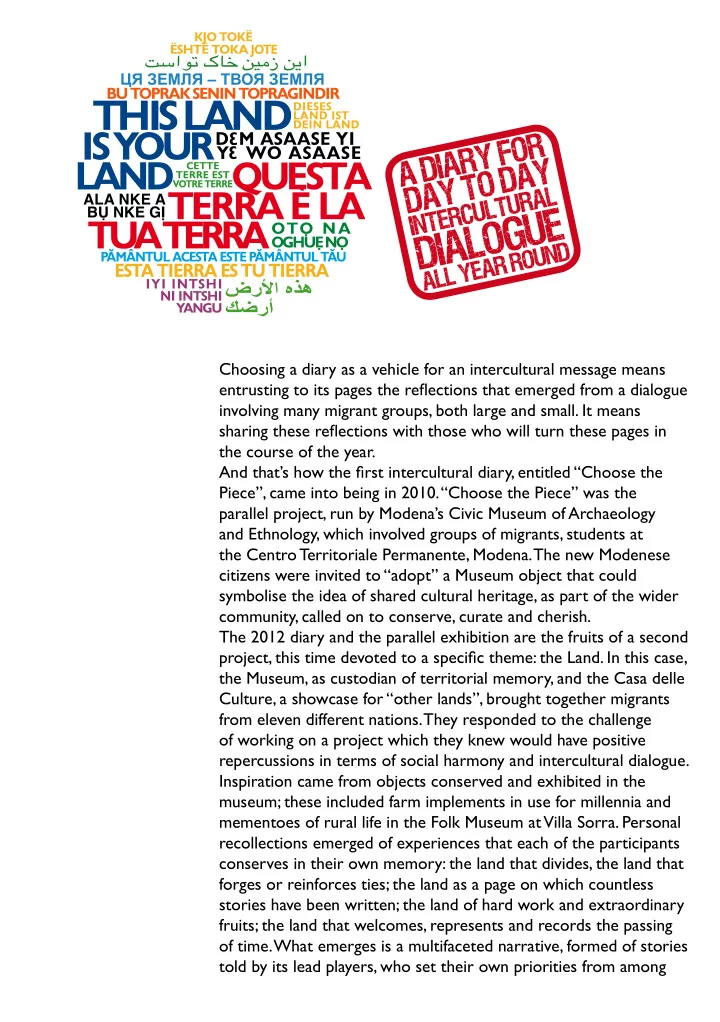
Choosing a diary as a vehicle for an intercultural message means entrusting to its pages the refmections that emerged from a dialogue involving many migrant groups, both large and small. It means sharing these refmections with those who will turn these pages in the course of the year. And that’s how the fjrst intercultural diary, entitled “Choose the Piece”, came into being in 2010. “Choose the Piece” was the parallel project, run by Modena’s Civic Museum of Archaeology and Ethnology, which involved groups of migrants, students at the Centro T erritoriale Permanente, Modena. The new Modenese citizens were invited to “adopt” a Museum object that could symbolise the idea of shared cultural heritage, as part of the wider community, called on to conserve, curate and cherish. The 2012 diary and the parallel exhibition are the fruits of a second project, this time devoted to a specifjc theme: the Land. In this case, the Museum, as custodian of territorial memory, and the Casa delle Culture, a showcase for “other lands”, brought together migrants from eleven different nations. They responded to the challenge

  • f working on a project which they knew would have positive

repercussions in terms of social harmony and intercultural dialogue. Inspiration came from objects conserved and exhibited in the museum; these included farm implements in use for millennia and mementoes of rural life in the Folk Museum at Villa Sorra. Personal recollections emerged of experiences that each of the participants conserves in their own memory: the land that divides, the land that forges or reinforces ties; the land as a page on which countless stories have been written; the land of hard work and extraordinary fruits; the land that welcomes, represents and records the passing

  • f time. What emerges is a multifaceted narrative, formed of stories

told by its lead players, who set their own priorities from among

slide-2
SLIDE 2

the many themes that regard the land – that huge reservoir of memory and aspiration. Naturally, given the scope of the issues involved, none

  • f these testimonies can claim to be exhaustive, but they do offer a

personal glimpse, and this is what makes the account unique. Whoever turns the pages of this diary will fjnd a store of real-life stories that came to light when members of the group sat down and shared their memories. These are what now unite Modena and the land around it with Argentina, the Congo, Albania, Ghana, Morocco, Colombia, Nigeria, Rumania, Iran, Turkey, the Ukraine. Objects from the museum’s collection, themselves mementoes of the land, provide a touching counterpoint. It is no mere coincidence that the project’s title is taken from a song written in 1940 by Woody Guthrie. In the course of time, the lines of this song have become a musical manifesto for tolerance and social solidarity, going way beyond the context in which they were fjrst

  • written. In the course of time, other verses were also added, and it is

likely that others will be added in future. Taking over the baton in a relay of ideals, we in turn add our voice to the chorus, writing another verse with the pages of this diary.

Civic Museum of Archaeology and Ethnology SiCklE made of bronze and dEEr AntlEr, from the terramare, Modena (1550 - 1150 B.C.) PuMPkin with SwEEt Corn from a burial site in central Peru (5th century) Folk Museum, Villa Sorra, hArVESting hook (msôra), Modena area, (early 20th century)

slide-3
SLIDE 3

dicembre december

2011

lunedì monday martedì tuesday mercoledì wednesday giovedì thursday venerdì friday sabato saturday domenica sunday

note

12 16 17 18 13 14 15

2 1 2

Project giorgio Cervetti ilaria Pulini Cristiana Zanasi Civic Museum of Archaeology and Ethnology, Modena Marco Coltellacci Association “Casa delle Culture”, Modena Milena Bertacchini gino Satta University of Modena and Reggio Emilia (UNIMORE) w ith Mustafà Altin (T urkey) idris Bakkari (Morocco) wilfred Eke (Nigeria) Cécile kashetu kyenge (Dem. Rep.

  • f the Congo)

Anton lesaj (Albania) thomas Mc Carthy (Ghana) germain nzinga (Dem. Rep.

  • f the Congo)

iryna Polishchuk (Ukraine) irma romero (Colombia) Mona Seddighi (Iran) nora Sigman (Argentina) Anca totolici (Rumania) with the collaboration of Adil laamane (Morocco) halyna hevko lidia Polishchuk (Ukraine) Anthony o.Eke gilbert idahosa reginald ihebom Esther nwogwugwu Jefgrey ochiama Francis

  • gbonna okonkwo

(Nigeria) with the participation of Maurizio Bettelli direction ilaria Pulini Coordination Cristiana Zanasi realization giorgio Cervetti Cristiana Zanasi Exhibition design Aldina Progetti Fausto Ferri design assistance from Maria Elena righi graphic design Filippo Partesotti partesotti.com translations Paul henry Angus Exhibition panels printed by Eidos Printing nuova grafjca interviews and fjlms giorgio Cervetti Andrea Comastri Photographs of participants and museum exhibits Andrea Comastri Paolo terzi Audiovisual plant lorri Media Service Sound technician Claudio Costanzini web site giorgio Cervetti with the collaboration of Marketing and Communications Offjce, Modena City Council Press offjce giulia Bondi Modena City Council

  • rganization and secretarial

Camilla Benedetti Maria grazia lucchi Annalisa lusetti Milvia Servadei Mediagroup thanks for their help to “A. delfjni” Civic library “Estense” university library giuseppe Panini Photomuseum Museo della Civiltà Contadina Bastiglia (MO) Museo Cervi Gattatico (RE) Sincere thanks to gianni and gabriella Zanasi for their warm welcome at Villa Cavazza roksolana Movchan who made the didukh (augural haystack) and Sonia Bonetti from Happyfmor for so helpfully supplying materials Eddagni Zineb and Marika Minghetti for demonstrating the use of henna kyenge kikoko tribal chief of Kyenge village (Congo) for the interview he gave kwaw Pentsir and Fussein ibrahim King and spokesman of Gomoa Simbrofo village who accepted our invitation to present the prayer from Ghana igwe John okafor-Agilo King of Nimo in the State of Anambra (Nigeria), lead player in the fjlm on the yam festivity nora guthrie and Anna Canoni Woody Guthrie Foundation Paola Varesi Director of the Museo Cervi di Gattatico (RE) for the documentation

  • n the tractor of the

Cervi Brothers And also gabriele Beccantini, Francesca and Emmanuele Coltellacci, Francesca guandalini, la lanterna di diogene, Paula Francisca nolfg herrera, Alessia Pelillo, Bianca rubino, Enrico Vignali Cardboard display Structures aldinagozzi.it