Childrens Use of Technology in the Home and in in ECCE Settings - - PowerPoint PPT Presentation

children s use of technology in
SMART_READER_LITE
LIVE PREVIEW

Childrens Use of Technology in the Home and in in ECCE Settings - - PowerPoint PPT Presentation

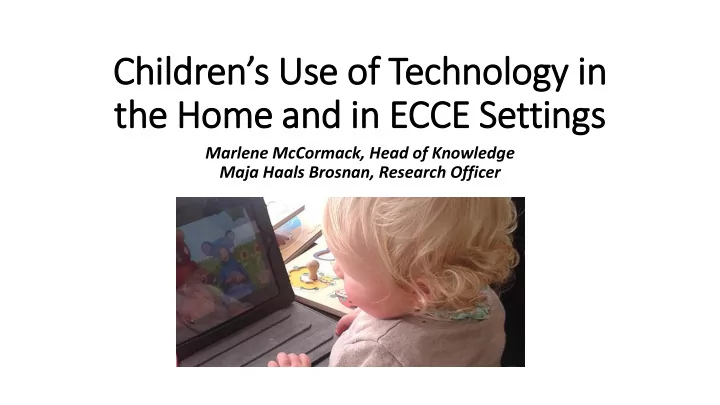
Childrens Use of Technology in the Home and in in ECCE Settings Marlene McCormack, Head of Knowledge Maja Haals Brosnan, Research Officer Does ICT have a place in ECCE settings? Parents Educators Participants Online Survey 248 Parents

slide-1
SLIDE 1

Children’s Use of Technology in the Home and in in ECCE Settings

Marlene McCormack, Head of Knowledge Maja Haals Brosnan, Research Officer

slide-2
SLIDE 2

Does ICT have a place in ECCE settings?

Parents Educators

slide-3
SLIDE 3

Participants

Online Survey 248 Parents & 172 Educators

Mothers 89% Fathers 8% Grandparents 2% Carers 1%

slide-4
SLIDE 4

Context xt

Children of all ages are increasingly exposed to and becoming adept at using a variety of different technology and media. According to an

  • ngoing study on digital childhoods, 81% of Irish children are now online

with “with notable trends towards individualised, privatised and mobile forms of access to the internet”. 82% of teenagers and 35% of 9-12 year

  • lds also have a social networking profile. In addition, Irish children spend

at least one hour per day online and 75% of 15-16 year olds use the internet everyday (EU Kids Online, 2011). Very little, however, is known about very young children’s use of and engagement with technology and

  • media. Yet with the prevalence of older children’s use of technology it is

important to understand how ICT and media influence younger children’s everyday lives, development and education.

slide-5
SLIDE 5

Aim

At Early Childhood Ireland we are interested in understanding the trends

  • f children’s use of technology in early childhood care and education

(ECCE) settings. In particular, we are interested in whether and how ECCE settings use ICT and media for educational purposes as well as for entertainment and communication purposes. With schools increasingly using ICT as part of their teaching but with research showing that Ireland is lacking behind its European neighbours in developing critical media literacy it is important to understand how ICT and media are used in different educational settings, including early childhood education, which increasing numbers of children are attending.

slide-6
SLIDE 6

Does ICT have a place in ECCE?

Parents Educators

slide-7
SLIDE 7

Parents’ Thoughts on ICT for Young Children Priorities for Their Children

slide-8
SLIDE 8

Parents’ Thoughts on ICT for Young Children ICT Uses in the Home

1. 1. 2. 2. 5. 5. 4. 3.

slide-9
SLIDE 9

Parents’ Thoughts on ICT for Young Children Challenges and Worries

slide-10
SLIDE 10

Parents on ICT Use in ECCE Settings

The majority

  • f parents

identify the ages 3-4 as the earliest age at which children benefit from ICT Parents worry about too much screen time / addiction to ICT Most parents consider ITC skills necessary for children but not in early childhood Parents want children to learn through play, not ICT, and want ICT to be used

  • nly as a

learning tool, not ‘babysitting’ 80% of parents think ICT should

  • nly be used

for very specific activities in ECCE settings

slide-11
SLIDE 11

Educators’ Views on ICT for Young Children

No place in ECCE Useful learning tool

slide-12
SLIDE 12

Educators’ Views on ICT for Young Children No place in ECCE

  • “Blocks and water play offer all the technology they require at age 3”
  • “Let them play…”
  • “ICT has no importance in preparing the child for school”
  • “Children can benefit from ICT but need exposure to non-ICT items first to

help them develop their imagination

  • “ICT allows for sedentary behaviour”
  • “Limits creativity”
  • “The more technology the worse social skills”
  • Children overexposed at home
  • Solitary
  • Replaces interaction
  • Inhibits development
  • Some fears that ICT worsening/causing ADHD and behavioural issues
slide-13
SLIDE 13

Educators’ Views on ICT for Young Children

Useful learning tool

  • “It is the way forward so it should be allowed…”
  • “It is a world of technology so children should become

familiar as early as possible”

  • “Need to acknowledge children’s interest and not create

forbidden fruit”

  • “Useful to bridge app gap”
  • Easier to monitor and use educationally in ECCE settings

compared to at home

  • Should be used to complement curriculum, learning,

particular themes and other work

  • Means to an end, not an end in itself
  • Should be set up in such a way that children collaborate
  • n projects
  • Needs to be planned and have thought going into it
slide-14
SLIDE 14

Current Use of ICT in ECCE Settings

Provide or would like to provide ICT 66.00%

Do not provide 34.00%

slide-15
SLIDE 15

Current Use of ICT in ECCE Settings

No place in ECCE Overexposure at home Lack of resources

Provide or would like to provide ICT 66.00%

Do not provide 34.00%

slide-16
SLIDE 16

Current Use of ICT in ECCE Settings

Provide or would like to provide ICT 66.00%

Do not provide 34.00%

slide-17
SLIDE 17

Current Use of ICT in ECCE Settings

Provide or would like to provide ICT 66.00%

Do not provide 34.00%

slide-18
SLIDE 18

Educators’ ICT Confidence

slide-19
SLIDE 19

ICT Learning Tool Examples

Music and Movement Geography Cultural Awareness Citizenship Communication

slide-20
SLIDE 20
  • Laptops/PCs
  • Tablets
  • Digital cameras / video camera
  • Interactive whiteboards
  • Touch screen toys
  • Guidelines from DES (similar to

those for primary schools)

  • Training
  • Additional funds / resources

For Educators

slide-21
SLIDE 21

Implications

  • Parents and educators think children are over-

exposed to ICT and call for balance

  • The majority of parents’ worries primarily concern

ICT behaviour associated with older children:

  • Online Safety
  • Cyber Bullying
  • Contents of video games
  • Screen time (easier to limit for young children)
  • Many of the parents’ concerns are easily addressed

in ECCE settings:

  • ICT as learning tool NOT virtual babysitter
  • Monitor programme contents
  • Supervise use
  • Optimise use to enhance development
  • Planned and purposeful use
  • Ensure balance
slide-22
SLIDE 22

Recommendations

Children’s use of ICT needs to be supervised and controlled ICT in ECCE settings has to be integrated with / contribute to the curriculum ECCE settings need to collaborate with parents in use of ICT Educators need sufficient training and resource to optimise use of ICT ICT primarily appropriate in pre-school rooms, NOT in baby/wobbler rooms

slide-23
SLIDE 23

Next Steps

  • ICT and children with additional needs
  • Further research into how ICT can be optimised for ECCE settings
  • Design of training and resource portfolio
  • Case studies of ECCE settings with positive

experiences of ICT use with children