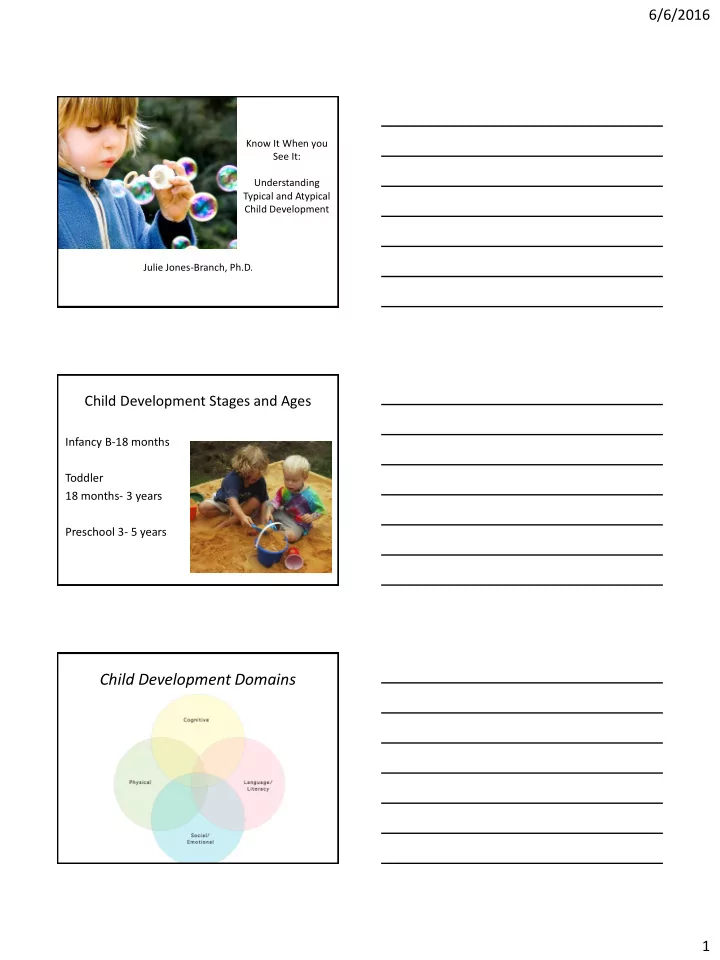
Child Development Domains 1 6/6/2016 Cognitive Brain Development - - PDF document

child development domains
SMART_READER_LITE
LIVE PREVIEW

Child Development Domains 1 6/6/2016 Cognitive Brain Development - - PDF document

6/6/2016 Know It When you See It: Understanding Typical and Atypical Child Development Julie Jones-Branch, Ph.D. Child Development Stages and Ages Infancy B-18 months Toddler 18 months- 3 years Preschool 3- 5 years Child Development


slide-1
SLIDE 1

6/6/2016 1

Know It When you See It: Understanding Typical and Atypical Child Development Julie Jones-Branch, Ph.D.

Child Development Stages and Ages

Infancy B-18 months Toddler 18 months- 3 years Preschool 3- 5 years

Child Development Domains

slide-2
SLIDE 2

6/6/2016 2

Cognitive—Brain Development

Synapses strengthen through exposure to repeated, meaningful experiences

Critical Periods and Pruning

slide-3
SLIDE 3

6/6/2016 3

Stages of Cognitive Development

Piaget Sensorimotor—B-2 years Pre-Operational—2-7 years Concrete Operations—7-11 years Formal Operations—12+ years

Brain is not fully developed until mid-20s

What do they need?

  • Predictable, Trusting environments
  • Less stress is best

– (toxic shock)

  • Stimulation of their senses

– Sight, Sound, Smell, Taste, Feel

  • Novelty

What can Adults do?

  • Provide consistent, reliable routine
  • Offer variety of materials (sounds, textures)
  • Support children’s exploration

– Describe/label environment – Show enthusiasm of children’s new discoveries

  • Understand stages of brain/cognitive

development to set appropriate expectations

slide-4
SLIDE 4

6/6/2016 4

Physical Development Large and Small Motor Large Motor Sequence

Put the following 8 skills in order of ‘sequence’— add what approximate age it should occur: Running Rolling Over Kicking Cutting Crawling Skipping Catching Walking

http://www.pbs.org/wholechild/abc/physical.html

Tracking

slide-5
SLIDE 5

6/6/2016 5

Importance of Tummy Time What do they need?

  • Space
  • Time
  • Variety of surfaces and textures

– Safe heights

What can Adults do?

  • Provide time, space and materials to explore
  • Encourage
  • Support physically

– Help them ‘move’ from one skill to the next

slide-6
SLIDE 6

6/6/2016 6 Sequence of Fine Motor Development

Stages/Sequence of Writing What do they need?

slide-7
SLIDE 7

6/6/2016 7

What can Adults do?

  • Offer opportunities with a variety of materials
  • Encourage by noting attempts and asking

children to share what they have written/drawn

  • Do not criticize ‘incorrect’ letters/pictures

Language/Literacy Development Receptive vs. Expressive Stages of Language Development (Birth to Age 3)

  • 1. Crying
  • 2. Cooing
  • 3. Babbling
  • 4. Gestures (8-12 months)
  • 5. First words (8-18 months)
  • 6. Telegraphic speech (18-24 months)
  • 7. Grammatical speech (~2 ½ years)
slide-8
SLIDE 8

6/6/2016 8

The 1995 Hart & Risley Study Meaningful Differences in the Everyday Experience of Young American Children by Betty Hart, Ph.D., and Todd R. Risley, Ph.D.

“With few exceptions, the more parents talked to their children, the faster the children’s vocabularies were growing and the higher the children’s IQ test scores at age three and later.” “The data revealed that the most important aspect of children’s language experience is its amount.”

=

slide-9
SLIDE 9

6/6/2016 9

= =

Piaget

Assimilation and Accommodation “The funny butterfly!”

slide-10
SLIDE 10

6/6/2016 10

“I think it is a Black Grasshopper!” Iyan 4 years

What do they need?

  • To hear language

– Read to – Talked to

  • To be able to have adults respond to their

attempts at language

slide-11
SLIDE 11

6/6/2016 11

Strategies for Extended Conversation

(the more turns the better)

  • Show Interest
  • Paraphrasing
  • Repeating and pausing
  • Open-ended question
  • I wonder Statements
  • Connect to previous experiences

Mom [ buying bread at a little shop]: Sam, where do you think they get this bread? Sam [age 4.5]: They must make it at the back of the store. Mom [pause]: Do you remember when your school went to the bakery factory and saw them make bread? Sam: Yes. They must have a little machine like that in the back of this store. Mom: Hmm. How about these vegetables they are selling? Sam: They must grow them right out back of the store. Mom: Sometimes we go on drives in the countryside and see farms where vegetables are growing. Sam: That food is sold is stores in the country. But not in our store here.

Sam = 4 turns Extending the Conversation

A Mother-Son Story

Social/Emotional Development

slide-12
SLIDE 12

6/6/2016 12

Stages of Play—Social

Onlooker/Solitary Play Parallel Associative Cooperative

Self-Regulation

  • Ability to calm
  • Self-control
  • Emotional recognition

“I hate you!”

“I don’t want to be your friend!”

“You are NOT invited to my birthday party!” All of these statements MEAN…

Emotions and Self-Regulation

slide-13
SLIDE 13

6/6/2016 13

‘Feelings come and feelings go….sometimes I don’t know what they’ll be. Whatever the feelings are, they are all a part of me!’

What do they need?

  • Trusting relationships
  • Time to develop
  • Opportunities to play with others and self-select

activities

  • Understanding of adults
  • Adults to facilitate and support them

What can Adults do?

  • Structure environment for least amount of

stress

– Should offer predictability and consistency

  • Recognize signs of basic needs
  • Name emotions
  • Suggest words to work through the situation
  • Offer physical support
  • Stay calm and neutral
slide-14
SLIDE 14

6/6/2016 14

Resources