Chikungunya O with post-chikungunya disorders Nyong Nyong Mayaro - - PDF document

chikungunya
SMART_READER_LITE
LIVE PREVIEW

Chikungunya O with post-chikungunya disorders Nyong Nyong Mayaro - - PDF document

Declaration of interest Management of Chronic Sequelae I declare working as temporary senior consultant for - PAHO and WHO (since 2010) of Arthritogenic Virus Infections: - Sanofi (2017) - Valneva (since 2017) What's New? Coll E. Javelle Prof


slide-1
SLIDE 1

1 Management of Chronic Sequelae

  • f Arthritogenic Virus Infections:

What's New?

Prof Fabrice SIMON, MD, PhD

Department of Infectious Diseases and Tropical Medicine, LAVERAN Military Teaching Hospital & UMR 190 Unité des virus émergents, Medicine University MARSEILLE – FRANCE

UMR Unité des Virus Émergents UVE IRD 190 ‐ Inserm 1207

Declaration of interest

I declare working as temporary senior consultant for

  • PAHO and WHO (since 2010)
  • Sanofi (2017)
  • Valneva (since 2017)
  • Coll. E Javelle

Coll E. Javelle

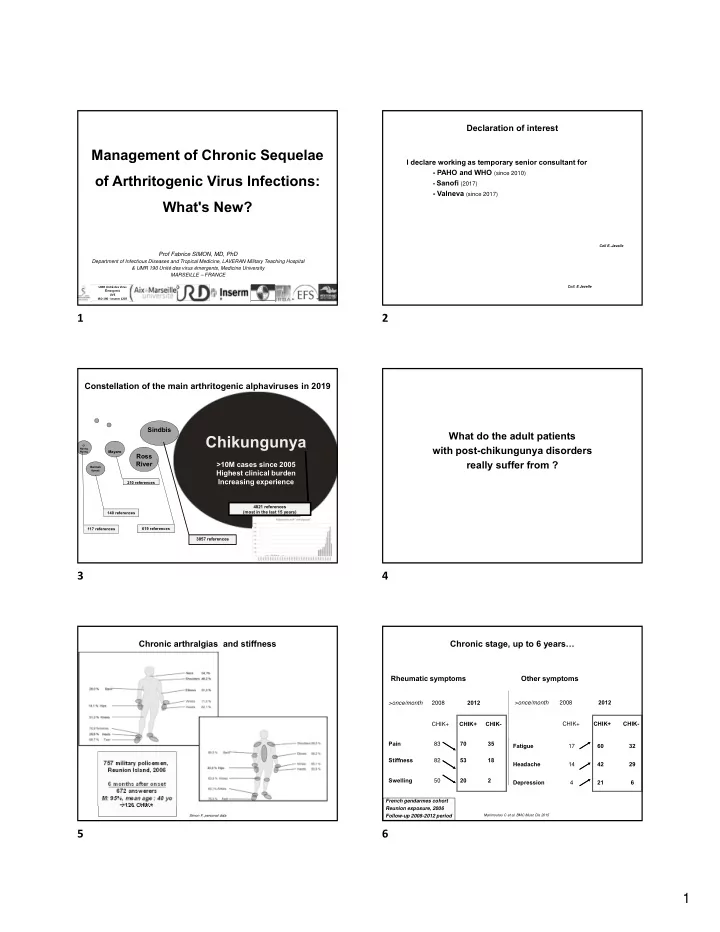
Constellation of the main arthritogenic alphaviruses in 2019

Chikungunya

>10M cases since 2005 Highest clinical burden Increasing experience

Sindbis

O’ Nyong Nyong

Ross River

Mayaro

Barmah forest

4821 references (most in the last 15 years) 619 references 3057 references 140 references 210 references 117 references

What do the adult patients with post-chikungunya disorders really suffer from ?

Simon F, personal data

757 military policemen, Reunion Island, 2006 6 months after onset 672 answerers M: 95%, mean age : 40 yo 126 CHIK+

Chronic arthralgias and stiffness Chronic stage, up to 6 years…

>once/month 2008 2012 CHIK+ CHIK+ CHIK- Pain 83 70 35 Stiffness 82 53 18 Swelling 50 20 2 >once/month 2008 2012 CHIK+ CHIK+ CHIK- Fatigue 17 60 32 Headache 14 42 29 Depression 4 21 6

Rheumatic symptoms Other symptoms

Marimoutou C et al. BMC Musc Dis 2015

French gendarmes cohort Reunion exposure, 2006 Follow-up 2008-2012 period

1 2 3 4 5 6

slide-2
SLIDE 2

2

Chronic stage, up to 6 years…

Long impaired quality of life

CHIK+ CHIK-

2012 2012 2008 2008

French gendarmes cohort Reunion exposure, 2006 Follow-up 2008-2012 period

Marimoutou C et al. BMC Musc Dis 2015

Two types of post-CHIK rheumatisms

Simon F et al. French guidelines on chikungunya, Med Mal Infect 2015

Tenosynovitis, tendonitis, fasciitis, bursitis, enthesitis…

F Simon, collection personnelle F Simon, collection personnelle F Simon, collection personnelle F Simon, collection personnelle F Simon, collection personnelle F Simon, collection personnelle

Post-CHIK chronic inflammatory rheumatisms

Stiffness

Pain

Handicap in daily life Stop of physical activities Deconditioning Stiffening Weight gain Depression Limitation in social life Chikungunya Self-depreciation

The post-CHIK vicious circle Multiple clinical and social consequences

7 8 9 10 11 12

slide-3
SLIDE 3

3

  • Physical examination

poorly contributive

  • Biological testings

frequently normal or subnormal

  • Imaging: rare joint

destruction

The clinical paradox of post-CHIK status For the majority of the patients

  • Pain
  • Fatigue
  • Sadness
  • Handicap in daily life
  • Social consequences
  • Sexual life
  • Quality of life

10 10 10 10 10 10 10

On the shelf and beyond

  • ʺ Symptomatic ʺ treatments

– Painkillers up to level 3, antineuropathic drugs – NSAIDs, corticosteroids – Physical therapy – Psychological support

  • ʺ Etiopathogenic ʺ treatments

– Antiviral drugs & anti-CHIKV monoclonal antibodies – Diseases modifying antirheumatic drugs: methotrexate, sulfasalazine, hydroxychloroquine, leflunomide, biological agents…

  • Other treatments

– Homeopathy – Phytotherapy

What should the ideal treatment do?

What are the targets for the treatment?

Acute

D1-D21

Post-acute

W4-W12

Chronic

From M4… Viremia Clinical inflammation Clinical impact Viral sanctuary(?)

Anti-CHIK drugs, including MAbs

Acute

D1-D21

Post-acute

W4-W12

Chronic

From M4… Viremia Clinical inflammation Clinical impact

Expected: Control of acute symptoms Prevention of chronicity

Viral sanctuary(?)

Anti-CHIK drugs, including MAbs

Acute

D1-D21

Post-acute

W4-W12

Chronic

From M4… Viremia Clinical inflammation Clinical impact

Expected: Etiopathogenic treatment of chronicity

Speculative For CIR only?

Viral sanctuary(?)

13 14 15 16 17 18

slide-4
SLIDE 4

4

Anti-inflammatory drugs

Acute

D1-D21

Post-acute

W4-W12

Chronic

From M4… Viremia Clinical inflammation Clinical impact

Expected: Control of acute articular symptoms Prevention of chronicity

Viral sanctuary(?)

Anti-inflammatory drugs

Acute

D1-D21

Post-acute

W4-W12

Chronic

From M4… Viremia Clinical inflammation Clinical impact

Expected: Symptomatic treatment

  • f chronic pain and handicap

Viral sanctuary(?)

Disease-modifying antirheumatic drugs (DMARDs)

Acute

D1-D21

Post-acute

W4-W12

Chronic

From M4… Viremia Clinical inflammation Clinical impact

Expected: Etiopathogenic treatment

  • f chronic joint inflammation

Should target the CIR only

Viral sanctuary(?)

What are the good endpoints?

  • Viral load…
  • Number of tender joints
  • Number of swollen joints
  • Morning stiffness
  • Clinically-assessed stiffness
  • Pain
  • Functional testings
  • Quality of life
  • Drug tolerance
  • Social life
  • CRP
  • Rheumatoid factors

The most important for the patients

Is there any magic bullet for the treatment?

An exponential number of papers on the treatment

PubMed, « chikungunya » & « treatment », 2019/06/06

Many scientific papers (in vitro, animal studies) Many cases reports Few series Experts’ opinions Some clinical trials Reviews Meta-analyses National & international guidelines

19 20 21 22 23 24

slide-5
SLIDE 5

5

Numerous reviews of the literature

Sales G et al. Rev Assoc Med Bras 2018 Da Cuhna RV et al. Mem Inst Osw Cruz 2017 Zaid et al. Arthr Rheum 2018 Marti-Carvajal A et al. PLoS One. 2017

Very few relevant data for EBM in CHIK disease

Only few CT, very few RCT Poor quality of the studies: numerous bias & low level of proof Different methodologies  impossible comparison Main criticisms : no randomization, pooling MSD&CIR, endpoints

Sales G et al. Rev Assoc Med Bras 2018 Marti-Carvajal A et al. PLoS One. 2017

Antiviral drugs and anti-CHIKV MAb

  • Antiviral drugs active anti-CHIKV

– Chloroquine : one RCT in Reunion 2006  not efficient – Ribavirin +/- doxycycline: no RCT – Sofosbuvir: no RCT – Some other candidates being studied in vitro

  • Anti-CHIKV Mab

– One being developed: no RCT

  • Efficacy at late stage speculative for both

Not recommended at any stage

De Lamballerie X et al. Vector Borne Zoonotic Dis. 2008 Da Silveira Oliveira AF et al. Molecules 2017

Painkillers

  • Analgesics

– Paracetamol: hepatotoxicity when used on chronic liver disease or

  • verdose

– Dipyrone: initially recommended in Brazil, risk for medullar toxicity

  • Opioids

– For refractory pain only. Short use.

  • Antineuropathic painkillers

– To be added for patients with DN4 score >4

Recommended after D10. Cautious use in patients with underlying conditions.

Brito C et al. Rev Soc Bras Med Trop 2016

NSAIDs & corticosteroids

  • Systemic NSAIDs

– No class has been shown to be superior – Full dose x few weeks when possible – Avoid if patient with coronary diseases, renal failure, hypertension, risk for digestive bleeding…

  • Corticosteroids

– Cautious use : low dose, short time, no long-action (DXM) – Followed by NSAID to avoid clinical rebound – Long-term adverse effects in patients older than 40: osteoporosis, cataract

Recommended, with caution in older adults Consider the diagnosis of CIR if refractory Search for an alternative for long-term treatment

Methotrexate

  • In vitro study suggests non benefit in acute stage
  • Recommended as first-line treatment for RA (ARA, EULAR)

– For patients fulfiling definition criteria – After 4-6 weeks

  • Empirically used in post-CHIK RA by rheumatologists in

Reunion island since 2005

  • No well-designed RCT
  • Some case series with positive results

– Possible adverse effects – Some failure when started too late

Recommended as first-line treatment for CIR only Requires biological follow-up

Taylor A et al. PLoS One 2013 Simon F et al. French guidelines on chikungunya, Med Mal Infect 2015

25 26 27 28 29 30

slide-6
SLIDE 6

6

77% of de novo CIR received MTX

  • 100% of RA, 80% of SA, <1/3 of UP
  • 75% efficacy (54/72) vs 25% failure (18/72)
  • Well tolerated
  • 15% second line treatment with biotherapy (12/72)

(TNF blockers, abatercept, rituximab or tocilizumab)

Experience of methotrexate in Reunion island, 2005-2010

Javelle E et al. ISHEID 2013, Marseille Javelle E et al. ISHEID 2013, Marseille

Experience of methotrexate in Reunion island, 2005-2010 Biological agents

  • Only few cases reports

– Anti-TNF, rituximab, tocilizumab

  • Not recommended as first-line treatment in RA
  • Expensive and not always available vs MTX or HCQ

For confirmed CIR as second-line treatment only Caution after a tropical stay (TB, strongyloidiasis)

Simon F et al. French guidelines on chikungunya, Med Mal Infect 2015

Hydroxychloroquine

  • Recommended in some CIR
  • Contradictory data in the litterature
  • Proposed in the Brazilian guidelines
  • Requires monitoring of ocular and cutaneous adverse effects

To be prescribed by a rheumatologist/internist

Simon F et al. French guidelines on chikungunya, Med Mal Infect 2015

Physical medicine

  • Low level of proof for these tools that are use daily…

– Poorly studied

  • Only one RCT in Brazil: benefit of adjunctive Pilates

– Reduction in pain, fatigue, and increase of QoL

  • Safe and benefitial fore many patients with post-CHIK

disorders Recommended at post-acute and chronic stage

Marques C et al. Clin Rehab 2019

Homeopathy, phytotherapy

  • No proof of efficacy

Not recommended at any stage

31 32 33 34 35 36

slide-7
SLIDE 7

7

What should I do now in my clinical practice?

Experience-based guidelines for CHIK disease

Free online

Principle of the post-CHIK treatment Dedicated case management

 Leave the chikungunya behind!

HCW SW Patients

Self-remobilization

SUFFERING BETTER QUALITY OF LIFE

Five pillars to manage persisting symptoms

  • Diagnosis time
  • Orientation of complex cases to the specialists
  • Control of the pain(s)
  • Control of the inflammation(s)
  • Physical therapies

Simon F et al. Am J Trop Med Hyg 2018 (in press)

5

Persisting rheumatic disorders: clinical management Caution if…

  • Intense acute stage
  • Patient older than 40
  • Corticodependance
  • Hands involvement
  • Any arthritis (synovitis)
  • Criteria for CIR
  • Arthralgia not improved after complete treatment for 6-8 weeks
  • Diagnosis uncertainty and complex clinical situation

Simon F et al. French guidelines on chikungunya, Med Mal Infect 2015

37 38 39 40 41 42

slide-8
SLIDE 8

8

Persisting rheumatic disorders, diagnosis algorithm

Simon F et al. French guidelines on chikungunya, Med Mal Infect 2015

44

Persisting rheumatic disorders, principles of treatment

Simon F et al. French guidelines on chikungunya, Med Mal Infect 2015

To the specialist if complex (diagnosis, treatment)

Persisting symptoms

Several techniques for physical therapy

  • Antalgic physiotherapy
  • Tenosynovitis  cryotherapy/orthese (night)
  • Subcutaneous oedema  Scottich bath/massage
  • Activo-passive mobilization for painful and/or stiff joints
  • Massage for the paravertebral muscles
  • Transversal deep massages for plantar fasciitis
  • Other technical tools

– Electrostimulation, ultrasounds with NSAIDs, infrared, shock waves…

Simon F et al. French guidelines on chikungunya, Med Mal Infect 2015

Rehabilitation and reconditioning

  • Repetition of soft movements to reduce stiffness
  • Pilates
  • Balneotherapy
  • Self-rehabilitation

– During and after physiotherapy – The step before restarting a soft sport

Simon F et al. French guidelines on chikungunya, Med Mal Infect 2015

In practice

  • For all patients +++
  • Painkillers, physiotherapy, local treatment, psycho-social support,

specific treatment if required & prolonged follow-up

  • For non-CIR
  • Non inflammatory features: NSAIDs for weeks
  • Polyarthralgia & periarticular oedema: NSAIDs, short corticotherapy
  • Aspecific diffuse pain: other cause ?
  • For CIR: guidelines in rheumatology

Simon F et al. French guidelines on chikungunya, Med Mal Infect 2015

Key-messages

  • Chikungunya is not dengue
  • Do not pool all the patients with chronic disorders
  • Most suffering people don’t go to the hospitals
  • There is no magic bullet for the treatment
  • Trained doctors + drugs + physical therapy + mobilization
  • Late is not lost
  • Clinical improvement with simple treatment is frequent
  • Well-designed studies for treatment are still needed

43 44 45 46 47 48

slide-9
SLIDE 9

9

49

This lecture results from the multidisciplinary experience

  • f the French Military Medical Service

in collaboration with: the University Hospitals of Reunion, Martinique and Marseille, GPs from Guadeloupe, the expert group for the French guidelines and the unit 190 on emerging viruses, Faculty of medicine, Marseille. simon-f@wanadoo.fr chikungunya.expertise@gmail.com

Some important questions to address

  • Overview of the current evidence concerning the

management of acute infection as well as chronic sequelae

  • f arthritogenic viral infections
  • Therapeutic value of different classes of drugs (NSAIDS,

paracetamol, corticosteroids, MTX, TNF-alpha blockers, chloroquine…) in different arthritogenic viruses

  • Prognostic markers
  • Coll. E Javelle

Coll E. Javelle

49 50