Chapter 9: Information and Strategic Behavior Asymmetric - - PDF document

chapter 9 information and strategic behavior
SMART_READER_LITE
LIVE PREVIEW

Chapter 9: Information and Strategic Behavior Asymmetric - - PDF document

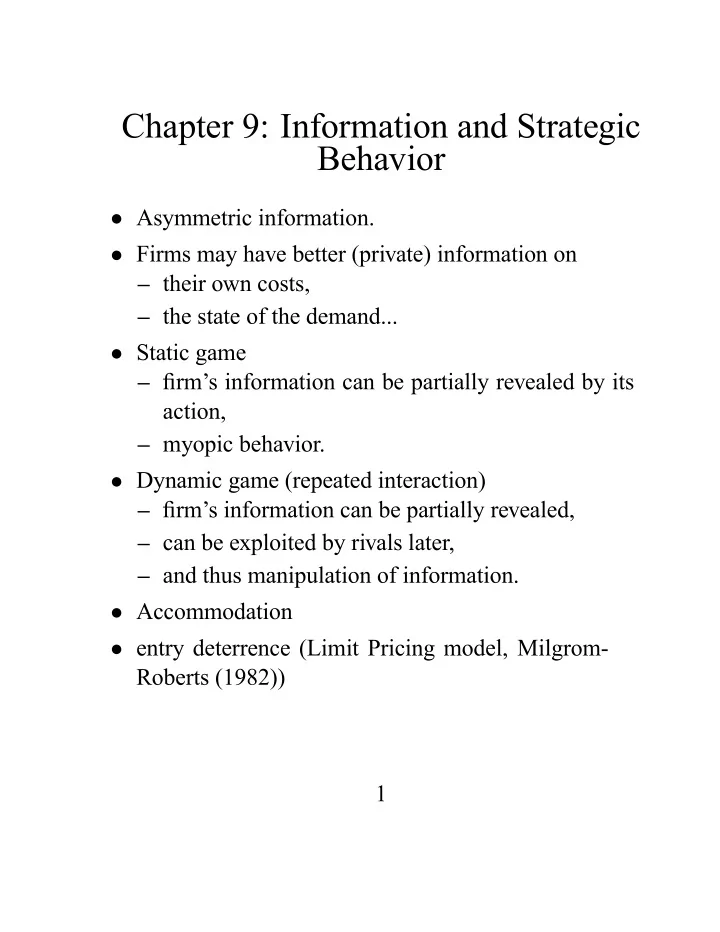
Chapter 9: Information and Strategic Behavior Asymmetric information. Firms may have better (private) information on their own costs, the state of the demand... Static game fi rms information can be partially revealed by


slide-1
SLIDE 1

Chapter 9: Information and Strategic Behavior

  • Asymmetric information.
  • Firms may have better (private) information on

– their own costs, – the state of the demand...

  • Static game

– firm’s information can be partially revealed by its action, – myopic behavior.

  • Dynamic game (repeated interaction)

– firm’s information can be partially revealed, – can be exploited by rivals later, – and thus manipulation of information.

  • Accommodation
  • entry deterrence (Limit Pricing model, Milgrom-

Roberts (1982)) 1

slide-2
SLIDE 2

1 Static competition under Asym- metric Information

  • 2 period model
  • 2 risk-neutral firms: firm 1 (incumbent), firm 2

(potential entrant) Timing: Period 1. – Firm 1 takes a decision (price, advertising, quantity...). – Firm 2 observes firm 1’s decision, and takes an action (entry, no entry...). Period 2. If duopoly, firms choose they price simultane-

  • usly (Bertrand competition).

Period 2, if entry.

  • Differentiated products.
  • Demand curves are symmetric and linear

Di(pi, pj) = a − bpi + dpj

for i, j = 1, 2 and i 6= j where 0 < d < b. 2

slide-3
SLIDE 3
  • The two goods are substitutes (dDi

dpj = d > 0) and

strategic complements ( d2Πi

dpidpj > 0).

  • Marginal cost of firm 2 is c2, and common knowledge.
  • Marginal cost of firm 1 can take 2 values c1 ∈ {cH

1 , cL 1}

and is private information.

  • Firm 2 has only prior beliefs concerning the cost of its

rival, x. Thus

c1 = ( cL

1

with probability x

cH

1

with probability (1 − x)

  • Firm 1’s expected MC from the point of view of 2 is

ce

1 = xcL 1 + (1 − x)cH 1

  • Ex post profit is

Πi(pi, pj) = (pi − ci)(a − bpi + dpj)

  • Firm 1’s program is

– if c1 = cL

1

Max

p1 (p1 − cL 1)(a − bp1 + dp∗ 2)

3

slide-4
SLIDE 4

– If c1 = cH

1

Max

p1 (p1 − cH 1 )(a − bp1 + dp∗ 2)

  • Firm 2’s program

Max

p2 {x[(p2 − c2)(a − bp2 + dpL 1)]

+(1 − x)[(p2 − c2)(a − bp2 + dpH

1 )]}

which is equivalent to

Max

p2 {(p2 − c2)(a − bp2) + (p2 − c2)pe 1}

where

pe

1 = xpL 1 + (1 − x)pH 1

  • Best response functions are

pL

1 = a + bcL 1 + dp2

2b = RL

1 (p2)

pH

1 = a + bcH 1 + dp2

2b = RH

1 (p2)

p2 = a + bc2 + dpe

1

2b = R2(pe

1)

  • Graph

4

slide-5
SLIDE 5
  • Solution of the system of 3 equations gives

p∗

2 = 2ab + ad + 2b2c2 + dbce 1

4b2 − d2

  • where ∂p∗

2

∂ce

1 > 0 and

∂p∗

2

∂(1−x) > 0

  • Then you plug p∗

2 in RL 1 (p2) and RH 1 (p2) to find the

solution pL

1 and pH 1 .

  • Under asymmetric information, everything is “as if”

firm 1 has an average reaction curve

Re

1(p2) = xRL 1 (p2) + (1 − x)RH 1 (p2)

= a + bce

1 + dp2

2b

  • Firm 1 has an incentive to prove that it has a high cost

before engaging in price competition. 5

slide-6
SLIDE 6

2 Dynamic Game

  • Assume that direct disclosure is impossible.

Timing: Period 1. Price competition Period 2. Price competition

  • If entry is not an issue (accommodate), firms want to

appear inoffensive so as to induce its rival to raise its price.

  • Thus, in first period: high price to signal high cost.
  • Thus, accommodation calls for puppy dog strategy

(be small to look inoffensive).

  • If deterrence is at stake, more aggressive behavior: the

firm wants to signal a low cost.

  • Thus, in first period, low price to induce its rival to

doubt about the viability of the market (limit pricing model).

  • Thus, deterrence calls for top dog strategy.

6

slide-7
SLIDE 7

3 Accommodation

  • A firm may rise its price to signal high cost and soften

the behavior of its rival.

  • Riordan (1985)’s model
  • 2 firms

Timing: Period A. Price competition Period B. Price competition

  • Marginal cost is 0.
  • Firm i’s demand is

qi = a − pi + pj

  • The demand intercept is unknown to both firms, and

has a mean ae.

  • In a one-period version of the game, program of firm i

Max

pi

{E(a − pi + pj)pi = (ae − pi + pj)pi}

  • thus

pi = ae + pj 2 ,

7

slide-8
SLIDE 8
  • and by symmetry, the Static Bertrand equilibrium is

p1 = p2 = ae.

  • 2 period version with same a for each period, and each

firm observes the realization of its own demand.

  • In the symmetric equilibrium,

– each firm sets

pA

1 = pA 2 = α

in the first period. – Thus, each firm learns perfectly a as

DA

i = a − α + α = a

– and the second-period is of complete information, and the program of firm i

Max

pB

i

(a − pB

i + pB j )pB i

  • thus

pB

i

= a + pB

j

2 ,

8

slide-9
SLIDE 9
  • and the symmetric equilibrium of second period is

pB

1 = pB 2 = a.

  • Consider a strategic behavior in period A: firm i

deviates and chooses

pA

i 6= α

  • Firm j observes a demand of

DA

j = a − α + pA i

  • Firm j has a wrong perception of a, and has a

perception e

a, a − α + pA

i = e

a − α + α = e a

and thus

e a(pA

i ) = a − α + pA i

  • In the second period, j believes it is playing a game of

perfect information, with intercept e

a(pA

i ), so it charges

pB

j = e

a(pA

i ) = a − α + pA i

9

slide-10
SLIDE 10

and thus

∂pB

j

∂pA

i

= 1

  • A unit increase in the first period triggers a unit increase

in the rival’s second period price.

  • However i knows the intercept is not the right one, and

the program of i in the second period is

Max

pB

i

{ΠB

i

= (a − pB

i + e

a(pA

i ))pB i }

  • Thus

pB

i = a + e

a(pA

i )

2 = a + pA

i − α

2

  • The derivative of the second period profit with respect

to pA

i is

dΠB

i

dpA

i

= ∂ΠB

i

∂pB

i

∂pB

i

∂pA

i

+ ∂ΠB

i

∂pA

i

= pB

i

∂e a(pA

i )

∂pA

i

= pB

i

10

slide-11
SLIDE 11
  • Firm i maximizes its expected present discounted

profit, thus the FOC is

EdΠA

i

dpA

i

+ δEdΠB

i

dpA

i

= 0

  • where δ is the discount factor.
  • Thus, it is equivalent to

ae − 2pA

i + α + δ(ae + pA i − α

2 ) = 0

  • In equilibrium pA

i = α, thus

α = ae(1 + δ) > ae

  • In a dynamic model, a firm may induce its rival to raise

its price. 11

slide-12
SLIDE 12

4 The Milgrom-Roberts (1982) Model of Limit Pricing

  • Asymmetric information drives firms to cut their price

in first period.

  • 2 risk-neutral firms: firm 1 (incumbent), firm 2

(potential entrant)

  • Asymmetric information on firm 1’s costs. Firm 2 has
  • nly prior beliefs concerning the cost of its rival, x.

Thus

c1 = ( cL

1

with probability x

cH

1

with probability (1 − x) Timing: Period 1.

  • Firm 1 chooses a first period price p1.

– Firm 2 observes p1 and decides whether to enter

{e, ne}.

Period 2. If firm 2 enters: price competition. If not, monopoly. 12

slide-13
SLIDE 13
  • Firm 2 learns 1’s cost immediately after entering.
  • The incumbent’s profit when price is p1 is

Mt

1(p1) = (p1 − ct 1)Q(p1)

where t = H, L. (strictly concave function in p1) – Thus pL

1, pH 1 are the monopoly prices charged by the

incumbent, pL

1 < pH 1 .

  • Duopoly’s payoffs are Dt

i for t = H, L and i = 1, 2.

  • Assume DH

2 > 0 > DL 2 : if low cost, no room for 2

firms, if high cost, room for duopoly.

  • δ Discount factor.
  • To simplify: only 2 prices pL

1, pH 1 and not a continuum

  • f prices.
  • Perfect Bayesian Equilibrium concept.
  • See tree of the game

13

slide-14
SLIDE 14

Benchmark case: symmetric information

  • Cost is low with probability x = 1
  • Cost is high with probability x = 0.
  • Decisions of firm 2 to enter?

– if low cost: does not enter, – if high cost: enters.

  • Decision of firm 1?

– if low cost, firm 1 chooses a low price if

ML

1 (pL 1) + δML 1 (pL 1) > ML 1 (pH 1 ) + δML 1 (pL 1)

⇒ ML

1 (pL 1) > ML 1 (pH 1 )

which is always satisfied. – if high cost, firm 1 chooses a high price if

MH

1 (pH 1 ) + δDH 1 > MH 1 (pL 1) + δDH 1

⇒ MH

1 (pH 1 ) > MH 1 (pL 1)

Result 1. Under symmetric information

♦ If c = cL

1, (pL 1, ne) is a Perfect Nash Equilibrium

♦ If c = cH

1 , (pH 1 , e) is a Perfect Nash Equilibrium

14

slide-15
SLIDE 15

Asymmetric Information

  • Separating equilibrium?

The incumbent does not choose the same price when its cost is high or low.

  • Pooling equilibrium?

The first period price is independent of the cost level. Separating equilibrium

  • Only one possible kind of separating:

– If c = cL

1, ne

– If c = cH

1 , e

  • Is it an equilibrium? and under what kind of circum-

stances?

  • It is an equilibrium if none of the firms deviate.

– If c = cL

1

ML

1 (pL 1) + δML 1 (pL 1) > ML 1 (pH 1 ) + δDL 1

⇒ ML

1 (pL 1) − ML 1 (pH 1 ) > δ(DL 1 − ML 1 (pL 1))

(1) 15

slide-16
SLIDE 16

– If c = cH

1

MH

1 (pH 1 ) + δDH 1 > MH 1 (pL 1) + δMH 1 (pH 1 )

⇒ MH

1 (pH 1 ) − MH 1 (pL 1) > δ(MH 1 (pH 1 ) − DH 1 )

(2) – The equation (1) is always satisfied, whereas (2) must be satisfied. Result 2. If (2) is satisfied, there exists a separating equilibrium such that

♦ the incumbent chooses pL

1 and firm 2 does not enter

(ne) if c = cL

1,

♦ the incumbent chooses pH

1 and firm 2 enters (e) if

c = cH

1 .

Pooling equilibrium

  • Two possible kinds of pooling:
  • P1. the incumbent always chooses pL

1, whatever the cost,

  • P2. the incumbent always chooses pH

1 , whatever the cost.

  • Updated beliefs equal to prior beliefs.

16

slide-17
SLIDE 17
  • P1. (pL

1) Player 2 stays out if

0 > xδDL

2 + (1 − x)δDH 2

⇒ x > e x = DH

2

DH

2 − DL 2

  • e

x ∈ [0, 1]?

  • e

x > 0 if DH

2 > DL 2 ,

  • e

x < 1 if DL

2 < 0.

  • Thus, for x > e

x firm 2 prefers to stay out.

  • Can firm 1 do better?

– If c = cL

1

ML

1 (pL 1) + δML 1 (pL 1) > ML 1 (pH 1 ) + δDL 1

OK and ML

1 (pL 1) + δML 1 (pL 1) > ML 1 (pH 1 ) + δML 1 (pL 1)

OK 17

slide-18
SLIDE 18

– If c = cH

1

MH

1 (pL 1) + δMH 1 (pH 1 ) > MH 1 (pH 1 ) + δDH 1

OK and MH

1 (pL 1) + δMH 1 (pH 1 ) > MH 1 (pH 1 ) + δMH 1 (pH 1 )

NO

  • Thus, with an out-of-equilibrium prob(e/pH

1 ) = 1,

there exists a pooling. Result 3. If (2) is not satisfied, there exists a pooling equilibrium such that

♦ the incumbent always chooses pL

1,

♦ and firm 2 does not enter (ne) ♦ with an out-of-equilibrium probability prob(e/pH

1 ) = 1.

18

slide-19
SLIDE 19
  • P2. (pH

1 ) Player 2 enters if

xδDL

2 + (1 − x)δDH 2 > 0

⇒ x < e x = DH

2

DL

2 − DH 2

  • Then for x < e

x firm 2 will enter.

  • Can firm 1 do better?

– If c = cL

1

ML

1 (pH 1 ) + δDL 1 > ML 1 (pH 1 ) + δML 1 (pL 1)

NO and ML

1 (pH 1 ) + δML 1 (pL 1) > ML 1 (pL 1) + δML 1 (pL 1)

NO – Thus firm 1 will always deviate.

  • There is no pooling P2.
  • If (2) is not satisfied, the incumbent manipulates the

price such that its action does not reveal any cost information. 19

slide-20
SLIDE 20
  • In continuous p ∈ [0, ∞[, same results except that

prices are different.

  • Single-crossing condition

∂2[(p1 − c1)Qm

1 (p1)]

∂p1∂c1 = −∂Qm

1

∂p1 > 0

  • It is more costly to the high type to charge low price.

Separating equilibrium

  • – if c = cH

1 , pH 1 = pH m

– if c = cL

1, pL 1 ∈ [e

e p1, e p1] where e p1 < pL

  • m. Low cost

type makes pooling very costly to the high cost type.

  • There exists a reasonable separating equilibrium where

– if c = cH

1 , pH 1 = pH m and entry occurs,

– if c = cL

1, pL 1 = e

p1and no entry.

  • The incumbent does not fool the entrant
  • But, there exists a limit pricing.

20

slide-21
SLIDE 21

Pooling equilibrium

  • The incumbent chooses pL

m.

  • The incumbent manipulates its price.
  • Less entry occurs than under symmetric information.
  • High cost type is engaged in limit pricing.

21