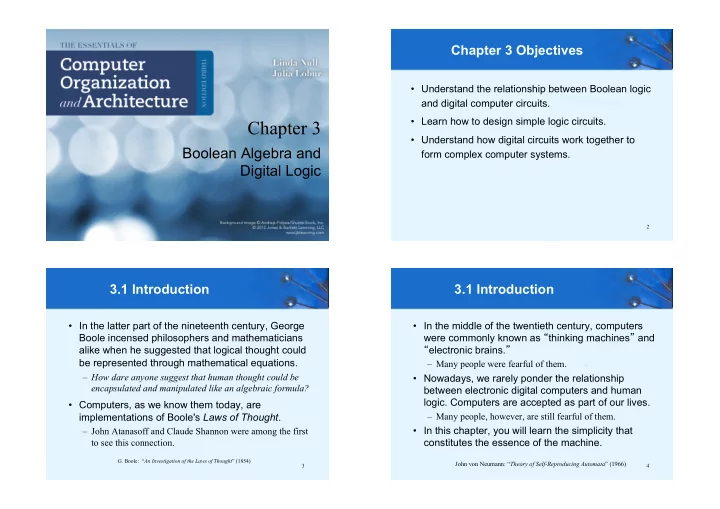
Chapter 3 Understand how digital circuits work together to Boolean - - PowerPoint PPT Presentation

chapter 3
SMART_READER_LITE
LIVE PREVIEW

Chapter 3 Understand how digital circuits work together to Boolean - - PowerPoint PPT Presentation

Chapter 3 Objectives Understand the relationship between Boolean logic and digital computer circuits. Learn how to design simple logic circuits. Chapter 3 Understand how digital circuits work together to Boolean Algebra and form


slide-1
SLIDE 1

Chapter 3

Boolean Algebra and Digital Logic

2

Chapter 3 Objectives

  • Understand the relationship between Boolean logic

and digital computer circuits.

  • Learn how to design simple logic circuits.
  • Understand how digital circuits work together to

form complex computer systems.

3

3.1 Introduction

  • In the latter part of the nineteenth century, George

Boole incensed philosophers and mathematicians alike when he suggested that logical thought could be represented through mathematical equations.

– How dare anyone suggest that human thought could be encapsulated and manipulated like an algebraic formula?

  • Computers, as we know them today, are

implementations of Boole's Laws of Thought.

– John Atanasoff and Claude Shannon were among the first to see this connection.

  • G. Boole: “An Investigation of the Laws of Thought” (1854)

4

3.1 Introduction

  • In the middle of the twentieth century, computers

were commonly known as thinking machines and electronic brains.

– Many people were fearful of them.

  • Nowadays, we rarely ponder the relationship

between electronic digital computers and human

  • logic. Computers are accepted as part of our lives.

– Many people, however, are still fearful of them.

  • In this chapter, you will learn the simplicity that

constitutes the essence of the machine.

John von Neumann: “Theory of Self-Reproducing Automata” (1966)

slide-2
SLIDE 2

5

3.2 Boolean Algebra

  • Boolean algebra is a mathematical system for

the manipulation of variables that can have

  • ne of two values.

– In formal logic, these values are true and false. – In digital systems, these values are on and off, 1 and 0, or high and low.

  • Boolean expressions are created by

performing operations on Boolean variables.

– Common Boolean operators include AND, OR, and NOT.

6

3.2 Boolean Algebra

  • A Boolean operator can be

completely described using a truth table.

  • The truth table for the Boolean
  • perators AND and OR are

shown at the right.

  • The AND operator is also known

as a Boolean product. The OR

  • perator is the Boolean sum.

7

3.2 Boolean Algebra

  • The truth table for the

Boolean NOT operator is shown at the right.

  • The NOT operation is most
  • ften designated by an
  • verbar. It is sometimes

indicated by a prime mark () or an elbow (¬).

8

3.2 Boolean Algebra

  • A Boolean function has:
  • At least one Boolean variable,
  • At least one Boolean operator, and
  • At least one input from the set {0,1}.
  • It produces an output that is also a member of

the set {0,1}.

slide-3
SLIDE 3

9

3.2 Boolean Algebra

  • The truth table for the

Boolean function: is shown at the right.

  • To make evaluation of the

Boolean function easier, the truth table contains extra (shaded) columns to hold evaluations of subparts of the function.

10

3.2 Boolean Algebra

  • As with common

arithmetic, Boolean

  • perations have rules of

precedence.

  • The NOT operator has

highest priority, followed by AND and then OR.

  • This is how we chose the

(shaded) function subparts in our table.

11

3.2 Boolean Algebra

  • Digital computers contain circuits that implement

Boolean functions.

  • The simpler that we can make a Boolean function,

the smaller the circuit that will result.

– Simpler circuits are cheaper to build, consume less power, and run faster than complex circuits.

  • With this in mind, we always want to reduce our

Boolean functions to their simplest form.

  • There are a number of Boolean identities that help

us to do this.

12

3.2 Boolean Algebra

  • Most Boolean identities have an AND (product)

form as well as an OR (sum) form. We give our identities using both forms. Our first group is rather intuitive:

slide-4
SLIDE 4

13

3.2 Boolean Algebra

  • Our second group of Boolean identities should be

familiar to you from your study of algebra:

14

3.2 Boolean Algebra

  • Our last group of Boolean identities are perhaps the

most useful.

  • If you have studied set theory or formal logic, these

laws are also familiar to you.

15

3.2 Boolean Algebra

  • We can use Boolean identities to simplify:

as follows:

16

3.2 Boolean Algebra

  • Sometimes it is more economical to build a

circuit using the complement of a function (and complementing its result) than it is to implement the function directly.

  • DeMorgan's law provides an easy way of finding

the complement of a Boolean function.

  • Recall DeMorgans law states:
slide-5
SLIDE 5

17

3.2 Boolean Algebra

  • DeMorgan's law can be extended to any number of

variables.

  • Replace each variable by its complement and

change all ANDs to ORs and all ORs to ANDs.

  • Thus, we find that the complement of:

is:

18

3.2 Boolean Algebra

  • Through our exercises in simplifying Boolean

expressions, we see that there are numerous ways of stating the same Boolean expression.

– These synonymous forms are logically equivalent. – Logically equivalent expressions have identical truth tables.

  • In order to eliminate as much confusion as

possible, designers express Boolean functions in standardized or canonical form.

19

3.2 Boolean Algebra

  • There are two canonical forms for Boolean

expressions: sum-of-products and product-of-sums. – Recall the Boolean product is the AND operation and the Boolean sum is the OR operation.

  • In the sum-of-products form, ANDed variables are

ORed together. – For example:

  • In the product-of-sums form, ORed variables are

ANDed together: – For example:

20

3.2 Boolean Algebra

  • It is easy to convert a function

to sum-of-products form using its truth table.

  • We are interested in the values
  • f the variables that make the

function true (=1).

  • Using the truth table, we list the

values of the variables that result in a true function value.

  • Each group of variables is then

ORed together.

slide-6
SLIDE 6

21

3.2 Boolean Algebra

  • The sum-of-products form

for our function is:

We note that this function is not in simplest terms. Our aim is

  • nly to rewrite our function in

canonical sum-of-products form.

22

  • We have looked at Boolean functions in abstract

terms.

  • In this section, we see that Boolean functions are

implemented in digital computer circuits called gates.

  • A gate is an electronic device that produces a result

based on two or more input values. – In reality, gates consist of one to six transistors, but digital designers think of them as a single unit. The basic physical component of a computer is the transistor; the basic logic component is the gate. – Integrated circuits contain collections of gates suited to a particular purpose.

3.3 Logic Gates

23

  • The three simplest gates are the AND, OR, and NOT

gates.

  • They correspond directly to their respective Boolean
  • perations, as you can see by their truth tables.

3.3 Logic Gates

24

  • Another very useful gate is the exclusive OR

(XOR) gate.

  • The output of the XOR operation is true only when

the values of the inputs differ.

3.3 Logic Gates

Note the special symbol for the XOR operation.

slide-7
SLIDE 7

25

  • NAND and NOR

are two very important gates. Their symbols and truth tables are shown at the right.

3.3 Logic Gates

26

3.3 Logic Gates

  • NAND and NOR

are known as universal gates because they are inexpensive to manufacture and any Boolean function can be constructed using

  • nly NAND or only

NOR gates.

27

3.3 Logic Gates

  • Gates can have multiple inputs and more than
  • ne output.

– A second output can be provided for the complement

  • f the operation.

– We'll see more of this later.

28

3.4 Digital Components

  • The main thing to remember is that combinations
  • f gates implement Boolean functions.
  • The circuit below implements the Boolean

function:

We simplify our Boolean expressions so that we can create simpler circuits.

slide-8
SLIDE 8

29

3.4 Digital Components

  • Typically, gates are not sold individually; they

are sold in units called integrated circuits.

  • Simple SSI integrated circuit with 4 NAND gates

SSI: Small scale integrated circuit

30

3.4 Digital Components

Implementation of F(x,y)= using 3 NAND gates.

x F(x,y)

xy

y

xy xy ≡

31

3.5 Combinational Circuits

  • We have designed a circuit that implements the

Boolean function:

  • This circuit is an example of a combinational logic
  • circuit. The output is a strict combination of the

current inputs.

  • Combinational logic circuits produce a specified
  • utput (almost) at the instant when input values

are applied.

– In a later section, we will explore circuits where this is not the case.

32

3.5 Combinational Circuits

  • Combinational logic circuits

give us many useful devices.

  • One of the simplest is the

half adder, which finds the sum of two bits.

  • We can gain some insight

into the construction of a half adder by looking at its truth table, shown at the right.

slide-9
SLIDE 9

33

3.5 Combinational Circuits

  • As we see, the sum can be

found using the XOR

  • peration and the carry

using the AND operation.

34

3.5 Combinational Circuits

  • We can change our half

adder into to a full-adder by including gates for processing the carry bit.

  • The truth table for a full-

adder is shown at the right.

35

3.5 Combinational Circuits

  • How can we change the

half adder shown below to make it a full-adder?

36

3.5 Combinational Circuits

  • Here is our completed full-adder (composed of two

half-adders and an OR gate).

slide-10
SLIDE 10

37

3.5 Combinational Circuits

  • Just as we combined half adders to make a full

adder, full adders can connected in series.

  • The carry bit ripples from one adder to the next;

hence, this configuration is called a ripple-carry adder.

Today's systems employ more efficient adders.

38

3.5 Combinational Circuits

  • Decoders are another important type of

combinational circuit.

  • Among other things, they are useful in selecting a

memory location according a binary value placed on the address lines of a memory bus.

  • Address decoders with n inputs can select any of 2n

locations.

This is a block diagram for a decoder.

39

3.5 Combinational Circuits

  • This is what a 2-to-4 decoder looks like on the

inside.

If x = 0 and y = 1, which output line is enabled?

40

3.5 Combinational Circuits

  • A multiplexer selects a single
  • utput from several inputs.
  • The particular input chosen

for output is determined by the value of the multiplexer's control lines.

  • To be able to select among n

inputs, log2n control lines are needed.

This is a block diagram for a multiplexer.

slide-11
SLIDE 11

41

3.5 Combinational Circuits

  • This is what a 4-to-1 multiplexer looks like on the

inside.

If S0 = 1 and S1 = 0, which input is transferred to the

  • utput?

42

3.5 Combinational Circuits

  • This shifter

moves the bits of a nibble one position to the left or right.

If S = 0, in which direction do the input bits shift?

43

3.5 Combinational Circuits

00: A + B 01: NOT A 10: A OR B 11: A AND B

  • A simple

2-bit ALU.

44

3.6 Sequential Circuits

  • Combinational logic circuits are perfect for

situations when we require the immediate application of a Boolean function to a set of inputs.

  • There are other times, however, when we need a

circuit to change its value with consideration to its current state as well as its inputs.

– These circuits have to remember their current state.

  • Sequential logic circuits provide this functionality for
  • us. Some outputs may depend on past inputs (the

sequence of inputs over time).

slide-12
SLIDE 12

45

3.6 Sequential Circuits

  • As the name implies, sequential logic circuits require

a means by which events can be sequenced.

  • State changes are controlled by clocks.

– A clock is a special circuit that sends electrical pulses through a circuit.

  • Clocks produce electrical waveforms such as the
  • ne shown below.

46

3.6 Sequential Circuits

  • State changes occur in sequential circuits only

when the clock ticks.

  • Circuits can change state on the rising edge, falling

edge, or when the clock pulse reaches its highest

  • r lowest voltage.

47

3.6 Sequential Circuits

  • Circuits that change state on the rising edge, or

falling edge of the clock pulse are called edge- triggered.

  • Level-triggered circuits change state when the

clock voltage reaches its highest or lowest level.

Most sequential circuits are edge-triggered.

48

3.6 Sequential Circuits

  • To retain their state values, sequential circuits rely
  • n feedback.
  • Feedback in digital circuits occurs when an output

is looped back to the input.

  • A simple example of this concept is shown below.

– If Q is 0 it will always be 0, if it is 1, it will always be 1. Why?

slide-13
SLIDE 13

49

3.6 Sequential Circuits

  • You can see how feedback works by examining the

most basic sequential logic components, the SR flip-flop.

– The SR stands for set/reset.

  • The internals of an SR flip-flop (using 2 NOR gates)

are shown below, along with its block diagram.

50

3.6 Sequential Circuits

  • The behavior of an SR flip-flop is described by

a characteristic table.

  • Q(t) means the value of the output at time t.

Q(t+1) is the value of Q after the next clock pulse.

51

3.6 Sequential Circuits

  • The SR flip-flop actually

has three inputs: S, R, and its current output, Q.

  • Thus, we can construct

a truth table for this circuit, as shown at the right.

  • Notice the two undefined
  • values. When both S

and R are 1, the SR flip- flop is unstable.

52

3.6 Sequential Circuits

  • If we can be sure that the inputs to an SR flip-flop

will never both be 1, we will never have an unstable circuit. This may not always be the case.

  • The SR flip-flop can be modified to provide a

stable state when both inputs are 1.

  • This modified flip-flop is

called a JK flip-flop, shown at the right.

  • The JK is possibly in

honor of Jack Kilby (inventor of the integrated circuit, 1958).

slide-14
SLIDE 14

53

3.6 Sequential Circuits

  • At the right, we see

how an SR flip-flop can be modified to create a JK flip-flop.

  • The characteristic

table indicates that the flip-flop is stable for all inputs.

54

3.6 Sequential Circuits

  • Another modification of the SR flip-flop is the

D flip-flop, shown below with its characteristic table.

  • You will notice that the output of the flip-flop

remains the same during subsequent clock

  • pulses. The output changes only when the value
  • f D changes.

55

3.6 Sequential Circuits

  • The D flip-flop is the fundamental circuit of

computer memory.

– D flip-flops are usually illustrated using the block diagram shown below.

  • The characteristic table for the D flip-flop is

shown at the right.

56

3.6 Sequential Circuits

  • The behavior of sequential circuits can be

expressed using characteristic tables or finite state machines (FSMs).

– FSMs consist of a set of nodes that hold the states of the machine and a set of arcs that connect the states.

  • Moore and Mealy machines are two types of FSMs

that are equivalent.

– They differ only in how they express the outputs of the machine.

  • Moore machines place outputs on each node, while

Mealy machines present their outputs on the transitions.

slide-15
SLIDE 15

57

3.6 Sequential Circuits

  • The behavior of a JK flop-flop is depicted below by

a Moore machine (left) and a Mealy machine (right).

58

3.6 Sequential Circuits

  • Although the behavior of Moore and Mealy

machines is identical, their implementations differ. This is our Moore machine.

Output depends only on the current state.

Next State Logic Output Logic 59

3.6 Sequential Circuits

This is our Mealy machine.

Output depends on the current state as well as the current input.

Next State Logic Output Logic

  • Although the behavior of Moore and Mealy

machines is identical, their implementations differ.

60

3.6 Sequential Circuits

  • It is difficult to express the complexities of actual

implementations using only Moore and Mealy machines.

– For one thing, they do not address the intricacies of timing very well. – Secondly, it is often the case that an interaction of numerous signals is required to advance a machine from

  • ne state to the next.
  • For these reasons, Christopher Clare invented the

algorithmic state machine (ASM).

The next slide illustrates the components of an ASM.

slide-16
SLIDE 16

61

3.6 Sequential Circuits

62

3.6 Sequential Circuits

  • This is an ASM for a microwave oven.

63

3.6 Sequential Circuits

  • Sequential circuits are used anytime that we have

a stateful application.

– A stateful application is one where the next state of the machine depends on the current state of the machine and the input.

  • A stateful application requires both combinational

and sequential logic.

  • The following slides provide several examples of

circuits that fall into this category.

64

3.6 Sequential Circuits

  • This illustration shows a

4-bit register consisting of D flip-flops. You will usually see its block diagram (below) instead.

A larger memory configuration is shown on the next slide.

slide-17
SLIDE 17

65

3.6 Sequential Circuits

4 x 3 memory

66

3.6 Sequential Circuits

  • A binary counter is

another example of a sequential circuit.

  • The low-order bit is

complemented at each clock pulse.

  • Whenever it changes

from 0 to 1, the next bit is complemented, and so on through the

  • ther flip-flops.

67

3.7 Designing Circuits

  • We have seen digital circuits from two points of

view: digital analysis and digital synthesis.

– Digital analysis explores the relationship between a circuits inputs and its outputs. – Digital synthesis creates logic diagrams using the values specified in a truth table.

  • Digital systems designers must also be mindful of

the physical behaviors of circuits to include minute propagation delays that occur between the time when a circuit's inputs are energized and when the

  • utput is accurate and stable.

68

3.7 Designing Circuits

  • Digital designers rely on specialized software to

create efficient circuits.

– Thus, software is an enabler for the construction of better hardware.

  • Of course, software is in reality a collection of

algorithms that could just as well be implemented in hardware.

– Recall the Principle of Equivalence of Hardware and Software.

slide-18
SLIDE 18

69

3.7 Designing Circuits

  • When we need to implement a simple, specialized

algorithm and its execution speed must be as fast as possible, a hardware solution is often preferred.

  • This is the idea behind embedded systems, which

are small special-purpose computers that we find in many everyday things.

  • Embedded systems require special programming

that demands an understanding of the operation of digital circuits, the basics of which you have learned in this chapter.

70

  • Computers are implementations of Boolean logic.
  • Boolean functions are completely described by

truth tables.

  • Logic gates are small circuits that implement

Boolean operators.

  • The basic gates are AND, OR, and NOT.

– The XOR gate is very useful in parity checkers and adders.

  • The universal gates are NOR, and NAND.

Chapter 3 Conclusion

71

  • Computer circuits consist of combinational logic

circuits and sequential logic circuits.

  • Combinational circuits produce outputs (almost)

immediately when their inputs change.

  • Sequential circuits require clocks to control their

changes of state.

  • The basic sequential circuit unit is the flip-flop:

The behaviors of the SR, JK, and D flip-flops are the most important to know.

Chapter 3 Conclusion

72

  • The behavior of sequential circuits can be

expressed using characteristic tables or through various finite state machines.

  • Moore and Mealy machines are two finite state

machines that model high-level circuit behavior.

  • Algorithmic state machines are better than

Moore and Mealy machines at expressing timing and complex signal interactions.

  • Examples of sequential circuits include memory

counters, and decoders.

Chapter 3 Conclusion

slide-19
SLIDE 19

73

End of Chapter 3