Chapter 26: Data Mining (Some slides courtesy of Rich Caruana, - - PDF document

chapter 26 data mining
SMART_READER_LITE
LIVE PREVIEW

Chapter 26: Data Mining (Some slides courtesy of Rich Caruana, - - PDF document

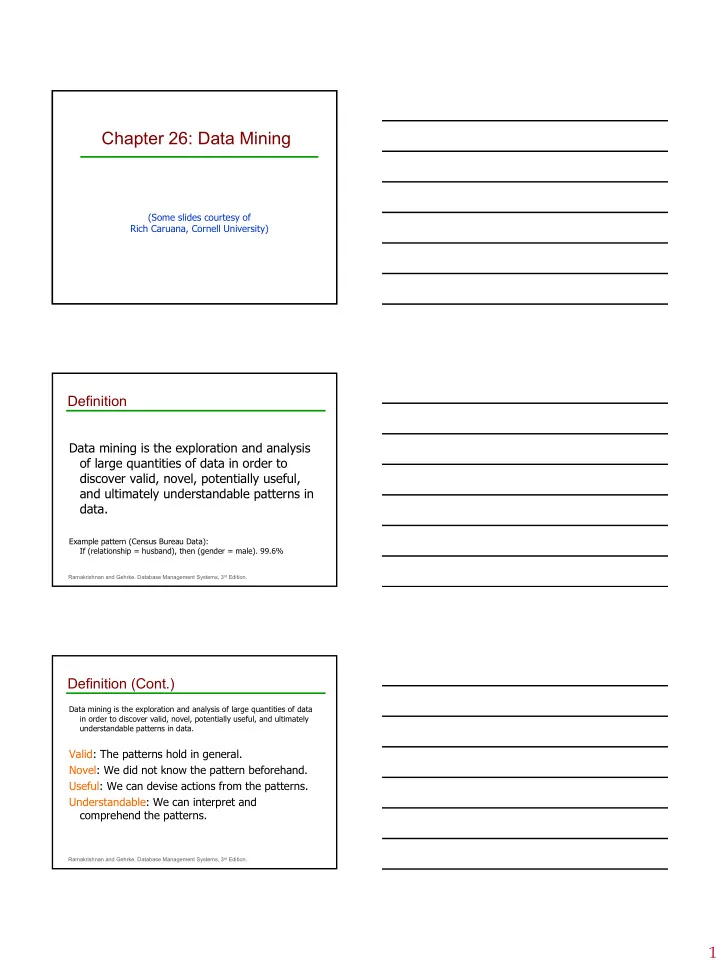
Chapter 26: Data Mining (Some slides courtesy of Rich Caruana, Cornell University) Definition Data mining is the exploration and analysis of large quantities of data in order to discover valid, novel, potentially useful, and ultimately


slide-1
SLIDE 1

1

Chapter 26: Data Mining

(Some slides courtesy of Rich Caruana, Cornell University)

Ramakrishnan and Gehrke. Database Management Systems, 3rd Edition.

Definition

Data mining is the exploration and analysis

  • f large quantities of data in order to

discover valid, novel, potentially useful, and ultimately understandable patterns in data.

Example pattern (Census Bureau Data): If (relationship = husband), then (gender = male). 99.6%

Ramakrishnan and Gehrke. Database Management Systems, 3rd Edition.

Definition (Cont.)

Data mining is the exploration and analysis of large quantities of data in order to discover valid, novel, potentially useful, and ultimately understandable patterns in data.

Valid: The patterns hold in general. Novel: We did not know the pattern beforehand. Useful: We can devise actions from the patterns. Understandable: We can interpret and comprehend the patterns.

slide-2
SLIDE 2

2

Ramakrishnan and Gehrke. Database Management Systems, 3rd Edition.

Why Use Data Mining Today?

Human analysis skills are inadequate:

  • Volume and dimensionality of the data
  • High data growth rate

Availability of:

  • Data
  • Storage
  • Computational power
  • Off-the-shelf software
  • Expertise

Ramakrishnan and Gehrke. Database Management Systems, 3rd Edition.

An Abundance of Data

  • Supermarket scanners, POS data
  • Preferred customer cards
  • Credit card transactions
  • Direct mail response
  • Call center records
  • ATM machines
  • Demographic data
  • Sensor networks
  • Cameras
  • Web server logs
  • Customer web site trails

Ramakrishnan and Gehrke. Database Management Systems, 3rd Edition.

Evolution of Database Technology

  • 1960s: IMS, network model
  • 1970s: The relational data model, first relational DBMS

implementations

  • 1980s: Maturing RDBMS, application-specific DBMS,

(spatial data, scientific data, image data, etc.), OODBMS

  • 1990s: Mature, high-performance RDBMS technology,

parallel DBMS, terabyte data warehouses, object- relational DBMS, middleware and web technology

  • 2000s: High availability, zero-administration, seamless

integration into business processes

  • 2010: Sensor database systems, databases on

embedded systems, P2P database systems, large-scale pub/sub systems, ???

slide-3
SLIDE 3

3

Ramakrishnan and Gehrke. Database Management Systems, 3rd Edition.

Computational Power

  • Moore’s Law:

In 1965, Intel Corporation cofounder Gordon Moore predicted that the density of transistors in an integrated circuit would double every year. (Later changed to reflect 18 months progress.)

  • Experts on ants estimate that there are 1016 to

1017 ants on earth. In the year 1997, we produced one transistor per ant.

Ramakrishnan and Gehrke. Database Management Systems, 3rd Edition.

Much Commercial Support

  • Many data mining tools
  • http://www.kdnuggets.com/software
  • Database systems with data mining

support

  • Visualization tools
  • Data mining process support
  • Consultants

Ramakrishnan and Gehrke. Database Management Systems, 3rd Edition.

Why Use Data Mining Today?

Competitive pressure! “The secret of success is to know something that nobody else knows.” Aristotle Onassis

  • Competition on service, not only on price (Banks, phone

companies, hotel chains, rental car companies)

  • Personalization, CRM
  • The real-time enterprise
  • “Systemic listening”
  • Security, homeland defense
slide-4
SLIDE 4

4

Ramakrishnan and Gehrke. Database Management Systems, 3rd Edition.

The Knowledge Discovery Process

Steps:

  • 1. Identify business problem
  • 2. Data mining
  • 3. Action
  • 4. Evaluation and measurement
  • 5. Deployment and integration into

businesses processes

Ramakrishnan and Gehrke. Database Management Systems, 3rd Edition.

Data Mining Step in Detail

2.1 Data preprocessing

  • Data selection: Identify target datasets and

relevant fields

  • Data cleaning
  • Remove noise and outliers
  • Data transformation
  • Create common units
  • Generate new fields

2.2 Data mining model construction 2.3 Model evaluation

Ramakrishnan and Gehrke. Database Management Systems, 3rd Edition.

Preprocessing and Mining

Original Data Target Data Preprocessed Data Patterns Knowledge Data Integration and Selection Preprocessing Model Construction Interpretation

slide-5
SLIDE 5

5

Ramakrishnan and Gehrke. Database Management Systems, 3rd Edition.

Example Application: Sports

IBM Advanced Scout analyzes NBA game statistics

  • Shots blocked
  • Assists
  • Fouls
  • Google: “IBM Advanced Scout”

Ramakrishnan and Gehrke. Database Management Systems, 3rd Edition.

Advanced Scout

  • Example pattern: An analysis of the

data from a game played between the New York Knicks and the Charlotte Hornets revealed that “When Glenn Rice played the shooting guard position, he shot 5/6 (83%)

  • n jump shots."
  • Pattern is interesting:

The average shooting percentage for the Charlotte Hornets during that game was 54%.

Ramakrishnan and Gehrke. Database Management Systems, 3rd Edition.

Example Application: Sky Survey

  • Input data: 3 TB of image data with 2 billion sky
  • bjects, took more than six years to complete
  • Goal: Generate a catalog with all objects and

their type

  • Method: Use decision trees as data mining

model

  • Results:
  • 94% accuracy in predicting sky object classes
  • Increased number of faint objects classified by 300%
  • Helped team of astronomers to discover 16 new high

red-shift quasars in one order of magnitude less

  • bservation time
slide-6
SLIDE 6

6

Ramakrishnan and Gehrke. Database Management Systems, 3rd Edition.

Gold Nuggets?

  • Investment firm mailing list: Discovered that old people do not

respond to IRA mailings

  • Bank clustered their customers. One cluster: Older customers, no

mortgage, less likely to have a credit card

  • “Bank of 1911”
  • Customer churn example

Ramakrishnan and Gehrke. Database Management Systems, 3rd Edition.

What is a Data Mining Model?

A data mining model is a description of a specific aspect of a dataset. It produces

  • utput values for an assigned set of input

values. Examples:

  • Linear regression model
  • Classification model
  • Clustering

Ramakrishnan and Gehrke. Database Management Systems, 3rd Edition.

Data Mining Models (Contd.)

A data mining model can be described at two levels:

  • Functional level:
  • Describes model in terms of its intended usage.

Examples: Classification, clustering

  • Representational level:
  • Specific representation of a model.

Example: Log-linear model, classification tree, nearest neighbor method.

  • Black-box models versus transparent models
slide-7
SLIDE 7

7

Ramakrishnan and Gehrke. Database Management Systems, 3rd Edition.

Data Mining: Types of Data

  • Relational data and transactional data
  • Spatial and temporal data, spatio-temporal
  • bservations
  • Time-series data
  • Text
  • Images, video
  • Mixtures of data
  • Sequence data
  • Features from processing other data sources

Ramakrishnan and Gehrke. Database Management Systems, 3rd Edition.

Types of Variables

  • Numerical: Domain is ordered and can be

represented on the real line (e.g., age, income)

  • Nominal or categorical: Domain is a finite set

without any natural ordering (e.g., occupation, marital status, race)

  • Ordinal: Domain is ordered, but absolute

differences between values is unknown (e.g., preference scale, severity of an injury)

Ramakrishnan and Gehrke. Database Management Systems, 3rd Edition.

Data Mining Techniques

  • Supervised learning
  • Classification and regression
  • Unsupervised learning
  • Clustering
  • Dependency modeling
  • Associations, summarization, causality
  • Outlier and deviation detection
  • Trend analysis and change detection
slide-8
SLIDE 8

8

Ramakrishnan and Gehrke. Database Management Systems, 3rd Edition.

Supervised Learning

  • F(x): true function (usually not known)
  • D: training sample drawn from F(x)

1 1 1 1 1 57,M,195,0,125,95,39,25,0,1,0,0,0,1,0,0,0,0,0,0,1,1,0,0,0,0,0,0,0,0 78,M,160,1,130,100,37,40,1,0,0,0,1,0,1,1,1,0,0,0,0,0,0,0,0,0,0,0,0,0 69,F,180,0,115,85,40,22,0,0,0,0,0,1,0,0,0,0,1,0,0,0,0,0,0,0,0,0,0,0,0 18,M,165,0,110,80,41,30,0,0,0,0,1,0,0,0,0,0,0,0,0,0,0,0,0,0,0,0,0,0 54,F,135,0,115,95,39,35,1,1,0,0,0,1,0,0,0,1,0,0,0,0,1,0,0,0,1,0,0,0,0 84,F,210,1,135,105,39,24,0,0,0,0,0,0,0,0,1,0,0,0,0,0,0,0,0,0,0,0,0,0 89,F,135,0,120,95,36,28,0,0,0,0,0,0,0,0,0,0,0,0,1,1,0,0,0,0,0,0,1,0,0 49,M,195,0,115,85,39,32,0,0,0,1,1,0,0,0,0,0,0,1,0,0,0,0,0,1,0,0,0,0 40,M,205,0,115,90,37,18,0,0,0,0,0,0,0,0,0,0,0,0,0,0,0,0,0,0,0,0,0,0 74,M,250,1,130,100,38,26,1,1,0,0,0,1,1,0,0,0,0,0,0,0,0,0,0,0,0,0,0 77,F,140,0,125,100,40,30,1,1,0,0,0,0,0,0,0,0,1,0,0,0,0,0,0,0,0,0,1,1 Ramakrishnan and Gehrke. Database Management Systems, 3rd Edition.

Supervised Learning

  • F(x): true function (usually not known)
  • D: training sample (x,F(x))

57,M,195,0,125,95,39,25,0,1,0,0,0,1,0,0,0,0,0,0,1,1,0,0,0,0,0,0,0,0 78,M,160,1,130,100,37,40,1,0,0,0,1,0,1,1,1,0,0,0,0,0,0,0,0,0,0,0,0,0 1 69,F,180,0,115,85,40,22,0,0,0,0,0,1,0,0,0,0,1,0,0,0,0,0,0,0,0,0,0,0,0 0 18,M,165,0,110,80,41,30,0,0,0,0,1,0,0,0,0,0,0,0,0,0,0,0,0,0,0,0,0,0 0 54,F,135,0,115,95,39,35,1,1,0,0,0,1,0,0,0,1,0,0,0,0,1,0,0,0,1,0,0,0,0 1

  • G(x): model learned from D

71,M,160,1,130,105,38,20,1,0,0,0,0,0,0,0,0,0,1,0,0,0,0,0,0,0,0,0,0 ?

  • Goal: E[(F(x)-G(x))2] is small (near zero) for

future samples

Ramakrishnan and Gehrke. Database Management Systems, 3rd Edition.

Supervised Learning

Well-defined goal: Learn G(x) that is a good approximation to F(x) from training sample D Well-defined error metrics: Accuracy, RMSE, ROC, …

slide-9
SLIDE 9

9

Ramakrishnan and Gehrke. Database Management Systems, 3rd Edition.

Supervised Learning

Training dataset: Test dataset:

71,M,160,1,130,105,38,20,1,0,0,0,0,0,0,0,0,0,1,0,0,0,0,0,0,0,0,0,0 ?

1 1 1 1 1 57,M,195,0,125,95,39,25,0,1,0,0,0,1,0,0,0,0,0,0,1,1,0,0,0,0,0,0,0,0 78,M,160,1,130,100,37,40,1,0,0,0,1,0,1,1,1,0,0,0,0,0,0,0,0,0,0,0,0,0 69,F,180,0,115,85,40,22,0,0,0,0,0,1,0,0,0,0,1,0,0,0,0,0,0,0,0,0,0,0,0 18,M,165,0,110,80,41,30,0,0,0,0,1,0,0,0,0,0,0,0,0,0,0,0,0,0,0,0,0,0 54,F,135,0,115,95,39,35,1,1,0,0,0,1,0,0,0,1,0,0,0,0,1,0,0,0,1,0,0,0,0 84,F,210,1,135,105,39,24,0,0,0,0,0,0,0,0,1,0,0,0,0,0,0,0,0,0,0,0,0,0 89,F,135,0,120,95,36,28,0,0,0,0,0,0,0,0,0,0,0,0,1,1,0,0,0,0,0,0,1,0,0 49,M,195,0,115,85,39,32,0,0,0,1,1,0,0,0,0,0,0,1,0,0,0,0,0,1,0,0,0,0 40,M,205,0,115,90,37,18,0,0,0,0,0,0,0,0,0,0,0,0,0,0,0,0,0,0,0,0,0,0 74,M,250,1,130,100,38,26,1,1,0,0,0,1,1,0,0,0,0,0,0,0,0,0,0,0,0,0,0 77,F,140,0,125,100,40,30,1,1,0,0,0,0,0,0,0,0,1,0,0,0,0,0,0,0,0,0,1,1 Ramakrishnan and Gehrke. Database Management Systems, 3rd Edition.

Un-Supervised Learning

Training dataset: Test dataset:

71,M,160,1,130,105,38,20,1,0,0,0,0,0,0,0,0,0,1,0,0,0,0,0,0,0,0,0,0 ?

1 1 1 1 1 57,M,195,0,125,95,39,25,0,1,0,0,0,1,0,0,0,0,0,0,1,1,0,0,0,0,0,0,0,0 78,M,160,1,130,100,37,40,1,0,0,0,1,0,1,1,1,0,0,0,0,0,0,0,0,0,0,0,0,0 69,F,180,0,115,85,40,22,0,0,0,0,0,1,0,0,0,0,1,0,0,0,0,0,0,0,0,0,0,0,0 18,M,165,0,110,80,41,30,0,0,0,0,1,0,0,0,0,0,0,0,0,0,0,0,0,0,0,0,0,0 54,F,135,0,115,95,39,35,1,1,0,0,0,1,0,0,0,1,0,0,0,0,1,0,0,0,1,0,0,0,0 84,F,210,1,135,105,39,24,0,0,0,0,0,0,0,0,1,0,0,0,0,0,0,0,0,0,0,0,0,0 89,F,135,0,120,95,36,28,0,0,0,0,0,0,0,0,0,0,0,0,1,1,0,0,0,0,0,0,1,0,0 49,M,195,0,115,85,39,32,0,0,0,1,1,0,0,0,0,0,0,1,0,0,0,0,0,1,0,0,0,0 40,M,205,0,115,90,37,18,0,0,0,0,0,0,0,0,0,0,0,0,0,0,0,0,0,0,0,0,0,0 74,M,250,1,130,100,38,26,1,1,0,0,0,1,1,0,0,0,0,0,0,0,0,0,0,0,0,0,0 77,F,140,0,125,100,40,30,1,1,0,0,0,0,0,0,0,0,1,0,0,0,0,0,0,0,0,0,1,1 Ramakrishnan and Gehrke. Database Management Systems, 3rd Edition.

Un-Supervised Learning

Training dataset: Test dataset:

71,M,160,1,130,105,38,20,1,0,0,0,0,0,0,0,0,0,1,0,0,0,0,0,0,0,0,0,0 ?

1 1 1 1 1 57,M,195,0,125,95,39,25,0,1,0,0,0,1,0,0,0,0,0,0,1,1,0,0,0,0,0,0,0,0 78,M,160,1,130,100,37,40,1,0,0,0,1,0,1,1,1,0,0,0,0,0,0,0,0,0,0,0,0,0 69,F,180,0,115,85,40,22,0,0,0,0,0,1,0,0,0,0,1,0,0,0,0,0,0,0,0,0,0,0,0 18,M,165,0,110,80,41,30,0,0,0,0,1,0,0,0,0,0,0,0,0,0,0,0,0,0,0,0,0,0 54,F,135,0,115,95,39,35,1,1,0,0,0,1,0,0,0,1,0,0,0,0,1,0,0,0,1,0,0,0,0 84,F,210,1,135,105,39,24,0,0,0,0,0,0,0,0,1,0,0,0,0,0,0,0,0,0,0,0,0,0 89,F,135,0,120,95,36,28,0,0,0,0,0,0,0,0,0,0,0,0,1,1,0,0,0,0,0,0,1,0,0 49,M,195,0,115,85,39,32,0,0,0,1,1,0,0,0,0,0,0,1,0,0,0,0,0,1,0,0,0,0 40,M,205,0,115,90,37,18,0,0,0,0,0,0,0,0,0,0,0,0,0,0,0,0,0,0,0,0,0,0 74,M,250,1,130,100,38,26,1,1,0,0,0,1,1,0,0,0,0,0,0,0,0,0,0,0,0,0,0 77,F,140,0,125,100,40,30,1,1,0,0,0,0,0,0,0,0,1,0,0,0,0,0,0,0,0,0,1,1
slide-10
SLIDE 10

10

Ramakrishnan and Gehrke. Database Management Systems, 3rd Edition.

Un-Supervised Learning

Data Set:

57,M,195,0,125,95,39,25,0,1,0,0,0,1,0,0,0,0,0,0,1,1,0,0,0,0,0,0,0,0 78,M,160,1,130,100,37,40,1,0,0,0,1,0,1,1,1,0,0,0,0,0,0,0,0,0,0,0,0,0 69,F,180,0,115,85,40,22,0,0,0,0,0,1,0,0,0,0,1,0,0,0,0,0,0,0,0,0,0,0,0 18,M,165,0,110,80,41,30,0,0,0,0,1,0,0,0,0,0,0,0,0,0,0,0,0,0,0,0,0,0 54,F,135,0,115,95,39,35,1,1,0,0,0,1,0,0,0,1,0,0,0,0,1,0,0,0,1,0,0,0,0 84,F,210,1,135,105,39,24,0,0,0,0,0,0,0,0,1,0,0,0,0,0,0,0,0,0,0,0,0,0 89,F,135,0,120,95,36,28,0,0,0,0,0,0,0,0,0,0,0,0,1,1,0,0,0,0,0,0,1,0,0 49,M,195,0,115,85,39,32,0,0,0,1,1,0,0,0,0,0,0,1,0,0,0,0,0,1,0,0,0,0 40,M,205,0,115,90,37,18,0,0,0,0,0,0,0,0,0,0,0,0,0,0,0,0,0,0,0,0,0,0 74,M,250,1,130,100,38,26,1,1,0,0,0,1,1,0,0,0,0,0,0,0,0,0,0,0,0,0,0 77,F,140,0,125,100,40,30,1,1,0,0,0,0,0,0,0,0,1,0,0,0,0,0,0,0,0,0,1,1 Ramakrishnan and Gehrke. Database Management Systems, 3rd Edition.

Lecture Overview

  • Data Mining I: Decision Trees
  • Data Mining II: Clustering
  • Data Mining III: Association Analysis

Ramakrishnan and Gehrke. Database Management Systems, 3rd Edition.

Classification Example

  • Example training database
  • Two predictor attributes:

Age and Car-type (Sport, Minivan and Truck)

  • Age is ordered, Car-type is

categorical attribute

  • Class label indicates

whether person bought product

  • Dependent attribute is

categorical Age Car Class 20 M Yes 30 M Yes 25 T No 30 S Yes 40 S Yes 20 T No 30 M Yes 25 M Yes 40 M Yes 20 S No

slide-11
SLIDE 11

11

Ramakrishnan and Gehrke. Database Management Systems, 3rd Edition.

Regression Example

  • Example training database
  • Two predictor attributes:

Age and Car-type (Sport, Minivan and Truck)

  • Spent indicates how much

person spent during a recent visit to the web site

  • Dependent attribute is

numerical Age Car Spent 20 M $200 30 M $150 25 T $300 30 S $220 40 S $400 20 T $80 30 M $100 25 M $125 40 M $500 20 S $420

Ramakrishnan and Gehrke. Database Management Systems, 3rd Edition.

Types of Variables (Review)

  • Numerical: Domain is ordered and can be

represented on the real line (e.g., age, income)

  • Nominal or categorical: Domain is a finite set

without any natural ordering (e.g., occupation, marital status, race)

  • Ordinal: Domain is ordered, but absolute

differences between values is unknown (e.g., preference scale, severity of an injury)

Ramakrishnan and Gehrke. Database Management Systems, 3rd Edition.

Definitions

  • Random variables X1, …, Xk (predictor variables)

and Y (dependent variable)

  • Xi has domain dom(Xi), Y has domain dom(Y)
  • P is a probability distribution on

dom(X1) x … x dom(Xk) x dom(Y) Training database D is a random sample from P

  • A predictor d is a function

d: dom(X1) … dom(Xk) dom(Y)

slide-12
SLIDE 12

12

Ramakrishnan and Gehrke. Database Management Systems, 3rd Edition.

Classification Problem

  • If Y is categorical, the problem is a classification

problem, and we use C instead of Y. |dom(C)| = J.

  • C is called the class label, d is called a classifier.
  • Take r be record randomly drawn from P.

Define the misclassification rate of d: RT(d,P) = P(d(r.X1, …, r.Xk) != r.C)

  • Problem definition: Given dataset D that is a

random sample from probability distribution P, find classifier d such that RT(d,P) is minimized.

Ramakrishnan and Gehrke. Database Management Systems, 3rd Edition.

Regression Problem

  • If Y is numerical, the problem is a regression

problem.

  • Y is called the dependent variable, d is called a

regression function.

  • Take r be record randomly drawn from P.

Define mean squared error rate of d: RT(d,P) = E(r.Y - d(r.X1, …, r.Xk))2

  • Problem definition: Given dataset D that is a

random sample from probability distribution P, find regression function d such that RT(d,P) is minimized.

Ramakrishnan and Gehrke. Database Management Systems, 3rd Edition.

Goals and Requirements

  • Goals:
  • To produce an accurate classifier/regression

function

  • To understand the structure of the problem
  • Requirements on the model:
  • High accuracy
  • Understandable by humans, interpretable
  • Fast construction for very large training

databases

slide-13
SLIDE 13

13

Ramakrishnan and Gehrke. Database Management Systems, 3rd Edition.

Different Types of Classifiers

  • Linear discriminant analysis (LDA)
  • Quadratic discriminant analysis (QDA)
  • Density estimation methods
  • Nearest neighbor methods
  • Logistic regression
  • Neural networks
  • Fuzzy set theory
  • Decision Trees

Ramakrishnan and Gehrke. Database Management Systems, 3rd Edition.

What are Decision Trees?

Minivan Age Car Type YES NO YES <30 >=30 Sports, Truck 30 60 Age YES YES NO Minivan Sports, Truck

Ramakrishnan and Gehrke. Database Management Systems, 3rd Edition.

Decision Trees

  • A decision tree T encodes d (a classifier or

regression function) in form of a tree.

  • A node t in T without children is called a

leaf node. Otherwise t is called an internal node.

slide-14
SLIDE 14

14

Ramakrishnan and Gehrke. Database Management Systems, 3rd Edition.

Internal Nodes

  • Each internal node has an associated

splitting predicate. Most common are binary predicates. Example predicates:

  • Age <= 20
  • Profession in {student, teacher}
  • 5000*Age + 3*Salary – 10000 > 0

Ramakrishnan and Gehrke. Database Management Systems, 3rd Edition.

Internal Nodes: Splitting Predicates

  • Binary Univariate splits:
  • Numerical or ordered X: X <= c, c in dom(X)
  • Categorical X: X in A, A subset dom(X)
  • Binary Multivariate splits:
  • Linear combination split on numerical

variables: Σ aiXi <= c

  • k-ary (k>2) splits analogous

Ramakrishnan and Gehrke. Database Management Systems, 3rd Edition.

Leaf Nodes

Consider leaf node t

  • Classification problem: Node t is labeled

with one class label c in dom(C)

  • Regression problem: Two choices
  • Piecewise constant model:

t is labeled with a constant y in dom(Y).

  • Piecewise linear model:

t is labeled with a linear model Y = yt + Σ aiXi

slide-15
SLIDE 15

15

Ramakrishnan and Gehrke. Database Management Systems, 3rd Edition.

Example

Encoded classifier: If (age<30 and carType=Minivan) Then YES If (age <30 and (carType=Sports or carType=Truck)) Then NO If (age >= 30) Then NO Minivan Age Car Type YES NO YES <30 >=30 Sports, Truck

Ramakrishnan and Gehrke. Database Management Systems, 3rd Edition.

Evaluation of Misclassification Error

Problem:

  • In order to quantify the quality of a

classifier d, we need to know its misclassification rate RT(d,P).

  • But unless we know P, RT(d,P) is

unknown.

  • Thus we need to estimate RT(d,P) as

good as possible.

Ramakrishnan and Gehrke. Database Management Systems, 3rd Edition.

Resubstitution Estimate

The Resubstitution estimate R(d,D) estimates RT(d,P) of a classifier d using D:

  • Let D be the training database with N records.
  • R(d,D) = 1/N Σ I(d(r.X) != r.C))
  • Intuition: R(d,D) is the proportion of training

records that is misclassified by d

  • Problem with resubstitution estimate:

Overly optimistic; classifiers that overfit the training dataset will have very low resubstitution error.

slide-16
SLIDE 16

16

Ramakrishnan and Gehrke. Database Management Systems, 3rd Edition.

Test Sample Estimate

  • Divide D into D1 and D2
  • Use D1 to construct the classifier d
  • Then use resubstitution estimate R(d,D2)

to calculate the estimated misclassification error of d

  • Unbiased and efficient, but removes D2

from training dataset D

Ramakrishnan and Gehrke. Database Management Systems, 3rd Edition.

V-fold Cross Validation

Procedure:

  • Construct classifier d from D
  • Partition D into V datasets D1, …, DV
  • Construct classifier di using D \ Di
  • Calculate the estimated misclassification error

R(di,Di) of di using test sample Di Final misclassification estimate:

  • Weighted combination of individual

misclassification errors: R(d,D) = 1/V Σ R(di,Di)

Ramakrishnan and Gehrke. Database Management Systems, 3rd Edition.

Cross-Validation: Example

d d1 d2 d3

slide-17
SLIDE 17

17

Ramakrishnan and Gehrke. Database Management Systems, 3rd Edition.

Cross-Validation

  • Misclassification estimate obtained

through cross-validation is usually nearly unbiased

  • Costly computation (we need to compute

d, and d1, …, dV); computation of di is nearly as expensive as computation of d

  • Preferred method to estimate quality of

learning algorithms in the machine learning literature

Ramakrishnan and Gehrke. Database Management Systems, 3rd Edition.

Decision Tree Construction

  • Top-down tree construction schema:
  • Examine training database and find best

splitting predicate for the root node

  • Partition training database
  • Recurse on each child node

Ramakrishnan and Gehrke. Database Management Systems, 3rd Edition.

Top-Down Tree Construction

BuildTree(Node t, Training database D, Split Selection Method S) (1) Apply S to D to find splitting criterion (2) if (t is not a leaf node) (3) Create children nodes of t (4) Partition D into children partitions (5) Recurse on each partition (6) endif

slide-18
SLIDE 18

18

Ramakrishnan and Gehrke. Database Management Systems, 3rd Edition.

Decision Tree Construction

  • Three algorithmic components:
  • Split selection (CART, C4.5, QUEST, CHAID,

CRUISE, …)

  • Pruning (direct stopping rule, test dataset

pruning, cost-complexity pruning, statistical tests, bootstrapping)

  • Data access (CLOUDS, SLIQ, SPRINT,

RainForest, BOAT, UnPivot operator)

Ramakrishnan and Gehrke. Database Management Systems, 3rd Edition.

Split Selection Method

  • Numerical or ordered attributes: Find a

split point that separates the (two) classes (Yes: No: )

30 35 Age

Ramakrishnan and Gehrke. Database Management Systems, 3rd Edition.

Split Selection Method (Contd.)

  • Categorical attributes: How to group?

Sport: Truck: Minivan: (Sport, Truck) -- (Minivan) (Sport) --- (Truck, Minivan) (Sport, Minivan) --- (Truck)

slide-19
SLIDE 19

19

Ramakrishnan and Gehrke. Database Management Systems, 3rd Edition.

Pruning Method

  • For a tree T, the misclassification rate

R(T,P) and the mean-squared error rate R(T,P) depend on P, but not on D.

  • The goal is to do well on records

randomly drawn from P, not to do well on the records in D

  • If the tree is too large, it overfits D and

does not model P. The pruning method selects the tree of the right size.

Ramakrishnan and Gehrke. Database Management Systems, 3rd Edition.

Data Access Method

  • Recent development: Very large training

databases, both in-memory and on secondary storage

  • Goal: Fast, efficient, and scalable decision

tree construction, using the complete training database.

Ramakrishnan and Gehrke. Database Management Systems, 3rd Edition.

Split Selection Methods

  • Multitude of split selection methods in the

literature

  • In this workshop:
  • CART
slide-20
SLIDE 20

20

Ramakrishnan and Gehrke. Database Management Systems, 3rd Edition.

Split Selection Methods: CART

  • Classification And Regression Trees

(Breiman, Friedman, Ohlson, Stone, 1984; considered “the” reference on decision tree construction)

  • Commercial version sold by Salford Systems

(www.salford-systems.com)

  • Many other, slightly modified implementations

exist (e.g., IBM Intelligent Miner implements the CART split selection method)

Ramakrishnan and Gehrke. Database Management Systems, 3rd Edition.

CART Split Selection Method

Motivation: We need a way to choose quantitatively between different splitting predicates

  • Idea: Quantify the impurity of a node
  • Method: Select splitting predicate that

generates children nodes with minimum impurity from a space of possible splitting predicates

Ramakrishnan and Gehrke. Database Management Systems, 3rd Edition.

Intuition: Impurity Function

X1 X2 Class 1 1 Yes 1 2 Yes 1 2 Yes 1 2 Yes 1 2 Yes 1 1 No 2 1 No 2 1 No 2 2 No 2 2 No

X1<=1 (50%,50%) X2<=1 (50%,50%) Yes (83%,17%) No (25%,75%) No (0%,100%) Yes (66%,33%)

slide-21
SLIDE 21

21

Ramakrishnan and Gehrke. Database Management Systems, 3rd Edition.

Impurity Function

  • Let p(j|t) be the proportion of class j training

records at node t

  • Node impurity measure at node t:

i(t) = phi(p(1|t), …, p(J|t))

  • phi is symmetric
  • Maximum value at arguments (J-1, …, J-1)

(maximum impurity)

  • phi(1,0,…,0) = … =phi(0,…,0,1) = 0

(node has records of only one class; “pure” node)

Ramakrishnan and Gehrke. Database Management Systems, 3rd Edition.

Example

  • Root node t:

p(1|t)=0.5; p(2|t)=0.5 Left child node t: P(1|t)=0.83; p(2|t)=-.17

  • Impurity of root node:

phi(0.5,0.5)

  • Impurity of left child

node: phi(0.83,0.17)

  • Impurity of right child

node: phi(0.0,1.0) X1<=1 (50%,50%) Yes (83%,17%) No (0%,100%)

Ramakrishnan and Gehrke. Database Management Systems, 3rd Edition.

Goodness of a Split

Consider node t with impurity phi(t) The reduction in impurity through splitting predicate s (t splits into children nodes tL with impurity phi(tL) and tR with impurity phi(tR)) is: ∆phi(s,t) = phi(t) – pL phi(tL) – pR phi(tR)

slide-22
SLIDE 22

22

Ramakrishnan and Gehrke. Database Management Systems, 3rd Edition.

Example (Contd.)

  • Impurity of root node:

phi(0.5,0.5)

  • Impurity of whole tree:

0.6* phi(0.83,0.17) + 0.4 * phi(0,1)

  • Impurity reduction:

phi(0.5,0.5)

  • 0.6* phi(0.83,0.17)
  • 0.4 * phi(0,1)

X1<=1 (50%,50%) Yes (83%,17%) No (0%,100%)

Ramakrishnan and Gehrke. Database Management Systems, 3rd Edition.

Error Reduction as Impurity Function

  • Possible impurity

function: Resubstitution error R(T,D).

  • Example:

R(no tree, D) = 0.5 R(T1,D) = 0.6*0.17 R(T2,D) = 0.4*0.25 + 0.6*0.33

X1<=1 (50%,50%) X2<=1 (50%,50%) Yes (83%,17%) No (25%,75%) No (0%,100%) Yes (66%,33%)

T1 T2

Ramakrishnan and Gehrke. Database Management Systems, 3rd Edition.

Problems with Resubstitution Error

  • Obvious problem:

There are situations where no split can decrease impurity

  • Example:

R(no tree, D) = 0.2 R(T1,D) =0.6*0.17+0.4*0.25 =0.2

X3<=1 (80%,20%) Yes 6: (83%,17%) Yes 4: (75%,25%)

slide-23
SLIDE 23

23

Ramakrishnan and Gehrke. Database Management Systems, 3rd Edition.

Problems with Resubstitution Error

  • More subtle problem:

X3<=1 8: (50%,50%) Yes 4: (75%,25%) No 4: (25%,75%) X4<=1 (50%,50%) No 6: (33%,66%) Yes 2: (100%,0%)

Ramakrishnan and Gehrke. Database Management Systems, 3rd Edition.

Problems with Resubstitution Error

Root node: n records, q of class 1 Left child node: n1 records, q’ of class 1 Right child node: n2 records, (q-q’) of class 1, n1+n2 = n

X3<=1 n: (q, (n-q)) Yes n1: (q’/n1, (n1-q’)/n1) Yes n2: ((q-q’)/n2, (n2-(q-q’)/n2)

Ramakrishnan and Gehrke. Database Management Systems, 3rd Edition.

Problems with Resubstitution Error

Tree structure: Root node: n records (q/n, (n-q)) Left child: n1 records (q’/n1, (n1-q’)/n1) Right child: n2 records ((q-q’)/n2, (n2-q’)/n2) Impurity before split: Error: q/n Impurity after split: Left child: n1/n * q’/n1 = q’/n Right child: n2/n * (q-q’)/n2 = (q-q’)/n Total error: q’/n + (q-q’)/n = q/n

slide-24
SLIDE 24

24

Ramakrishnan and Gehrke. Database Management Systems, 3rd Edition.

Problems with Resubstitution Error

Heart of the problem: Assume two classes: phi(p(1|t), p(2|t)) = phi(p(1|t), 1-p(1|t)) = phi (p(1|t)) Resubstitution errror has the following property: phi(p1 + p2) = phi(p1)+phi(p2)

Ramakrishnan and Gehrke. Database Management Systems, 3rd Edition.

Example: Only Root Node

phi X3<=1 8: (50%,50%) 0.5 1

Ramakrishnan and Gehrke. Database Management Systems, 3rd Edition.

Example: Split (75,25), (25,75)

phi X3<=1 8: (50%,50%) Yes 4: (75%,25%) No 4: (25%,75%) 0.5 1

slide-25
SLIDE 25

25

Ramakrishnan and Gehrke. Database Management Systems, 3rd Edition.

Example: Split (33,66), (100,0)

phi X4<=1 (80%,20%) No 6: (33%,66%) Yes 2: (100%,0%) 0.5 1

Ramakrishnan and Gehrke. Database Management Systems, 3rd Edition.

Remedy: Concavity

Use impurity functions that are concave: phi’’ < 0 Example impurity functions

  • Entropy:

phi(t) = - Σ p(j|t) log(p(j|t))

  • Gini index:

phi(t) = Σ p(j|t)2

Ramakrishnan and Gehrke. Database Management Systems, 3rd Edition.

Example Split With Concave Phi

phi X4<=1 (80%,20%) No 6: (33%,66%) Yes 2: (100%,0%) 0.5 1

slide-26
SLIDE 26

26

Ramakrishnan and Gehrke. Database Management Systems, 3rd Edition.

Nonnegative Decrease in Impurity

Theorem: Let phi(p1, …, pJ) be a strictly concave function on j=1, …, J, Σj pj = 1. Then for any split s: ∆phi(s,t) >= 0 With equality if and only if: p(j|tL) = p(j|tR) = p(j|t), j = 1, …, J Note: Entropy and gini-index are concave.

Ramakrishnan and Gehrke. Database Management Systems, 3rd Edition.

CART Univariate Split Selection

  • Use gini-index as impurity function
  • For each numerical or ordered attribute X,

consider all binary splits s of the form X <= x where x in dom(X)

  • For each categorical attribute X, consider all

binary splits s of the form X in A, where A subset dom(X)

  • At a node t, select split s* such that

∆phi(s*,t) is maximal over all s considered

Ramakrishnan and Gehrke. Database Management Systems, 3rd Edition.

CART: Shortcut for Categorical Splits

Computational shortcut if |Y|=2.

  • Theorem: Let X be a categorical attribute with

dom(X) = {b1, …, bk}, |Y|=2, phi be a concave function, and let p(X=b1) <= … <= p(X=bk). Then the best split is of the form: X in {b1, b2, …, bl} for some l < k

  • Benefit: We need only to check k-1 subsets of

dom(X) instead of 2(k-1)-1 subsets

slide-27
SLIDE 27

27

Ramakrishnan and Gehrke. Database Management Systems, 3rd Edition.

CART Multivariate Split Selection

  • For numerical predictor variables, examine

splitting predicates s of the form: Σi ai Xi <= c with the constraint: Σi ai

2 = 1

  • Select splitting predicate s* with

maximum decrease in impurity.

Ramakrishnan and Gehrke. Database Management Systems, 3rd Edition.

Problems with CART Split Selection

  • Biased towards variables with more splits

(M-category variable has 2M-1-1) possible splits, an M-valued ordered variable has (M-1) possible splits

  • Computationally expensive for categorical

variables with large domains

Ramakrishnan and Gehrke. Database Management Systems, 3rd Edition.

Pruning Methods

  • Test dataset pruning
  • Direct stopping rule
  • Cost-complexity pruning
  • MDL pruning
  • Pruning by randomization testing
slide-28
SLIDE 28

28

Ramakrishnan and Gehrke. Database Management Systems, 3rd Edition.

Top-Down and Bottom-Up Pruning

Two classes of methods:

  • Top-down pruning: Stop growth of the

tree at the right size. Need a statistic that indicates when to stop growing a subtree.

  • Bottom-up pruning: Grow an overly large

tree and then chop off subtrees that “overfit” the training data.

Ramakrishnan and Gehrke. Database Management Systems, 3rd Edition.

Stopping Policies

A stopping policy indicates when further growth of the tree at a node t is counterproductive.

  • All records are of the same class
  • The attribute values of all records are identical
  • All records have missing values
  • At most one class has a number of records

larger than a user-specified number

  • All records go to the same child node if t is split

(only possible with some split selection methods)

Ramakrishnan and Gehrke. Database Management Systems, 3rd Edition.

Test Dataset Pruning

  • Use an independent test sample D’ to

estimate the misclassification cost using the resubstitution estimate R(T,D’) at each node

  • Select the subtree T’ of T with the

smallest expected cost

slide-29
SLIDE 29

29

Ramakrishnan and Gehrke. Database Management Systems, 3rd Edition.

Test Dataset Pruning Example

X1<=1 (50%,50%) (83%,17%) X2<=1 No (100%,0%) No (0%,100%) Yes (75%,25%)

Test set:

X1 X2 Class 1 1 Yes 1 2 Yes 1 2 Yes 1 2 Yes 1 1 Yes 1 2 No 2 1 No 2 1 No 2 2 No 2 2 No

Only root: 10% misclassification Full tree: 30% misclassification

Ramakrishnan and Gehrke. Database Management Systems, 3rd Edition.

Cost Complexity Pruning

(Breiman, Friedman, Olshen, Stone, 1984) Some more tree notation

  • t: node in tree T
  • leaf(T): set of leaf nodes of T
  • |leaf(T)|: number of leaf nodes of T
  • Tt: subtree of T rooted at t
  • {t}: subtree of Tt containing only node t

Ramakrishnan and Gehrke. Database Management Systems, 3rd Edition.

Notation: Example

leaf(T) = {t1,t2,t3} |leaf(T)|=3 Tree rooted at node t: Tt Tree consisting

  • f only node t: {t}

leaf(Tt)={t1,t2} leaf({t})={t}

X1<=1 t: X2<=1 t1: No t3: No t2: Yes

slide-30
SLIDE 30

30

Ramakrishnan and Gehrke. Database Management Systems, 3rd Edition.

Cost-Complexity Pruning

  • Test dataset pruning is the ideal case, if we

have a large test dataset. But:

  • We might not have a large test dataset
  • We want to use all available records for tree

construction

  • If we do not have a test dataset, we do not
  • btain “honest” classification error estimates
  • Remember cross-validation: Re-use training

dataset in a clever way to estimate the classification error.

Ramakrishnan and Gehrke. Database Management Systems, 3rd Edition.

Cost-Complexity Pruning

1. /* cross-validation step */ Construct tree T using D 2. Partition D into V subsets D1, …, DV 3. for (i=1; i<=V; i++) Construct tree Ti from (D \ Di) Use Di to calculate the estimate R(Ti, D \ Di) endfor 4. /* estimation step */ Calculate R(T,D) from R(Ti, D \ Di)

Ramakrishnan and Gehrke. Database Management Systems, 3rd Edition.

Cross-Validation Step

R? R1 R2 R3

slide-31
SLIDE 31

31

Ramakrishnan and Gehrke. Database Management Systems, 3rd Edition.

Cost-Complexity Pruning

  • Problem: How can we relate the

misclassification error of the CV-trees to the misclassification error of the large tree?

  • Idea: Use a parameter that has the same

meaning over different trees, and relate trees with similar parameter settings.

  • Such a parameter is the cost-complexity
  • f the tree.

Ramakrishnan and Gehrke. Database Management Systems, 3rd Edition.

Cost-Complexity Pruning

  • Cost complexity of a tree T:

Ralpha(T) = R(T) + alpha |leaf(T)|

  • For each A, there is a tree that minimizes the

cost complexity:

  • alpha = 0: full tree
  • alpha = infinity: only root node

alpha=0.6 alpha=0.4 alpha=0.25 alpha=0.0

Ramakrishnan and Gehrke. Database Management Systems, 3rd Edition.

Cost-Complexity Pruning

  • When should we prune the subtree rooted at t?
  • Ralpha({t}) = R(t) + alpha
  • Ralpha(Tt) = R(Tt) + alpha |leaf(Tt)|
  • Define

g(t) = (R(t)-R(Tt)) / (|leaf(Tt)|-1)

  • Each node has a critical value g(t):
  • Alpha < g(t): leave subtree Tt rooted at t
  • Alpha >= g(t): prune subtree rooted at t to {t}
  • For each alpha we obtain a unique minimum

cost-complexity tree.

slide-32
SLIDE 32

32

Ramakrishnan and Gehrke. Database Management Systems, 3rd Edition.

Example Revisited

alpha>=0.45 0.3<alpha<0.45 0.2<alpha<=0.3 0<alpha<=0.2

Ramakrishnan and Gehrke. Database Management Systems, 3rd Edition.

Cost Complexity Pruning

1. Let T1 > T2 > … > {t} be the nested cost- complexity sequence of subtrees of T rooted at t. Let alpha1 < … < alphak be the sequence of associated critical values of alpha. Define alphak’=squareroot(alphak * alphak+1) 2. Let Ti be the tree grown from D \ Di 3. Let Ti(alphak’) be the minimal cost-complexity tree for alphak’

Ramakrishnan and Gehrke. Database Management Systems, 3rd Edition.

Cost Complexity Pruning

  • 4. Let R’(Ti)(alphak’)) be the misclassification

cost of Ti(alphak’) based on Di

  • 5. Define the V-fold cross-validation

misclassification estimate as follows: R*(Tk) = 1/V Σi R’(Ti(alphak’))

  • 6. Select the subtree with the smallest

estimated CV error

slide-33
SLIDE 33

33

Ramakrishnan and Gehrke. Database Management Systems, 3rd Edition.

k-SE Rule

  • Let T* be the subtree of T that minimizes

the misclassification error R(Tk) over all k

  • But R(Tk) is only an estimate:
  • Estimate the estimated standard error

SE(R(T*)) of R(T*)

  • Let T** be the smallest tree such that

R(T**) <= R(T*) + k*SE(R(T*)); use T** instead of T*

  • Intuition: A smaller tree is easier to

understand.

Ramakrishnan and Gehrke. Database Management Systems, 3rd Edition.

Cost Complexity Pruning

Advantages:

  • No independent test dataset necessary
  • Gives estimate of misclassification error, and

chooses tree that minimizes this error Disadvantages:

  • Originally devised for small datasets; is it still

necessary for large datasets?

  • Computationally very expensive for large

datasets (need to grow V trees from nearly all the data)

Ramakrishnan and Gehrke. Database Management Systems, 3rd Edition.

Missing Values

  • What is the problem?
  • During computation of the splitting predicate,

we can selectively ignore records with missing values (note that this has some problems)

  • But if a record r misses the value of the

variable in the splitting attribute, r can not participate further in tree construction

Algorithms for missing values address this problem.

slide-34
SLIDE 34

34

Ramakrishnan and Gehrke. Database Management Systems, 3rd Edition.

Mean and Mode Imputation

Assume record r has missing value r.X, and splitting variable is X.

  • Simplest algorithm:
  • If X is numerical (categorical), impute the
  • verall mean (mode)
  • Improved algorithm:
  • If X is numerical (categorical), impute the

mean(X|t.C) (the mode(X|t.C))

Ramakrishnan and Gehrke. Database Management Systems, 3rd Edition.

Decision Trees: Summary

  • Many application of decision trees
  • There are many algorithms available for:
  • Split selection
  • Pruning
  • Handling Missing Values
  • Data Access
  • Decision tree construction still active research

area (after 20+ years!)

  • Challenges: Performance, scalability, evolving

datasets, new applications

Ramakrishnan and Gehrke. Database Management Systems, 3rd Edition.

Lecture Overview

  • Data Mining I: Decision Trees
  • Data Mining II: Clustering
  • Data Mining III: Association Analysis
slide-35
SLIDE 35

35

Ramakrishnan and Gehrke. Database Management Systems, 3rd Edition.

Supervised Learning

  • F(x): true function (usually not known)
  • D: training sample drawn from F(x)

1 1 1 1 1 57,M,195,0,125,95,39,25,0,1,0,0,0,1,0,0,0,0,0,0,1,1,0,0,0,0,0,0,0,0 78,M,160,1,130,100,37,40,1,0,0,0,1,0,1,1,1,0,0,0,0,0,0,0,0,0,0,0,0,0 69,F,180,0,115,85,40,22,0,0,0,0,0,1,0,0,0,0,1,0,0,0,0,0,0,0,0,0,0,0,0 18,M,165,0,110,80,41,30,0,0,0,0,1,0,0,0,0,0,0,0,0,0,0,0,0,0,0,0,0,0 54,F,135,0,115,95,39,35,1,1,0,0,0,1,0,0,0,1,0,0,0,0,1,0,0,0,1,0,0,0,0 84,F,210,1,135,105,39,24,0,0,0,0,0,0,0,0,1,0,0,0,0,0,0,0,0,0,0,0,0,0 89,F,135,0,120,95,36,28,0,0,0,0,0,0,0,0,0,0,0,0,1,1,0,0,0,0,0,0,1,0,0 49,M,195,0,115,85,39,32,0,0,0,1,1,0,0,0,0,0,0,1,0,0,0,0,0,1,0,0,0,0 40,M,205,0,115,90,37,18,0,0,0,0,0,0,0,0,0,0,0,0,0,0,0,0,0,0,0,0,0,0 74,M,250,1,130,100,38,26,1,1,0,0,0,1,1,0,0,0,0,0,0,0,0,0,0,0,0,0,0 77,F,140,0,125,100,40,30,1,1,0,0,0,0,0,0,0,0,1,0,0,0,0,0,0,0,0,0,1,1 Ramakrishnan and Gehrke. Database Management Systems, 3rd Edition.

Supervised Learning

  • F(x): true function (usually not known)
  • D: training sample (x,F(x))

57,M,195,0,125,95,39,25,0,1,0,0,0,1,0,0,0,0,0,0,1,1,0,0,0,0,0,0,0,0 78,M,160,1,130,100,37,40,1,0,0,0,1,0,1,1,1,0,0,0,0,0,0,0,0,0,0,0,0,0 1 69,F,180,0,115,85,40,22,0,0,0,0,0,1,0,0,0,0,1,0,0,0,0,0,0,0,0,0,0,0,0 0 18,M,165,0,110,80,41,30,0,0,0,0,1,0,0,0,0,0,0,0,0,0,0,0,0,0,0,0,0,0 0 54,F,135,0,115,95,39,35,1,1,0,0,0,1,0,0,0,1,0,0,0,0,1,0,0,0,1,0,0,0,0 1

  • G(x): model learned from D

71,M,160,1,130,105,38,20,1,0,0,0,0,0,0,0,0,0,1,0,0,0,0,0,0,0,0,0,0 ?

  • Goal: E[(F(x)-G(x))2] is small (near zero) for

future samples

Ramakrishnan and Gehrke. Database Management Systems, 3rd Edition.

Supervised Learning

Well-defined goal: Learn G(x) that is a good approximation to F(x) from training sample D Well-defined error metrics: Accuracy, RMSE, ROC, …

slide-36
SLIDE 36

36

Ramakrishnan and Gehrke. Database Management Systems, 3rd Edition.

Supervised Learning

Training dataset: Test dataset:

71,M,160,1,130,105,38,20,1,0,0,0,0,0,0,0,0,0,1,0,0,0,0,0,0,0,0,0,0 ?

1 1 1 1 1 57,M,195,0,125,95,39,25,0,1,0,0,0,1,0,0,0,0,0,0,1,1,0,0,0,0,0,0,0,0 78,M,160,1,130,100,37,40,1,0,0,0,1,0,1,1,1,0,0,0,0,0,0,0,0,0,0,0,0,0 69,F,180,0,115,85,40,22,0,0,0,0,0,1,0,0,0,0,1,0,0,0,0,0,0,0,0,0,0,0,0 18,M,165,0,110,80,41,30,0,0,0,0,1,0,0,0,0,0,0,0,0,0,0,0,0,0,0,0,0,0 54,F,135,0,115,95,39,35,1,1,0,0,0,1,0,0,0,1,0,0,0,0,1,0,0,0,1,0,0,0,0 84,F,210,1,135,105,39,24,0,0,0,0,0,0,0,0,1,0,0,0,0,0,0,0,0,0,0,0,0,0 89,F,135,0,120,95,36,28,0,0,0,0,0,0,0,0,0,0,0,0,1,1,0,0,0,0,0,0,1,0,0 49,M,195,0,115,85,39,32,0,0,0,1,1,0,0,0,0,0,0,1,0,0,0,0,0,1,0,0,0,0 40,M,205,0,115,90,37,18,0,0,0,0,0,0,0,0,0,0,0,0,0,0,0,0,0,0,0,0,0,0 74,M,250,1,130,100,38,26,1,1,0,0,0,1,1,0,0,0,0,0,0,0,0,0,0,0,0,0,0 77,F,140,0,125,100,40,30,1,1,0,0,0,0,0,0,0,0,1,0,0,0,0,0,0,0,0,0,1,1 Ramakrishnan and Gehrke. Database Management Systems, 3rd Edition.

Un-Supervised Learning

Training dataset: Test dataset:

71,M,160,1,130,105,38,20,1,0,0,0,0,0,0,0,0,0,1,0,0,0,0,0,0,0,0,0,0 ?

1 1 1 1 1 57,M,195,0,125,95,39,25,0,1,0,0,0,1,0,0,0,0,0,0,1,1,0,0,0,0,0,0,0,0 78,M,160,1,130,100,37,40,1,0,0,0,1,0,1,1,1,0,0,0,0,0,0,0,0,0,0,0,0,0 69,F,180,0,115,85,40,22,0,0,0,0,0,1,0,0,0,0,1,0,0,0,0,0,0,0,0,0,0,0,0 18,M,165,0,110,80,41,30,0,0,0,0,1,0,0,0,0,0,0,0,0,0,0,0,0,0,0,0,0,0 54,F,135,0,115,95,39,35,1,1,0,0,0,1,0,0,0,1,0,0,0,0,1,0,0,0,1,0,0,0,0 84,F,210,1,135,105,39,24,0,0,0,0,0,0,0,0,1,0,0,0,0,0,0,0,0,0,0,0,0,0 89,F,135,0,120,95,36,28,0,0,0,0,0,0,0,0,0,0,0,0,1,1,0,0,0,0,0,0,1,0,0 49,M,195,0,115,85,39,32,0,0,0,1,1,0,0,0,0,0,0,1,0,0,0,0,0,1,0,0,0,0 40,M,205,0,115,90,37,18,0,0,0,0,0,0,0,0,0,0,0,0,0,0,0,0,0,0,0,0,0,0 74,M,250,1,130,100,38,26,1,1,0,0,0,1,1,0,0,0,0,0,0,0,0,0,0,0,0,0,0 77,F,140,0,125,100,40,30,1,1,0,0,0,0,0,0,0,0,1,0,0,0,0,0,0,0,0,0,1,1 Ramakrishnan and Gehrke. Database Management Systems, 3rd Edition.

Un-Supervised Learning

Training dataset: Test dataset:

71,M,160,1,130,105,38,20,1,0,0,0,0,0,0,0,0,0,1,0,0,0,0,0,0,0,0,0,0 ?

1 1 1 1 1 57,M,195,0,125,95,39,25,0,1,0,0,0,1,0,0,0,0,0,0,1,1,0,0,0,0,0,0,0,0 78,M,160,1,130,100,37,40,1,0,0,0,1,0,1,1,1,0,0,0,0,0,0,0,0,0,0,0,0,0 69,F,180,0,115,85,40,22,0,0,0,0,0,1,0,0,0,0,1,0,0,0,0,0,0,0,0,0,0,0,0 18,M,165,0,110,80,41,30,0,0,0,0,1,0,0,0,0,0,0,0,0,0,0,0,0,0,0,0,0,0 54,F,135,0,115,95,39,35,1,1,0,0,0,1,0,0,0,1,0,0,0,0,1,0,0,0,1,0,0,0,0 84,F,210,1,135,105,39,24,0,0,0,0,0,0,0,0,1,0,0,0,0,0,0,0,0,0,0,0,0,0 89,F,135,0,120,95,36,28,0,0,0,0,0,0,0,0,0,0,0,0,1,1,0,0,0,0,0,0,1,0,0 49,M,195,0,115,85,39,32,0,0,0,1,1,0,0,0,0,0,0,1,0,0,0,0,0,1,0,0,0,0 40,M,205,0,115,90,37,18,0,0,0,0,0,0,0,0,0,0,0,0,0,0,0,0,0,0,0,0,0,0 74,M,250,1,130,100,38,26,1,1,0,0,0,1,1,0,0,0,0,0,0,0,0,0,0,0,0,0,0 77,F,140,0,125,100,40,30,1,1,0,0,0,0,0,0,0,0,1,0,0,0,0,0,0,0,0,0,1,1

slide-37
SLIDE 37

37

Ramakrishnan and Gehrke. Database Management Systems, 3rd Edition.

Un-Supervised Learning

Data Set:

57,M,195,0,125,95,39,25,0,1,0,0,0,1,0,0,0,0,0,0,1,1,0,0,0,0,0,0,0,0 78,M,160,1,130,100,37,40,1,0,0,0,1,0,1,1,1,0,0,0,0,0,0,0,0,0,0,0,0,0 69,F,180,0,115,85,40,22,0,0,0,0,0,1,0,0,0,0,1,0,0,0,0,0,0,0,0,0,0,0,0 18,M,165,0,110,80,41,30,0,0,0,0,1,0,0,0,0,0,0,0,0,0,0,0,0,0,0,0,0,0 54,F,135,0,115,95,39,35,1,1,0,0,0,1,0,0,0,1,0,0,0,0,1,0,0,0,1,0,0,0,0 84,F,210,1,135,105,39,24,0,0,0,0,0,0,0,0,1,0,0,0,0,0,0,0,0,0,0,0,0,0 89,F,135,0,120,95,36,28,0,0,0,0,0,0,0,0,0,0,0,0,1,1,0,0,0,0,0,0,1,0,0 49,M,195,0,115,85,39,32,0,0,0,1,1,0,0,0,0,0,0,1,0,0,0,0,0,1,0,0,0,0 40,M,205,0,115,90,37,18,0,0,0,0,0,0,0,0,0,0,0,0,0,0,0,0,0,0,0,0,0,0 74,M,250,1,130,100,38,26,1,1,0,0,0,1,1,0,0,0,0,0,0,0,0,0,0,0,0,0,0 77,F,140,0,125,100,40,30,1,1,0,0,0,0,0,0,0,0,1,0,0,0,0,0,0,0,0,0,1,1 Ramakrishnan and Gehrke. Database Management Systems, 3rd Edition.

Supervised vs. Unsupervised Learning Supervised

  • y=F(x): true function
  • D: labeled training set
  • D: {xi,F(xi)}
  • Learn:

G(x): model trained to predict labels D

  • Goal:

E[(F(x)-G(x))2] ≈ 0

  • Well defined criteria:

Accuracy, RMSE, ...

Unsupervised

  • Generator: true model
  • D: unlabeled data sample
  • D: {xi}
  • Learn

??????????

  • Goal:

??????????

  • Well defined criteria:

??????????

Ramakrishnan and Gehrke. Database Management Systems, 3rd Edition.

What to Learn/Discover?

  • Statistical Summaries
  • Generators
  • Density Estimation
  • Patterns/Rules
  • Associations (see previous segment)
  • Clusters/Groups (this segment)
  • Exceptions/Outliers
  • Changes in Patterns Over Time or Location
slide-38
SLIDE 38

38

Ramakrishnan and Gehrke. Database Management Systems, 3rd Edition.

Clustering: Unsupervised Learning

  • Given:
  • Data Set D (training set)
  • Similarity/distance metric/information
  • Find:
  • Partitioning of data
  • Groups of similar/close items

Ramakrishnan and Gehrke. Database Management Systems, 3rd Edition.

Similarity?

  • Groups of similar customers
  • Similar demographics
  • Similar buying behavior
  • Similar health
  • Similar products
  • Similar cost
  • Similar function
  • Similar store
  • Similarity usually is domain/problem specific

Ramakrishnan and Gehrke. Database Management Systems, 3rd Edition.

Distance Between Records

  • d-dim vector space representation and distance

metric

r1: 57,M,195,0,125,95,39,25,0,1,0,0,0,1,0,0,0,0,0,0,1,1,0,0,0,0,0,0,0,0 r2: 78,M,160,1,130,100,37,40,1,0,0,0,1,0,1,1,1,0,0,0,0,0,0,0,0,0,0,0,0,0 ... rN: 18,M,165,0,110,80,41,30,0,0,0,0,1,0,0,0,0,0,0,0,0,0,0,0,0,0,0,0,0,0

Distance (r1,r2) = ???

  • Pairwise distances between points (no d-dim space)
  • Similarity/dissimilarity matrix

(upper or lower diagonal)

  • Distance:

0 = near, ∞ = far

  • Similarity:

0 = far, ∞ = near

  • - 1 2 3 4 5 6 7 8 9 10

1 - d d d d d d d d d 2 - d d d d d d d d 3 - d d d d d d d 4 - d d d d d d 5 - d d d d d 6 - d d d d 7 - d d d 8 - d d 9 - d

slide-39
SLIDE 39

39

Ramakrishnan and Gehrke. Database Management Systems, 3rd Edition.

Properties of Distances: Metric Spaces

  • A metric space is a set S with a global

distance function d. For every two points x, y in S, the distance d(x,y) is a nonnegative real number.

  • A metric space must also satisfy
  • d(x,y) = 0 iff x = y
  • d(x,y) = d(y,x) (symmetry)
  • d(x,y) + d(y,z) >= d(x,z) (triangle inequality)

Ramakrishnan and Gehrke. Database Management Systems, 3rd Edition.

Minkowski Distance (Lp Norm)

  • Consider two records x=(x1,…,xd), y=(y1,…,yd):

Special cases:

  • p=1: Manhattan distance
  • p=2: Euclidean distance

p p d d p p

y x y x y x y x d | | ... | | | | ) , (

2 2 1 1

− + + − + − =

| | ... | | | | ) , (

2 2 1 1 p p y

x y x y x y x d − + + − + − =

2 2 2 2 2 1 1

) ( ... ) ( ) ( ) , (

d d

y x y x y x y x d − + + − + − =

Ramakrishnan and Gehrke. Database Management Systems, 3rd Edition.

Only Binary Variables

2x2 Table:

  • Simple matching coefficient:

(symmetric)

  • Jaccard coefficient:

(asymmetric)

d c b a c b y x d + + + + = ) , (

d c b c b y x d + + + = ) , (

a+b+c+d b+d a+c Sum c+d d c 1 a+b b a Sum 1

slide-40
SLIDE 40

40

Ramakrishnan and Gehrke. Database Management Systems, 3rd Edition.

Nominal and Ordinal Variables

  • Nominal: Count number of matching variables
  • m: # of matches, d: total # of variables
  • Ordinal: Bucketize and transform to numerical:
  • Consider record x with value xi for ith attribute of

record x; new value xi’:

d m d y x d − = ) , ( 1 ) ( 1 ' − − =

i i

X dom x i x

Ramakrishnan and Gehrke. Database Management Systems, 3rd Edition.

Mixtures of Variables

  • Weigh each variable differently
  • Can take “importance” of variable into

account (although usually hard to quantify in practice)

Ramakrishnan and Gehrke. Database Management Systems, 3rd Edition.

Clustering: Informal Problem Definition

Input:

  • A data set of N records each given as a d-

dimensional data feature vector. Output:

  • Determine a natural, useful “partitioning” of the

data set into a number of (k) clusters and noise such that we have:

  • High similarity of records within each cluster (intra-

cluster similarity)

  • Low similarity of records between clusters (inter-

cluster similarity)

slide-41
SLIDE 41

41

Ramakrishnan and Gehrke. Database Management Systems, 3rd Edition.

Types of Clustering

  • Hard Clustering:
  • Each object is in one and only one cluster
  • Soft Clustering:
  • Each object has a probability of being in each

cluster

Ramakrishnan and Gehrke. Database Management Systems, 3rd Edition.

Clustering Algorithms

  • Partitioning-based clustering
  • K-means clustering
  • K-medoids clustering
  • EM (expectation maximization) clustering
  • Hierarchical clustering
  • Divisive clustering (top down)
  • Agglomerative clustering (bottom up)
  • Density-Based Methods
  • Regions of dense points separated by sparser regions
  • f relatively low density

Ramakrishnan and Gehrke. Database Management Systems, 3rd Edition.

K-Means Clustering Algorithm

Initialize k cluster centers Do Assignment step: Assign each data point to its closest cluster center Re-estimation step: Re-compute cluster centers While (there are still changes in the cluster centers) Visualization at:

  • http://www.delft-cluster.nl/textminer/theory/kmeans/kmeans.html
slide-42
SLIDE 42

42

Ramakrishnan and Gehrke. Database Management Systems, 3rd Edition.

Issues

Why is K-Means working:

  • How does it find the cluster centers?
  • Does it find an optimal clustering
  • What are good starting points for the algorithm?
  • What is the right number of cluster centers?
  • How do we know it will terminate?

Ramakrishnan and Gehrke. Database Management Systems, 3rd Edition.

K-Means: Distortion

  • Communication between sender and receiver
  • Sender encodes dataset: xi {1,…,k}
  • Receiver decodes dataset: j centerj
  • Distortion:
  • A good clustering has minimal distortion.

( )

∑ −

=

N x encode i

i

center x

D

1 ) ( 2 Ramakrishnan and Gehrke. Database Management Systems, 3rd Edition.

Properties of the Minimal Distortion

  • Recall: Distortion
  • Property 1: Each data point xi is encoded by its

nearest cluster center centerj. (Why?)

  • Property 2: When the algorithm stops, the

partial derivative of the Distortion with respect to each center attribute is zero.

( )

∑ −

=

N x encode i

i

center x

D

1 ) ( 2

slide-43
SLIDE 43

43

Ramakrishnan and Gehrke. Database Management Systems, 3rd Edition.

Property 2 Followed Through

  • Calculating the partial derivative:
  • Thus at the minimum:

( ) ∑

∑ − ∑ −

= ∈

= =

k j center Cluster i j i N x encode i

j i

center x center x

D

1 ) ( 2 1 ) ( 2

) ( ∑ ∑ −

∈ ∈

= − − = ∂ ∂ = ∂ ∂

) ( ! ) ( 2

) ( 2

) (

j j

c Cluster i j i c Cluster i j i j j

center x center center D

center x

∈ =

) (

| )} ( { | 1

j

center Cluster i i j j

x

center Cluster i center

Ramakrishnan and Gehrke. Database Management Systems, 3rd Edition.

K-Means Minimal Distortion Property

  • Property 1: Each data point xi is encoded by its

nearest cluster center centerj

  • Property 2: Each center is the centroid of its

cluster.

  • How do we improve a configuration:
  • Change encoding (encode a point by its nearest

cluster center)

  • Change the cluster center (make each center the

centroid of its cluster)

Ramakrishnan and Gehrke. Database Management Systems, 3rd Edition.

K-Means Minimal Distortion Property (Contd.)

  • Termination? Count the number of distinct

configurations …

  • Optimality? We might get stuck in a local
  • ptimum.
  • Try different starting configurations.
  • Choose the starting centers smart.
  • Choosing the number of centers?
  • Hard problem. Usually choose number of

clusters that minimizes some criterion.

slide-44
SLIDE 44

44

Ramakrishnan and Gehrke. Database Management Systems, 3rd Edition.

K-Means: Summary

  • Advantages:
  • Good for exploratory data analysis
  • Works well for low-dimensional data
  • Reasonably scalable
  • Disadvantages
  • Hard to choose k
  • Often clusters are non-spherical

Ramakrishnan and Gehrke. Database Management Systems, 3rd Edition.

K-Medoids

  • Similar to K-Means, but for categorical

data or data in a non-vector space.

  • Since we cannot compute the cluster

center (think text data), we take the “most representative” data point in the cluster.

  • This data point is called the medoid (the
  • bject that “lies in the center”).

Ramakrishnan and Gehrke. Database Management Systems, 3rd Edition.

Agglomerative Clustering

Algorithm:

  • Put each item in its own cluster (all singletons)
  • Find all pairwise distances between clusters
  • Merge the two closest clusters
  • Repeat until everything is in one cluster

Observations:

  • Results in a hierarchical clustering
  • Yields a clustering for each possible number of clusters
  • Greedy clustering: Result is not “optimal” for any cluster

size

slide-45
SLIDE 45

45

Ramakrishnan and Gehrke. Database Management Systems, 3rd Edition.

Agglomerative Clustering Example

Ramakrishnan and Gehrke. Database Management Systems, 3rd Edition.

Density-Based Clustering

  • A cluster is defined as a connected dense

component.

  • Density is defined in terms of number of

neighbors of a point.

  • We can find clusters of arbitrary shape

Ramakrishnan and Gehrke. Database Management Systems, 3rd Edition.

DBSCAN

E-neighborhood of a point

  • NE(p) = {q ∈D | dist(p,q) ≤ E}

Core point

  • |NE(q)| ≥ MinPts

Directly density-reachable

  • A point p is directly density-reachable from a point q wrt. E, MinPts if

1) p ∈ NE(q) and 2) |NE(q)| ≥ MinPts (core point condition).

slide-46
SLIDE 46

46

Ramakrishnan and Gehrke. Database Management Systems, 3rd Edition.

DBSCAN

Density-reachable

  • A point p is density-reachable from a point q wrt. E and MinPts if

there is a chain of points p1, ..., pn, p1 = q, pn = p such that pi+1 is directly density-reachable from pi

Density-connected

  • A point p is density-connected to a point q wrt. E and MinPts if

there is a point o such that both, p and q are density-reachable from o wrt. E and MinPts.

Ramakrishnan and Gehrke. Database Management Systems, 3rd Edition.

DBSCAN Cluster

  • A cluster C satisfies:

1) ∀ p, q: if p ∈ C and q is density-reachable from p wrt. E and MinPts, then q ∈ C. (Maximality) 2) ∀ p, q ∈ C: p is density-connected to q wrt. E and MinPts. (Connectivity)

Noise

Those points not belonging to any cluster

Ramakrishnan and Gehrke. Database Management Systems, 3rd Edition.

DBSCAN

Can show (1) Every density-reachable set is a cluster: The set O = {o | o is density-reachable from p wrt. Eps and MinPts} is a cluster wrt. Eps and MinPts. (2) Every cluster is a density-reachable set: Let C be a cluster wrt. Eps and MinPts and let p be any point in C with |NEps(p)| ≥ MinPts. Then C equals to the set O = {o | o is density-reachable from p wrt. Eps and MinPts}. This motivates the following algorithm:

  • For each point, DBSCAN determines the Eps-environment and

checks whether it contains more than MinPts data points

  • If so, it labels it with a cluster number
  • If a neighbor q of a point p has already a cluster number,

associate this number with p

slide-47
SLIDE 47

47

Ramakrishnan and Gehrke. Database Management Systems, 3rd Edition.

DBSCAN

Arbitrary shape clusters found by DBSCAN

Ramakrishnan and Gehrke. Database Management Systems, 3rd Edition.

DBSCAN: Summary

  • Advantages:
  • Finds clusters of arbitrary shapes
  • Disadvantages:
  • Targets low dimensional spatial data
  • Hard to visualize for >2-dimensional data
  • Needs clever index to be scalable
  • How do we set the magic parameters?

Ramakrishnan and Gehrke. Database Management Systems, 3rd Edition.

Lecture Overview

  • Data Mining I: Decision Trees
  • Data Mining II: Clustering
  • Data Mining III: Association Analysis
slide-48
SLIDE 48

48

Ramakrishnan and Gehrke. Database Management Systems, 3rd Edition.

Market Basket Analysis

  • Consider shopping cart filled with several

items

  • Market basket analysis tries to answer the

following questions:

  • Who makes purchases?
  • What do customers buy together?
  • In what order do customers purchase items?

Ramakrishnan and Gehrke. Database Management Systems, 3rd Edition.

Market Basket Analysis

Given:

  • A database of

customer transactions

  • Each transaction is a

set of items

  • Example:

Transaction with TID 111 contains items {Pen, Ink, Milk, Juice}

TID CID Date Item Qty 111 201 5/1/99 Pen 2 111 201 5/1/99 Ink 1 111 201 5/1/99 Milk 3 111 201 5/1/99 Juice 6 112 105 6/3/99 Pen 1 112 105 6/3/99 Ink 1 112 105 6/3/99 Milk 1 113 106 6/5/99 Pen 1 113 106 6/5/99 Milk 1 114 201 7/1/99 Pen 2 114 201 7/1/99 Ink 2 114 201 7/1/99 Juice 4

Ramakrishnan and Gehrke. Database Management Systems, 3rd Edition.

Market Basket Analysis (Contd.)

  • Coocurrences
  • 80% of all customers purchase items X, Y and

Z together.

  • Association rules
  • 60% of all customers who purchase X and Y

also buy Z.

  • Sequential patterns
  • 60% of customers who first buy X also

purchase Y within three weeks.

slide-49
SLIDE 49

49

Ramakrishnan and Gehrke. Database Management Systems, 3rd Edition.

Confidence and Support

We prune the set of all possible association rules using two interestingness measures:

  • Confidence of a rule:
  • X Y has confidence c if P(Y|X) = c
  • Support of a rule:
  • X Y has support s if P(XY) = s

We can also define

  • Support of an itemset (a coocurrence) XY:
  • XY has support s if P(XY) = s

Ramakrishnan and Gehrke. Database Management Systems, 3rd Edition.

Example

Examples:

  • {Pen} => {Milk}

Support: 75% Confidence: 75%

  • {Ink} => {Pen}

Support: 100% Confidence: 100%

TID CID Date Item Qty 111 201 5/1/99 Pen 2 111 201 5/1/99 Ink 1 111 201 5/1/99 Milk 3 111 201 5/1/99 Juice 6 112 105 6/3/99 Pen 1 112 105 6/3/99 Ink 1 112 105 6/3/99 Milk 1 113 106 6/5/99 Pen 1 113 106 6/5/99 Milk 1 114 201 7/1/99 Pen 2 114 201 7/1/99 Ink 2 114 201 7/1/99 Juice 4

Ramakrishnan and Gehrke. Database Management Systems, 3rd Edition.

Example

  • Find all itemsets with

support >= 75%?

TID CID Date Item Qty 111 201 5/1/99 Pen 2 111 201 5/1/99 Ink 1 111 201 5/1/99 Milk 3 111 201 5/1/99 Juice 6 112 105 6/3/99 Pen 1 112 105 6/3/99 Ink 1 112 105 6/3/99 Milk 1 113 106 6/5/99 Pen 1 113 106 6/5/99 Milk 1 114 201 7/1/99 Pen 2 114 201 7/1/99 Ink 2 114 201 7/1/99 Juice 4

slide-50
SLIDE 50

50

Ramakrishnan and Gehrke. Database Management Systems, 3rd Edition.

Example

  • Can you find all

association rules with support >= 50%?

TID CID Date Item Qty 111 201 5/1/99 Pen 2 111 201 5/1/99 Ink 1 111 201 5/1/99 Milk 3 111 201 5/1/99 Juice 6 112 105 6/3/99 Pen 1 112 105 6/3/99 Ink 1 112 105 6/3/99 Milk 1 113 106 6/5/99 Pen 1 113 106 6/5/99 Milk 1 114 201 7/1/99 Pen 2 114 201 7/1/99 Ink 2 114 201 7/1/99 Juice 4

Ramakrishnan and Gehrke. Database Management Systems, 3rd Edition.

Market Basket Analysis: Applications

  • Sample Applications
  • Direct marketing
  • Fraud detection for medical insurance
  • Floor/shelf planning
  • Web site layout
  • Cross-selling

Ramakrishnan and Gehrke. Database Management Systems, 3rd Edition.

Applications of Frequent Itemsets

  • Market Basket Analysis
  • Association Rules
  • Classification (especially: text, rare

classes)

  • Seeds for construction of Bayesian

Networks

  • Web log analysis
  • Collaborative filtering
slide-51
SLIDE 51

51

Ramakrishnan and Gehrke. Database Management Systems, 3rd Edition.

Association Rule Algorithms

  • More abstract problem redux
  • Breadth-first search
  • Depth-first search

Ramakrishnan and Gehrke. Database Management Systems, 3rd Edition.

Problem Redux

Abstract:

  • A set of items {1,2,…,k}
  • A dabase of transactions

(itemsets) D={T1, T2, …, Tn}, Tj subset {1,2,…,k} GOAL: Find all itemsets that appear in at least x transactions (“appear in” == “are subsets of”) I subset T: T supports I For an itemset I, the number of transactions it appears in is called the support of I. x is called the minimum support.

Concrete:

  • I = {milk, bread, cheese, …}
  • D = { {milk,bread,cheese},

{bread,cheese,juice}, …} GOAL: Find all itemsets that appear in at least 1000 transactions {milk,bread,cheese} supports {milk,bread}

Ramakrishnan and Gehrke. Database Management Systems, 3rd Edition.

Problem Redux (Contd.)

Definitions:

  • An itemset is frequent if it is a

subset of at least x

  • transactions. (FI.)
  • An itemset is maximally

frequent if it is frequent and it does not have a frequent

  • superset. (MFI.)

GOAL: Given x, find all frequent (maximally frequent) itemsets (to be stored in the FI (MFI)). Obvious relationship: MFI subset FI Example: D={ {1,2,3}, {1,2,3}, {1,2,3}, {1,2,4} } Minimum support x = 3 {1,2} is frequent {1,2,3} is maximal frequent Support({1,2}) = 4 All maximal frequent itemsets: {1,2,3}

slide-52
SLIDE 52

52

Ramakrishnan and Gehrke. Database Management Systems, 3rd Edition.

The Itemset Lattice

{} {2} {1} {4} {3} {1,2} {2,3} {1,3} {1,4} {2,4} {1,2,3,4} {1,2,3} {3,4} {1,2,4} {1,3,4} {2,3,4}

Ramakrishnan and Gehrke. Database Management Systems, 3rd Edition.

Frequent Itemsets

Frequent itemsets Infrequent itemsets {} {2} {1} {4} {3} {1,2} {2,3} {1,3} {1,4} {2,4} {1,2,3,4} {1,2,3} {3,4} {1,2,4} {1,3,4} {2,3,4}

Ramakrishnan and Gehrke. Database Management Systems, 3rd Edition.

Breath First Search: 1-Itemsets

{} {2} {1} {4} {3} {1,2} {2,3} {1,3} {1,4} {2,4} {1,2,3,4} {1,2,3} {3,4} {1,2,4} {1,3,4} {2,3,4} The Apriori Principle: I infrequent (I union {x}) infrequent Infrequent Frequent Currently examined Don’t know

slide-53
SLIDE 53

53

Ramakrishnan and Gehrke. Database Management Systems, 3rd Edition.

Breath First Search: 2-Itemsets

{} {2} {1} {4} {3} {1,2} {2,3} {1,3} {1,4} {2,4} {1,2,3,4} {1,2,3} {3,4} {1,2,4} {1,3,4} {2,3,4} Infrequent Frequent Currently examined Don’t know

Ramakrishnan and Gehrke. Database Management Systems, 3rd Edition.

Breath First Search: 3-Itemsets

{} {2} {1} {4} {3} {1,2} {2,3} {1,3} {1,4} {2,4} {1,2,3,4} {1,2,3} {3,4} {1,2,4} {1,3,4} {2,3,4} Infrequent Frequent Currently examined Don’t know

Ramakrishnan and Gehrke. Database Management Systems, 3rd Edition.

Breadth First Search: Remarks

  • We prune infrequent itemsets and avoid to

count them

  • To find an itemset with k items, we need to

count all 2k subsets

slide-54
SLIDE 54

54

Ramakrishnan and Gehrke. Database Management Systems, 3rd Edition.

Depth First Search (1)

{} {2} {1} {4} {3} {1,2} {2,3} {1,3} {1,4} {2,4} {1,2,3,4} {1,2,3} {3,4} {1,2,4} {1,3,4} {2,3,4} Infrequent Frequent Currently examined Don’t know

Ramakrishnan and Gehrke. Database Management Systems, 3rd Edition.

Depth First Search (2)

{} {2} {1} {4} {3} {1,2} {2,3} {1,3} {1,4} {2,4} {1,2,3,4} {1,2,3} {3,4} {1,2,4} {1,3,4} {2,3,4} Infrequent Frequent Currently examined Don’t know

Ramakrishnan and Gehrke. Database Management Systems, 3rd Edition.

Depth First Search (3)

{} {2} {1} {4} {3} {1,2} {2,3} {1,3} {1,4} {2,4} {1,2,3,4} {1,2,3} {3,4} {1,2,4} {1,3,4} {2,3,4} Infrequent Frequent Currently examined Don’t know

slide-55
SLIDE 55

55

Ramakrishnan and Gehrke. Database Management Systems, 3rd Edition.

Depth First Search (4)

{} {2} {1} {4} {3} {1,2} {2,3} {1,3} {1,4} {2,4} {1,2,3,4} {1,2,3} {3,4} {1,2,4} {1,3,4} {2,3,4} Infrequent Frequent Currently examined Don’t know

Ramakrishnan and Gehrke. Database Management Systems, 3rd Edition.

Depth First Search (5)

{} {2} {1} {4} {3} {1,2} {2,3} {1,3} {1,4} {2,4} {1,2,3,4} {1,2,3} {3,4} {1,2,4} {1,3,4} {2,3,4} Infrequent Frequent Currently examined Don’t know

Ramakrishnan and Gehrke. Database Management Systems, 3rd Edition.

Depth First Search: Remarks

  • We prune frequent itemsets and avoid counting

them (works only for maximal frequent itemsets)

  • To find an itemset with k items, we need to

count k prefixes

slide-56
SLIDE 56

56

Ramakrishnan and Gehrke. Database Management Systems, 3rd Edition.

BFS Versus DFS

Breadth First Search

  • Prunes infrequent

itemsets

  • Uses anti-

monotonicity: Every superset of an infrequent itemset is infrequent Depth First Search

  • Prunes frequent

itemsets

  • Uses monotonicity:

Every subset of a frequent itemset is frequent

Ramakrishnan and Gehrke. Database Management Systems, 3rd Edition.

Extensions

  • Imposing constraints
  • Only find rules involving the dairy department
  • Only find rules involving expensive products
  • Only find “expensive” rules
  • Only find rules with “whiskey” on the right hand side
  • Only find rules with “milk” on the left hand side
  • Hierarchies on the items
  • Calendars (every Sunday, every 1st of the month)

Ramakrishnan and Gehrke. Database Management Systems, 3rd Edition.

Itemset Constraints

Definition:

  • A constraint is an arbitrary property of itemsets.

Examples:

  • The itemset has support greater than 1000.
  • No element of the itemset costs more than $40.
  • The items in the set average more than $20.

Goal:

  • Find all itemsets satisfying a given constraint P.

“Solution”:

  • If P is a support constraint, use the Apriori Algorithm.
slide-57
SLIDE 57

57

Ramakrishnan and Gehrke. Database Management Systems, 3rd Edition.

Negative Pruning in Apriori

{} {2} {1} {4} {3} {2,3} {1,3} {1,4} {2,4} {1,2,3,4} {1,2,3} {3,4} {1,2,4} {1,3,4} {2,3,4} {1,2} Frequent Infrequent Currently examined Don’t know

Ramakrishnan and Gehrke. Database Management Systems, 3rd Edition.

Frequent Infrequent Currently examined Don’t know

Negative Pruning in Apriori

{} {2} {1} {4} {3} {2,3} {1,3} {1,4} {2,4} {1,2,3,4} {1,2,3} {3,4} {1,2,4} {1,3,4} {2,3,4} {1,2}

Ramakrishnan and Gehrke. Database Management Systems, 3rd Edition.

Negative Pruning in Apriori

{} {2} {1} {4} {3} {2,3} {1,3} {1,4} {2,4} {1,2,3,4} {1,2,3} {3,4} {1,2,4} {1,3,4} {2,3,4} {1,2} Frequent Infrequent Currently examined Don’t know

slide-58
SLIDE 58

58

Ramakrishnan and Gehrke. Database Management Systems, 3rd Edition.

Two Trivial Observations

  • Apriori can be applied to any constraint P that is

antimonotone.

  • Start from the empty set.
  • Prune supersets of sets that do not satisfy P.
  • Itemset lattice is a boolean algebra, so Apriori

also applies to a monotone Q.

  • Start from set of all items instead of empty set.
  • Prune subsets of sets that do not satisfy Q.

Ramakrishnan and Gehrke. Database Management Systems, 3rd Edition.

Negative Pruning a Monotone Q

{} {2} {1} {4} {3} {2,3} {1,3} {1,4} {2,4} {1,2,3,4} {1,2,3} {3,4} {1,2,4} {1,3,4} {2,3,4} {1,2} Satisfies Q Doesn’t satisfy Q Currently examined Don’t know

Ramakrishnan and Gehrke. Database Management Systems, 3rd Edition.

Positive Pruning in Apriori

{} {2} {1} {4} {3} {2,3} {1,3} {1,4} {2,4} {1,2,3,4} {1,2,3} {3,4} {1,2,4} {1,3,4} {2,3,4} {1,2} Frequent Infrequent Currently examined Don’t know

slide-59
SLIDE 59

59

Ramakrishnan and Gehrke. Database Management Systems, 3rd Edition.

{2,3}

Positive Pruning in Apriori

{} {2} {1} {4} {3} {1,3} {1,4} {2,4} {1,2,3,4} {1,2,3} {3,4} {1,2,4} {1,3,4} {2,3,4} {1,2} Frequent Infrequent Currently examined Don’t know

Ramakrishnan and Gehrke. Database Management Systems, 3rd Edition.

Positive Pruning in Apriori

{} {2} {1} {4} {3} {2,3} {1,3} {1,4} {2,4} {1,2,3,4} {1,2,3} {3,4} {1,2,4} {1,3,4} {2,3,4} {1,2} Frequent Infrequent Currently examined Don’t know

Ramakrishnan and Gehrke. Database Management Systems, 3rd Edition.

Classifying Constraints

Antimonotone:

  • support(I) > 1000
  • max(I) < 100

Neither:

  • average(I) > 50
  • variance(I) < 2
  • 3 < sum(I) < 50

Monotone:

  • sum(I) > 3
  • min(I) < 40

These are the constraints we really want.

slide-60
SLIDE 60

60

Ramakrishnan and Gehrke. Database Management Systems, 3rd Edition.

The Problem Redux

Current Techniques:

  • Approximate the difficult constraints.
  • Monotone approximations are common.

New Goal:

  • Given constraints P and Q, with P antimonotone

(support) and Q monotone (statistical constraint).

  • Find all itemsets that satisfy both P and Q.

Recent solutions:

  • Newer algorithms can handle both P and Q

Ramakrishnan and Gehrke. Database Management Systems, 3rd Edition.

Conceptual Illustration of Problem

Satisfies Q Satisfies P & Q Satisfies P

{} D All supersets satisfy Q All subsets satisfy P

Ramakrishnan and Gehrke. Database Management Systems, 3rd Edition.

Applications

  • Spatial association rules
  • Web mining
  • Market basket analysis
  • User/customer profiling
slide-61
SLIDE 61

61

Ramakrishnan and Gehrke. Database Management Systems, 3rd Edition.

Extensions: Sequential Patterns