Chapter 20 Galaxies 20.1 Islands of Stars And the Foundation of - - PDF document

chapter 20 galaxies
SMART_READER_LITE
LIVE PREVIEW

Chapter 20 Galaxies 20.1 Islands of Stars And the Foundation of - - PDF document

Chapter 20 Galaxies 20.1 Islands of Stars And the Foundation of Modern Cosmology Our goals for learning How are the lives of galaxies connected with the history of the universe? What are the three major types of galaxies? How


slide-1
SLIDE 1

1

Chapter 20 Galaxies

And the Foundation of Modern Cosmology

20.1 Islands of Stars

  • Our goals for learning
  • How are the lives of galaxies connected

with the history of the universe?

  • What are the three major types of galaxies?
  • How are galaxies grouped together?

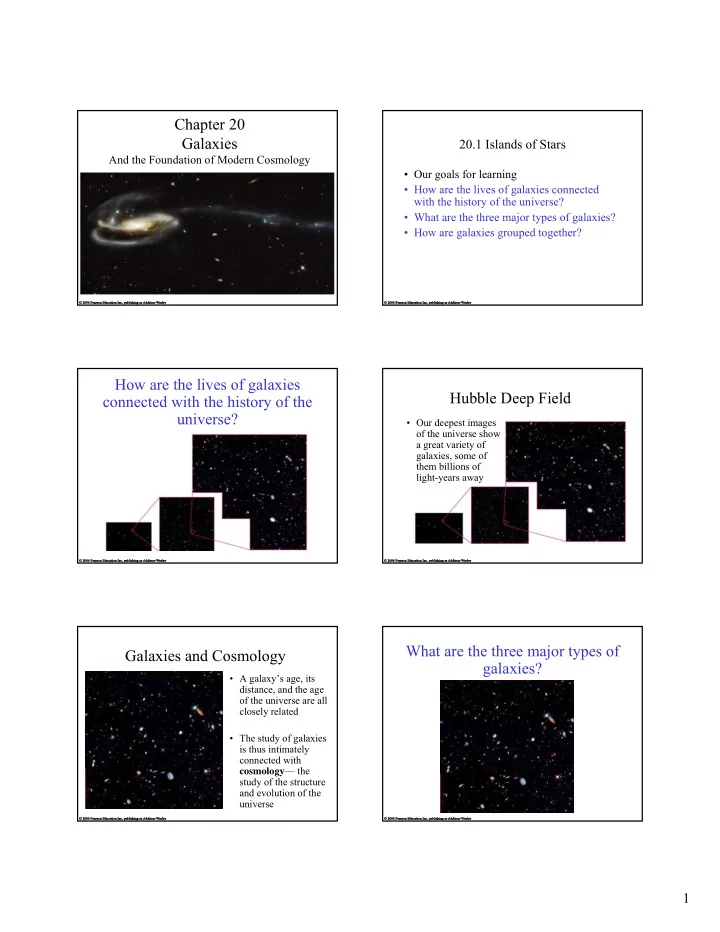
How are the lives of galaxies connected with the history of the universe? Hubble Deep Field

  • Our deepest images
  • f the universe show

a great variety of galaxies, some of them billions of light-years away

Galaxies and Cosmology

  • A galaxy’s age, its

distance, and the age

  • f the universe are all

closely related

  • The study of galaxies

is thus intimately connected with cosmology— the study of the structure and evolution of the universe

What are the three major types of galaxies?

slide-2
SLIDE 2

2

Hubble Ultra Deep Field Hubble Ultra Deep Field Hubble Ultra Deep Field

Spiral Galaxy

Hubble Ultra Deep Field

Spiral Galaxy Elliptical Galaxy

Hubble Ultra Deep Field

Elliptical Galaxy Spiral Galaxy

Hubble Ultra Deep Field

Spiral Galaxy Elliptical Galaxy Elliptical Galaxy

slide-3
SLIDE 3

3

Irregular Galaxies

Hubble Ultra Deep Field

Spiral Galaxy Elliptical Galaxy Elliptical Galaxy

Spiral Galaxy disk bulge halo Spheroidal Component: bulge & halo, old stars, few gas clouds Disk Component: stars of all ages, many gas clouds Disk Component: stars of all ages, many gas clouds Spheroidal Component: bulge & halo,

  • ld stars,

few gas clouds Blue-white color indicates ongoing star formation Red-yellow color indicates older star population Disk Component: stars of all ages, many gas clouds Spheroidal Component: bulge & halo,

  • ld stars,

few gas clouds Blue-white color indicates ongoing star formation Red-yellow color indicates older star population Disk Component: stars of all ages, many gas clouds Spheroidal Component: bulge & halo,

  • ld stars,

few gas clouds

slide-4
SLIDE 4

4

Barred Spiral Galaxy: Has a bar of stars across the bulge Lenticular Galaxy: Has a disk like a spiral galaxy but much less dusty gas (intermediate between spiral and elliptical) Elliptical Galaxy: All spheroidal component, virtually no disk component Red-yellow color indicates

  • lder star

population Irregular Galaxy Blue-white color indicates ongoing star formation Hubble’s galaxy classes Spheroid Dominates Disk Dominates

How are galaxies grouped together?

slide-5
SLIDE 5

5

Spiral galaxies are

  • ften found

in groups of galaxies (up to a few dozen galaxies) Elliptical galaxies are much more common in huge clusters

  • f galaxies

(hundreds to thousands of galaxies)

What have we learned?

  • How are the lives of galaxies connected

with the history of the universe?

– Galaxies generally formed when the universe was young and have aged along with the universe

  • What are the three major types of

galaxies?

– Spiral galaxies, elliptical galaxies, and irregular galaxies – Spirals have both disk and spheroidal components; ellipticals have no disk

What have we learned?

  • How are galaxies grouped together?

– Spiral galaxies tend to collect into groups of up to a few dozen galaxies – Elliptical galaxies are more common in large clusters containing hundreds to thousands of galaxies

20.2 Measuring Galactic Distances

  • Our goals for learning
  • How do we measure the distances to

galaxies?

How do we measure the distances to galaxies?

slide-6
SLIDE 6

6

Brightness alone does not provide enough information to measure distance Step 1 Determine size

  • f solar system

using radar Step 2 Determine distances of stars out to a few hundred light-years using parallax Luminosity passing through each sphere is the same Area of sphere: 4π (radius)2 Divide luminosity by area to get brightness The relationship between apparent brightness and luminosity depends on distance: Luminosity Brightness = 4π (distance)2 We can determine a star’s distance if we know its luminosity and can measure its apparent brightness: Luminosity Distance = 4π x Brightness A standard candle is an object whose luminosity we can determine without measuring its distance Step 3 Apparent brightness of star cluster’s main sequence tells us its distance

slide-7
SLIDE 7

7

Knowing a star cluster’s distance, we can determine the luminosity of each type of star within it Cepheid variable stars are very luminous Step 4 Because the period of a Cepheid variable star tells us its luminosity, we can use these stars as standard candles Cepheid variable stars with longer periods have greater luminosities White-dwarf supernovae can also be used as standard candles Step 5 Apparent brightness of white-dwarf supernova tells us the distance to its galaxy (up to 10 billion light- years)

slide-8
SLIDE 8

8

Tully-Fisher Relation Entire galaxies can also be used as standard candles because galaxy luminosity is related to rotation speed We measure galaxy distances using a chain of interdependent techniques

What have we learned?

  • How do we measure the distances to

galaxies?

– The distance-measurement chain begins with parallax measurements that build on radar ranging in our solar system – Using parallax and the relationship between luminosity, distance, and brightness, we can calibrate a series of standard candles – We can measure distances greater than 10 billion light years using white dwarf supernovae as standard candles

20.3 Hubble’s Law

  • Our goals for learning
  • How did Hubble prove that galaxies lie far beyond

the Milky Way?

  • What is Hubble’s Law?
  • How do distance measurements tell us the age of

the universe?

  • How does the universe’s expansion affect our

distance measurements?

How did Hubble prove that galaxies lie far beyond the Milky Way? The Puzzle of “Spiral Nebulae”

  • Before Hubble, some scientists argued that

“spiral nebulae” were entire galaxies like our Milky Way, while others maintained they were smaller collections of stars within the Milky Way

  • The debate remained unsettled until someone

finally measured their distances

slide-9
SLIDE 9

9

Hubble settled the debate by measuring the distance to the Andromeda Galaxy using Cepheid variables as standard candles

What is Hubble’s Law?

The spectral features of virtually all galaxies are redshifted ⇒ They’re all moving away from us By measuring distances to galaxies, Hubble found that redshift and distance are related in a special way Hubble’s Law: velocity = H0 x distance Redshift of a galaxy tells us its distance through Hubble’s Law: distance = velocity H0

slide-10
SLIDE 10

10

Distances of farthest galaxies are measured from redshifts

How do distance measurements tell us the age of the universe?

The expansion rate appears to be the same everywhere in space The universe has no center and no edge (as far as we can tell) One example of something that expands but has no center

  • r edge is the surface of a balloon

Cosmological Principle

The universe looks about the same no matter where you are within it

  • Matter is evenly distributed on very large scales

in the universe

  • No center & no edges
  • Not proved but consistent with all observations to

date Hubble’s constant tells us age of universe because it relates velocities and distances of all galaxies

Age = ~ 1 / H0 Distance Velocity

slide-11
SLIDE 11

11

How does the universe’s expansion affect our distance measurements?

distance?

Distances between faraway galaxies change while light travels Distances between faraway galaxies change while light travels Astronomers think in terms

  • f lookback

time rather than distance

distance?

Expansion stretches photon wavelengths causing a cosmological redshift directly related to lookback time

What have we learned?

  • How did Hubble prove that galaxies lie far

beyond the Milky Way?

– He measured the distance to the Andromeda galaxy using Cepheid variable stars as standard candles

  • What is Hubble’s Law?

– The faster a galaxy is moving away from us, the greater its distance:

velocity = H0 x distance

What have we learned?

  • How do distance measurements tell us the

age of the universe?

– Measuring a galaxy’s distance and speed allows us to figure out how long the galaxy took to reach its current distance – Measuring Hubble’s constant tells us that amount of time: about 14 billion years

  • How does the universe’s expansion affect
  • ur distance measurements?

– Lookback time is easier to define than distance for objects whose distances grow while their light travels to Earth