Chapter 2: Threads: Questions ! How is a thread different from a - - PDF document

chapter 2 threads questions
SMART_READER_LITE
LIVE PREVIEW

Chapter 2: Threads: Questions ! How is a thread different from a - - PDF document

Chapter 2: Threads: Questions ! How is a thread different from a process? CSCI [4|6]730 ! Why are threads useful? Operating Systems ! How can POSIX threads be useful? ! What are user-level and kernel-level threads? ! What are problems with


slide-1
SLIDE 1

Maria Hybinette, UGA

CSCI [4|6]730 Operating Systems

Threads

Maria Hybinette, UGA

2

Chapter 2: Threads: Questions

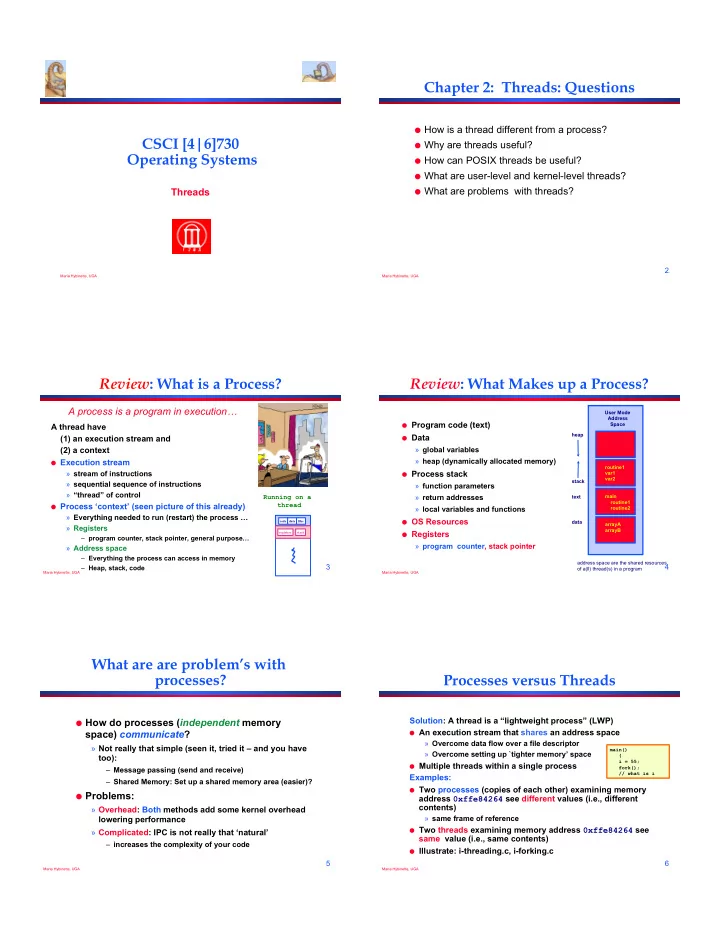
! How is a thread different from a process? ! Why are threads useful? ! How can POSIX threads be useful? ! What are user-level and kernel-level threads? ! What are problems with threads?

Maria Hybinette, UGA

3

Review: What is a Process?

A thread have (1) an execution stream and (2) a context

! Execution stream

» stream of instructions » sequential sequence of instructions » “thread” of control

! Process ‘context’ (seen picture of this already)

» Everything needed to run (restart) the process ! » Registers

– program counter, stack pointer, general purpose!

» Address space

– Everything the process can access in memory – Heap, stack, code

A process is a program in execution!

Running on a thread

code data files registers stack Maria Hybinette, UGA

4

Review: What Makes up a Process?

! Program code (text) ! Data

» global variables » heap (dynamically allocated memory)

! Process stack

» function parameters » return addresses » local variables and functions

! OS Resources ! Registers

» program counter, stack pointer

User Mode Address Space heap stack data routine1 var1 var2 main routine1 routine2 arrayA arrayB text address space are the shared resources

  • f a(ll) thread(s) in a program

Maria Hybinette, UGA

5

What are are problem’s with processes?

! How do processes (independent memory

space) communicate?

» Not really that simple (seen it, tried it – and you have too):

– Message passing (send and receive) – Shared Memory: Set up a shared memory area (easier)? ! Problems:

» Overhead: Both methods add some kernel overhead lowering performance » Complicated: IPC is not really that ‘natural’

– increases the complexity of your code

Maria Hybinette, UGA

6

Processes versus Threads

Solution: A thread is a “lightweight process” (LWP)

! An execution stream that shares an address space

» Overcome data flow over a file descriptor » Overcome setting up `tighter memory’ space

! Multiple threads within a single process

Examples:

! Two processes (copies of each other) examining memory

address 0xffe84264 see different values (i.e., different contents)

» same frame of reference

! Two threads examining memory address 0xffe84264 see

same value (i.e., same contents)

! Illustrate: i-threading.c, i-forking.c

main() { i = 55; fork(); // what is i

slide-2
SLIDE 2

Maria Hybinette, UGA

7

What Makes up a Thread?

! Own stack (necessary?) ! Own registers (necessary?)

» Own program counter » Own stack pointer

! State (running, sleeping) ! Signal mask

User Mode Address Space heap stack data routine1 var1 var2 main routine1 routine2 arrayA arrayB text address space are the shared resources

  • f a(ll) thread(s) in a program

routine1 var1 var2 Stack Pointer Program Counter

Maria Hybinette, UGA

8

Single and Multithreaded Process

code data files registers stack code data files registers stack registers stack registers stack

Maria Hybinette, UGA

9

Why Support Threads?

! Divide large task across several cooperative threads ! Multi-threaded task has many performance benefits ! Examples:

» Web Server: create threads to:

– Get network message from client – Get URL data from disk – Compose response – Send a response

» Word processor: create threads to:

– Display graphics – Read keystrokes from users – Perform spelling and grammar checking in background

Maria Hybinette, UGA

10

Why Support Threads?

! Divide large task across several cooperative threads ! Multi-threaded task has many performance benefits ! Adapt to slow devices

» One thread waits for device while other threads computes

! Defer work

» One thread performs non-critical work in the background, when idle

! Parallelism

» Each thread runs simultaneously on a multiprocessor

Maria Hybinette, UGA

11

Why Threads instead of a Processes?

! Advantages of Threads:

» Thread operations cheaper than corresponding process operations

– In terms of: Creation, termination, (context) switching

» IPC cheap through shared memory

– No need to invoke kernel to communicate between threads ! Disadvantages of Threads:

» True Concurrent programming is a challenge (what does this mean? True concurrency?) » Synchronization between threads needed to use shared variables (more on this later – this is HARD).

Maria Hybinette, UGA

12

Why are Threads Challenging? pthread1 Example: Output?

main() { pthread_t t1, t2; char *msg1 = “Thread 1”; char *msg2 = “Thread 2”; int ret1, ret2; ret1 = pthread_create( &t1, NULL, print_fn, (void *)msg1 ); ret2 = pthread_create( &t2, NULL, print_fn, (void *)msg2 ); if( ret1 || ret2 ) {

  • fprintf(stderr, “ERROR: pthread_created failed.\n”);
  • exit(1);

} pthread_join( t1, NULL ); pthread_join( t2, NULL ); printf( “Thread 1 and thread 2 complete.\n” ); } void print_fn(void *ptr) { printf(“%s\n”, (char *)ptr); }

slide-3
SLIDE 3

Maria Hybinette, UGA

13

Why are Threads Challenging?

! Example: Transfer $50.00 between two

accounts and output the total balance of the accounts:

! Tasks:

M = Balance in Maria’s account (begin $100) T = Balance in Tucker’s account (begin $50) B = Total balance T = 50, M = 100 M = M - $50.00 T = T + $50.00 B = M + T

Idea: on distributing the tasks: (1) One thread debits and credits (2) The other Totals Does that work?

Maria Hybinette, UGA

14

Why are Threads Challenging?

! Tasks:

T = 50, M = 100 M = M - $50.00 T = T + $50.00 B = M + T M = M - $50.00 T = T + $50.00 B = M + T M = M - $50.00 B = M + T T = T + $50.00 B = M + T M = M - $50.00 T = T + $50.00

One thread debits & credits One thread totals

B = $150 B = $100 B = $150

Maria Hybinette, UGA

15

Common Programming Models

! Manager/worker

» Single manager handles input and assigns work to the worker threads

! Producer/consumer

» Multiple producer threads create data (or work) that is handled by one of the multiple consumer threads

! Pipeline

» Task is divided into series of subtasks, each of which is handled in series by a different thread

Maria Hybinette, UGA

16

Thread Support

! Three approaches to provide thread support

» User-level threads » Kernel-level threads » Hybrid of User-level and Kernel-level threads

Maria Hybinette, UGA

17

Latencies

! Comparing user-level threads, kernel threads, and

processes

! Thread/Process Creation Cost: » Evaluate –with Null fork: the time to create, schedule, execute, and complete the entity that invokes the null procedure ! Thread/Process Synchronization Cost: » Evaluate – with Signal-Wait: the time for an entity to signal a waiting entity and then wait on a condition (overhead of synchronization)

Procedure call = 7 us Kernel Trap = 17 us

User Level Threads Kernel Level Threads Processes

Null fork

34 948 11,300

Signal-wait

37 441 1,840

30X,12X

Maria Hybinette, UGA

18

User-Level Threads

! Many-to-one thread mapping

» Implemented by user-level runtime libraries

– Create, schedule, synchronize threads at user-level, state in user level space

» OS is not aware of user-level threads

– OS thinks each process contains only a single thread of control

P P ! Advantages

» Does not require OS support; Portable » Can tune scheduling policy to meet application (user level) demands » Lower overhead thread operations since no system calls

! Disadvantages

» Cannot leverage multiprocessors (no true parallelism) » Entire process blocks when one thread blocks

slide-4
SLIDE 4

Maria Hybinette, UGA

19

Blocked UL Threads: Jacketing

! Avoids ‘blocking’ on system calls that block (e.g., I/O) ! Solution:

» Instead of calling a blocking system call call an application level I/O jacket routine (a nonblocking call) » Jacket routine provides code that determines whether I/O device is busy or available (idle). » Busy:

– Thread enters the ready state and passes control to another thread – Control returns to thread it retries

» Idle:

– Thread is allowed to make system call.

Maria Hybinette, UGA

20

Kernel-Level Threads

! One-to-one thread mapping

» OS provides each user-level thread with a kernel thread » Each kernel thread scheduled independently » Thread operations (creation, scheduling, synchronization) performed by OS

! Advantages

» Each kernel-level thread can run in parallel on a multiprocessor » When one thread blocks, other threads from process can be scheduled

! Disadvantages

» Higher overhead for thread operations » OS must scale well with increasing number of threads

P P

Maria Hybinette, UGA

21

Two-Level Model

! one-one & (strict) many-to-many

» OS provides each user-level thread with a kernel thread » Supports both bound an unbound threads

– Bound threads - permanently bound to a single kernel level thread – Unbound threads may move to other kernel threads

! Advantages

» Flexible, best of two worlds

! Disadvantages

» More complicated

P P P

Maria Hybinette, UGA

22

Hybrid of Kernel & User -Level Threads

! m - n thread mapping (many to many)

» Application creates m threads » OS provides pool of n kernel threads » Few user-level threads mapped to each kernel-level thread

! Advantages

» Can get best of user-level and kernel-level implementations » Works well given many short-lived user threads mapped to constant-size pool

! Disadvantages

» Complicated! » How to select mappings? » How to determine the best number of kernel threads?

– User specified – OS dynamically adjusts number depending on system load P P

Maria Hybinette, UGA

23

Summary: Thread Models

P P P P P P ! Kernel Level: Windows 95/98/NT/2000, Solaris, Linux ! User Level: POSIX Pthreads, Mach, C-threads, Solaris threads ! Hybrids: IRIX, HP-UX, True 64 UNIX, Older Solaris models

Maria Hybinette, UGA

24

Design: Threading Issues: fork() & exec()

! fork()

» Duplicate all threads? » Duplicate only the thread that performs the fork » Resulting new process is single threaded? » -> solution provide two different forks (mfork)

! exec()

» Replaces the process - including all threads? » If exec is after fork then replacing all threads is unnecessary.

slide-5
SLIDE 5

Maria Hybinette, UGA

25

Threading Issues: Cancellation

! Example 1: User pushes top button on a web

browsers - while other threads are images (one thread per image).

» Asynchronous Cancellation: Immediate (OS need to reclaim resources)

! Example 2: Several threads concurrently

searches data base and one thread finds target data.

» Deferred Cancellation: Thread terminates it self when notices it is scheduled for termination.

Maria Hybinette, UGA

26

Threading Issues: Threads and Signals

! Problem: To which thread should OS deliver signal? ! Option 1: Require sender to specify thread ID (instead

  • f process id)

» Sender may not know about individual threads

! Option 2: OS picks destination thread

» POSIX: Each thread has signal mask (disable specified signals) » OS delivers signal to all threads without signal masked » Application determines which thread is most appropriate for handing signal

! Synchronous - delivered to the same process that

caused the signal

! Asynchronous - event is external to running process.

Maria Hybinette, UGA

27

Other Thread Issues

! Creating thread is still costly! ! No bound of number of threads!

Maria Hybinette, UGA

28

Thread Pools

! Create a number of threads in a pool where a

number of threads await work

! Advantages:

» Usually slightly faster to service a request with an existing thread than waiting to create a new thread » Allows the number of threads in the application(s) to be bound to the size of the pool

! The number of threads can be set

heuristically based on the hardware and can even be dynamically adjusted taking into account user statistics.

Maria Hybinette, UGA

29

IPC: Shared Memory

! Processes

» Each process has private address space » Explicitly set up shared memory segment within each address space

! Threads

» Always share address space (use heap for shared data), don’t need to set up shared space already there.

! Advantages

» Fast and easy to share data

! Disadvantages

» Must synchronize data accesses; error prone (later)

Maria Hybinette, UGA

30

IPC: Message Passing (also for threads, similar to processes)

! Message passing most commonly used between processes

» Explicitly pass data between sender (src) + receiver (destination) » Example: Unix pipes

! Advantages:

» Makes sharing explicit » Improves modularity (narrow interface) » Does not require trust between sender and receiver

! Disadvantages:

» Performance overhead to copy messages

! Issues:

» How to name source and destination?

– One process, set of processes, or mailbox (port)

» Does sending process wait (I.e., block) for receiver?

– Blocking: Slows down sender – Non-blocking: Requires buffering between sender and receiver

slide-6
SLIDE 6

Maria Hybinette, UGA

31

IPC: Signals

! Signal

» Software interrupt that notifies a process of an event » Examples: SIGFPE, SIGKILL, SIGUSR1, SIGSTOP, SIGCONT

! What happens when a signal is received?

» Catch: Specify signal handler to be called » Ignore: Rely on OS default action

– Example: Abort, memory dump, suspend or resume process

» Mask: Block signal so it is not delivered

– May be temporary (while handling signal of same type) ! Disadvantage

» Does not specify any data to be exchanged » Complex semantics with threads

Thread Design

Maria Hybinette, UGA

32

Scheduler Activations Notes

! Provides better OS support for user level

threading

» Dynamic adjustment of number of kernel level threads to user level threads:

– E.g. Two level and the m:n thread models need to maintain appropriate ratios

» Key Idea: Kernel notifies thread scheduler of all kernel events via upcalls

*** Textbook Read

Maria Hybinette, UGA

33

Scheduler Activations

! Use an intermediate data structure

between user/kernel level threads.

! Details: User level threads run and are

scheduled (by the user level scheduler) on ‘virtual processor’

» A data structure or light-weigh process (LWP) that is between the kernel thread and the user thread. » Each LWP is attached to a kernel thread and kernel threads are what the OS schedules to run on physical processors. LWP

Kernel Level Thread User Level Thread

Maria Hybinette, UGA

34

Scheduler Activations

! An application may require any number of

LWPs to run efficiently.

» Example: A CPU-bound application on a single processor.

– Needs only one LWP.

» Example: An I/O-bound application

– May need many LWPs- one for each concurrent blocking system since if there are not enough LWPs, the unassigned threads must wait for one of the LWPs to return from the kernel.

Maria Hybinette, UGA

35

Scheduler Activations

! Why not a user level thread scheduler that spawns a kernel

thread for blocking operations? » Forget spawning, use a pool of kernel threads. » But how do we know if an operation will block?

– read might block, or data might be in page cache. – Any memory reference might cause a page fault to disk.

! Scheduler Activations ! Kernel tells user when a thread is going to block, via an

upcall. » Kernel can provide a kernel thread to run the user-level upcall handler (or preempt user thread). » User-level scheduler suspends blocking thread and can give back kernel thread it was running on.

Maria Hybinette, UGA

36

Quiz 3

1.

What resources (context) within a process are shared between threads?

2.

What resources (context) cannot be shared among threads within the same process?

3.

What happens to other p-threads within the same process when a thread reads from disk?

4.

Name a user level thread package?

5.

Do Java threads use kernel or user level threads (Justify your answer)?