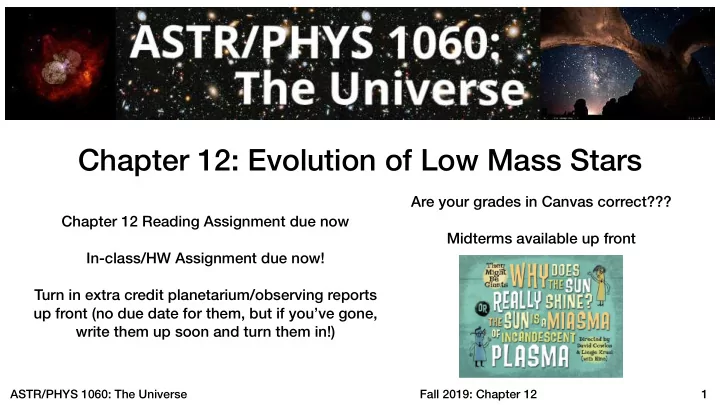
Chapter 12: Evolution of Low Mass Stars Are your grades in Canvas - - PowerPoint PPT Presentation

chapter 12 evolution of low mass stars
SMART_READER_LITE
LIVE PREVIEW

Chapter 12: Evolution of Low Mass Stars Are your grades in Canvas - - PowerPoint PPT Presentation

Chapter 12: Evolution of Low Mass Stars Are your grades in Canvas correct??? Chapter 12 Reading Assignment due now Midterms available up front In-class/HW Assignment due now! Turn in extra credit planetarium/observing reports up front (no due


slide-1
SLIDE 1

Fall 2019: Chapter 12 ASTR/PHYS 1060: The Universe

Chapter 12: Evolution of Low Mass Stars

1

Chapter 12 Reading Assignment due now In-class/HW Assignment due now! Turn in extra credit planetarium/observing reports up front (no due date for them, but if you’ve gone, write them up soon and turn them in!) Are your grades in Canvas correct??? Midterms available up front

slide-2
SLIDE 2

ASTR/PHYS 1060: The Universe Fall 2019: Chapter 12

Stellar Properties

2

Age Color Luminosity Size Mass Temperature Spectral Type

Which of these is most important?

slide-3
SLIDE 3

ASTR/PHYS 1060: The Universe Fall 2019: Chapter 12

Stellar Properties

3

Age Color Luminosity Size Mass Temperature Spectral Type

slide-4
SLIDE 4

ASTR/PHYS 1060: The Universe Fall 2019: Chapter 12

Luminosity depends on mass

4

slide-5
SLIDE 5

ASTR/PHYS 1060: The Universe Fall 2019: Chapter 12 5

High Mass Low Mass

slide-6
SLIDE 6

ASTR/PHYS 1060: The Universe Fall 2019: Chapter 12 6

High Mass Low Mass

slide-7
SLIDE 7

ASTR/PHYS 1060: The Universe Fall 2019: Chapter 12 7

slide-8
SLIDE 8

ASTR/PHYS 1060: The Universe Fall 2019: Chapter 12

Why are fainter (and less massive) stars more common than brighter ones?

8

A) They live longer B) They form more frequently C) They aren’t more common, we just see them more easily

slide-9
SLIDE 9

ASTR/PHYS 1060: The Universe Fall 2019: Chapter 12

The future of our Sun and the evolution of low-mass stars

9

slide-10
SLIDE 10

ASTR/PHYS 1060: The Universe Fall 2019: Chapter 12 10

Protostars to Stars

slide-11
SLIDE 11

ASTR/PHYS 1060: The Universe Fall 2019: Chapter 12

Lifetime as a function of mass

11

slide-12
SLIDE 12

ASTR/PHYS 1060: The Universe Fall 2019: Chapter 12 12

Main Sequence Power: Hydrogen Core Burning Temperature = 5800 K Luminosity = 1 LSun Lifetime = 10 billion years

slide-13
SLIDE 13

ASTR/PHYS 1060: The Universe Fall 2019: Chapter 12 13

Red Giant Branch Power: Hydrogen Shell Burning Final Temperature = 3200 K Final Luminosity = 1000 LSun Lifetime = 200 million years

slide-14
SLIDE 14

ASTR/PHYS 1060: The Universe Fall 2019: Chapter 12 14

Helium Burning or Horizontal Branch Power: Helium (into Carbon) Core Burning + Hydrogen shell burning Temperature = 4500 K Luminosity = 100 LSun Lifetime = 100 million years

slide-15
SLIDE 15

ASTR/PHYS 1060: The Universe Fall 2019: Chapter 12 15

Asymptotic Giant Branch Power: Helium shell burning + Hydrogen shell burning Final Temperature = 3000 K Final Luminosity = 5000 LSun Lifetime = 1 million years

slide-16
SLIDE 16

ASTR/PHYS 1060: The Universe Fall 2019: Chapter 12 16

Planetary Nebulae

  • uter atmosphere ejected by

radiation from the core

slide-17
SLIDE 17

ASTR/PHYS 1060: The Universe Fall 2019: Chapter 12 17

White Dwarf Power: None Temperature = 15000 K Luminosity = 0.001 LSun Lifetime = 1 billion years (to cool down to ~7000 K)

slide-18
SLIDE 18

ASTR/PHYS 1060: The Universe Fall 2019: Chapter 12 18

slide-19
SLIDE 19

ASTR/PHYS 1060: The Universe Fall 2019: Chapter 12 19

slide-20
SLIDE 20

ASTR/PHYS 1060: The Universe Fall 2019: Chapter 12 20

slide-21
SLIDE 21

ASTR/PHYS 1060: The Universe Fall 2019: Chapter 12 21

slide-22
SLIDE 22

ASTR/PHYS 1060: The Universe Fall 2019: Chapter 12 22

slide-23
SLIDE 23

ASTR/PHYS 1060: The Universe Fall 2019: Chapter 12

Future Evolution

  • f the Sun

23

Again, this time with feeling!

slide-24
SLIDE 24

ASTR/PHYS 1060: The Universe Fall 2019: Chapter 12 24

Size changes along with temperature

slide-25
SLIDE 25

ASTR/PHYS 1060: The Universe Fall 2019: Chapter 12 25

The universe is about 13 billion years old. If I see a 0.7 solar mass star, what phase of evolution will it be in?

A) Main Sequence B) Red Giant Branch C) Helium Burning D) Asymptotic Giant Branch

slide-26
SLIDE 26

ASTR/PHYS 1060: The Universe Fall 2019: Chapter 12 26

How do we know the different stages of a star's life? We

  • bviously have not been observing

stars for long enough to see it go through all the stages.

slide-27
SLIDE 27

ASTR/PHYS 1060: The Universe Fall 2019: Chapter 12 27

Star Clusters: stars of many masses born at the same time

slide-28
SLIDE 28

ASTR/PHYS 1060: The Universe Fall 2019: Chapter 12 28

Which of these star clusters is the oldest?

A B C

slide-29
SLIDE 29

ASTR/PHYS 1060: The Universe Fall 2019: Chapter 12 29

Theory (red line) & Observations (white dots)

We can make a model of any star based on its mass and age

slide-30
SLIDE 30

ASTR/PHYS 1060: The Universe Fall 2019: Chapter 12 30

Which stars in this cluster are the most massive?

A B C D

slide-31
SLIDE 31

ASTR/PHYS 1060: The Universe Fall 2019: Chapter 12

Because stars in clusters form at the same time, and a star’s evolution is determined primarily by its mass, we can

  • bserve many

clusters and figure

  • ut how stars evolve

31

slide-32
SLIDE 32

ASTR/PHYS 1060: The Universe Fall 2019: Chapter 12

What happens when close binary stars evolve?

32

What is this???

slide-33
SLIDE 33

ASTR/PHYS 1060: The Universe Fall 2019: Chapter 12

What happens when close binary stars evolve?

33

slide-34
SLIDE 34

ASTR/PHYS 1060: The Universe Fall 2019: Chapter 12

What happens when close binary stars evolve?

34

slide-35
SLIDE 35

ASTR/PHYS 1060: The Universe Fall 2019: Chapter 12

What happens when close binary stars evolve?

35

slide-36
SLIDE 36

ASTR/PHYS 1060: The Universe Fall 2019: Chapter 12

What happens when close binary stars evolve?

36

slide-37
SLIDE 37

ASTR/PHYS 1060: The Universe Fall 2019: Chapter 12

What happens when close binary stars evolve?

37

A “nova” is what? A) Material from Star 2 hits the surface of the white dwarf, causing it to heat up B) Material from Star 2 accumulates on the surface until it’s hot enough to burn (fuse H -> He) C) Enough material falls on the white dwarf to cause the entire star to explode

slide-38
SLIDE 38

ASTR/PHYS 1060: The Universe Fall 2019: Chapter 12

What happens when close binary stars evolve?

38

slide-39
SLIDE 39

ASTR/PHYS 1060: The Universe Fall 2019: Chapter 12

What happens when close binary stars evolve?

39

slide-40
SLIDE 40

ASTR/PHYS 1060: The Universe Fall 2019: Chapter 12

Type Ia Supernovae

40