Chapter 11 Current Programmed Control Buck converter L i s (t) i L - - PowerPoint PPT Presentation

chapter 11 current programmed control
SMART_READER_LITE
LIVE PREVIEW

Chapter 11 Current Programmed Control Buck converter L i s (t) i L - - PowerPoint PPT Presentation

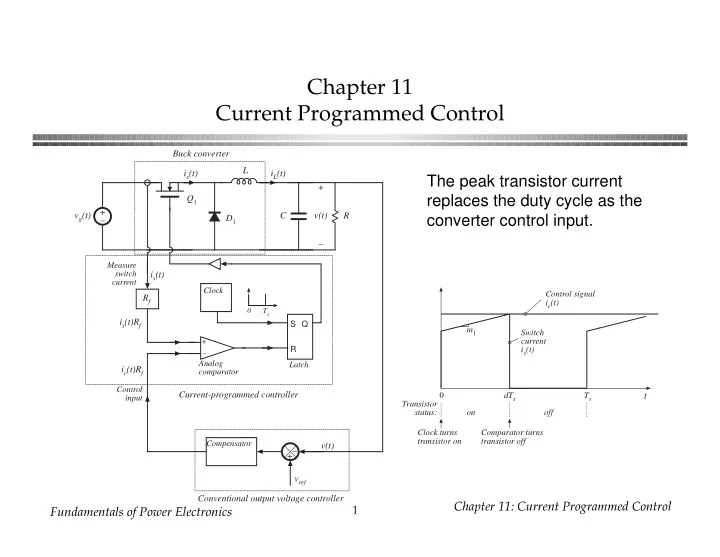
Chapter 11 Current Programmed Control Buck converter L i s (t) i L (t) The peak transistor current + replaces the duty cycle as the Q 1 + v g (t) C v(t) R converter control input. D 1 Measure switch i s (t) current Clock


slide-1
SLIDE 1

Fundamentals of Power Electronics

1

Chapter 11: Current Programmed Control

Chapter 11 Current Programmed Control

+ – Buck converter Current-programmed controller R vg(t) is(t) + v(t) – iL(t) Q1 L C D1

+ –

Analog comparator Latch

Ts

S R Q Clock

is(t) Rf

Measure switch current

is(t)Rf

Control input

ic(t)Rf –+ vref v(t)

Compensator

Conventional output voltage controller

Switch current is(t) Control signal ic(t) m1

t

dTs Ts

  • n
  • ff

Transistor status: Clock turns transistor on Comparator turns transistor off

The peak transistor current replaces the duty cycle as the converter control input.

slide-2
SLIDE 2

Fundamentals of Power Electronics

2

Chapter 11: Current Programmed Control

Current programmed control vs. duty cycle control

Advantages of current programmed control:

  • Simpler dynamics —inductor pole is moved to high frequency
  • Simple robust output voltage control, with large phase margin,

can be obtained without use of compensator lead networks

  • It is always necessary to sense the transistor current, to protect

against overcurrent failures. We may as well use the information during normal operation, to obtain better control

  • Transistor failures due to excessive current can be prevented

simply by limiting ic(t)

  • Transformer saturation problems in bridge or push-pull

converters can be mitigated A disadvantage: susceptibility to noise

slide-3
SLIDE 3

Fundamentals of Power Electronics

3

Chapter 11: Current Programmed Control

Chapter 11: Outline

11.1 Oscillation for D > 0.5 11.2 A simple first-order model Simple model via algebraic approach Averaged switch modeling 11.3 A more accurate model Current programmed controller model: block diagram CPM buck converter example 11.4 Discontinuous conduction mode 11.5 Summary

slide-4
SLIDE 4

Fundamentals of Power Electronics

4

Chapter 11: Current Programmed Control

11.1 Oscillation for D > 0.5

  • The current programmed controller is inherently unstable for

D > 0.5, regardless of the converter topology

  • Controller can be stabilized by addition of an artificial ramp

Objectives of this section:

  • Stability analysis
  • Describe artificial ramp scheme
slide-5
SLIDE 5

Fundamentals of Power Electronics

5

Chapter 11: Current Programmed Control

Inductor current waveform, CCM

iL(t)

ic m1

t

dTs Ts iL(0) iL(Ts) – m2

buck converter m1 = vg – v L – m2 = – v L boost converter m1 = vg L – m2 = vg – v L buck–boost converter m1 = vg L – m2 = v L Inductor current slopes m1 and –m2

slide-6
SLIDE 6

Fundamentals of Power Electronics

6

Chapter 11: Current Programmed Control

Steady-state inductor current waveform, CPM

iL(t)

ic m1

t

dTs Ts iL(0) iL(Ts) – m2

iL(dTs) = ic = iL(0) + m1dTs

d = ic – iL(0) m1Ts

iL(Ts) = iL(dTs) – m2d'Ts = iL(0) + m1dTs – m2d'Ts First interval: Solve for d: Second interval:

0 = M 1DTs – M 2D'Ts

In steady state:

M 2 M 1 = D D'

slide-7
SLIDE 7

Fundamentals of Power Electronics

7

Chapter 11: Current Programmed Control

Perturbed inductor current waveform

iL(t)

ic m1

t

DTs Ts IL0 – m2 – m2 m1 Steady-state waveform Perturbed waveform I L0 + iL(0) dTs D + d Ts iL(0) iL(Ts)

slide-8
SLIDE 8

Fundamentals of Power Electronics

8

Chapter 11: Current Programmed Control

Change in inductor current perturbation

  • ver one switching period

iL(Ts) ic m1 – m2 – m2 m1 Steady-state waveform Perturbed waveform dTs iL(0)

magnified view

iL(0) = – m1dTs

iL(Ts) = m2dTs

iL(Ts) = iL(0) – m2 m1 iL(Ts) = iL(0) – D D'

slide-9
SLIDE 9

Fundamentals of Power Electronics

9

Chapter 11: Current Programmed Control

Change in inductor current perturbation

  • ver many switching periods

iL(Ts) = iL(0) – D D' iL(2Ts) = iL(Ts) – D D' = iL(0) – D D'

2

iL(nTs) = iL((n – 1)Ts) – D D' = iL(0) – D D'

n

iL(nTs) → when – D D' < 1 ∞ when – D D' > 1

D < 0.5

For stability:

slide-10
SLIDE 10

Fundamentals of Power Electronics

10

Chapter 11: Current Programmed Control

Example: unstable operation for D = 0.6

iL(t)

ic

t

Ts IL0 iL(0) 2Ts 3Ts 4Ts – 1.5iL(0) 2.25iL(0) – 3.375iL(0)

α = – D D' = – 0.6 0.4 = – 1.5

slide-11
SLIDE 11

Fundamentals of Power Electronics

11

Chapter 11: Current Programmed Control

Example: stable operation for D = 1/3

α = – D D' = – 1/3 2/3 = – 0.5

– 1 8 iL(0) 1 4 iL(0) – 1 2 iL(0)

iL(t)

ic

t

Ts IL0 iL(0) 2Ts 3Ts 4Ts 1 16 iL(0)

slide-12
SLIDE 12

Fundamentals of Power Electronics

12

Chapter 11: Current Programmed Control

Stabilization via addition of an artificial ramp to the measured switch current waveform

+ – Buck converter Current-programmed controller R vg(t) is(t) + v(t) – iL(t) Q1 L C D1

+ –

Analog comparator Latch

ia(t)Rf

Ts

S R Q

ma

Clock

is(t) + + Rf

Measure switch current

is(t)Rf

Control input

ic(t)Rf

Artificial ramp ia(t)

ma

t

Ts 2Ts

Now, transistor switches off when

ia(dTs) + iL(dTs) = ic

  • r,

iL(dTs) = ic – ia(dTs)

slide-13
SLIDE 13

Fundamentals of Power Electronics

13

Chapter 11: Current Programmed Control

Steady state waveforms with artificial ramp

iL(dTs) = ic – ia(dTs)

iL(t) ic m1

t

dTs Ts IL0 – m2 – ma (ic – ia(t))

slide-14
SLIDE 14

Fundamentals of Power Electronics

14

Chapter 11: Current Programmed Control

Stability analysis: perturbed waveform

– ma iL(Ts) iL ( ) ic m1

t

DTs Ts IL0 – m2 – m2 m1 Steady-state waveform Perturbed waveform I L0 + iL(0) dTs D + d Ts (ic – ia(t))

slide-15
SLIDE 15

Fundamentals of Power Electronics

15

Chapter 11: Current Programmed Control

Stability analysis: change in perturbation

  • ver complete switching periods

iL(0) = – dTs m1 + ma iL(Ts) = – dTs ma – m2

iL(Ts) = iL(0) – m2 – ma m1 + ma iL(nTs) = iL((n –1)Ts) – m2 – ma m1 + ma = iL(0) – m2 – ma m1 + ma

n

= iL(0) αn α = – m2 – ma m1 + ma

iL(nTs) → when α < 1 ∞ when α > 1

First subinterval: Second subinterval: Net change over one switching period: After n switching periods: Characteristic value:

slide-16
SLIDE 16

Fundamentals of Power Electronics

16

Chapter 11: Current Programmed Control

The characteristic value α

  • For stability, require | α | < 1
  • Buck and buck-boost converters: m2 = – v/L

So if v is well-regulated, then m2 is also well-regulated

  • A common choice: ma = 0.5 m2

This leads to α = –1 at D = 1, and | α | < 1 for 0 ≤ D < 1. The minimum α that leads to stability for all D.

  • Another common choice: ma = m2

This leads to α = 0 for 0 ≤ D < 1. Deadbeat control, finite settling time

α = – 1 – ma m2 D' D + ma m2

slide-17
SLIDE 17

Fundamentals of Power Electronics

17

Chapter 11: Current Programmed Control

11.2 A Simple First-Order Model

Compensator + – +– R + v(t) – vg(t) Current programmed controller d(t) Converter voltages and currents Switching converter vref ic(t) v(t)

slide-18
SLIDE 18

Fundamentals of Power Electronics

18

Chapter 11: Current Programmed Control

The first-order approximation

iL(t)

Ts = ic(t)

  • Neglects switching ripple and artificial ramp
  • Yields physical insight and simple first-order model
  • Accurate when converter operates well into CCM (so that switching

ripple is small) and when the magnitude of the artificial ramp is not too large

  • Resulting small-signal relation:

iL(s) ≈ ic(s)

slide-19
SLIDE 19

Fundamentals of Power Electronics

19

Chapter 11: Current Programmed Control

11.2.1 Simple model via algebraic approach: CCM buck-boost example

+ – L C R + v(t) – vg(t) Q1 D1 iL(t)

iL(t)

ic

t

dTs Ts vg L v L

slide-20
SLIDE 20

Fundamentals of Power Electronics

20

Chapter 11: Current Programmed Control

Small-signal equations of CCM buck–boost, duty cycle control

L diL(t) dt = Dvg(t) + D'v(t) + Vg – V d(t) C dv(t) dt = – D'iL – v(t) R + ILd(t) ig(t) = DiL + ILd(t)

Derived in Chapter 7

slide-21
SLIDE 21

Fundamentals of Power Electronics

21

Chapter 11: Current Programmed Control

Transformed equations

Take Laplace transform, letting initial conditions be zero:

sLiL(s) = Dvg(s) + D'v(s) + Vg – V d(s) sCv(s) = – D'iL(s) – v(s) R + ILd(s) ig(s) = DiL(s) + ILd(s)

slide-22
SLIDE 22

Fundamentals of Power Electronics

22

Chapter 11: Current Programmed Control

The simple approximation

Now let

iL(s) ≈ ic(s)

Eliminate the duty cycle (now an intermediate variable), to express the equations using the new control input iL. The inductor equation becomes:

sLic(s) ≈ Dvg(s) + D'v(s) + Vg – V d(s)

Solve for the duty cycle variations:

d(s) = sLic(s) – Dvg(s) – D'v(s) Vg – V

slide-23
SLIDE 23

Fundamentals of Power Electronics

23

Chapter 11: Current Programmed Control

The simple approximation, continued

Substitute this expression to eliminate the duty cycle from the remaining equations:

sCv(s) = – D'ic(s) – v(s) R + IL sLic(s) – Dvg(s) – D'v(s) Vg – V ig(s) = Dic(s) + IL sLic(s) – Dvg(s) – D'v(s) Vg – V

Collect terms, simplify using steady-state relations:

sCv(s) = sLD D'R – D' ic(s) – D R + 1 R v(s) – D2 D'R vg(s) ig(s) = sLD D'R + D ic(s) – D R v(s) – D2 D'R vg(s)

slide-24
SLIDE 24

Fundamentals of Power Electronics

24

Chapter 11: Current Programmed Control

Construct equivalent circuit: input port

D2 D'R vg + – – D'R D2 D 1 + sL D'R ic D R v ig vg

ig(s) = sLD D'R + D ic(s) – D R v(s) – D2 D'R vg(s)

slide-25
SLIDE 25

Fundamentals of Power Electronics

25

Chapter 11: Current Programmed Control

Construct equivalent circuit: output port

sCv(s) = sLD D'R – D' ic(s) – D R + 1 R v(s) – D2 D'R vg(s)

R D' 1 – sLD D'2R ic D R v D2 D'R vg R D sCv v R C Node

slide-26
SLIDE 26

Fundamentals of Power Electronics

26

Chapter 11: Current Programmed Control

CPM Canonical Model, Simple Approximation

+ – ig vg R C r1 f1(s) ic g1 v g2 vg f2(s) ic r2 v + –

slide-27
SLIDE 27

Fundamentals of Power Electronics

27

Chapter 11: Current Programmed Control

Table of results for basic converters

Table 11. 1 Current programmed mode small-signal equivalent circuit parameters, simple model Converter g1 f1 r1 g2 f2 r2 Buck

D R D 1 + sL R – R D2

1 ∞ Boost 1 ∞

1 D'R

D' 1 – sL D'2R

R Buck-boost

– D R

D 1 + sL D'R – D'R D2 – D2 D'R – D' 1 – sDL D'2R R D

slide-28
SLIDE 28

Fundamentals of Power Electronics

28

Chapter 11: Current Programmed Control

Transfer functions predicted by simple model

+ – ig vg R C r1 f1(s) ic g1 v g2 vg f2(s) ic r2 v + –

Gvc(s) = v(s) ic(s)

vg = 0

= f2 r2 || R || 1 sC Gvc(s) = – R D' 1 + D 1 – s DL D'2R 1 + s RC 1 + D

Control-to-output transfer function Result for buck-boost example

slide-29
SLIDE 29

Fundamentals of Power Electronics

29

Chapter 11: Current Programmed Control

Transfer functions predicted by simple model

+ – ig vg R C r1 f1(s) ic g1 v g2 vg f2(s) ic r2 v + –

Line-to-output transfer function Result for buck-boost example

Gvg(s) = v(s) vg(s)

ic = 0

= g2 r2 || R || 1 sC

Gvg(s) = – D2 1 – D2 1 1 + s RC 1 + D

slide-30
SLIDE 30

Fundamentals of Power Electronics

30

Chapter 11: Current Programmed Control

Transfer functions predicted by simple model

+ – ig vg R C r1 f1(s) ic g1 v g2 vg f2(s) ic r2 v + –

Output impedance Result for buck-boost example

Zout(s) = r2 || R || 1 sC

Zout(s) = R 1 + D 1 1 + s RC 1 + D

slide-31
SLIDE 31

Fundamentals of Power Electronics

31

Chapter 11: Current Programmed Control

11.2.2 Averaged switch modeling

with the simple approximation

+ – L C R + v(t) – vg(t) iL(t) + v2(t) – i1(t) i2(t) Switch network + v1(t) –

v2(t)

Ts = d(t) v1(t) Ts

i1(t)

Ts = d(t) i2(t) Ts

Averaged terminal waveforms, CCM: The simple approximation:

i2(t)

Ts ≈ ic(t) Ts

slide-32
SLIDE 32

Fundamentals of Power Electronics

32

Chapter 11: Current Programmed Control

CPM averaged switch equations

v2(t)

Ts = d(t) v1(t) Ts

i1(t)

Ts = d(t) i2(t) Ts

i2(t)

Ts ≈ ic(t) Ts

Eliminate duty cycle:

i1(t)

Ts = d(t) ic(t) Ts =

v2(t)

Ts

v1(t)

Ts

ic(t)

Ts

i1(t)

Ts v1(t) Ts = ic(t) Ts v2(t) Ts = p(t) Ts

So:

  • Output port is a current source
  • Input port is a dependent current sink
slide-33
SLIDE 33

Fundamentals of Power Electronics

33

Chapter 11: Current Programmed Control

CPM averaged switch model

+ – L C R + 〈v(t)〉Ts – 〈vg(t)〉Ts 〈iL(t)〉Ts + 〈v2(t)〉Ts – 〈i1(t)〉Ts 〈i2(t)〉Ts Averaged switch network + 〈v1(t)〉Ts – 〈ic(t)〉Ts 〈 p(t)〉Ts

slide-34
SLIDE 34

Fundamentals of Power Electronics

34

Chapter 11: Current Programmed Control

Results for other converters

+ – L C R + 〈v(t)〉Ts – 〈vg(t)〉Ts 〈iL(t)〉Ts Averaged switch network 〈ic(t)〉Ts 〈 p(t)〉Ts

+ – L C R + 〈v(t)〉Ts – 〈vg(t)〉Ts 〈iL(t)〉Ts Averaged switch network 〈ic(t)〉Ts 〈 p(t)〉Ts

Boost Buck-boost

slide-35
SLIDE 35

Fundamentals of Power Electronics

35

Chapter 11: Current Programmed Control

Perturbation and linearization to construct small-signal model

v1(t)

Ts = V1 + v1(t)

i1(t)

Ts = I1 + i1(t)

v2(t)

Ts = V2 + v2(t)

i2(t)

Ts = I2 + i2(t)

ic(t)

Ts = Ic + ic(t)

Let

V1 + v1(t) I1 + i1(t) = Ic + ic(t) V2 + v2(t)

Resulting input port equation: Small-signal result:

i1(t) = ic(t) V2 V1 + v2(t) Ic V1 – v1(t) I1 V1

Output port equation: î2 = îc

slide-36
SLIDE 36

Fundamentals of Power Electronics

36

Chapter 11: Current Programmed Control

Resulting small-signal model Buck example

+ – L C R + – + – Switch network small-signal ac model + – vg – V1 I1 i1 i2 ic V2 V1 ic v1 v2 Ic V1 v2 v

i1(t) = ic(t) V2 V1 + v2(t) Ic V1 – v1(t) I1 V1

slide-37
SLIDE 37

Fundamentals of Power Electronics

37

Chapter 11: Current Programmed Control

Origin of input port negative incremental resistance

Quiescent

  • perating

point Power source characteristic 〈i1(t)〉Ts 〈v1(t)〉Ts 〈v1(t)〉Ts 〈i1(t)〉Ts = 〈 p(t)〉Ts 1 r1 = – I1 V1 V1 I1

slide-38
SLIDE 38

Fundamentals of Power Electronics

38

Chapter 11: Current Programmed Control

Expressing the equivalent circuit in terms of the converter input and output voltages

+ – L C R + – vg ic v – D2 R D R v ic D 1 + sL R ig i L

i1(s) = D 1 + s L R ic(s) + D R v(s) – D2 R vg(s)

slide-39
SLIDE 39

Fundamentals of Power Electronics

39

Chapter 11: Current Programmed Control

Predicted transfer functions of the CPM buck converter

+ – L C R + – vg ic v – D2 R D R v ic D 1 + sL R ig i L

Gvc(s) = v(s) ic(s)

vg = 0

= R || 1 sC

Gvg(s) = v(s) vg(s)

ic = 0

= 0

slide-40
SLIDE 40

Fundamentals of Power Electronics

40

Chapter 11: Current Programmed Control

11.3 A More Accurate Model

  • The simple models of the previous section yield insight into the low-

frequency behavior of CPM converters

  • Unfortunately, they do not always predict everything that we need to

know: Line-to-output transfer function of the buck converter Dynamics at frequencies approaching fs

  • More accurate model accounts for nonideal operation of current mode

controller built-in feedback loop

  • Converter duty-cycle-controlled model, plus block diagram that

accurately models equations of current mode controller

slide-41
SLIDE 41

Fundamentals of Power Electronics

41

Chapter 11: Current Programmed Control

11.3.1Current programmed controller model

iL(t) ic m1

t

dTs Ts – m2 – ma 〈iL(t)〉Ts = d〈iL(t)〉dTs + d'〈iL(t)〉d'Ts 〈iL(t)〉d'Ts 〈iL(t)〉dTs (ic – ia(t)) madTs

m1dTs 2 m2d'Ts 2

iL(t)

Ts = ic(t) Ts – madTs – d m1dTs

2 – d' m2d'Ts 2 = ic(t)

Ts – madTs – m1

d 2Ts 2 – m2 d'2Ts 2

slide-42
SLIDE 42

Fundamentals of Power Electronics

42

Chapter 11: Current Programmed Control

Perturb

iL(t)

Ts = IL + iL(t)

ic(t)

Ts = Ic + ic(t)

d(t) = D + d(t) m1(t) = M 1 + m1(t) m2(t) = M 2 + m2(t)

Let

buck converter m1 = vg – v L m2 = v L boost converter m1 = vg L m2 = v – vg L buck-boost converter m1 = vg L m2 = – v L

Note that it is necessary to perturb the slopes, since these depend on the applied inductor

  • voltage. For basic converters,

It is assumed that the artificial ramp slope does not vary.

slide-43
SLIDE 43

Fundamentals of Power Electronics

43

Chapter 11: Current Programmed Control

Linearize

IL + iL(t) = Ic + ic(t) – M aTs D + d(t) – M 1 + m1(t) D + d(t)

2 Ts

2 – M 2 + m2(t) D' – d(t)

2 Ts

2

The first-order ac terms are

iL(t) = ic(t) – M aTs + DM 1Ts – D'M 2Ts d(t) – D2Ts 2 m1(t) – D'2Ts 2 m2(t)

Simplify using dc relationships:

iL(t) = ic(t) – M aTsd(t) – D2Ts 2 m1(t) – D'2Ts 2 m2(t)

Solve for duty cycle variations:

d(t) = 1 M aTs ic(t) – iL(t) – D2Ts 2 m1(t) – D'2Ts 2 m2(t)

slide-44
SLIDE 44

Fundamentals of Power Electronics

44

Chapter 11: Current Programmed Control

Equation of the current programmed controller

The expression for the duty cycle is of the general form

d(t) = Fm ic(t) – iL(t) – Fgvg(t) – Fvv(t)

Table 11.2. Current programmed controller gains for basic converters Converter Fg Fv Buck D2Ts 2L 1 – 2D Ts 2L Boost 2D – 1 Ts 2L D'2Ts 2L Buck-boost D2Ts 2L – D'2Ts 2L

Fm = 1/MaTs

slide-45
SLIDE 45

Fundamentals of Power Electronics

45

Chapter 11: Current Programmed Control

Block diagram of the current programmed controller

d(t) = Fm ic(t) – iL(t) – Fgvg(t) – Fvv(t)

+ – + – – Fm Fg Fv v ic vg d i L

  • Describes the duty cycle

chosen by the CPM controller

  • Append this block

diagram to the duty cycle controlled converter model, to obtain a complete CPM system model

slide-46
SLIDE 46

Fundamentals of Power Electronics

46

Chapter 11: Current Programmed Control

CPM buck converter model

+ – + – – Fm Fg Fv v ic vg d i L + – I d(t) vg(t) + – L Vg d(t) + v(t) – R C 1 : D i L(t) Tv Ti

slide-47
SLIDE 47

Fundamentals of Power Electronics

47

Chapter 11: Current Programmed Control

CPM boost converter model

+ – + – – Fm Fg Fv v ic vg d i L Tv Ti + – L C R vg(t) i L(t) + v(t) – + – V d(t) I d(t)

D' : 1

slide-48
SLIDE 48

Fundamentals of Power Electronics

48

Chapter 11: Current Programmed Control

CPM buck-boost converter model

+ – + – – Fm Fg Fv v ic vg d i L Tv Ti + – I d(t) vg(t) + – L Vg – V d(t) + v(t) – R C I d(t) 1 : D D' : 1 i L(t)

slide-49
SLIDE 49

Fundamentals of Power Electronics

49

Chapter 11: Current Programmed Control

11.3.2 Example: analysis of CPM buck converter

+ – + – – Fm Fg Fv v ic vg d i L + – I d(t) vg(t) + – L V D d + v(t) – R C 1 : D i L(t) Tv Ti Zi(s) Zo(s)

{

Zo = R || 1 sC Zi = sL + R || 1 sC iL(s) = D Zi(s) vg(s) + V D2 d(s) v(s) = iL(s) Zo(s)

slide-50
SLIDE 50

Fundamentals of Power Electronics

50

Chapter 11: Current Programmed Control

Block diagram of entire CPM buck converter

D Zi(s) V D2 + – + – – Fm Fg Fv v ic vg d i L + + i L Zo(s) Tv Ti

Tv(s) = Fm V D2 D Zi(s) Zo(s) Fv Ti(s) = 1 Zo(s) Fv Tv(s) 1 + Tv(s)

Voltage loop gain: Current loop gain:

Ti(s) = Fm V D2 D Zi(s) 1 + Fm V D2 D Zi(s) Zo(s) Fv

Transfer function from îc to îL:

iL(s) ic(s) = Ti(s) 1 + Ti(s)

slide-51
SLIDE 51

Fundamentals of Power Electronics

51

Chapter 11: Current Programmed Control

Discussion: Transfer function from îc to îL

iL(s) ic(s) = Ti(s) 1 + Ti(s)

  • When the loop gain Ti(s) is large in magnitude,

then îL is approximately equal to îc. The results then coincide with the simple approximation.

  • The control-to-output transfer function can be written as

Gvc(s) = v(s) ic(s) = Zo(s) Ti(s) 1 + Ti(s)

which is the simple approximation result, multiplied by the factor Ti/(1 + Ti).

slide-52
SLIDE 52

Fundamentals of Power Electronics

52

Chapter 11: Current Programmed Control

Loop gain Ti(s)

Ti(s) = K 1 – α 1 + α 1 + sRC 1 + s L R 2DM a M 2 1 – α 1 + α + s2 LC 2DM a M 2 1 – α 1 + α

Result for the buck converter:

α = – 1 – ma m2 D' D + ma m2

Characteristic value K = 2L/RTs CCM for K > D’ Controller stable for | α | < 1

slide-53
SLIDE 53

Fundamentals of Power Electronics

53

Chapter 11: Current Programmed Control

f

Ti0 f0 fz fc 0dB Q Ti 1 + Ti Ti

Loop gain

Ti(s) = Ti0 1 + s ωz 1 + s Qω0 + s ω0

2

Ti0 = K 1 – α 1 + α ωz = 1 RC ω0 = 1 LC 2DM a M 2 1 – α 1 + α Q = R C L M 2 2DM a 1 + α 1 – α

slide-54
SLIDE 54

Fundamentals of Power Electronics

54

Chapter 11: Current Programmed Control

Crossover frequency fc

High frequency asymptote of Ti is

Ti(s) ≈ Ti0 s ωz s ω0

2 = Ti0

ω0

2

sωz

Equate magnitude to one at crossover frequency:

Ti(j2πfc) ≈ Ti0 f 0

2

2πfc fz = 1

Solve for crossover frequency:

fc = M 2 M a fs 2πD

slide-55
SLIDE 55

Fundamentals of Power Electronics

55

Chapter 11: Current Programmed Control

Construction of transfer functions

iL(s) ic(s) = Ti(s) 1 + Ti(s) ≈ 1 1 + s ωc

Gvc(s) = Zo(s) Ti(s) 1 + Ti(s) ≈ R 1 1 + sRC 1 + s ωc

—the result of the simple first-order model, with an added pole at the loop crossover frequency

slide-56
SLIDE 56

Fundamentals of Power Electronics

56

Chapter 11: Current Programmed Control

Exact analysis

Gvc(s) = R Ti0 1 + Ti0 1 1 + s Ti0 1 + Ti0 1 ωz + 1 1 + Ti0 Qω0 + 1 1 + Ti0 s ω0

2

Gvc(s) ≈ R 1 1 + s ωz + s2 Ti0 ω0

2

for | Ti0 | >> 1, Low Q approximation:

Gvc(s) ≈ R 1 1 + s ωz 1 + sωz Ti0ω0

2

which agrees with the previous slide

slide-57
SLIDE 57

Fundamentals of Power Electronics

57

Chapter 11: Current Programmed Control

Line-to-output transfer function

Solution of complete block diagram leads to

v(s) = ic(s) Zo(s) Ti(s) 1 + Ti(s) + vg(s) Gg0(s) 1 + Ti(s)

with

Gg0(s) = Zo(s) D Zi(s) 1 – V D2 FmFg 1 + V D2 FmFvZo(s) D Zi(s)

slide-58
SLIDE 58

Fundamentals of Power Electronics

58

Chapter 11: Current Programmed Control

Line-to-output transfer function

Gvg(s) = v(s) vg(s)

ic(s) = 0

= Gg0(s) 1 + Ti(s)

Gvg(s) = 1 1 + Ti0 (1 – α) (1 + α) 2D2 M a M 2 – 1 2 1 + s Ti0 1 + Ti0 1 ωz + 1 1 + Ti0 Qω0 + 1 1 + Ti0 s ω0

2

Poles are identical to control-to-output transfer function, and can be factored the same way:

Gvg(s) ≈ Gvg(0) 1 + s ωz 1 + s ωc

slide-59
SLIDE 59

Fundamentals of Power Electronics

59

Chapter 11: Current Programmed Control

Line-to-output transfer function: dc gain

Gvg(0) ≈ 2D2 K M a M 2 – 1 2

for large Ti0 For any Ti0 , the dc gain goes to zero when Ma/M2 = 0.5 Effective feedforward of input voltage variations in CPM controller then effectively cancels out the vg variations in the direct forward path of the converter.

slide-60
SLIDE 60

Fundamentals of Power Electronics

60

Chapter 11: Current Programmed Control

11.4 Discontinuous conduction mode

  • Again, use averaged switch modeling approach
  • Result: simply replace

Transistor by power sink Diode by power source

  • Inductor dynamics appear at high frequency, near to or greater

than the switching frequency

  • Small-signal transfer functions contain a single low frequency

pole

  • DCM CPM boost and buck-boost are stable without artificial ramp
  • DCM CPM buck without artificial ramp is stable for D < 2/3. A

small artificial ramp ma ≥ 0.086m2 leads to stability for all D.

slide-61
SLIDE 61

Fundamentals of Power Electronics

61

Chapter 11: Current Programmed Control

DCM CPM buck-boost example

+ – L C R + v(t) – vg(t) iL(t) Switch network + v1(t) – – v2(t) + i1(t) i2(t) m1 = v1 Ts L m2 = v2 Ts L

t iL(t) ipk vL(t) v1(t) Ts v2(t) Ts ic

– ma

slide-62
SLIDE 62

Fundamentals of Power Electronics

62

Chapter 11: Current Programmed Control

Analysis

m1 = v1 Ts L m2 = v2 Ts L

t iL(t) ipk vL(t) v1(t) Ts v2(t) Ts ic

– ma

ipk = m1d1Ts

m1 = v1(t)

Ts

L ic = ipk + mad1Ts = m1 + ma d1Ts d1(t) = ic(t) m1 + ma Ts

slide-63
SLIDE 63

Fundamentals of Power Electronics

63

Chapter 11: Current Programmed Control

Averaged switch input port equation

d1Ts Ts t i1(t) ipk Area q1 i1(t) Ts d2Ts d3Ts i2(t) ipk Area q2 i2(t) Ts

i1(t)

Ts = 1

Ts i1(τ)dτ

t t + Ts

= q1 Ts i1(t)

Ts = 1

2 ipk(t)d1(t)

i1(t)

Ts = 1

2 m1d 1

2(t)Ts

i1(t)

Ts =

1 2 Lic

2fs

v1(t)

Ts 1 + ma

m1

2

i1(t)

Ts v1(t) Ts =

1 2 Lic

2fs

1 + ma m1

2 = p(t) Ts

slide-64
SLIDE 64

Fundamentals of Power Electronics

64

Chapter 11: Current Programmed Control

Discussion: switch network input port

  • Averaged transistor waveforms obey a power sink characteristic
  • During first subinterval, energy is transferred from input voltage

source, through transistor, to inductor, equal to

W = 1

2 Li pk

2

This energy transfer process accounts for power flow equal to

p(t)

Ts = W fs = 1

2 Li pk

2 fs

which is equal to the power sink expression of the previous slide.

slide-65
SLIDE 65

Fundamentals of Power Electronics

65

Chapter 11: Current Programmed Control

Averaged switch output port equation

d1Ts Ts t i1(t) ipk Area q1 i1(t) Ts d2Ts d3Ts i2(t) ipk Area q2 i2(t) Ts

i2(t)

Ts = 1

Ts i2(τ)dτ

t t + Ts

= q2 Ts

q2 = 1

2 ipkd2Ts

d2(t) = d1(t) v1(t)

Ts

v2(t)

Ts

i2(t)

Ts =

p(t)

Ts

v2(t)

Ts

i2(t)

Ts v2(t) Ts =

1 2 Lic

2(t)fs

1 + ma m1

2 = p(t) Ts

slide-66
SLIDE 66

Fundamentals of Power Electronics

66

Chapter 11: Current Programmed Control

Discussion: switch network output port

  • Averaged diode waveforms obey a power sink characteristic
  • During second subinterval, all stored energy in inductor is

transferred, through diode, to load

  • Hence, in averaged model, diode becomes a power source,

having value equal to the power consumed by the transistor power sink element

slide-67
SLIDE 67

Fundamentals of Power Electronics

67

Chapter 11: Current Programmed Control

Averaged equivalent circuit

i2(t) Ts v2(t) Ts v1(t) Ts i1(t) Ts + – L C R + – + – – +

v(t) Ts

vg(t) Ts p(t) Ts

slide-68
SLIDE 68

Fundamentals of Power Electronics

68

Chapter 11: Current Programmed Control

Steady state model: DCM CPM buck-boost

+ – R + V – Vg P

V 2 R = P

Solution

P =

1 2 LI c

2(t)fs

1 + M a M 1

2

V= PR = Ic RLfs 2 1 + M a M 1

2

for a resistive load

slide-69
SLIDE 69

Fundamentals of Power Electronics

69

Chapter 11: Current Programmed Control

Models of buck and boost

+ – L C R + –

v(t) Ts

vg(t) Ts p(t) Ts + – L C R + –

v(t) Ts

vg(t) Ts p(t) Ts

Buck Boost

slide-70
SLIDE 70

Fundamentals of Power Electronics

70

Chapter 11: Current Programmed Control

Summary of steady-state DCM CPM characteristics

Table 11.3. Steady-state DCM CPM characteristics of basic converters Converter M Icrit Stability range when ma = 0 Buck

Pload – P Pload

1 2 Ic – M ma Ts

0 ≤ M < 2

3

Boost

Pload Pload – P Ic – M – 1 M ma Ts 2 M

0 ≤ D ≤ 1 Buck-boost Depends on load characteristic: Pload = P

Ic – M M – 1 ma Ts 2 M – 1

0 ≤ D ≤ 1

I > Icrit for CCM I < Icrit for DCM

slide-71
SLIDE 71

Fundamentals of Power Electronics

71

Chapter 11: Current Programmed Control

Buck converter: output characteristic with ma = 0

I = P Vg – V + P V = P V 1 – Vg V

I V

Ic Vg

1 2 Ic 1 2 Vg 2 3 Vg

4P Vg CCM unstable for M > 1

2

DCM unstable for M > 2

3

CCM DCM A B CPM buck characteristic with ma = 0 resistive load line I = V/R

  • with a resistive load, there

can be two operating points

  • the operating point having

V > 0.67Vg can be shown to be unstable

slide-72
SLIDE 72

Fundamentals of Power Electronics

72

Chapter 11: Current Programmed Control

Linearized small-signal models: Buck

+ – + – v1 r1 f1ic g1v2 i1 g2v1 f2ic r2 i2 v2 + – L C R + – vg v i L

slide-73
SLIDE 73

Fundamentals of Power Electronics

73

Chapter 11: Current Programmed Control

Linearized small-signal models: Boost

+ – + – v1 r1 f1ic g1v2 i1 g2v1 f2ic r2 i2 v2 + – L C R + – vg v i L

slide-74
SLIDE 74

Fundamentals of Power Electronics

74

Chapter 11: Current Programmed Control

Linearized small-signal models: Buck-boost

+ – + – v1 r1 f1ic g1v2 i1 g2v1 f2ic r2 i2 v2 – + L C R + – vg v i L

slide-75
SLIDE 75

Fundamentals of Power Electronics

75

Chapter 11: Current Programmed Control

DCM CPM small-signal parameters: input port

Table 11.4. Current programmed DCM small-signal equivalent circuit parameters: input port Converter g1 f1 r1 Buck 1 R M 2 1 – M 1 – ma m1 1 + ma m1 2 I1 Ic

– R 1 – M M 2 1 + ma m1 1 – ma m1

Boost – 1 R M M – 1 2 I Ic R M 2 2 – M M – 1 + 2 ma m1 1 + ma m1 Buck-boost 2 I1 Ic – R M 2 1 + ma m1 1 – ma m1

slide-76
SLIDE 76

Fundamentals of Power Electronics

76

Chapter 11: Current Programmed Control

DCM CPM small-signal parameters: output port

Table 11.5. Current programmed DCM small-signal equivalent circuit parameters: output port Converter g2 f2 r2 Buck

1 R M 1 – M ma m1 2 – M – M 1 + ma m1

2 I Ic

R 1 – M 1 + ma m1 1 – 2M + ma m1

Boost

1 R M M – 1

2 I2 Ic

R M – 1 M

Buck-boost

2M R ma m1 1 + ma m1 2 I2 Ic

R

slide-77
SLIDE 77

Fundamentals of Power Electronics

77

Chapter 11: Current Programmed Control

Simplified DCM CPM model, with L = 0

+ – + – r1 f1ic g1v g2vg f2ic r2 C R vg v

Buck, boost, buck-boost all become

Gvc(s) = v ic

vg = 0

= Gc0 1 + s ωp Gc0 = f2 R || r2 ωp = 1 R || r2 C Gvg(s) = v vg

ic = 0

= Gg0 1 + s ωp

Gg0 = g2 R || r2

slide-78
SLIDE 78

Fundamentals of Power Electronics

78

Chapter 11: Current Programmed Control

Buck ωp

ωp = 1 RC 2 – 3M 1 – M + ma m2 M 2 – M 1 – M 1 – M + M ma m2

Plug in parameters:

  • For ma = 0, numerator is negative when M > 2/3.
  • ωp then constitutes a RHP pole. Converter is unstable.
  • Addition of small artificial ramp stabilizes system.
  • ma > 0.086 leads to stability for all M ≤ 1.
  • Output voltage feedback can also stabilize system, without an

artificial ramp

slide-79
SLIDE 79

Fundamentals of Power Electronics

79

Chapter 11: Current Programmed Control

11.5 Summary of key points

1. In current-programmed control, the peak switch current is(t) follows the control input ic(t). This widely used control scheme has the advantage of a simpler control-to-output transfer function. The line-to-output transfer functions of current-programmed buck converters are also reduced. 2. The basic current-programmed controller is unstable when D > 0.5, regardless of the converter topology. The controller can be stabilized by addition of an artificial ramp having slope ma. When ma ≥ 0.5 m2, then the controller is stable for all duty cycle. 3. The behavior of current-programmed converters can be modeled in a simple and intuitive manner by the first-order approximation 〈 iL(t) 〉Ts ≈ ic(t). The averaged terminal waveforms of the switch network can then be modeled simply by a current source of value ic , in conjunction with a power sink or power source element. Perturbation and linearization of these elements leads to the small-signal model. Alternatively, the small- signal converter equations derived in Chapter 7 can be adapted to cover the current programmed mode, using the simple approximation iL(t) ≈ ic(t).

slide-80
SLIDE 80

Fundamentals of Power Electronics

80

Chapter 11: Current Programmed Control

Summary of key points

4. The simple model predicts that one pole is eliminated from the converter line-to-output and control-to-output transfer functions. Current programming does not alter the transfer function zeroes. The dc gains become load-dependent. 5. The more accurate model of Section 11.3 correctly accounts for the difference between the average inductor current 〈 iL(t) 〉Ts and the control input ic(t). This model predicts the nonzero line-to-output transfer function Gvg(s) of the buck converter. The current-programmed controller behavior is modeled by a block diagram, which is appended to the small-signal converter models derived in Chapter 7. Analysis of the resulting multiloop feedback system then leads to the relevant transfer functions. 6. The more accurate model predicts that the inductor pole occurs at the crossover frequency fc of the effective current feedback loop gain Ti(s). The frequency fc typically occurs in the vicinity of the converter switching frequency fs . The more accurate model also predicts that the line-to-output transfer function Gvg(s) of the buck converter is nulled when ma = 0.5 m2.

slide-81
SLIDE 81

Fundamentals of Power Electronics

81

Chapter 11: Current Programmed Control

Summary of key points

7. Current programmed converters operating in the discontinuous conduction mode are modeled in Section 11.4. The averaged transistor waveforms can be modeled by a power sink, while the averaged diode waveforms are modeled by a power source. The power is controlled by ic(t). Perturbation and linearization of these averaged models, as usual, leads to small-signal equivalent circuits.