Changes in Functional Activity with Prediction during Cycling - - PowerPoint PPT Presentation

changes in functional activity with prediction during
SMART_READER_LITE
LIVE PREVIEW

Changes in Functional Activity with Prediction during Cycling - - PowerPoint PPT Presentation

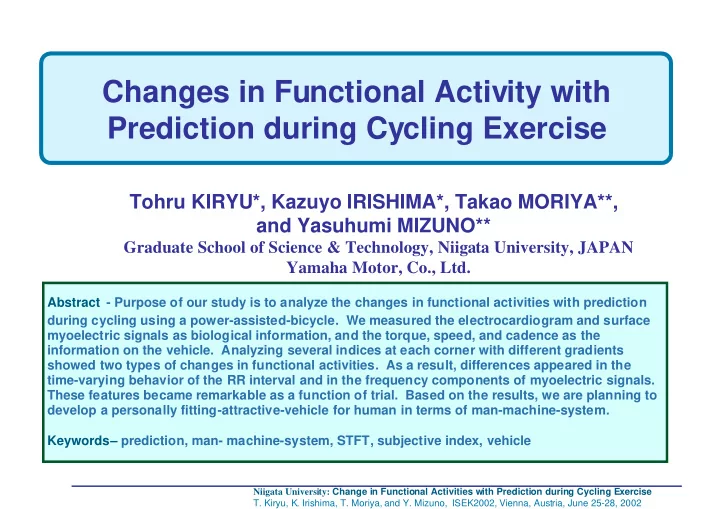
Changes in Functional Activity with Prediction during Cycling Exercise Tohru KIRYU*, Kazuyo IRISHIMA*, Takao MORIYA**, and Yasuhumi MIZUNO** Graduate School of Science & Technology, Niigata University, JAPAN Yamaha Motor, Co., Ltd. Abstract


slide-1
SLIDE 1

Niigata University: Change in Functional Activities with Prediction during Cycling Exercise

  • T. Kiryu, K. Irishima, T. Moriya, and Y. Mizuno, ISEK2002, Vienna, Austria, June 25-28, 2002

Tohru KIRYU*, Kazuyo IRISHIMA*, Takao MORIYA**, and Yasuhumi MIZUNO**

Graduate School of Science & Technology, Niigata University, JAPAN Yamaha Motor, Co., Ltd.

Changes in Functional Activity with Prediction during Cycling Exercise

Abstract - Purpose of our study is to analyze the changes in functional activities with prediction during cycling using a power-assisted-bicycle. We measured the electrocardiogram and surface myoelectric signals as biological information, and the torque, speed, and cadence as the information on the vehicle. Analyzing several indices at each corner with different gradients showed two types of changes in functional activities. As a result, differences appeared in the time-varying behavior of the RR interval and in the frequency components of myoelectric signals. These features became remarkable as a function of trial. Based on the results, we are planning to develop a personally fitting-attractive-vehicle for human in terms of man-machine-system. Keywords– prediction, man- machine-system, STFT, subjective index, vehicle

slide-2
SLIDE 2

Niigata University: Change in Functional Activities with Prediction during Cycling Exercise

  • T. Kiryu, K. Irishima, T. Moriya, and Y. Mizuno, ISEK2002, Vienna, Austria, June 25-28, 2002

Autonomic Nervous System for Continuing Physical Activity Motivation for Exercise

Proprioception

Brain Muscles

Visual System Somatic Sensers Vestibular System

for Controlling Exercise Neuromuscular system Motor Command Energy Metabolism for Continuing Exercise

time-scale long short

Several Time-Scales for Exercise

slide-3
SLIDE 3

Niigata University: Change in Functional Activities with Prediction during Cycling Exercise

  • T. Kiryu, K. Irishima, T. Moriya, and Y. Mizuno, ISEK2002, Vienna, Austria, June 25-28, 2002

Motor Control Strategy

active control to perform future desired exercise passive control to maintain exercise

feedback control feedforward control Motor Control

Control Strategy for the Environment The behavior of motor control seems to be remarkable around the corner with different gradients

controlled

  • bject

inverse dynamic model trajectory torque + feedback controller +

  • differentiation

desired trajectory feedback torque feedforward torque

slide-4
SLIDE 4

Niigata University: Change in Functional Activities with Prediction during Cycling Exercise

  • T. Kiryu, K. Irishima, T. Moriya, and Y. Mizuno, ISEK2002, Vienna, Austria, June 25-28, 2002

Experimental Conditions for Cycling

eleven non-expert male and three female subjects (22.9 ±0.5 years

  • ld)

muscles: vastus lateralis gain: 60 dB frequency band width: 5.3Hz - 1.0kHz 4-bar active array electrode estimated from ECG gain: 42 dB frequency band width: 1.1Hz - 1.0kHz disposable disk electrode

  • Subjects
  • Myoelectric Signals
  • Heart Rate

2-min data during resting 3-min data during cycling exercise rest

180±10sec

consecutive 6 trials

slide-5
SLIDE 5

Niigata University: Change in Functional Activities with Prediction during Cycling Exercise

  • T. Kiryu, K. Irishima, T. Moriya, and Y. Mizuno, ISEK2002, Vienna, Austria, June 25-28, 2002

Corners with Different Gradients

timing of signals at the down-up corner with turning left

p-1 p-3 p-2 p-4 p-5 p-6 Steep uphill 6 degree p-3 p-2 p-4 p-5 p-1 p-6

10s.d. < torque triggered by torque

triggered by muscle activity

Side View Top View

phase2→phase3:steep down to up

Speed and stable control is required

s.d. s.d. 2 s.d. < EMG

start start finish finish start start finish finish

EMG Torque

second corner

slide-6
SLIDE 6

Niigata University: Change in Functional Activities with Prediction during Cycling Exercise

  • T. Kiryu, K. Irishima, T. Moriya, and Y. Mizuno, ISEK2002, Vienna, Austria, June 25-28, 2002

Analysis for Overall Behavior

  • Autonomic Nervous Activities

Heart Rate

uniformly resampling the interpolated R-R interval time-series at 4

  • Hz. Original sampling frequency of ECG was 5 kHz.

time-varying behavior of the LF and HF components of the R-R interval time-series estimated by the continuous wavelet analysis.

  • Muscle Activities

Myoelectric Signal

5 kHz sampling. ARV and MPF time-series resampled at 4 Hz. ARV (Average Rectified Value): muscle force related activities MPF (Mean Power Frequency): metabolic change in the muscle correlation coefficient between ARV and MPF, . γARV-MPF

slide-7
SLIDE 7

Niigata University: Change in Functional Activities with Prediction during Cycling Exercise

  • T. Kiryu, K. Irishima, T. Moriya, and Y. Mizuno, ISEK2002, Vienna, Austria, June 25-28, 2002

Analysis at Each Contraction

Time-Frequency Representations (TFRs) of ME signals at each contraction for decomposing time-frequency components.

  • Evaluation of TFRs at first half and latter half of a contraction
  • Evaluation of TFRs in relation to muscular fatigue

muscle contraction is an active sensor for snapshot assessment

at each trial exercise / rest

early / last at each contraction

  • ne trial
  • ne trial

physical activity time

muscle activity possibly includes the information on the motor control strategy during cycling with prediction

slide-8
SLIDE 8

Niigata University: Change in Functional Activities with Prediction during Cycling Exercise

  • T. Kiryu, K. Irishima, T. Moriya, and Y. Mizuno, ISEK2002, Vienna, Austria, June 25-28, 2002

Overall Behavior

p-1 p-3 p-2 p-4 p-5 p-6

RR interval

γARV-torque γARV-MPF

[sec] 160 40 120

[sec] 160

40 120 [sec] 160 40 120 0.8 0.3 1

  • 1

subject: S.K., Oct. 30, 2001

2nd trial

1

  • 1
slide-9
SLIDE 9

Niigata University: Change in Functional Activities with Prediction during Cycling Exercise

  • T. Kiryu, K. Irishima, T. Moriya, and Y. Mizuno, ISEK2002, Vienna, Austria, June 25-28, 2002

Classification of RRI

triggered by Muscle Activity

Steeply Decreasing in RR interval Gradually Decreasing in RR interval

SDRR (4/11) GDRR (7/11)

Time-Varying Behavior of RRI Two Groups

triggered time by muscle activity time[sec] RRI [sec] time [sec] RRI [sec]

  • 50

50

  • 50

50 0.3 0.8 0.3 0.8

subject: M.S., Sep. 25, 2001 subject: S.K., Oct. 30, 2001

slide-10
SLIDE 10

Niigata University: Change in Functional Activities with Prediction during Cycling Exercise

  • T. Kiryu, K. Irishima, T. Moriya, and Y. Mizuno, ISEK2002, Vienna, Austria, June 25-28, 2002

HR, speed, torque for SDRR

0.8 0.3 25

  • 25

[sec] [sec]

[km/h] RRI

p-1 p-3 p-2 p-4 p-5 p-6

25

  • 25

15 [sec] speed 35 RRI at phase3

2nd trial 3rd trial 6th trial

25

  • 25

[sec] 100 torque 0.8 0.3 25

  • 25

[sec] [sec] RRI at phase4 [N•m] [km/h]

subject: S.K., Oct. 30, 2001

Triggered by EMG

slide-11
SLIDE 11

Niigata University: Change in Functional Activities with Prediction during Cycling Exercise

  • T. Kiryu, K. Irishima, T. Moriya, and Y. Mizuno, ISEK2002, Vienna, Austria, June 25-28, 2002

HR, speed, torque for GDRR

0.8 0.3 25

  • 25

[sec] [sec] 25

  • 25

15 [sec] speed 35 RRI at phase3 25

  • 25

[sec] torque 0.8 0.3 25

  • 25

[sec] RRI at phase4 [N•m] [km/h]

Triggered by EMG

1st trial 3rd trial 6th trial

subject: S.K., Oct. 30, 2001

[km/h] RRI

p-1 p-3 p-2 p-4 p-5 p-6

[sec]

slide-12
SLIDE 12

Niigata University: Change in Functional Activities with Prediction during Cycling Exercise

  • T. Kiryu, K. Irishima, T. Moriya, and Y. Mizuno, ISEK2002, Vienna, Austria, June 25-28, 2002

HRV for SDRR

start start finish finish

[Hz] 150 0.75

  • 70

[sec]

0.5 0.1

[sec] 50 100 150 50 100

  • 70

[sec] 1

  • 46.1

p-1 p-3 p-2 p-4 p-5 p-6

experiment rest rest

0.3 Strong peek around 0.3-0.5Hz

RSA( ( ( (Respiratory Sinus Arrhythmia) ) ) )

disappearing of RSA Immediate recover

subject: S.K., Oct. 30, 2001

2nd trial

slide-13
SLIDE 13

Niigata University: Change in Functional Activities with Prediction during Cycling Exercise

  • T. Kiryu, K. Irishima, T. Moriya, and Y. Mizuno, ISEK2002, Vienna, Austria, June 25-28, 2002

HRV for GDRR

[Hz] 150 0.75

  • 70

[sec]

0.5 0.1

[sec] 50 100 150 50 100

  • 70

[sec] 1

  • 41.5

p-1 p-3 p-2 p-4 p-5 p-6

0.3

MWSA( ( ( (Mayer-Wave related Sinus Arrhythmia ) ) ) )

110.1

subject: M.S., Sep. 25, 2001

start start finish finish

experiment rest rest

Strong peek around 0.1Hz disappearing of MWSA gradual recover

1st trial

slide-14
SLIDE 14

Niigata University: Change in Functional Activities with Prediction during Cycling Exercise

  • T. Kiryu, K. Irishima, T. Moriya, and Y. Mizuno, ISEK2002, Vienna, Austria, June 25-28, 2002

HR & Muscle Activity for SDRR

Triggered by EMG

Subject SK, 2001-Oct.-30

25

  • 25

[sec] 0.3 0.8

2nd trial 3rd trial 6th trial RRI

[sec] [Hz] 500 [Hz] 500 [Hz] 500 [Hz] 500 46 [sec] 45 47 [sec] 46 41.5 42.5 [sec] 42.5 43.5 [sec] 45 47 [sec] 45

2nd trial EMG

41.5

Torque 6th trial

43.5 [sec] 41.5

1st stroke 2nd stroke

TFR of EMG

1st stroke 2nd stroke

47 [sec] 43.5 [sec]

slide-15
SLIDE 15

Niigata University: Change in Functional Activities with Prediction during Cycling Exercise

  • T. Kiryu, K. Irishima, T. Moriya, and Y. Mizuno, ISEK2002, Vienna, Austria, June 25-28, 2002

HR & Muscle Activity for GDRR

Triggered by EMG

25

  • 25

[sec] 0.3 0.8

1st trial 3rd trial 6th trial RRI

[sec] 500 [Hz] 500 40.5 42.5 [sec] 41.5 39.5 40.5 [sec] 40.5 41.5 [sec] 40.5 42.5 [sec] 40.5

1st trial

39.5

Torque 6th trial

41.5 [sec] 39.5

1st stroke 2nd stroke 1st stroke 2nd stroke

42.5 [sec] 41.5 [sec] 41.5 [sec] 500 [Hz] [Hz] [Hz] 500

EMG TFR of EMG

Subject SK, 2001-Oct.-30

slide-16
SLIDE 16

Niigata University: Change in Functional Activities with Prediction during Cycling Exercise

  • T. Kiryu, K. Irishima, T. Moriya, and Y. Mizuno, ISEK2002, Vienna, Austria, June 25-28, 2002

MPF of TFRs at first half and latter half of a contraction

SDRR GDRR first half latter half

1st stroke 2nd stroke 100.7 ± ± ± ± 44.4

MPF in Hz

115.5 ± ± ± ±54.5 111.3 ± ± ± ± 50.2 126.0 ± ± ± ±55.3 1st stroke 2nd stroke 69.1 ± ± ± ± 18.7 74.1 ± ± ± ±20.1 69.6 ± ± ± ± 20.0 76.2 ± ± ± ±20.1

slide-17
SLIDE 17

Niigata University: Change in Functional Activities with Prediction during Cycling Exercise

  • T. Kiryu, K. Irishima, T. Moriya, and Y. Mizuno, ISEK2002, Vienna, Austria, June 25-28, 2002

Conclusion

  • There were the differences in the motor control strategy
  • f individuals assisted by the autonomic nervous

activity.

  • We investigated the muscle contractions after turning

left the down-up corner, by using the TFRs of ME signals.

  • To control the vehicle noticeably, timing of the muscle

contraction at the first stroke was apt to vary.

  • The muscle contraction at the second stroke was steady strong

and that finally caused muscular fatigue demonstrated in the TFRs. Studying the physical activities during cycling exercise, in terms of the prediction of motor control.

a new strategy of the control scheme for the power-assisted bicycle based

  • n biosignal information
slide-18
SLIDE 18

Niigata University: Change in Functional Activities with Prediction during Cycling Exercise

  • T. Kiryu, K. Irishima, T. Moriya, and Y. Mizuno, ISEK2002, Vienna, Austria, June 25-28, 2002

References

  • a. Change in HRV during exercise
  • i. Y. Nakamura, N. Hayashi, and I. Muraoka, “Temporal effect of muscle contraction on respiratory sinus arrhythmia”, Meth. Inform. Med.,
  • pp. 268-270, 1997.
  • ii. J. P. Clarys, J. Publie, E. Zinzen, “Ergonomic analyses of downhill skiing,” J. Sports Sci., vol. 12, 3, pp. 243-250, 1994.
  • iii. M. V. Kamath, E. L. Fallen, and R. McKelvie, “Effect of steady state exercise on the power spectrum of heart rate variability,” Med. Sci.
  • Sports. Exerc., vol. 23, pp. 428-434, 1991.
  • b. Review of muscle sympathetic nerve activity (MSNA)
  • i. D. R. Seals, R. G. Victor, “Regulation of muscle sympathetic nerve activity during exercise in humans,” Exerc. Sport Sci. Rev., vol. 19,

313-49, 1991.

  • ii. J. H. Mitchell, “Neural control of the circulation during exercise,” Med. Sci. Sports Exerc., vol. 22, pp. 141-154, 1990.
  • c. Physiology of MSNA
  • i. A. Nakata, S. Takata, T. Yuasa, A. Shimakura, M. Maruyama, H. Nagai, S. Sakagami, K. Kobayashi, “Spectral analysis of heart rate,

arterial pressure, and muscle sympathetic nerve activity in normal humans,” Am. J. Physiol., vol. 274, H1211-1217, 1998.

  • ii. M. Saito, R. Sone, M. Ikeda, T. Mano, “Sympathetic outflow to the skeletal muscle in humans increases during prolonged light exercise,”
  • J. Appl. Physiol., vol. 82, 4, 1237-43, 1997.
  • iii. D. R. Seals, R. M. Enoka, “Sympathetic activation is associated with increases in EMG during fatiguing exercise,” J. Appl. Physiol., vol.

66, 1, 88-95, 1989.

  • d. Signal processing during dynamic contraction
  • i. P. Bonato, G. Gagliati, and M. Knaflitz, “Analysis of myoelectric signals recorded during dynamic contractions: A time-frequency

approach to assessing muscle fatigue,” IEEE Magazine of Med Biol., vol. 15, pp. 102-111, 1996.

  • ii. S. Pola, A. Macerata, M. Emdin, C. Marchesi, “Estimation of the power spectral density in nonstationary cardiovascular time-series:

Assessing the role of the time-frequency representations (TFR),” IEEE Trans. Biomed., Eng., vol. BME-43, 1, pp. 46-59, 1996.

  • iii. Y. Yamamoto and R. L. Hughson, “Coarse-graining spectral analysis: new method for studying heart rate variability,” J. Appl. Physiol.,
  • vol. 71, vol. 3, pp. 1143-1150, 1991.
slide-19
SLIDE 19

Niigata University: Change in Functional Activities with Prediction during Cycling Exercise

  • T. Kiryu, K. Irishima, T. Moriya, and Y. Mizuno, ISEK2002, Vienna, Austria, June 25-28, 2002

Time-Frequency Representations (TFRs)

  • ME Signal
  • Short-term Fourier Transform
  • Wavelet Transform
  • Matching Pursuit

1

time [sec]

0.2 0.4 0.6 0.8 500 400 300 200 100 [Hz]

  • 480

480 [µV] 1

time [sec]

0.2 0.4 0.6 0.8 500 400 300 200 100 [Hz] 1

time [sec]

0.2 0.4 0.6 0.8 500 400 300 200 100 [Hz]

slide-20
SLIDE 20

Niigata University: Change in Functional Activities with Prediction during Cycling Exercise

  • T. Kiryu, K. Irishima, T. Moriya, and Y. Mizuno, ISEK2002, Vienna, Austria, June 25-28, 2002

Snapshot Measurement and Assessment

  • Radio controlled remote data acquisition system
  • Biosignal processing for selecting and dealing with

dominant components at each phase

  • Wavelet analysis of heart rate variability (HRV).
  • Correlation coefficients of myoelectric indices for evaluating

muscle activities.

  • Focusing on periodical change of functional activities

with the progression of fatigue

  • Scatter graph between an autonomic nervous index and a

muscular fatigue index.

  • Interaction between autonomic nervous activity and

neuromuscular activity at each contractions during exercise

slide-21
SLIDE 21

Niigata University: Change in Functional Activities with Prediction during Cycling Exercise

  • T. Kiryu, K. Irishima, T. Moriya, and Y. Mizuno, ISEK2002, Vienna, Austria, June 25-28, 2002

TFRs of ME Signals during Cycling

Active Control

500 400 300 200 100 [Hz] [µV] 480

  • 480

1 time [sec] 0.2 0.4 0.6 0.8 1 time [sec] 0.2 0.4 0.6 0.8 500 400 300 200 100 [Hz] [µV] 480

  • 480

3rd cycle top of a steep hill

1st trial

side view start

decent-turn-ascend

  • Subj. KS, Oct. 31, 2000

Cycling Cycling

start finish top view

500 400 300 200 100

[Hz] [µV]

480

  • 480

1 2

time [ sec]

fatigue

vastus lateralis muscle

slide-22
SLIDE 22

Niigata University: Change in Functional Activities with Prediction during Cycling Exercise

  • T. Kiryu, K. Irishima, T. Moriya, and Y. Mizuno, ISEK2002, Vienna, Austria, June 25-28, 2002

TFRs of ME Signals during Cycling as a Function of Trial

side view start

decent-turn-ascend

start finish top view

1st trial 3rd trial 7th trial Interaction between overall behavior and temporal muscle activity

Cycling Cycling

500 400 300 200 100

[Hz] [µV]

480

  • 480

1 2 500 400 300 200 100

[Hz] [µV]

480

  • 480

1 2 500 400 300 200 100

[Hz] [µV]

480

  • 480

1 2

fatigue

Active Control

  • Subj. KS, Oct. 31, 2000

vastus lateralis muscle