Changelog jmp start_loop jge end_loop # rbx >= 10? cmpq $10, %rbx - - PowerPoint PPT Presentation

changelog
SMART_READER_LITE
LIVE PREVIEW

Changelog jmp start_loop jge end_loop # rbx >= 10? cmpq $10, %rbx - - PowerPoint PPT Presentation

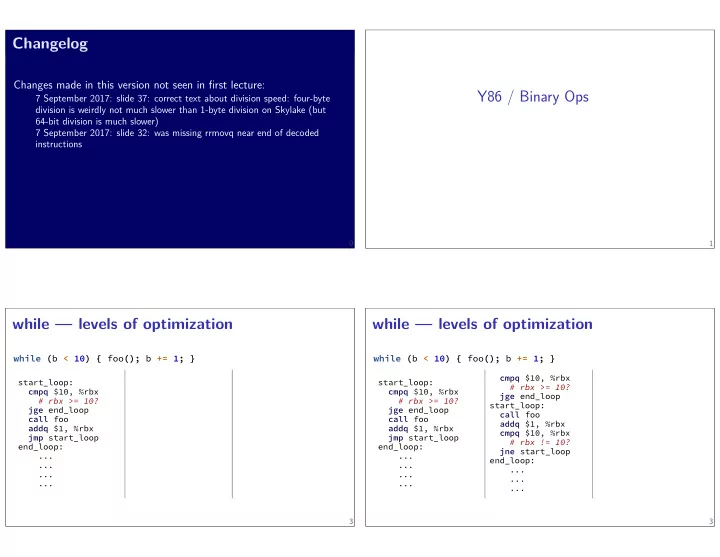
Changelog jmp start_loop jge end_loop # rbx >= 10? cmpq $10, %rbx ... ... ... ... end_loop: addq $1, %rbx call foo call foo jge end_loop # rbx >= 10? cmpq $10, %rbx start_loop: while ( b < 10) { foo (); b += 1; } while levels


slide-1
SLIDE 1

Changelog

Changes made in this version not seen in fjrst lecture:

7 September 2017: slide 37: correct text about division speed: four-byte division is weirdly not much slower than 1-byte division on Skylake (but 64-bit division is much slower) 7 September 2017: slide 32: was missing rrmovq near end of decoded instructions

Y86 / Binary Ops

1

while — levels of optimization

while (b < 10) { foo(); b += 1; }

start_loop: cmpq $10, %rbx # rbx >= 10? jge end_loop call foo addq $1, %rbx jmp start_loop end_loop: ... ... ... ... cmpq $10, %rbx # rbx >= 10? jge end_loop start_loop: call foo addq $1, %rbx cmpq $10, %rbx # rbx != 10? jne start_loop end_loop: ... ... ... cmpq $10, %rbx # rbx >= 10 jge end_loop movq $10, %rax subq %rbx, %rax movq %rax, %rbx start_loop: call foo decq %rbx # rbx != 0 jne start_loop movq $10, %rbx end_loop:

3

while — levels of optimization

while (b < 10) { foo(); b += 1; }

start_loop: cmpq $10, %rbx # rbx >= 10? jge end_loop call foo addq $1, %rbx jmp start_loop end_loop: ... ... ... ... cmpq $10, %rbx # rbx >= 10? jge end_loop start_loop: call foo addq $1, %rbx cmpq $10, %rbx # rbx != 10? jne start_loop end_loop: ... ... ... cmpq $10, %rbx # rbx >= 10 jge end_loop movq $10, %rax subq %rbx, %rax movq %rax, %rbx start_loop: call foo decq %rbx # rbx != 0 jne start_loop movq $10, %rbx end_loop:

3

slide-2
SLIDE 2

while — levels of optimization

while (b < 10) { foo(); b += 1; }

start_loop: cmpq $10, %rbx # rbx >= 10? jge end_loop call foo addq $1, %rbx jmp start_loop end_loop: ... ... ... ... cmpq $10, %rbx # rbx >= 10? jge end_loop start_loop: call foo addq $1, %rbx cmpq $10, %rbx # rbx != 10? jne start_loop end_loop: ... ... ... cmpq $10, %rbx # rbx >= 10 jge end_loop movq $10, %rax subq %rbx, %rax movq %rax, %rbx start_loop: call foo decq %rbx # rbx != 0 jne start_loop movq $10, %rbx end_loop:

3

last time

condition codes: ZF (zero), SF (sign), OF (overfmow), CF (carry) jump tables: jmp *table(%rax)

read address of next instruction from table

microarchitecture vs. instruction set architecutre (ISA) cmovCC: conditional move Y86: movq → {rrmovq, irmovq, mrmovq, rmmovq}

4

pre-quiz next week

textbooks are defjnitely available quiz on reading for next week get a textbook if you don’t have one

5

bomb HW grades

are on the gradebook please check: possible you registered a bomb with an invalid computing ID some transient weirdness with gradebook if you had used multiple bombs, now fjxed

6

slide-3
SLIDE 3

strlen/strsep lab

next week: in-lab quiz to write two functions: strlen — length of nul-terminated string strsep (simplifjed) — divide string into ‘tokens’

7

strsep (1)

char *strsep(char **ptrToString, char delimiter); char string[] = "this is a test"; char *ptr = string; char *token; while ((token = strsep(&ptr, ' ')) != NULL) { printf("[%s]", token); } /* output: [this][is][a][test] */ /* final value of buffer: "this\0is\0a\0test" */

8

strsep (2)

char *strsep(char **ptrToString, char delimiter); char string[] = "this is a test"; char *ptr = string; char *token; token = strsep(&ptr, ' '); /* token points to &string[0], string "this" */ /* ' ' after "this" replaced by '\0' */ /* ptr points to &string[5]: "is a test" */

9

Y86-64 instruction set

based on x86

  • mits most of the 1000+ instructions

leaves addq jmp pushq subq jCC popq andq cmovCC movq (renamed) xorq call hlt (renamed) nop ret much, much simpler encoding

10

slide-4
SLIDE 4

Y86-64: specifying addresses

Valid: rmmovq %r11, 10(%r12) Invalid: rmmovq %r11, 10(%r12,%r13) Invalid: rmmovq %r11, 10(,%r12,4) Invalid: rmmovq %r11, 10(%r12,%r13,4)

11

Y86-64: specifying addresses

Valid: rmmovq %r11, 10(%r12) Invalid:

✭✭✭✭✭✭✭✭✭✭✭✭✭✭✭✭✭✭✭✭✭✭✭ ✭ ❤❤❤❤❤❤❤❤❤❤❤❤❤❤❤❤❤❤❤❤❤❤❤ ❤

rmmovq %r11, 10(%r12,%r13) Invalid:

✭✭✭✭✭✭✭✭✭✭✭✭✭✭✭✭✭✭✭✭✭ ✭ ❤❤❤❤❤❤❤❤❤❤❤❤❤❤❤❤❤❤❤❤❤ ❤

rmmovq %r11, 10(,%r12,4) Invalid:

✭✭✭✭✭✭✭✭✭✭✭✭✭✭✭✭✭✭✭✭✭✭✭✭✭ ✭ ❤❤❤❤❤❤❤❤❤❤❤❤❤❤❤❤❤❤❤❤❤❤❤❤❤ ❤

rmmovq %r11, 10(%r12,%r13,4)

11

Y86-64: accessing memory (1)

r12 ← memory[10 + r11] + r12 Invalid:

✭✭✭✭✭✭✭✭✭✭✭✭✭✭✭✭✭ ✭ ❤❤❤❤❤❤❤❤❤❤❤❤❤❤❤❤❤ ❤

addq 10(%r11), %r12 Instead: mrmovq 10(%r11), %r11 /* overwrites %r11 */ addq %r11, %r12

12

Y86-64: accessing memory (1)

r12 ← memory[10 + r11] + r12 Invalid:

✭✭✭✭✭✭✭✭✭✭✭✭✭✭✭✭✭ ✭ ❤❤❤❤❤❤❤❤❤❤❤❤❤❤❤❤❤ ❤

addq 10(%r11), %r12 Instead: mrmovq 10(%r11), %r11 /* overwrites %r11 */ addq %r11, %r12

12

slide-5
SLIDE 5

Y86-64: accessing memory (2)

r12 ← memory[10 + 8 * r11] + r12 Invalid:

✭✭✭✭✭✭✭✭✭✭✭✭✭✭✭✭✭✭✭✭ ❤❤❤❤❤❤❤❤❤❤❤❤❤❤❤❤❤❤❤❤

addq 10(,%r11,8), %r12 Instead: /* replace %r11 with 8*%r11 */ addq %r11, %r11 addq %r11, %r11 addq %r11, %r11 mrmovq 10(%r11), %r11 addq %r11, %r12

13

Y86-64: accessing memory (2)

r12 ← memory[10 + 8 * r11] + r12 Invalid:

✭✭✭✭✭✭✭✭✭✭✭✭✭✭✭✭✭✭✭✭ ❤❤❤❤❤❤❤❤❤❤❤❤❤❤❤❤❤❤❤❤

addq 10(,%r11,8), %r12 Instead: /* replace %r11 with 8*%r11 */ addq %r11, %r11 addq %r11, %r11 addq %r11, %r11 mrmovq 10(%r11), %r11 addq %r11, %r12

13

Y86-64 constants (1)

irmovq $100, %r11

  • nly instruction with non-address constant operand

14

Y86-64 constants (2)

r12 ← r12 + 1 Invalid: ✭✭✭✭✭✭✭✭✭✭✭✭

❤❤❤❤❤❤❤❤❤❤❤❤

addq $1, %r12 Instead, need an extra register: irmovq $1, %r11 addq %r11, %r12

15

slide-6
SLIDE 6

Y86-64 constants (2)

r12 ← r12 + 1 Invalid: ✭✭✭✭✭✭✭✭✭✭✭✭

❤❤❤❤❤❤❤❤❤❤❤❤

addq $1, %r12 Instead, need an extra register: irmovq $1, %r11 addq %r11, %r12

15

Y86-64: operand uniqueness

  • nly one kind of value for each operand

instruction name tells you the kind (why movq was ‘split’ into four names)

16

Y86-64: condition codes

ZF — value was zero? SF — sign bit was set? i.e. value was negative? this course: no OF, CF (to simplify assignments) set by addq, subq, andq, xorq not set by anything else

17

Y86-64: using condition codes

subq SECOND, FIRST (value = FIRST - SECOND)

j__

  • r

cmov__ condition code bit test value test le SF = 1 or ZF = 1 value ≤ 0 l SF = 1 value < 0 e ZF = 1 value = 0 ne ZF = 0 value = 0 ge SF = 0 value ≥ 0 g SF = 0 and ZF = 0 value > 0

missing OF (overfmow fmag); CF (carry fmag)

18

slide-7
SLIDE 7

Y86-64: conditionals (1)

✘✘✘ ❳❳❳

cmp, ✘✘✘

✘ ❳❳❳ ❳

test instead: use side efgect of normal arithmetic instead of cmpq %r11, %r12 jle somewhere maybe: subq %r11, %r12 jle (but changes %r12)

19

Y86-64: conditionals (1)

✘✘✘ ❳❳❳

cmp, ✘✘✘

✘ ❳❳❳ ❳

test instead: use side efgect of normal arithmetic instead of cmpq %r11, %r12 jle somewhere maybe: subq %r11, %r12 jle (but changes %r12)

19

Y86-64: conditionals (1)

✘✘✘ ❳❳❳

cmp, ✘✘✘

✘ ❳❳❳ ❳

test instead: use side efgect of normal arithmetic instead of cmpq %r11, %r12 jle somewhere maybe: subq %r11, %r12 jle (but changes %r12)

19

push/pop

pushq %rbx

%rsp ← %rsp − 8 memory[%rsp] ← %rbx

popq %rbx

%rbx ← memory[%rsp] %rsp ← %rsp + 8

. . . memory[%rsp + 16] memory[%rsp + 8] memory[%rsp] memory[%rsp - 8] memory[%rsp - 16]

value to pop where to push

stack growth

20

slide-8
SLIDE 8

call/ret

call LABEL

push PC (next instruction address) on stack jmp to LABEL address

ret

pop address from stack jmp to that address

. . . memory[%rsp + 16] memory[%rsp + 8] memory[%rsp] memory[%rsp - 8] memory[%rsp - 16]

address ret jumps to where call stores return address

stack growth

21

Y86-64 state

%rXX — 15 registers

%r15 missing — replaced with “no register” smaller parts of registers missing

ZF (zero), SF (sign), OF (overfmow)

book has OF, we’ll not use it CF (carry) missing (no unsigned jumps)

Stat — processor status — halted? PC — program counter (AKA instruction pointer) main memory

22

typical RISC ISA properties

fewer, simpler instructions seperate instructions to access memory fjxed-length instructions more registers no “loops” within single instructions no instructions with two memory operands few addressing modes

23

Y86-64 instruction formats

byte: 1 2 3 4 5 6 7 8 9 halt nop 1 rrmovq/cmovCC rA, rB 2 cc rA rB irmovq V, rB 3 F rB rmmovq rA, D(rB) 4 0 rA rB mrmovq D(rB), rA 5 0 rA rB OPq rA, rB 6 fn rA rB jCC Dest 7 cc call Dest 8 ret 9 pushq rA A 0 rA F popq rA B 0 rA F V D D Dest Dest

24

slide-9
SLIDE 9

secondary opcodes: cmovcc/jcc

byte: 1 2 3 4 5 6 7 8 9 halt nop 1 rrmovq/cmovCC rA, rB 2 cc rA rB irmovq V, rB 3 F rB rmmovq rA, D(rB) 4 0 rA rB mrmovq D(rB), rA 5 0 rA rB OPq rA, rB 6 fn rA rB jCC Dest 7 cc call Dest 8 ret 9 pushq rA A 0 rA F popq rA B 0 rA F V D D Dest Dest 0 always (jmp/rrmovq) 1 le 2 l 3 e 4 ne 5 ge 6 g

25

secondary opcodes: OPq

byte: 1 2 3 4 5 6 7 8 9 halt nop 1 rrmovq/cmovCC rA, rB 2 cc rA rB irmovq V, rB 3 F rB rmmovq rA, D(rB) 4 0 rA rB mrmovq D(rB), rA 5 0 rA rB OPq rA, rB 6 fn rA rB jCC Dest 7 cc call Dest 8 ret 9 pushq rA A 0 rA F popq rA B 0 rA F V D D Dest Dest

add

1

sub

2

and

3

xor

26

Registers: rA, rB

byte: 1 2 3 4 5 6 7 8 9 halt nop 1 rrmovq/cmovCC rA, rB 2 cc rA rB irmovq V, rB 3 F rB rmmovq rA, D(rB) 4 0 rA rB mrmovq D(rB), rA 5 0 rA rB OPq rA, rB 6 fn rA rB jCC Dest 7 cc call Dest 8 ret 9 pushq rA A 0 rA F popq rA B 0 rA F V D D Dest Dest

%rax

8

%r8

1

%rcx

9

%r9

2

%rdx

A

%r10

3

%rbx

B

%r11

4

%rsp

C

%r12

5

%rbp

D

%r13

6

%rsi

E

%r14

7

%rdi

F

none

27

Registers: rA, rB

byte: 1 2 3 4 5 6 7 8 9 halt nop 1 rrmovq/cmovCC rA, rB 2 cc rA rB irmovq V, rB 3 F rB rmmovq rA, D(rB) 4 0 rA rB mrmovq D(rB), rA 5 0 rA rB OPq rA, rB 6 fn rA rB jCC Dest 7 cc call Dest 8 ret 9 pushq rA A 0 rA F popq rA B 0 rA F V D D Dest Dest

%rax

8

%r8

1

%rcx

9

%r9

2

%rdx

A

%r10

3

%rbx

B

%r11

4

%rsp

C

%r12

5

%rbp

D

%r13

6

%rsi

E

%r14

7

%rdi

F

none

27

slide-10
SLIDE 10

Immediates: V, D, Dest

byte: 1 2 3 4 5 6 7 8 9 halt nop 1 rrmovq/cmovCC rA, rB 2 cc rA rB irmovq V, rB 3 F rB rmmovq rA, D(rB) 4 0 rA rB mrmovq D(rB), rA 5 0 rA rB OPq rA, rB 6 fn rA rB jCC Dest 7 cc call Dest 8 ret 9 pushq rA A 0 rA F popq rA B 0 rA F V D D Dest Dest

28

Immediates: V, D, Dest

byte: 1 2 3 4 5 6 7 8 9 halt nop 1 rrmovq/cmovCC rA, rB 2 cc rA rB irmovq V, rB 3 F rB rmmovq rA, D(rB) 4 0 rA rB mrmovq D(rB), rA 5 0 rA rB OPq rA, rB 6 fn rA rB jCC Dest 7 cc call Dest 8 ret 9 pushq rA A 0 rA F popq rA B 0 rA F V D D Dest Dest

28

Y86-64 encoding (1)

long addOne(long x) { return x + 1; } x86-64: movq %rdi, %rax addq $1, %rax ret Y86-64: irmovq $1, %rax addq %rdi, %rax ret

29

Y86-64 encoding (1)

long addOne(long x) { return x + 1; } x86-64: movq %rdi, %rax addq $1, %rax ret Y86-64: irmovq $1, %rax addq %rdi, %rax ret

29

slide-11
SLIDE 11

Y86-64 encoding (2)

addOne: irmovq $1, %rax addq %rdi, %rax ret ⋆

3 F %rax 01 00 00 00 00 00 00 00

30 F0 01 00 00 00 00 00 00 00 60 70 90

30

Y86-64 encoding (2)

addOne: irmovq $1, %rax addq %rdi, %rax ret ⋆

3 F 01 00 00 00 00 00 00 00

30 F0 01 00 00 00 00 00 00 00 60 70 90

30

Y86-64 encoding (2)

addOne: irmovq $1, %rax addq %rdi, %rax ret

3 F 01 00 00 00 00 00 00 00

6 add %rdi %rax

30 F0 01 00 00 00 00 00 00 00 60 70 90

30

Y86-64 encoding (2)

addOne: irmovq $1, %rax addq %rdi, %rax ret

3 F 01 00 00 00 00 00 00 00

6 7

30 F0 01 00 00 00 00 00 00 00 60 70 90

30

slide-12
SLIDE 12

Y86-64 encoding (2)

addOne: irmovq $1, %rax addq %rdi, %rax ret

3 F 01 00 00 00 00 00 00 00 6 7

9

30 F0 01 00 00 00 00 00 00 00 60 70 90

30

Y86-64 encoding (2)

addOne: irmovq $1, %rax addq %rdi, %rax ret

3 F 01 00 00 00 00 00 00 00 6 7 9

30 F0 01 00 00 00 00 00 00 00 60 70 90

30

Y86-64 encoding (3)

doubleTillNegative: /* suppose at address 0x123 */ addq %rax, %rax jge doubleTillNegative

6 add %rax %rax

31

Y86-64 encoding (3)

doubleTillNegative: /* suppose at address 0x123 */ addq %rax, %rax jge doubleTillNegative ⋆

6 add %rax %rax

31

slide-13
SLIDE 13

Y86-64 encoding (3)

doubleTillNegative: /* suppose at address 0x123 */ addq %rax, %rax jge doubleTillNegative ⋆

6

31

Y86-64 encoding (3)

doubleTillNegative: /* suppose at address 0x123 */ addq %rax, %rax jge doubleTillNegative

6

7 ge 23 01 00 00 00 00 00 00

31

Y86-64 encoding (3)

doubleTillNegative: /* suppose at address 0x123 */ addq %rax, %rax jge doubleTillNegative

6

7 5 23 01 00 00 00 00 00 00

31

Y86-64 encoding (3)

doubleTillNegative: /* suppose at address 0x123 */ addq %rax, %rax jge doubleTillNegative

6 7 5 23 01 00 00 00 00 00 00

31

slide-14
SLIDE 14

Y86-64 decoding

20 10 60 20 61 37 72 84 00 00 00 00 00 00 00 20 12 20 01 70 68 00 00 00 00 00 00 00 rrmovq %rcx, %rax addq %rdx, %rax subq %rbx, %rdi jl 0x84 rrmovq %rcx, %rdx rrmovq %rax, %rcx jmp 0x68

byte: 1 2 3 4 5 6 7 8 9 halt nop 1 rrmovq/cmovCC rA, rB 2 cc rA rB irmovq V, rB 3 F rB rmmovq rA, D(rB) 4 0 rA rB mrmovq D(rB), rA 5 0 rA rB OPq rA, rB 6 fn rA rB jCC Dest 7 cc call Dest 8 ret 9 pushq rA A 0 rA F popq rA B 0 rA F V D D Dest Dest

32

Y86-64 decoding

20 10 60 20 61 37 72 84 00 00 00 00 00 00 00 20 12 20 01 70 68 00 00 00 00 00 00 00 rrmovq %rcx, %rax addq %rdx, %rax subq %rbx, %rdi jl 0x84 rrmovq %rcx, %rdx rrmovq %rax, %rcx jmp 0x68

byte: 1 2 3 4 5 6 7 8 9 halt nop 1 rrmovq/cmovCC rA, rB 2 cc rA rB irmovq V, rB 3 F rB rmmovq rA, D(rB) 4 0 rA rB mrmovq D(rB), rA 5 0 rA rB OPq rA, rB 6 fn rA rB jCC Dest 7 cc call Dest 8 ret 9 pushq rA A 0 rA F popq rA B 0 rA F V D D Dest Dest

32

Y86-64 decoding

20 10 60 20 61 37 72 84 00 00 00 00 00 00 00 20 12 20 01 70 68 00 00 00 00 00 00 00 rrmovq %rcx, %rax

◮ 0 as cc: always ◮ 1 as reg: %rcx ◮ 0 as reg: %rax

addq %rdx, %rax subq %rbx, %rdi jl 0x84 rrmovq %rcx, %rdx rrmovq %rax, %rcx jmp 0x68

byte: 1 2 3 4 5 6 7 8 9 halt nop 1 rrmovq/cmovCC rA, rB 2 cc rA rB irmovq V, rB 3 F rB rmmovq rA, D(rB) 4 0 rA rB mrmovq D(rB), rA 5 0 rA rB OPq rA, rB 6 fn rA rB jCC Dest 7 cc call Dest 8 ret 9 pushq rA A 0 rA F popq rA B 0 rA F V D D Dest Dest

32

Y86-64 decoding

20 10 60 20 61 37 72 84 00 00 00 00 00 00 00 20 12 20 01 70 68 00 00 00 00 00 00 00 rrmovq %rcx, %rax addq %rdx, %rax subq %rbx, %rdi

◮ 0 as fn: add ◮ 1 as fn: sub

jl 0x84 rrmovq %rcx, %rdx rrmovq %rax, %rcx jmp 0x68

byte: 1 2 3 4 5 6 7 8 9 halt nop 1 rrmovq/cmovCC rA, rB 2 cc rA rB irmovq V, rB 3 F rB rmmovq rA, D(rB) 4 0 rA rB mrmovq D(rB), rA 5 0 rA rB OPq rA, rB 6 fn rA rB jCC Dest 7 cc call Dest 8 ret 9 pushq rA A 0 rA F popq rA B 0 rA F V D D Dest Dest

32

slide-15
SLIDE 15

Y86-64 decoding

20 10 60 20 61 37 72 84 00 00 00 00 00 00 00 20 12 20 01 70 68 00 00 00 00 00 00 00 rrmovq %rcx, %rax addq %rdx, %rax subq %rbx, %rdi jl 0x84

◮ 2 as cc: l (less than) ◮ hex 84 00… as little endian Dest:

0x84

rrmovq %rcx, %rdx rrmovq %rax, %rcx jmp 0x68

byte: 1 2 3 4 5 6 7 8 9 halt nop 1 rrmovq/cmovCC rA, rB 2 cc rA rB irmovq V, rB 3 F rB rmmovq rA, D(rB) 4 0 rA rB mrmovq D(rB), rA 5 0 rA rB OPq rA, rB 6 fn rA rB jCC Dest 7 cc call Dest 8 ret 9 pushq rA A 0 rA F popq rA B 0 rA F V D D Dest Dest

32

Y86-64 decoding

20 10 60 20 61 37 72 84 00 00 00 00 00 00 00 20 12 20 01 70 68 00 00 00 00 00 00 00 rrmovq %rcx, %rax addq %rdx, %rax subq %rbx, %rdi jl 0x84 rrmovq %rcx, %rdx rrmovq %rax, %rcx jmp 0x68

byte: 1 2 3 4 5 6 7 8 9 halt nop 1 rrmovq/cmovCC rA, rB 2 cc rA rB irmovq V, rB 3 F rB rmmovq rA, D(rB) 4 0 rA rB mrmovq D(rB), rA 5 0 rA rB OPq rA, rB 6 fn rA rB jCC Dest 7 cc call Dest 8 ret 9 pushq rA A 0 rA F popq rA B 0 rA F V D D Dest Dest

32

Y86-64: convenience for hardware

4 bits to decode instruction size/layout (mostly) uniform placement of

  • perands (“uniform decode”)

jumping to zeroes (uninitialized?) by accident halts no attempt to fjt (parts of) multiple instructions in a byte

byte: 1 2 3 4 5 6 7 8 9 halt nop 1 rrmovq/cmovCC rA, rB 2 cc rA rB irmovq V, rB 3 F rB rmmovq rA, D(rB) 4 0 rA rB mrmovq D(rB), rA 5 0 rA rB OPq rA, rB 6 fn rA rB jCC Dest 7 cc call Dest 8 ret 9 pushq rA A 0 rA F popq rA B 0 rA F V D D Dest Dest

33

Y86-64

Y86-64: simplifjed, more RISC-y version of X86-64 minimal set of arithmetic

  • nly movs touch memory
  • nly jumps, calls, and movs take immediates

simple variable-length encoding later: implementing with circuits

34

slide-16
SLIDE 16

extracting opcodes (1)

byte: 1 2 3 4 5 6 7 8 9 halt nop 1 rrmovq/cmovCC rA, rB 2 cc rA rB irmovq V, rB 3 F rB rmmovq rA, D(rB) 4 0 rA rB mrmovq D(rB), rA 5 0 rA rB OPq rA, rB 6 fn rA rB jCC Dest 7 cc call Dest 8 ret 9 pushq rA A 0 rA F popq rA B 0 rA F V D D Dest Dest

typedef unsigned char byte; int get_opcode(byte *instr) { return ???; }

35

extracing opcodes (2)

typedef unsigned char byte; int get_opcode_and_function(byte *instr) { return instr[0]; } /* first byte = opcode * 16 + fn/cc code */ int get_opcode(byte *instr) { return instr[0] / 16; }

36

aside: division

division is really slow Intel “Skylake” microarchitecture:

about six cycles per division …and much worse for eight-byte division versus: four additions per cycle

but this case: it’s just extracting ‘top wires’ — simpler?

37

aside: division

division is really slow Intel “Skylake” microarchitecture:

about six cycles per division …and much worse for eight-byte division versus: four additions per cycle

but this case: it’s just extracting ‘top wires’ — simpler?

37

slide-17
SLIDE 17

extracting opcode in hardware

0 0 1 0 0 0 0 0 0111 0010 = 0x72 (fjrst byte of jl) 2

38

exposing wire selection

x86 instruction: shr — shift right shr $amount, %reg (or variable: shr %cl, %reg)

%reg (initial value) %reg (fjnal value) 0 0 1 0 … … … … 1 1 1 1 1 1 ? ? ? ?

39

exposing wire selection

x86 instruction: shr — shift right shr $amount, %reg (or variable: shr %cl, %reg)

%reg (initial value) %reg (fjnal value) 0 0 1 0 … … … … 1 1 1 1 1 1 ? ? ? ?

39

exposing wire selection

x86 instruction: shr — shift right shr $amount, %reg (or variable: shr %cl, %reg)

%reg (initial value) %reg (fjnal value) 0 0 1 0 … … … … 1 1 1 1 1 1 ? ? ? ?

39

slide-18
SLIDE 18

shift right

x86 instruction: shr — shift right shr $amount, %reg (or variable: shr %cl, %reg)

get_opcode: // eax ← byte at memory[rdi] with zero padding // intel syntax: movzx eax, byte ptr [rdi] movzbl (%rdi), %eax shrl $4, %eax ret

40

shift right

x86 instruction: shr — shift right shr $amount, %reg (or variable: shr %cl, %reg)

get_opcode: // eax ← byte at memory[rdi] with zero padding // intel syntax: movzx eax, byte ptr [rdi] movzbl (%rdi), %eax shrl $4, %eax ret

40

right shift in C

get_opcode: // %rdi -- instruction address // eax ← one byte of memory[rdi] with zero padding // intel syntax: movzx eax, byte ptr [rdi] movzbl (%rdi), %eax shrl $4, %eax ret typedef unsigned char byte; int get_opcode(byte *instr) { return instr[0] >> 4; }

41

right shift in C

typedef unsigned char byte; int get_opcode1(byte *instr) { return instr[0] >> 4; } int get_opcode2(byte *instr) { return instr[0] / 16; }

example output from optimizing compiler:

get_opcode1: movzbl (%rdi), %eax shrl $4, %eax ret get_opcode2: movb (%rdi), %al shrb $4, %al movzbl %al, %eax ret

42

slide-19
SLIDE 19

right shift in C

typedef unsigned char byte; int get_opcode1(byte *instr) { return instr[0] >> 4; } int get_opcode2(byte *instr) { return instr[0] / 16; }

example output from optimizing compiler:

get_opcode1: movzbl (%rdi), %eax shrl $4, %eax ret get_opcode2: movb (%rdi), %al shrb $4, %al movzbl %al, %eax ret

42

right shift in math

1 >> 0 == 1 0000 0001 1 >> 1 == 0 0000 0000 1 >> 2 == 0 0000 0000 10 >> 0 == 10 0000 1010 10 >> 1 == 5 0000 0101 10 >> 2 == 2 0000 0010

x >> y =

x × 2−y 43

constructing instructions

typedef unsigned char byte; byte make_simple_opcode(byte icode) { // function code is fixed as 0 for now return opcode * 16; }

44

constructing instructions in hardware

icode 0 0 0 0

  • pcode

45

slide-20
SLIDE 20

shift left

✭✭✭✭✭✭✭✭✭✭✭✭ ❤❤❤❤❤❤❤❤❤❤❤❤

shr $-4, %reg instead: shl $4, %reg (“shift left”)

✭✭✭✭✭✭✭✭✭✭✭✭ ✭ ❤❤❤❤❤❤❤❤❤❤❤❤ ❤

  • pcode >> (-4)

instead: opcode << 4

1 0 1 1 0 1 1

46

shift left

✭✭✭✭✭✭✭✭✭✭✭✭ ❤❤❤❤❤❤❤❤❤❤❤❤

shr $-4, %reg instead: shl $4, %reg (“shift left”)

✭✭✭✭✭✭✭✭✭✭✭✭ ✭ ❤❤❤❤❤❤❤❤❤❤❤❤ ❤

  • pcode >> (-4)

instead: opcode << 4

1 0 1 1 0 1 1

46

shift left

x86 instruction: shl — shift left shl $amount, %reg (or variable: shr %cl, %reg)

%reg (initial value) %reg (fjnal value) 1 0 1 1 0 1 1 … … … … 1 1

47

shift left

x86 instruction: shl — shift left shl $amount, %reg (or variable: shr %cl, %reg)

%reg (initial value) %reg (fjnal value) 1 0 1 1 0 1 1 … … … … 1 1

47

slide-21
SLIDE 21

left shift in math

1 << 0 == 1 0000 0001 1 << 1 == 2 0000 0010 1 << 2 == 4 0000 0100 10 << 0 == 10 0000 1010 10 << 1 == 20 0001 0100 10 << 2 == 40 0010 1000

<<

48

left shift in math

1 << 0 == 1 0000 0001 1 << 1 == 2 0000 0010 1 << 2 == 4 0000 0100 10 << 0 == 10 0000 1010 10 << 1 == 20 0001 0100 10 << 2 == 40 0010 1000

x << y = x × 2y

48

backup slides

49

Y86-64 instruction set

based on x86

  • mits most of the 1000+ instructions

leaves addq jmp pushq subq jCC popq andq cmovCC movq (renamed) xorq call hlt (renamed) nop ret much, much simpler encoding

50

slide-22
SLIDE 22

Y86-64: movq

SDmovq

source destination

i — immediate r — register m — memory irmovq

✘✘✘✘✘ ✘ ❳❳❳❳❳ ❳

immovq

✘✘✘✘✘ ✘ ❳❳❳❳❳ ❳

iimovq rrmovq rmmovq

✘✘✘✘✘ ✘ ❳❳❳❳❳ ❳

rimovq mrmovq

✭✭✭✭✭ ✭ ❤❤❤❤❤ ❤

mmmovq

✘✘✘✘✘ ✘ ❳❳❳❳❳ ❳

mimovq

51

Y86-64: movq

SDmovq

source destination

i — immediate r — register m — memory irmovq

✘✘✘✘✘ ✘ ❳❳❳❳❳ ❳

immovq

✘✘✘✘✘ ✘ ❳❳❳❳❳ ❳

iimovq rrmovq rmmovq

✘✘✘✘✘ ✘ ❳❳❳❳❳ ❳

rimovq mrmovq

✭✭✭✭✭ ✭ ❤❤❤❤❤ ❤

mmmovq

✘✘✘✘✘ ✘ ❳❳❳❳❳ ❳

mimovq

51

Y86-64: movq

SDmovq

source destination

i — immediate r — register m — memory irmovq

✘✘✘✘✘ ✘ ❳❳❳❳❳ ❳

immovq

✘✘✘✘✘ ✘ ❳❳❳❳❳ ❳

iimovq rrmovq rmmovq

✘✘✘✘✘ ✘ ❳❳❳❳❳ ❳

rimovq mrmovq

✭✭✭✭✭ ✭ ❤❤❤❤❤ ❤

mmmovq

✘✘✘✘✘ ✘ ❳❳❳❳❳ ❳

mimovq

51

Y86-64 instruction set

based on x86

  • mits most of the 1000+ instructions

leaves addq jmp pushq subq jCC popq andq cmovCC movq (renamed) xorq call hlt (renamed) nop ret much, much simpler encoding

52

slide-23
SLIDE 23

cmovCC

conditional move exist on x86-64 (but you probably didn’t see them) Y86-64: register-to-register only instead of: jle skip_move rrmovq %rax, %rbx skip_move: // ... can do: cmovg %rax, %rbx

53

Y86-64 instruction set

based on x86

  • mits most of the 1000+ instructions

leaves addq jmp pushq subq jCC popq andq cmovCC movq (renamed) xorq call hlt (renamed) nop ret much, much simpler encoding

54

halt

(x86-64 instruction called hlt) Y86-64 instruction halt stops the processor

  • therwise — something’s in memory “after” program!

real processors: reserved for OS

55

Y86-64: condition codes with OF

subq SECOND, FIRST (value = FIRST - SECOND)

j__

  • r

cmov__ condition code bit test value test le SF = OF or ZF = 0 value ≤ 0 l SF = OF value < 0 e ZF = 1 value = 0 ne ZF = 0 value = 0 ge SF = OF or ZF = 1 value ≥ 0 g SF = OF value > 0

56