Challenges for Data Driven Systems Eiko Yoneki University of - - PDF document

challenges for data driven systems
SMART_READER_LITE
LIVE PREVIEW

Challenges for Data Driven Systems Eiko Yoneki University of - - PDF document

Challenges for Data Driven Systems Eiko Yoneki University of Cambridge Computer Laboratory Quick History of Data Management 4000 B C Manual recording From tablets to papyrus to paper A. Payberah2014 2 1800's - 1940's Punched


slide-1
SLIDE 1

Challenges for Data Driven Systems

Eiko Yoneki

University of Cambridge Computer Laboratory

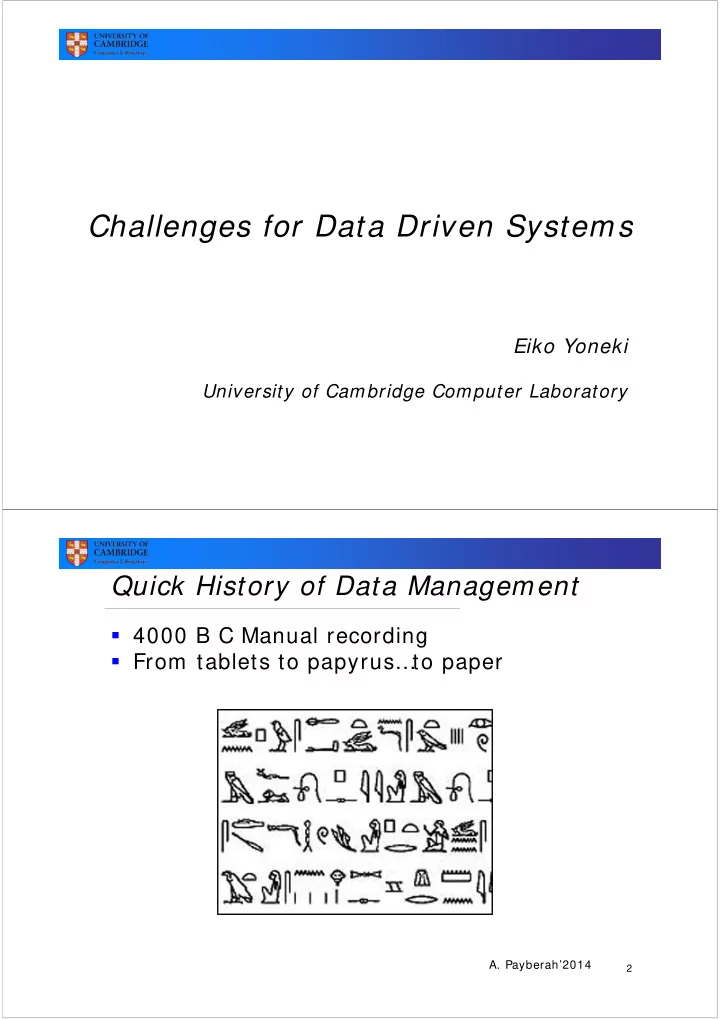
Quick History of Data Management

4000 B C Manual recording From tablets to papyrus… to paper

2

  • A. Payberah’2014
slide-2
SLIDE 2

1800's - 1940's

Punched cards (no fault-tolerance) Binary data 1911: IBM appeared

3

  • A. Payberah’2014

1940's - 1970's

Magnetic tapes Batch transaction processing Hierarchical DBMS Network DBMS

4

  • A. Payberah’2014
slide-3
SLIDE 3

1980's

Relational DBMS (tables) and SQL ACID (Atomicity Consistency Isolation Durability) Client-server computing Parallel processing

5

  • A. Payberah’2014

1990's - 2000's

The Internet...

6

  • A. Payberah’2014
slide-4
SLIDE 4

2010's

NoSQL: BASE instead of ACID

Basic Availability, Soft-state, Eventual consistency

Big Data is emerging!

7

  • A. Payberah’2014

Emergence of Big Data

Increase of Storage Capacity Increase of Processing Capacity Availability of Data Hardware and software technologies can manage ocean of data

8

slide-5
SLIDE 5

Challenge to process Big Data

Integration of complex data processing with programming, networking and storage A key vision for future computing

9

Big Data: Technologies

10

Distributed infrastructure

Cloud (e.g. Infrastructure as a service)

  • cf. Multi-core (parallel computing)

Storage

Distributed storage (e.g. Amazon S3)

Data model/ indexing

High-performance schema-free database (e.g. NoSQL DB)

Programming Model

Distributed processing (e.g. MapReduce)

Operations on big data

Analytics

slide-6
SLIDE 6

Big Data: Technologies

11

Distributed infrastructure

Cloud (e.g. Infrastructure as a service)

Storage

Distributed storage (e.g. Amazon S3)

Data model/ indexing

High-performance schema-free database (e.g. NoSQL DB)

Programming Model

Distributed processing (e.g. MapReduce)

Operations on big data

Analytics – Realtime Analytics

Distributed Infrastructure

12

Zookeeper, Chubby

manage

slide-7
SLIDE 7

Distributed Infrastructure

13

Computing + Storage transparently

Cloud computing, Web 2.0 Scalability and fault tolerance

Distributed servers

Amazon EC2, Google App Engine, Elastic, Azure

System? OS, customisations Sizing? RAM/ CPU based on tiered model Storage? Quantity, type

Distributed storage

Amazon S3 Hadoop Distributed File System (HDFS) Google File System (GFS), BigTable…

Challenges

14

Distribute and shard parts over machines

Still fast traversal and read to keep related data together Scale out instead scale up

Avoid naïve hashing for sharding

Do not depend on the number of node But difficult add/ remove nodes Trade off – data locality, consistency, availability, read/ write/ search speed, latency etc.

Analytics requires both real time and post fact analytics – and incremental operation

slide-8
SLIDE 8

Big Data: Technologies

15

Distributed infrastructure

Cloud (e.g. Infrastructure as a service)

Storage

Distributed storage (e.g. Amazon S3)

Data model/ indexing

High-performance schema-free database (e.g. NoSQL DB)

Programming Model

Distributed processing (e.g. MapReduce)

Operations on big data

Analytics – Realtime Analytics

Data Model/ Indexing

16

Support large data Fast and flexible access to data Operate on distributed infrastructure Is SQL Database sufficient?

slide-9
SLIDE 9

NoSQL (Schema Free) Database

17

NoSQL database

Operate on distributed infrastructure Based on key-value pairs (no predefined schema) Fast and flexible

Pros: Scalable and fast Cons: Fewer consistency/ concurrency guarantees and weaker queries support Implementations

MongoDB, CouchDB, Cassandra, Redis, BigTable, Hibase …

Big Data: Technologies

18

Distributed infrastructure

Cloud (e.g. Infrastructure as a service)

Storage

Distributed storage (e.g. Amazon S3)

Data model/ indexing

High-performance schema-free database (e.g. NoSQL DB)

Programming Model

Distributed processing (e.g. MapReduce) Stream processing

Operations on big data

Analytics – Realtime Analytics

slide-10
SLIDE 10

Distributed Processing

19

Non standard programming models

No traditional parallel programming models (e.g. MPI) e.g. MapReduce

Data (flow) parallel programming

e.g. MapReduce, Dryad/ LINQ, NAIAD, Spark

MapReduce

20

Target problem needs to be parallelisable Split into a set of smaller code (map) Next small piece of code executed in parallel Results from map operation get synthesised into a result of the original problem (reduce)

slide-11
SLIDE 11

CIEL: Dynamic Task Graph

Data-dependent control flow CIEL: Execution engine for dynamic task graphs (D. Murray et al. CIEL: a universal execution engine for

distributed data-flow computing, NSDI 2011)

21

Stream Data Processing

Stream Data Processing

Stream: infinite sequence of { tuple, timestamp} pairs Continuous query: result of query in unbounded stream

Database systems and Data stream systems

Database

Mostly static data, ad-hoc one-time queries Store and query

Data stream

Mostly transient data, continuous queries

22

slide-12
SLIDE 12

Real-Time Data

Departure from traditional static web pages New time-sensitive data is generated continuously Rich connections between entities Challenges:

High rate of updates Continuous data mining - Incremental data processing Data consistency

23

Big Data: Technologies

24

Distributed infrastructure

Cloud (e.g. Infrastructure as a service)

Storage

Distributed storage (e.g. Amazon S3)

Data model/ indexing

High-performance schema-free database (e.g. NoSQL DB)

Programming Model

Distributed processing (e.g. MapReduce)

Operations on big data

Analytics

slide-13
SLIDE 13

Techniques for Analysis

Applying these techniques: larger and more diverse datasets can be used to generate more numerous and insightful results than smaller, less diverse ones

25

  • Classification
  • Cluster analysis
  • Crowd sourcing
  • Data fusion/ integration
  • Data mining
  • Ensemble learning
  • Genetic algorithms
  • Machine learning
  • NLP
  • Neural networks
  • Network analysis
  • Optimisation
  • Pattern recognition
  • Predictive modelling
  • Regression
  • Sentiment analysis
  • Signal processing
  • Spatial analysis
  • Statistics
  • Supervised learning
  • Simulation
  • Time series analysis
  • Unsupervised learning
  • Visualisation

Typical Operation with Big Data

26

Smart sampling of data

Reducing data with maintaining statistical properties

Find similar items

Efficient multidimensional indexing

Incremental updating of models Distributed linear algebra dealing with large sparse matrices Plus usual data mining, machine learning and statistics

Supervised (e.g. classification, regression) Non-supervised (e.g. clustering..)

slide-14
SLIDE 14

Do we need new Algorithms?

27

Can’t always store all data

Online/ streaming algorithms

Memory vs. disk becomes critical

Algorithms with limited passes

N2 is impossible

Approximate algorithms

Easy Cases

28

Sorting

Google 1 trillion items (1PB) sorted in 6 Hours

Searching

Hashing and distributed search

Random split of data to feed M/ R operation

BUT Not all algorithms are parallelisable

slide-15
SLIDE 15

More Complex Case: Stream Data

29

Have we seen x before? Rolling average of previous K items Hot list–most frequent items seen so far

Probability start tracking new item

Querying data streams

Continuous Query

Big Graph Data

30

Protein Interactions [ genomebiology.com] Gene expression data Bipartite graph of appearing phrases in documents Airline Graph Social Networks

slide-16
SLIDE 16

How to Process Big Graph Data?

31

Data-Parallel (MapReduce, DryadLINQ)

Partitioned across several machines and replicated No efficient random access to data Graph algorithms are not fully parallelisable

Parallel DB

Tabular format providing ACID properties Allow data to be partitioned and processed in parallel Graph does not map well to tabular format

Moden NoSQL

Allow flexible structure (e.g. graph) Trinity, Neo4J, HyperGraphDB In-memory graph store for improving latency (e.g. Redis, Scalable Hyperlink Store (SHS))

Big Graph Data Processing

MapReduce is ill-suited for graph processing

Many iterations are needed Intermediate results at every iteration harm performance

Graph specific data parallel

Vertex-based iterative computation model Iterative algorithms common in ML and graph analysis

32

slide-17
SLIDE 17

Big Data Analytics Stack

33

  • A. Payberah’2014

Big Data Analytics Stack

34

  • A. Payberah’2014
slide-18
SLIDE 18

Topic Areas

Session 1: Introduction Session 2: Programming in Data Centric Environment Session 3: Processing Models of Large-Scale Graph Data Session 4: Map/ Reduce Hands-on Tutorial with EC2 Session 5: Optimisation in Graph Data Processing + Guest lecture Session 6: Stream Data Processing + Guest lecture Session 7: Scheduling Irregular Tasks Session 8: Project study presentation

35

Summary

R212 course web page:

www.cl.cam.ac.uk/ ~ ey204/ teaching/ ACS/ R212_2014_2015

Enjoy the course!

36