
SLIDE 1
Challenges faced by
- perators in
Humanitarian Aviation Operation
1
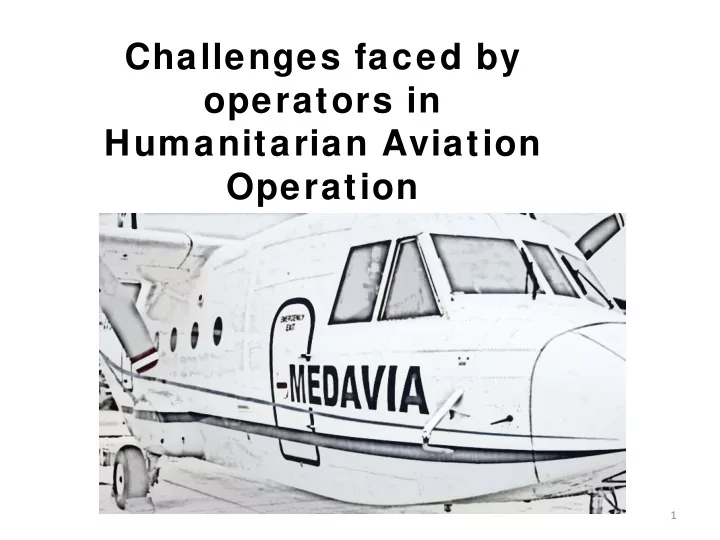
Challenges faced by operators in Humanitarian Aviation Operation - - PowerPoint PPT Presentation
Challenges faced by operators in Humanitarian Aviation Operation 1 2 Remote locations RWY incursions RWY condition RWY excursions Maintenance facilities Quick senior management risk demonstration SAR resources Crew
1
2
Quick senior management risk demonstration
3
4
Even if the worst case scenario doesn’t happen, what about aircraft retrieval?
Does my safety case cover this?
5
6
7
8
RWY incursions
Whether by animal (RI.A’s) or vehicular, aircraft or human (RI.VAP) control of unfenced runways will always be problematic. This is increased where populations have been allowed to inhabit land adjacent to the manoeuvring areas. Mitigations:
likely high traffic human/animal footpaths, tracks and causeways.
awareness/inspections.
Note MDM felt that low pass was more risky than ground inspection. RI.A mitigation strategy’s 9
Further mitigations ‘In house’ RWY hotspot maps & risk assessments
10
Possible causes:
vital)
(very likely if they are apprehensive about RWY contamination or trying to avoid a burst tyre)
11
12
The ideal
13
RWY contamination is also linked to the next subject…
14
RWY Excursion
Mitigations: Operational risk assessment for each sector. VFR - Stabilized approach. GA accepted in preference to an unstable approach. Low energy at touch down. Real time ‘verified’ RWY condition + WX is key. Clear markings, frangible distance to go markers, duplicate approach plates helpful. Good perspective, vital. No holes & no black holes! ‘Length is always nice to have’
15
16
17
18
Fatigue Susceptibility to illness Susceptibility to disease Eat anywhere Vaccinations Limited eating places & menu Hygiene Rest
19
20
21
Take off, initial climb, approach, landing incidents
Red = incidents that involved a fire event
22
23
24
Nokia K95 stun gun (tazer) 25
26
27
Fuel handling
getting the message across to multiple handlers.
quantity issues and discrepancies with various handlers, with differing standards of equipment and accuracy.
and crew awareness
fuel quality plays in keeping the aircraft airborne.
28
29
30
31