CHAIRMAN AND CHIEF EXECUTIVES STATEMENT AND QUESTIONS FOLLOWING THE - - PDF document

chairman and chief executive s statement and questions
SMART_READER_LITE
LIVE PREVIEW

CHAIRMAN AND CHIEF EXECUTIVES STATEMENT AND QUESTIONS FOLLOWING THE - - PDF document

Page 1 of 23 CHAIRMAN AND CHIEF EXECUTIVES STATEMENT AND QUESTIONS FOLLOWING THE ANNUAL GENERAL MEETING 7 MAY 2020 Sir Ian Davis, Chairman of the Board Thank you for joining us today. My name is Ian Davis, Chairman of the Board of


slide-1
SLIDE 1

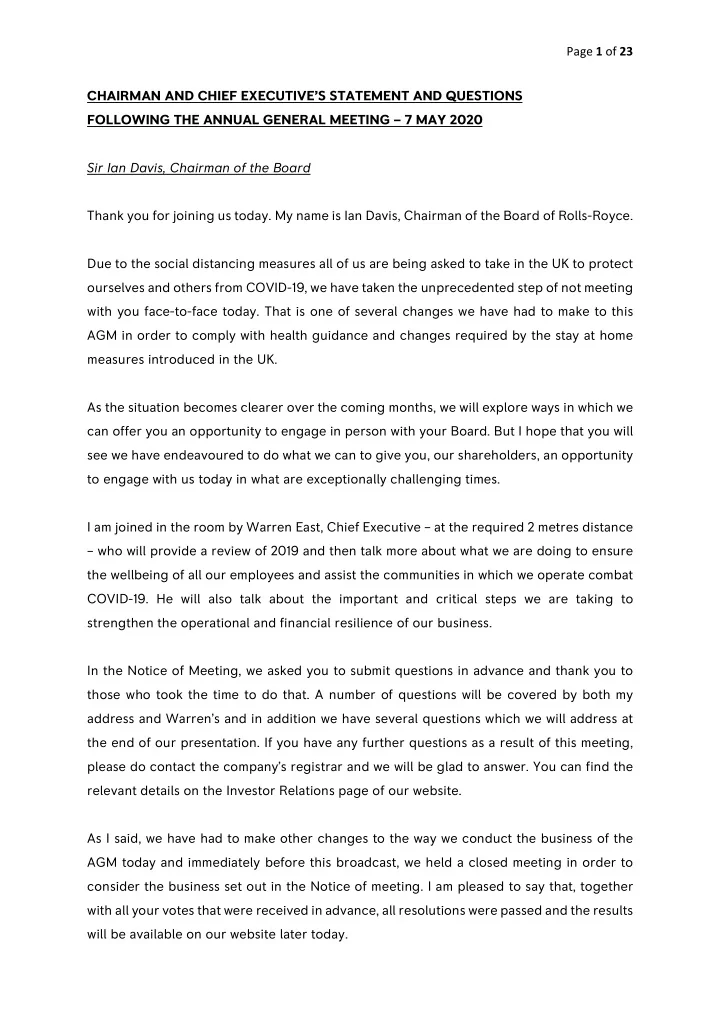
Page 1 of 23 CHAIRMAN AND CHIEF EXECUTIVE’S STATEMENT AND QUESTIONS FOLLOWING THE ANNUAL GENERAL MEETING – 7 MAY 2020 Sir Ian Davis, Chairman of the Board Thank you for joining us today. My name is Ian Davis, Chairman of the Board of Rolls-Royce. Due to the social distancing measures all of us are being asked to take in the UK to protect

  • urselves and others from COVID-19, we have taken the unprecedented step of not meeting

with you face-to-face today. That is one of several changes we have had to make to this AGM in order to comply with health guidance and changes required by the stay at home measures introduced in the UK. As the situation becomes clearer over the coming months, we will explore ways in which we can offer you an opportunity to engage in person with your Board. But I hope that you will see we have endeavoured to do what we can to give you, our shareholders, an opportunity to engage with us today in what are exceptionally challenging times. I am joined in the room by Warren East, Chief Executive – at the required 2 metres distance – who will provide a review of 2019 and then talk more about what we are doing to ensure the wellbeing of all our employees and assist the communities in which we operate combat COVID-19. He will also talk about the important and critical steps we are taking to strengthen the operational and financial resilience of our business. In the Notice of Meeting, we asked you to submit questions in advance and thank you to those who took the time to do that. A number of questions will be covered by both my address and Warren’s and in addition we have several questions which we will address at the end of our presentation. If you have any further questions as a result of this meeting, please do contact the company’s registrar and we will be glad to answer. You can find the relevant details on the Investor Relations page of our website. As I said, we have had to make other changes to the way we conduct the business of the AGM today and immediately before this broadcast, we held a closed meeting in order to consider the business set out in the Notice of meeting. I am pleased to say that, together with all your votes that were received in advance, all resolutions were passed and the results will be available on our website later today.

slide-2
SLIDE 2

Page 2 of 23 Immediately after the conclusion of this meeting, we will hold a General Meeting on a single resolution recommending an increase of our borrowing limits in order to give us greater flexibility at this time. We do not have plans to borrow up to this limit, but in a time of uncertainty we believe it is prudent to create headroom to give management flexibility to act as necessary. Your Board believes that the resolution being proposed at this General Meeting is in the best interests of the Company and its shareholders as a whole and the Directors have voted in favour of this resolution. Details of the outcome of that meeting – which will also be closed – will be posted on our website later today. Traditionally at this point I would introduce you to your Board, but for obvious reasons they are not physically with me today. I would like to welcome Dame Angela Strank to your Board. She joined us at the start of this month and will be a member of the Nominations & Governance Committee, the Safety, Ethics & Sustainability Committee and the Science & Technology Committee. Dame Angela is currently chief scientist and head of downstream technology at BP and a member of their Executive Management Team although she will be retiring from BP at the end of this year. During 2019, we announced the appointment of George Culmer as a Non-Executive

  • Director. He joined at the start of 2020 and is a member of the Nominations & Governance

Committee, the Audit Committee and the Safety, Ethics & Sustainability Committee. A chartered accountant, George was until recently chief financial officer at Lloyds Banking Group and is also the senior independent director at Aviva. During 2019, we were sorry to see the departure of Ruth Cairnie as a Non-Executive Director, following her appointment as chair of Babcock International Group. Ruth made extraordinary contributions to the Board and to the Group, not least in her role as Chairman

  • f the Remuneration Committee.

Also in 2019, Brad Singer, a partner and chief operating officer of ValueAct Capital, stepped down as a Non-Executive Director. Since joining us in 2016, Brad had been an active member of the Board, offering a valued external perspective and helping us to drive progress in our efforts to transform Rolls-Royce. I am sure all of you will join me in thanking both Ruth and Brad for their contributions over the years.

slide-3
SLIDE 3

Page 3 of 23 Lewis Booth will have completed nine years on the Board this month and is stepping down as Chairman of the Audit Committee. However, the Board has approved that he will remain as an independent Non-Executive Director and as an Audit Committee member to provide continuity of support to Nick Luff as he takes over as Chairman of the Audit Committee. The Board also approved the term extension for Sir Frank Chapman to remain as an independent Non-Executive Director and as Chairman of the Safety, Ethics & Sustainability Committee, recognising his significant support for our safety, ethics and sustainability

  • agenda. Sir Frank Chapman will have completed his nine years on the Board in November

this year. I am pleased to report to you that both Lewis Booth and Sir Frank Chapman will be remaining with us until next year’s AGM at the latest. I will hand over to Warren in a moment, but first I would like to make a few introductory remarks. As I said earlier, these are exceptionally challenging times. The COVID-19 pandemic has created a global shock, the full scale of which is still unfolding - especially the longer-term economic consequences on all countries, notably on government finances and economic

  • growth. All our stakeholders are feeling the effects: from customers, partners and suppliers

to governments, employees, their families and you, our shareholders. Your Board is receiving regular updates on the measures being taken by management to deal with the impact of the pandemic on Rolls-Royce. The primary impact has, of course, been on our Civil Aerospace business, which accounts for approximately half of the

  • Company. Anyone who raises their eyes skywards will see the result of the grounding of

airline fleets across the world. In April, the International Air Transport Association (IATA) warned that global air traffic for 2020 could be 48% below 2019 levels. And as half the revenues we make in Civil Aerospace come from engine flying hours, fewer flights means less cash coming into our business. We, like many other executives in the broader aerospace sector, will be working with partners to ensure a successful and orderly restart

  • f the industry.
slide-4
SLIDE 4

Page 4 of 23 We must mitigate this impact, while positioning ourselves for the future that will come. We have commenced a number of contingency measures in order to mitigate the impact on

  • ur 2020 financial performance – ensuring we can deal with the sudden short-term

repercussions of the virus on our business. Warren will outline those measures in further detail in a moment. We appreciate the swift action taken by governments across the world to support businesses, but we must also take difficult decisions to ensure that we endure this period and emerge strongly on the other side – and that will require support and sacrifices from all of our stakeholders. Given the rising level of uncertainty as to how the COVID-19 situation will develop, your Board has decided not to recommend or make the final payment to shareholders in respect

  • f the 2019 financial year. Your Board believes that, in light of the uncertain macro-

economic outlook, this is an appropriate and precautionary measure to take at this point as the Group seeks to ensure an appropriate level of liquidity in the event of a prolonged reduction in trading activity. I would like to thank all our shareholders for understanding why this is a prudent step to take at this time. In order to bolster our financial resilience, our employees are seeing a 10% reduction in salaries, while senior management – including the Executive team – have accepted a 20% reduction, which is being mirrored by your Board. The Remuneration Committee, meanwhile, will make full use of its discretion to amend any future executive awards under the Group’s Long-Term Incentive Plans to avoid any windfall gains caused by a general stock market recovery – which is something I think all of us are hoping we will eventually see. The exact shape of the future into which we will emerge is still the subject of much debate and conjecture, but it seems likely that this virus and its impact on the global economy will have a lasting impact. The civil aerospace market will need to evolve and adapt in the years to come and with the support of our stakeholders we are confident that we can recover and continue to lead the way. During this time, we have derived strength from the diversity

  • f our business units. Our Power Systems business has been less significantly impacted and

Defence operations have proven resilient to the disruption. You will have heard me talk before about culture, how making sure every employee can be at their best is so important to the success of a business. I can honestly say that the

slide-5
SLIDE 5

Page 5 of 23 behaviours and dedication I have seen exhibited across Rolls-Royce during the last few weeks have made me feel very proud. All of us on the Board would like to thank our people for their dedication, support and effort at all times, but particularly in the current environment. I will now hand over to Warren. Warren East, Chief Executive As Ian has said, and all of us joining online and not in person can see, these are exceptionally challenging times. Not just for our business and the industries in which we operate, but for everyone. In this unprecedented period of uncertainty, we have rapidly adapted our business to safeguard its future for all of our stakeholders. We have implemented heightened safety procedures to protect our people who need to be in the workplace, whilst many others are working from home. We are also providing practical assistance to combat the impact of COVID-19 on the countries in which we

  • perate. In the UK, for instance, we have put our manufacturing and supply chain expertise

to use in the drive to increase the supply of ventilators for hospitals. In parallel, we have strengthened the financial resilience of the Group to ensure we are well positioned to weather the pandemic. We are working hard to mitigate the near-term disruption caused by COVID-19 and are making stronger than expected progress on our mitigating actions, giving us confidence that we can now deliver up to £1.0 billion of savings this year. However, we must also take the difficult but necessary decisions to ensure the Group emerges from this period with the appropriate cost base for what will be a smaller commercial aerospace market which may take several years to recover. I am proud of the dedication and commitment of my colleagues and thankful for the continuing support of our shareholders and other stakeholders during this challenging time.

slide-6
SLIDE 6

Page 6 of 23 Before we return to COVID-19, the first part of the business of this meeting is for me to report back to you, our shareholders, on the progress of Rolls-Royce in 2019. For those of you on the phone, the slides for my presentation are available on our website and you can follow this review of the year on slides 4 to 8. [Slide 4] We ended 2019 with positive momentum, showing solid progress across the Group thanks to a good finish to the year following a tough first half. We reported 25% growth in full year underlying operating profit and an encouraging level

  • f core free cash flow, over £900m, driven by higher profits, improved efficiency and a

reduction in inventory as the year progressed. [Slide 5] In 2019, we delivered a robust trading performance across all divisions. Civil Aerospace improved its underlying profit significantly, with record engine deliveries, good aftermarket performance and improved OE unit losses. Power Systems saw revenues increase, despite some tough end markets, with growth in power generation and market share gains in Asia. During the year we also increased our services penetration, further capitalising on the more than 140,000 MTU engines we have in use worldwide. Defence performed well throughout the year despite a headwind from the adverse OE mix. Another year with a very strong book to bill ratio meant another record order intake in Defence of £5.3bn. Alongside good operational performance this produced healthy cashflow. [Slide 6] 2019 was a pivotal year for the resolution of our Trent 1000 engine durability challenges. We made significant progress and have now achieved fixes for 8 out of 9 issues. However,

slide-7
SLIDE 7

Page 7 of 23 the engine’s durability issues weighed heavily on 2019, in terms of the financial cost of returning the fleet to the levels of service our customers expect and dealing with the unacceptable disruption we have been causing them. As the year drew to a close, we carried out a detailed technical re-evaluation of our progress on the final fix, a new high-pressure turbine blade for the Trent 1000 TEN. Based

  • n this re-evaluation and test activity, we reset our financial and operational expectations

for the engine in November, with a revised estimate of the final durability of the engine’s high-pressure turbine blades. This allowed us to provide certainty for customers and greater clarity for investors. As a result of the Trent 1000 issues, and as announced in November, we recognised a net exceptional charge of £1.36bn within our 2019 financial results, contributing to a reported loss of £852m for the year. We are progressing well with the final new HP blade and have now started engine testing and, despite everything else that is currently happening, we continue to expect certification

  • f this component in the first half of 2021. We now have enough overhauled and spare

engines such that, once fitted, our aircraft on ground reduces to about ten, and we remain

  • n target to achieve single digits by the end of the second quarter of this year.

[Slide 7] Our restructuring efforts gained momentum in 2019, with run-rate cost savings of £269m. Indirect headcount reduction followed the introduction of new processes, taking the cumulative net indirect headcount reduction to almost 3,000 of the 4,600 goal we set back in 2018 for 2020. I was very heartened by the performance and behaviours that I saw within the business in the second half of last year, this gave me increased confidence coming into 2020 that the changes we have been implementing over the past two years are creating a tangible and sustainable cultural and performance shift within our business. [Slide 8] Strategically, we bolstered our ambitions to be a leader in low carbon technologies during 2019. We acquired eAircraft, the electric and hybrid-electric aerospace propulsion activities of Siemens, adding new products and a team of specialist electrical designers and engineers

slide-8
SLIDE 8

Page 8 of 23 to our portfolio, as well as a handful of design wins. Late last year we also unveiled the plane which will seek to break the speed record for an all-electric aircraft as part of our ACCEL programme. Power Systems is, of course, already well advanced in the provision of low carbon energy such as hybrid-propulsion systems for applications including trains and yachts, and during 2019 we signed customer contracts and framework agreements for hybrid solutions for both markets. We are increasingly taking our expertise in power generation and integrating it with power management systems, renewable energy sources and battery technology to create micro- grids that can deliver cleaner, decentralised energy. Since October, we have been

  • perating our own microgrid in Friedrichshafen and during 2019 we received the first

customer orders. Early in 2020, we further enhanced our capabilities in this area with the acquisition of a majority holding in power storage specialist Qinous. We also completed the sale of Commercial Marine and agreed the sale of our North America Civil Nuclear business in 2019. [Slide 9] For those of you on the phone, I’m now on slide 9. At the time of our full year results at the end of February, the impact of COVID-19 was still evident predominantly in China. We said it was a macro-risk to our business, but took the decision to provide guidance excluding COVID-19 for 2020 in order to provide a benchmark for the year ahead upon which investors could build their models before considering their own assumptions of the impact of the disease. Since then, as we all know, there is almost no part of the world that has not been impacted and the scale of the measures being brought in by governments to slow the spread of the virus is unprecedented. By the time we reported our results, we had detail of the impact on flying hours into, out of and within China. In March, however, we started to see flight restrictions being

slide-9
SLIDE 9

Page 9 of 23 implemented by many more countries and come April, airlines were grounding large proportions of their fleets. As a result, in early April, we withdrew our financial guidance for 2020. Due to the unprecedented reduction in air traffic caused by COVID-19, we are anticipating a significant net cash outflow during the second quarter, and it remains too early to guide

  • n the likely outcome for the full year.

[Slide 10] In terms of the impact seen so far, Civil Aerospace widebody engine flying hours were approximately 40% lower in the first four months of the year. This reflected a fall of 90% in April as airlines around the world have temporarily grounded large proportions of their fleets. As a result of this lower level of activity we are now enacting a significant reduction in the volume of service visits in our maintenance, repair and overhaul (MRO) shops, compared with our original plans; and consequently now expect MRO volumes in 2020 to be moderately below 2019 levels. Additionally, our airframe customers have reduced aircraft production rates and as a result we now expect to deliver about 250 engines in 2020, down from our previous guidance of 450 announced in February. During this time, we derive strength from the diversity of our business units, with almost half of our sales coming from non-Civil Aerospace end markets. Our Defence business continues to perform robustly, however the impact of social distancing and elevated absence levels is presenting some operational challenges, particularly for some of our suppliers. We are closely monitoring our supply chain and taking actions, where possible, to mitigate the impact on our productivity. Since our trading update in April, Power Systems has experienced a deterioration in demand due to the impact of COVID-19 on economic activity in our end markets. In particular, we have seen our industrial end markets heavily impacted, especially mining and

slide-10
SLIDE 10

Page 10 of 23

  • il & gas. Service activity is also lower, and several yacht production facilities have

temporarily closed. Delays to construction projects has affected PowerGen demand, however, as we look ahead, we anticipate a trend for higher data traffic to results in increased demand for mission-critical backup power for data centres. As a result, Power Systems financial performance in 2020 is likely to be materially lower than it was in 2019, although we do still expect it to contribute positively to Group profit and cash flows in the full year. [Slide 11] For those of you on the phone, I’m now on slide 11. Throughout this outbreak, our top priority has been to do everything we can to safeguard the lives and livelihoods of our people and to play our part in helping our customers, partners and communities. Proactive measures remain in place at our facilities to help keep our people safe and minimise operational disruption, which are aligned with local and national guidelines. These include remote working practices alongside workplace measures such as social distancing, enhanced hygiene procedures and modified shift systems in our manufacturing facilities, which enable us to continue to serve our customers in these difficult times. We are supporting our communities with whatever practical help we can offer. In the UK, we are proud to be a member of the VentilatorChallengeUK consortium which is producing additional ventilators for the NHS. Our role is to lead the development and execution of a parallel supply chain to feed assembly lines for the Smiths ParaPAC 300

  • ventilator. In little more than one month we have established a new supply chain to deliver
  • ver 3.5 million parts with a team that includes project managers, manufacturing engineers,

buyers and quality controllers, who have worked round the clock. These parts are being delivered to production lines in the UK, who are ramping up production of ventilators and will soon be producing at least 1,500 units a week. Across Rolls-Royce, teams are using their skills in manufacturing techniques including 3D printing to produce personal protective equipment, including over ten thousand face shields, to help protect local healthcare staff. One team in the UK working with medics and

slide-11
SLIDE 11

Page 11 of 23 engineers at The Manufacturing Technology Centre developed, tested and put into

  • peration a shield to protect front line staff from frequent exposure to aerosolised COVID-

19 – all in just one week. These fast-make prototype activities were supported with funding from Innovate UK. As a leading promoter of Science Technology Engineering and Mathematics, or STEM, activities designed to inspire the future generation, we are also playing our part in helping the many people who need to keep children excited and learning during these trying times. We have made a wide range of materials available on our website. These include lesson plans that are linked to the UK’s national curriculum, on flight, electricity, recycling and green energy. These materials use our all-electric ACCEL aircraft programme as their starting point. We also have indoor learning activities available through our partnership with the Scout Association. Just last week we published content from our Digital Academy,

  • ffering our world-class digital training programme to help people and businesses around

the world learn new digital skills. Courses available on our website range from ‘bitesize’ hour-long sessions, to fully certified training programmes. Our R2 Data Labs team, meanwhile, has assembled a group of leading companies to collaborate on the Emergent Alliance. This collection of data analytics experts will combine traditional economic, business, travel and retail data sets with behaviour and sentiment data, to provide insights that will support the global recovery from the pandemic. [Slide 12] Turning to slide 12. COVID-19 has caused significant disruption to the global aerospace industry, with an unprecedented reduction in air traffic. In order to mitigate the impact on our 2020 financial performance we immediately implemented a number of contingency measures. In response to the change in outlook resulting from the global spread of COVID-19 and to ensure cash headroom in the event of a prolonged reduction in trading activity, we took a precautionary decision in March to draw fully on our £2.5 billion revolving credit facility. An additional revolving credit facility of £1.5 billion was also secured in April to bolster the Group’s liquidity position, this has now been increased to £1.9 billion following the completion of discussions with a larger group of banks.

slide-12
SLIDE 12

Page 12 of 23 Notwithstanding our financial and liquidity position, and as Ian said earlier, the Board decided that in light of the uncertain macro outlook, it would no longer recommend a final shareholder payment of 7.1 pence per share in respect of 2019. I know this will be a disappointment to many of you, but it is the prudent thing to do. We have made better than anticipated progress with self-help specific mitigation activities to further reduce our cash expenditure and we now expect to generate a cash flow benefit

  • f up to £1 billion this year. We are achieving this by minimising discretionary costs such as

non-critical capital expenditure projects, consulting and professional fees, ceasing all non- essential travel and postponing external recruitment. We have also introduced reduced working hours and removed overtime and are reducing salary costs across our global workforce by 10% this year, subject to local legal requirements. Our senior managers – including the Executive Team – have taken an additional 10% pay cut. There has also been a corresponding reduction in fees for Non-Executive Directors of the Board. We have taken a number of immediate actions to adapt to the current market conditions and reduced volume expectations for both

  • riginal

equipment production and Maintenance Repair and Overhaul activity. These include working with our supply-chain to reduce direct procurement as well as placing over 4,000 of our own employees in the UK

  • n furlough. We have pledged to ensure that they receive no less than 80% of their salary

and we will make up any difference beyond government caps. Looking ahead, the severity of the disruption caused by COVID-19 is expected to lead to a smaller commercial aerospace market which may take several years to recover. As a result, we are actively pursuing changes to our business, particularly in Civil Aerospace, to better align to the medium-term market conditions. We are committed to working with our trade union and employee representatives, as well as our customers and suppliers, as we adjust to the new outlook and establish a more appropriate cost base in order to secure our future for all stakeholders. We have promised to give our people further details of the impact of the current situation on the size of our workforce before the end of this month and will consult with affected employees in due course. [Slide 13] Finally, on slide 13.

slide-13
SLIDE 13

Page 13 of 23 Our strategic choices over the last few years, including streamlining our portfolio, investing in our management systems, and building a culture of agility – have helped us to respond quickly to COVID-19 with actions to mitigate the immediate impact. There is a lot of speculation about the exact shape of the recovery from this pandemic – and obviously we have worked through a number of scenarios – but I firmly believe that flying is a societal good and it will be one of the drivers of any global economic recovery. Once that recovery begins, the shape of our portfolio and the synergies between our divisions will leave us well placed to capitalise on the long-term potential of our markets. I firmly believe that the world on the other side of this pandemic will be even more focused

  • n the provision of lower carbon, more sustainable power. This plays well to our strengths

and our strategy. The transition to low carbon power was always going to be an opportunity that we could seize through increasingly efficient engines and our world class innovation; becoming a disruptor in new markets. Now opportunities may come even sooner than we

  • riginally anticipated. We must – and we will – emerge from this period ready to pioneer

the power that matters. Thank you, I will now hand back to Ian. Sir Ian Davis Thank you Warren. Traditionally at this point I would ask for questions from the floor. But for this AGM we requested that shareholders send us their questions in advance and thank you to those of you that did. I will now read out those questions for the benefit of everyone watching and listening in and Warren or I will address them. The first question is from Mr Arblaster. The current severe decline in civil aircraft utilisation helps to emphasise the importance of the B52 re-engineering programme for the USAF. Mr East mentions this in his Strategic

slide-14
SLIDE 14

Page 14 of 23 Report Review on page 8 of the Annual Report. Does he yet have any further news on this very important opportunity for the Group? Warren, would you address this please. Warren East Of course. The U.S. Air Force is continuing to progress the re-engineering of its fleet of B-52s with a new, in-production, commercial-off-the-shelf engine. We anticipate that a Request For Proposal will be issued in the coming weeks and a selection decision made by early 2021. We will compete with our F130 engine, a variant of the commercial BR725 engine. Should we win the competition we will manufacture, assemble and test the F130 engines in our newly modernized facilities in Indianapolis. We consider the F130 to be a perfect fit for the B-52. It’s the right size, thrust and fuel efficiency. It’s a modern design with high reliability and a proven service record. Thanks Ian Sir Ian Davis The next question is from Mr Neal who asks: To what extent does the Ardour T45, powering the Goshawk US Navy pilot training aircraft, figure in the Company’s accounts today. In the 1970s and 1980s, I worked on the T-45 programme in Derby, Bristol and Long beach, ending up as Project Programme Manager. I believe the T45 is still ‘going strong’ and contributing to Rolls-Royce’s income. Is this so? Warren, can you take this please? Warren East Firstly I’d like to thank Mr Neal and all his colleagues for the work they put in to the

  • programme. The enduring returns that we see from military programmes over an extended

period of time are one of the core characteristics of our Defence business.

slide-15
SLIDE 15

Page 15 of 23 We continue to service and support the Adour engines (known as the F405 in the US) that power the U.S. Navy T-45 training fleet, based in two military training sites in the southern U.S. And this does indeed continue to provide us with a steady flow of services revenue into

  • ur Defence business. So again, thank you.

Sir Ian Davis Turning to a question from Mr Atkinson: When the Ultra Fan engines go into service, do you anticipate that it will be a niche product

  • r will it have such a wide application that it will threaten the continued existence of other

manufacturers? Again, Warren, can you answer this one? Warren East Of course. UltraFan, as many of you will know, is a demonstrator programme for a suite of new

  • technologies. It is not simply one single new engine. Those individual technologies will give

us competitive advantages as well as options. Exactly how we use them and when we use them is not something – for obvious competitive reasons – I can talk about today. I would add that UltraFan is also an important step towards lower carbon power as the architecture behind it is even more efficient than the Trent XWB, which as I am sure you know is the world’s most efficient civil large gas turbine engine in service today. Thank you. Sir Ian Davis I have three questions from Hermes Investment Management The first one is:

slide-16
SLIDE 16

Page 16 of 23 When will Rolls-Royce publish company-specific metrics and targets for its key product areas that reflect the longer-term ambition for its role in the low carbon transition and against which stakeholders can evaluate progress and impact? Warren, do you want to take this too? Warren East Sure As part of a broader review of our sustainability strategy, we are reviewing our sustainability targets this year, with a particular view to replace those which expire at the end of 2020. We are proud to already have a leading target to reach net zero emissions from our

  • perations and facilities by 2030 and we are committed to playing a leading role in enabling

the vital sectors in which we operate to get to net zero emissions by 2050. One of our key tasks is to articulate more clearly what this means and the potential pathway we will take to reach net zero emissions by 2050, including considering potential future targets. We will provide more on this when we have completed this work. Sir Ian Davis Their second question is Will the company commit to advance climate disclosure over the next two reporting cycles with the aim that by 2022 it achieves material alignment with the intention of the TCFD, as per the 5-year implementation aim of the Taskforce’s recommendations? Warren? Warren East We have taken steps to enhance our climate-related reporting over the past few years to bring it in line with the TCFD recommendations; this includes strengthening our related

slide-17
SLIDE 17

Page 17 of 23 governance, introducing climate scenarios to our strategic planning processes, and reviewing our treatment of climate-related risk. A further step in strengthening our reporting will be the consideration of product-related climate targets in relation to the above. Thank you for the question. Sir Ian Davis Thanks Warren, I’d like to add comment that it is reassuring to see that the desire for demonstrable action on climate change remains high on the agenda despite the immediate pressures of COVID-19 today. I was pleased therefore to receive the statement from Hermes accompanying these questions, submitted on behalf of the Climate Action 100+ investor coalition, that recognised the continued commitment Rolls-Royce has demonstrated in building the company’s position and school of thought on the necessary transition to a low carbon economy. This is a topic I believe to be of the upmost importance. And so the last of the three questions from Hermes is Will the Remuneration Committee seek to include a climate metric or metrics in the variable pay plans of the executive team? If so, what would the metric or metrics be and by when would the Committee seek for these to be included? I’ll take this one. The remuneration policy has been left deliberately open to the addition of further targets, with a particular expectation that we may introduce ESG related, particularly climate, targets in the future in line with the sustainability review mentioned earlier. Our next question is from Ms Nazari

slide-18
SLIDE 18

Page 18 of 23 What is the timeline on which the company is planning to convert all its aircraft into all- electric aircraft given that a similar situation to the COVID-19 pandemic is bound to happen again if we do not take action quickly enough regarding the climate crisis? Warren, would you like to take this question? Warren East Of course. Despite the immediate pressures of the COVID-19 crisis, the climate emergency has not waned and we remain committed to playing a leading role in enabling the vital sectors in which we operate to get to net zero emissions by 2050. There is no doubt this must be a core part of the post-COVID recovery of aviation in particular. But there will not be one single solution that will get us there. We must rely on a combination of technologies, including further improving engine efficiency, and other measures, such as the increased use of sustainable, lower carbon fuels, to achieve that. Electrification will play an important part, particularly in the smaller end of the market. Here we expect to attempt to break the world-speed record with a fully electric single seater plane later this year; and introduce our first certified propulsion unit for 2 to 4 seater aircraft to the market by 2023. The technologies we are developing for these smaller aircraft can be scaled up and applied

  • ver time into larger aircraft, particularly regional. At the larger end of the market,

particularly for widebody long-haul flights, we don’t yet see a viable technological pathway for fully electric flight. But we anticipate there will be more electric planes, perhaps with some form of hybrid technology, but more likely using fuel sources that are not fossil-fuel based. These technologies will take time to bring to market and must be supported by the right policy environment that ensures they are sustainable and do not compromise product

  • safety. But we remain confident in our ultimate goal that aviation can be compatible with a

net zero carbon future by 2050.

slide-19
SLIDE 19

Page 19 of 23 Thank you for the question. Sir Ian Davis Now to a question by Ms Brown on behalf of the CCLA Investment Management

  • n behalf of a coalition of investors with assets under management of c.£2.2 trillion.

While we fully appreciate the extraordinary pressures that you are under at present, we would urge you to address the threat posed by COVID-19 to the mental health of your workforce and the risk it poses to the overall sustainability of your business. We are encouraging businesses to develop a specific mental health action plan during COVID-19 for all your employees and would welcome hearing your approach. Thank you. I will take this one myself. I think all of us are to some extent feeling the strain of these unprecedented times. It is particularly hard for those who are self-isolating or spending an extensive amount of time within their homes and away from colleagues, friends and family. This is a very necessary precaution, but that does not make it any easier. Your Board is acutely aware of the impact of the virus on people’s mental health. We have been regularly updated by management on the advice and resources being offered through internal communications to our people. We also have mechanisms in place which enable us to keep in touch with our people on furlough. Ultimately, however, it is the job of all our managers to make sure that they remain close to their teams, that they empathise with those who are feeling anxious right now and that – for want of a better phrase – they keep everyone’s morale up. As just one example, I know Warren has been making a personal video every week to make sure he can connect with as many people as possible and provide as much reassurance as he can. The next question is from Mr Hamilton, who asks “In view of the fact that inequality is widely recognised as one of the greatest evils in the UK, is it not time that the remuneration of Directors and Senior staff was substantially reduced?”

slide-20
SLIDE 20

Page 20 of 23 Well, Mr Hamilton, the Remuneration Committee maintains a very close watch on levels of executive pay in order to ensure that we can attract and retain the people that we need. You will see on pages 14 and 15 of the Annual Report the very clear links between our key performance indicators and remuneration. As you will also see in the report of the Committee from page 85, we have always taken a careful approach to executive reward and for the third year running the Committee has not proposed any changes in quantum for existing Executive Directors. I’ll return to this topic with the next question, which comes from Mr Shippard, who asks “The company has recently said it is anticipating losing a lot of orders in the face of the possible reduction in travel and therefore a reduction in the need for aircraft. As a consequence, it has warned that there are likely to be redundancies. Presumably the members of the Board will be reduced pro rata and all of them will be very carefully considering their need to receive the full amount of their remuneration and expenses. Perhaps, already they are only taking 80% of their remuneration and expenses to show sympathy with those who have been furloughed.” Thank you. As we said in the trading update in April, we have already reduced the salaries

  • f our senior management – including the Executive Team – by 20%. There has been a

corresponding reduction in fees for non-executive directors. The penultimate question comes from Mr Cuddington, who says: You will not need me to tell you that the impact of COVID-19 on the airline industry is

  • devastating. All areas will have to take their share of the pain, but what concerns me is that

the capability of the company to design, develop and certificate a competitive large engine will be lost forever. It must already be diminished. It is this engineering competence that is

  • nly possessed by the three large aero engine companies. However, what concerns me is

that there is no one on the Board who really understands how the commercial airline industry works. So, I urge you to find somebody who can fulfil that role on the Board and not only listen to them but be mindful that for the long term, engineering capability will be key to a successful future, not just technology. Thank you.

slide-21
SLIDE 21

Page 21 of 23 Your Board is very mindful of understanding the needs of the airline industry and we receive regular insights from the leadership within our Civil Aerospace business, which retains incredibly close ties not only with airframers but with the airline industry as a whole. As to your broader point. We are also very mindful of the need to protect Rolls-Royce’s ability to innovate and the Board has extensive experience of engineering as well as technology – and the aerospace industry. Several of our members are chartered engineers and together we collectively have many decades of experience – perhaps more than some

  • f us would care to admit – within companies engaged in high-value manufacturing,

advanced engineering and safety critical technology. I believe your Board is very well versed in both engineering and technology. The last question comes from Mr Barton: It has been very impressive how skills and capabilities are being used to benefit society with ventilators, face masks, etc. Given that ability in a crisis to step up and do something different successfully, what are your thoughts around repurposing some of our people and facilities currently involved in Civil Aero work to enter a new line of business for Rolls- Royce in an area post COVID-19 that will have a demand (perhaps medical equipment or electrical power)? This could be a temporary venture to bridge the slump in air travel and if it proves really successful it could be continued with or sold. Warren, would you like to take this please? Warren East With pleasure. A few weeks ago I visited the team working in Derby to support our work on ventilators –

  • bviously maintaining the appropriate social distance. I was particularly impressed by the

entrepreneurial spirit shown by the team. While it is very unlikely that on the other side of the pandemic Rolls-Royce will go into the medical devices business, the behaviours that I saw on display – the agile way in which people were problem solving and the collaboration with multiple teams – are exactly what we have been driving for across the company; and are exactly what will help get us through this challenging period.

slide-22
SLIDE 22

Page 22 of 23 This is not a crisis of our making. But it is the crisis that we face and I have been impressed with the way that colleagues across the Group are tackling it. In reality this is almost certainly the darkest hour for our whole company since the 1970s. Thanks to much hard work from all of our people, including some difficult changes over the last few years we are a much, much stronger company today than we were then. The COVID-19 pandemic has shown that we derive strength from the diversity of our group. Rolls-Royce stands upon three legs, not just one. Our Defence and Power Systems businesses have always had close links with our Civil Aerospace business. Defence has benefitted from Civil’s work in gas turbines and has Civil products in use with customers, such as the MT30 naval gas turbine engine. Power Systems has learned a lot from Civil about data collection and creating aftermarket services. While Civil and Defence have both been able to learn from Power Systems’ experience in hybrid electrical systems. Power Systems has hybrid-electric products in service with customers right now and is learning valuable lessons that can be drawn upon by the rest of the Group. On the other side of this pandemic, the world will have need of the vital power that we

  • produce. And I firmly believe that the call for that vital power to be lower carbon will be
  • strong. This plays to our strengths and strategy.

We have emerged from troubled times before to achieve incredible things. We will do so again. Thank you. Sir Ian Davis With there being no more questions to address, I would like to draw this meeting to a close. Thank you all for joining us today. All of us on your Board are sorry that we have not been able to meet in person as we usually do at this time of year. As I said earlier, as the situation becomes clearer over the coming

slide-23
SLIDE 23

Page 23 of 23 months, we will explore ways in which we can offer you an opportunity to engage in person with us – perhaps in the autumn. In the meantime, thank you for your continued support and stay safe in these unprecedented times.