CERN and the LHC Computing Challenge by Wolf gang von Rden Head, - - PowerPoint PPT Presentation

cern and the lhc computing challenge by wolf gang von r
SMART_READER_LITE
LIVE PREVIEW

CERN and the LHC Computing Challenge by Wolf gang von Rden Head, - - PowerPoint PPT Presentation

where the Web was born CERN and the LHC Computing Challenge by Wolf gang von Rden Head, I T Department HP DutchWorld 12 th October 2004 October 2004 HP DutchWorld 2004 1 CERN is also: What is CERN? - 2500 staff (physicists, engineers,


slide-1
SLIDE 1

October 2004 HP DutchWorld 2004 1
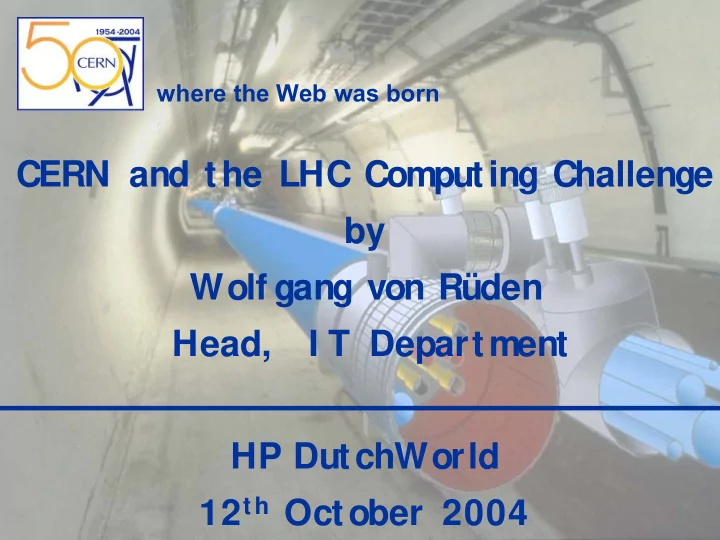
where the Web was born

CERN and the LHC Computing Challenge by Wolf gang von Rüden Head, I T Department HP DutchWorld 12th October 2004

slide-2
SLIDE 2

October 2004 HP DutchWorld 2004 2

CERN is also:

  • 2500 staff

(physicists, engineers, technicians, …)

  • Some 6500 visiting

scientists (half of the world's particle physicists) They come from 500 universities representing 80 nationalities.

What is CERN?

  • CERN is the world's largest particle physics centre
  • Particle physics is about:
  • elementary particles, the constituents all matter

in the Universe is made of

  • fundamental forces which hold matter together
  • Particles physics requires:
  • special tools to create and study new particles
slide-3
SLIDE 3

October 2004 HP DutchWorld 2004 3

What is CERN?

  • Physicists smash particles into each other to:
  • identify their components
  • create new particles
  • reveal the nature of the interactions between them
  • recreate the environment present at the origin of
  • ur Universe (big bang)
  • What for? To answer fundamental questions like:

how did the Universe begin? What is the origin of mass? What is the nature of antimatter?

slide-4
SLIDE 4

October 2004 HP DutchWorld 2004 4

What is CERN?

The special tools for particle physics are:

  • ACCELERATORS, huge machines able to speed up

particles to very high energies before colliding them into other particles

  • DETECTORS, massive instruments which register the

particles produced when the accelerated particles collide

  • COMPUTING, to re-construct the collisions, to extract

the physics data and perform the analysis

slide-5
SLIDE 5

October 2004 HP DutchWorld 2004 5

What is CERN?

  • CERN has made many important discoveries, but our current

understanding of the Universe is still incomplete!

  • Higher energy collisions are the key to further discoveries of more

massive particles (E=mc2)

  • One particle predicted by theorists remains elusive: the Higgs boson
slide-6
SLIDE 6

October 2004 HP DutchWorld 2004 6

  • To answer some of the still open questions, CERN

is building a new accelerator, the Large Hadron Collider (LHC)

  • The LHC will be the most powerful instrument ever built to

investigate elementary particles

  • Four very large experiments matching this machine are under

construction, ready to make new discoveries in 2007 and beyond

  • If the Higgs boson exists, then we will most certainly find it

What is CERN?

slide-7
SLIDE 7

October 2004 HP DutchWorld 2004 7

CERN’s accelerator complex

Experiment A Experiment B

  • PS – Proton Synchrotron
  • SPS – Super Proton Synchrotron
  • LHC – Large Hadron Collider
slide-8
SLIDE 8

October 2004 HP DutchWorld 2004 8

The CERN Site

Mont Blanc, 4810 m Downtown Geneva CMS ATLAS CERN sites ALICE LHCb

slide-9
SLIDE 9

October 2004 HP DutchWorld 2004 9

What is LHC?

LHC is due to switch on in 2007 Four experiments, with detectors as ‘big as cathedrals’: ALICE ATLAS CMS LHCb

  • LHC will collide beams of protons at an energy of 14 TeV
  • Using the latest super-conducting technologies, it will
  • perate at about – 270ºC, just above the absolute zero of

temperature

  • With its 27 km circumference, the accelerator will be the

largest superconducting installation in the world.

slide-10
SLIDE 10

October 2004 HP DutchWorld 2004 10

Typical Experiment Layout

  • Complex system of detectors centred around the

beam interaction point

slide-11
SLIDE 11

October 2004 HP DutchWorld 2004 11

Particle Detection Techniques

Multiple layers of increasing density to identify particles

slide-12
SLIDE 12

October 2004 HP DutchWorld 2004 12

ATLAS, one of the four LHC experiments

As tall as our main building !

ATLAS has 150 million measurement channels

slide-13
SLIDE 13

October 2004 HP DutchWorld 2004 13

LHC data (simplified)

Per experiment:

  • 40 million collisions per second
  • After filtering, 100 collisions of interest per second
  • A Megabyte of digitised information for each

collision = recording rate of 0.1 Gigabytes/sec

  • 1 billion collisions recorded = 1 Petabyte/year

1 Megabyte (1MB) A digital photo 1 Gigabyte (1GB) = 1000MB A DVD movie 1 Terabyte (1TB) = 1000GB World annual book production 1 Petabyte (1PB) = 1000TB 10% of the annual production by LHC experiments 1 Exabyte (1EB) = 1000 PB World annual information production

Total: ~10.000.000.000.000.000 bytes/year = 1% of

CMS LHCb ATLAS ALICE

slide-14
SLIDE 14

October 2004 HP DutchWorld 2004 14 Concorde ( 1 5 Km ) Balloon ( 3 0 Km ) CD stack w ith 1 year LHC data! ( ~ 2 0 Km )

  • Mt. Blanc

( 4 .8 Km )

LHC data (simplified)

LHC data correspond to about 20 million CDs each year

Where will the experiments store all of these data?

slide-15
SLIDE 15

October 2004 HP DutchWorld 2004 15

LHC data processing

LHC data analysis requires a computing power equivalent to ~ 70,000 of today's fastest PC processors

Where will the experiments find such a computing power?

slide-16
SLIDE 16

reconstruction simulation analysis

interactive physics analysis

batch physics analysis batch physics analysis

detector event summary data raw data

event reprocessing event reprocessing event simulation event simulation

analysis objects (extracted by physics topic)

Data Handling and Computation for Physics Analysis

selection & reconstruction selection & reconstruction

processed data

les.robert son@cern.ch

slide-17
SLIDE 17

October 2004 HP DutchWorld 2004 17

High Throughput Computing

mass storage application servers WAN data cache

simple, flexible architecture

  • easy to integrate mass market components
  • easy evolution to new technologies
slide-18
SLIDE 18

October 2004 HP DutchWorld 2004 18

High Throughput Computing

mass storage application servers WAN data cache Large aggregate capacity, performance price sensitive on acquisition, cost sensitive on operation Open solutions and standards, simplified architecture have worked well for the past 15 years in sustaining high growth of capacity and performance while containing/reducing costs

simple, flexible architecture

  • easy to integrate mass market components
  • easy evolution to new technologies
slide-19
SLIDE 19

October 2004 HP DutchWorld 2004 19

Computing at CERN today

  • High-throughput computing based on reliable “commodity” technology
  • About 2000 dual processor PCs
  • More than 3 Petabyte of data on disk (10%) and tapes (90%)

Nowhere near enough!

slide-20
SLIDE 20

October 2004 HP DutchWorld 2004 20

Building up LHC computing at CERN

Networking by 2007: ~ 70 Gb/s to external centres ~ 100 Gb/s general networking

Moore’s law (based

  • n 2000)

Estimated DISK Capacity at CERN

1000 2000 3000 4000 5000 6000 7000 1998 1999 2000 2001 2002 2003 2004 2005 2006 2007 2008 2009 2010 year TeraBytes

Estimated Mass Storage at CERN

LHC Other experiments 20 40 60 80 100 120 140 1998 1999 2000 2001 2002 2003 2004 2005 2006 2007 2008 2009 2010 Year PetaBytes

Estimated CPU Capacity at CERN

1,000 2,000 3,000 4,000 5,000 6,000 1998 1999 2000 2001 2002 2003 2004 2005 2006 2007 2008 2009 2010 year K SI95

today

slide-21
SLIDE 21

October 2004 HP DutchWorld 2004 21

Preparing for 7,000 boxes in 2008 Preparing for 7,000 boxes in 2008

New electrical substation

2.5 MW power

slide-22
SLIDE 22

October 2004 HP DutchWorld 2004 22

Preparing for 7,000 boxes in 2008 Preparing for 7,000 boxes in 2008

slide-23
SLIDE 23

October 2004 HP DutchWorld 2004 23

Preparing for 7,000 boxes in 2008 Preparing for 7,000 boxes in 2008

2000 CPUs 400 TB Disk Storage 50’000 Tape Slots Today:

slide-24
SLIDE 24

October 2004 HP DutchWorld 2004 24

Computing for LHC

Europe: ~270 institutes ~4500 users Elsewhere: ~200 institutes ~1600 users

  • Problem: even with computer centre upgrade, CERN

can only provide a fraction of the necessary resources

  • Solution: computing centres, which were isolated in the

past, will now be connected, uniting the

computing resources of particle physicists in the world using GRID technologies!

slide-25
SLIDE 25

October 2004 HP DutchWorld 2004 25

Grid @ CERN

  • LHC Computing Grid (LCG) – the flagship project
  • Enabling Grids for E-Science in Europe (EGEE)
  • Has started in April 2004 with 70 partners and 32M€ EU funding
  • Will provide the next generation middleware
  • Will run a 24/7 Grid service together with LCG
  • CERN openlab for DataGrid applications
  • Funded by CERN and Industry
  • Main project: opencluster
  • New project: openlab security (under preparation)
slide-26
SLIDE 26

October 2004 HP DutchWorld 2004 26

LCG-2

slide-27
SLIDE 27

October 2004 HP DutchWorld 2004 27

HP Puerto Rico

LCG-2

slide-28
SLIDE 28

October 2004 HP DutchWorld 2004 28

LCG-2

25 Universities 4 National Labs 2800 CPUs

Grid3

slide-29
SLIDE 29

October 2004 HP DutchWorld 2004 29

LCG-2

30 sites 3200 cpus 25 Universities 4 National Labs 2800 CPUs

Grid3

slide-30
SLIDE 30

October 2004 HP DutchWorld 2004 30

HP Puerto Rico

LCG-2

30 sites 3200 cpus 25 Universities 4 National Labs 2800 CPUs

Grid3

Soon to come: HP Labs Palo Alto and Bristol HP supported sites in Singapore and China

slide-31
SLIDE 31

October 2004 HP DutchWorld 2004 31

In partnership with and sponsored by

slide-32
SLIDE 32

October 2004 HP DutchWorld 2004 32

CERN openlab

  • IT Department’s main R&D focus
  • Framework for collaboration with industry
  • Evaluation, integration, validation

  • f cutting-edge technologies that can serve LCG
  • Initially a 3-year lifetime

– As of 1.1.2003 – Later: Annual prolongations

  • Slogan: “You make it, we break it”.

LCG LCG CERN openlab CERN openlab

03 04 05 06 02 07 08

slide-33
SLIDE 33

October 2004 HP DutchWorld 2004 33

  • penlab participation
  • Five Partners (contributing ≥ 1.5 M€ over 3 years)

– Enterasys:

  • 10 GbE core routers

– HP:

  • Integrity servers (103 * 2-ways, 2 * 4-ways)
  • Two post-doc positions

– IBM:

  • Storage Tank file system (SAN FS), currently with 28 TB

– Intel:

  • Large number of 64-bit Itanium processors & 10 Gbps NICs
  • 64-bit Nocona system w/PCI-Express

– Oracle:

  • 10g Database software w/add-ons
  • Two post-doc positions
  • One contributor (contributing ≥ 170 k€ for 1 year)

– Voltaire

  • 96-way Infiniband switch and necessary HCAs
slide-34
SLIDE 34

October 2004 HP DutchWorld 2004 34

High Throughput Cluster Prototype

  • penlab/LCG
  • Experience with likely

ingredients in LCG:

  • - 64-bit programming
  • - next generation I/O

(10 Gb Ethernet, Infiniband, etc.)

  • High performance

cluster used for evaluations, and for data challenges with experiments

  • Flexible configuration –

components moved in and out of production environment

  • Co-funded by industry

and CERN

2 * 100 IA32 CPU Server

(dual 2.4 GHz P4, 1 GB memory)

36 Disk Server

(dual P4, IDE disks, ~ 1TB disk space each)

4 * GE connections to the campus backbone

10GE WAN connection 10GE

4 *ENTERASYS N7 10 GE Switches 2 * Enterasys X-Series 28 TB , IBM StorageTank 2 * 50 Itanium Server

(dual 1.3/1.5 GHz Itanium2, 2 GB memory) 10 GE per node 10 GE per node 1 GE per node

12 Tape Server

(STK 9940B)

96-way Infiniband switch from Voltaire being added

slide-35
SLIDE 35

October 2004 HP DutchWorld 2004 35

HP/Intel’s opencluster CPUs

slide-36
SLIDE 36

October 2004 HP DutchWorld 2004 36

Use of Itanium systems

  • Why Itanium?

– Choice made in already in 2002, only solution available – Pure 64-bit approach forces “complete conversion” to new mode

  • Ported programs: ROOT, CLHEP, GEANT4, ALIROOT, LCG2, etc.

– HP Itanium servers have excellent stability and I/O capabilities – We use standard “Scientific Linux CERN 3” (RedHat compatible)

  • Intel and GNU compilers

– Very good performance monitoring tools, for both application and system performance – SPECint performance is adequate (~1300 SPECint) – Eagerly awaiting dual-core “Montecito” processors next year

  • When to switch to Itanium ?

– Price/performance break-even expected for mid 2007 (cost argument) – Whenever the addressing range requires it (≥ 4GB memory) – Get ready in time, certifying applications is a lot of work!

slide-37
SLIDE 37

October 2004 HP DutchWorld 2004 37

Use of Itanium systems

  • Why Itanium?

– Choice made in already in 2002, only solution available – Pure 64-bit approach forces “complete conversion” to new mode

  • Ported programs: ROOT, CLHEP, GEANT4, ALIROOT, LCG2, etc.

– HP Itanium servers have excellent stability and I/O capabilities – We use standard “Scientific Linux CERN 3” (RedHat compatible)

  • Intel and GNU compilers

– Very good performance monitoring tools, for both application and system performance – SPECint performance is adequate (~1300 SPECint) – Eagerly awaiting dual-core “Montecito” processors next year

  • When to switch to Itanium ?

– Price/performance break-even expected for mid 2007 (cost argument) – Whenever the addressing range requires it (≥ 4GB memory) – Get ready in time, certifying applications is a lot of work!

slide-38
SLIDE 38

October 2004 HP DutchWorld 2004 38

Gridification, a success story

  • Starting point: The software chosen for LCG had been developed
  • nly with IA32 (and specific Red Hat versions) in mind
  • Two openlab members worked for many months to complete the

porting of LCG-2 software to Itanium – Result: All major components now work on Itanium/Linux:

  • Worker Nodes, Compute Elements, Storage Elements, User

Interface, etc. – Code, available via Web-site, transferred to HP sites (initially Puerto Rico and Bristol) – Changes given back to software maintenance teams

  • Porting experience summarized in white paper

A good step forward to a heterogeneous Grid !

slide-39
SLIDE 39

October 2004 HP DutchWorld 2004 39

10 Gbps WAN tests

(between CERN and California Institute of Technology)

  • Initial breakthrough during Telecom-2003

– with IPv4 (single/multiple) streams: 5.44 Gbps

  • Linux, Itanium-2 (RX 2600), Intel 10Gbps NIC

– Also IPv6 (single/multiple) streams

  • In June 2004

– Again IPv4, and single stream (Datatag/Openlab): – 6.55 Gbps with Linux, Itanium-2 (RX4640), S2IO NIC

  • In September 2004:

– Same conditions as before: – 7.29 Gbps

But SuNET with a much longer lightpath has just grabbed the record, even if they only reach 4.3 Gbps. We will be back!

slide-40
SLIDE 40

October 2004 HP DutchWorld 2004 40

What do our partners say ?

  • “Through this collaboration with the CERN DataGrid, HP’s researchers and

engineers will be put to the test to truly push the envelope in developing advanced Grid computing technologies.” Jim Duley, Director for Technology programs, HP University Relations

  • “This is the perfect environment for us to enhance our Storage Tank Technology

to meet the demanding requirements of large scale Grid computing systems.” Jai Menon, IBM Fellow and co-director of IBM’s Storage Systems Institute.

  • “CERN’s DataGrid project is an ideal application for Intel’s most powerful

processor yet, the Itanium. The awesome computer power required will find a formidable engine in the Itanium.” Steve Chase, Director, Business and communication Solutions group of Intel.

  • “The aggregate data throughput for LHC will exceed one terabit per second.

Enterasys is confident that its 10-Gigabit Ethernet Technology will enable CERN to unlock the full potential of its DataGrid.” John Roese, CTO of Enterasys Networks.

  • “Leading-edge Grid technologies developed at CERN will be road-tested as part
  • f its LHC project. As these technologies the come into the commercial

mainstream, both we and our customers will benefit even further.” Sergio Giacoletto, Executive VP, Oracle Systems Europe, Middle East and Africa.

slide-41
SLIDE 41

October 2004 HP DutchWorld 2004 41

Change – what does it mean ?

  • Stan Williams, HP labs Palo Alto, during the Computing

in High Energy Physics Conference, Interlaken, two weeks ago:

“During the 50 years of CERN’s existence, computing performance has improved by 8 orders (100 million) of magnitude”. “Today's computers are roughly a factor of one billion less efficient at doing their job than the laws of fundamental physics state that they could be.”

  • Whatever we have seen so far, this is just the
  • beginning. The development continues to accelerate.
  • Change will be a constant fact of life, we better learn to

manage it properly

  • The highest cost factor is still the personnel cost
slide-42
SLIDE 42

October 2004 HP DutchWorld 2004 42

During the last 20 years …

1980 1990 2000 f rom Super- Computer through Clusters to Grids performance, capacity

slide-43
SLIDE 43

October 2004 HP DutchWorld 2004 43

Conclusions

  • High Energy physics, and LHC in particular, has enormous

computing needs

  • The amount of data (15PB/year) that LHC will generate is far

beyond that of any previous project

  • Science is still a driving force for advancing computing

techniques, but science can’t be successful without industry

  • The CERN openlab is a good example of successful partnership.
  • Grids are becoming a reality; it is time now to get ready for them
  • Computing and communication have developed faster than any
  • ther technology over the past 50 years, by at least a factor of
  • ne billion !!
  • There is no end in sight! Physics limits will allow for another

factor of 100 Million during the next 20 years

  • Change will happen with or without you, so you better get ready

for it

  • We expect at least four major changes during the LHC lifetime
slide-44
SLIDE 44

Thank you f or your attention

Questions?