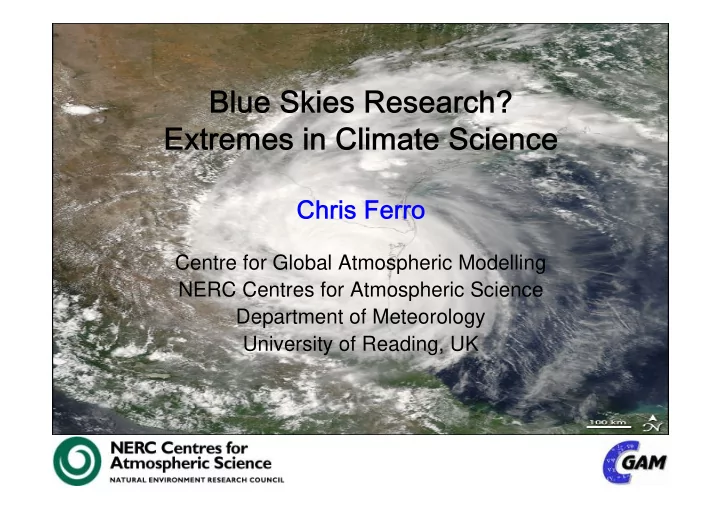
SLIDE 1
Centre for Global Atmospheric Modelling NERC Centres for Atmospheric Science Department of Meteorology University of Reading, UK
SLIDE 2 Drought Monsoon Hurricane Tornado
BBC NASA NASA BBC
SLIDE 3
Dependent on many space and time scales Nonstationary on many space and time scales Large but limited datasets from many sources Computer models provide experimental tools
SLIDE 4
Describe risks of extreme events and their changes Understand processes related to extreme events Simulate extreme events in computer models Predict risks of future extreme events
SLIDE 5
Frequency, magnitude, location, timing, space-time evolution and extent Robust estimation, model diagnostics Exploit spatial dependence Explore high-dimensional dependence
North Atlantic Oscillation Pattern (NOAA)
SLIDE 6
Small- and large-scale processes governing short- and long-term changes Improve predictability and climate models Derive extremes from well- simulated processes Statistical modelling tests theories and constraints
Specific Humidity [0.1 g / kg]
SLIDE 7 Compare simulated and
Downscale simulations Effects of model resolution Model differences
Extremal properties of observed and simulated daily rainfall through year
SLIDE 8 Global and regional effects
Attribute changes to causes Combine information from multi-model ensembles Verify predictions
Proportional increases in 10-winter return levels of daily rainfall from 1960 to 2070 assuming A2 emissions scenario
SLIDE 9
Important and challenging field Growing demand for statistical methods Need for new methods, software and collaboration c.a.t.ferro@reading.ac.uk www.met.rdg.ac.uk/~sws02caf