Centre Econometric and Allied Research (CEAR) Department of - - PowerPoint PPT Presentation

centre econometric and allied research cear department of
SMART_READER_LITE
LIVE PREVIEW

Centre Econometric and Allied Research (CEAR) Department of - - PowerPoint PPT Presentation

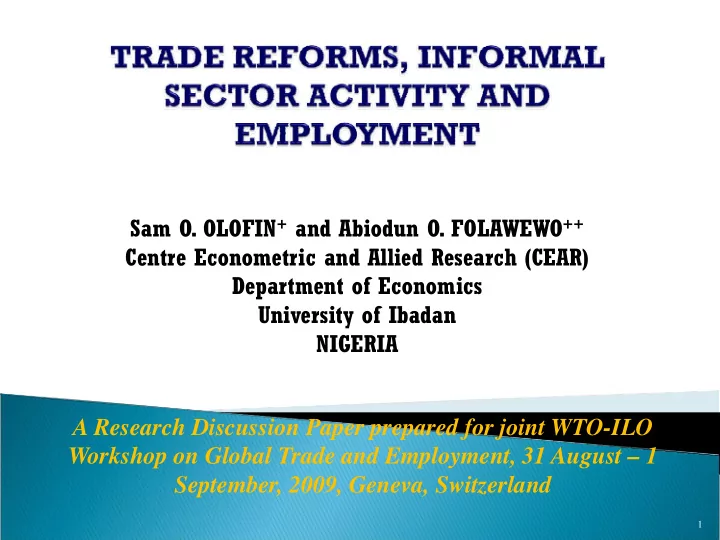
Sam O. OLOFIN + and Abiodun O. FOLAWEWO ++ Centre Econometric and Allied Research (CEAR) Department of Economics University of Ibadan NIGERIA A Research Discussion Paper prepared for joint WTO-ILO Workshop on Global Trade and Employment, 31


slide-1
SLIDE 1

Sam O. OLOFIN+ and Abiodun O. FOLAWEWO++ Centre Econometric and Allied Research (CEAR) Department of Economics University of Ibadan NIGERIA A Research Discussion Paper prepared for joint WTO-ILO Workshop on Global Trade and Employment, 31 August – 1 September, 2009, Geneva, Switzerland

1

slide-2
SLIDE 2

Introduction Suggestions for likely research focus and emphasis Justifying the re-focusing of emphasis Some theoretical propositions awaiting further empirical verification Some major empirical findings deserving of further evidence Some methodological and data issues

2

slide-3
SLIDE 3

As

As an an aftermath aftermath

  • f
  • f

political political independence independence developing developing countries countries embarked embarked

  • n
  • n

strategies strategies towards towards achieving achieving economic conomic independence independence

  • Adoption of inward-oriented development

strategy in the wake of independence in the early 1960s

  • Tariff barriers
  • Non Tariff barriers

Result – lack

  • f

growth and slow pace

  • f

development (Krueger, Krueger, 1978; 1978; Krueger Krueger and nd Tuncer, Tuncer, 1982; 1982; Bhagwati, Bhagwati, 1988; 1988; Dollar, Dollar, 1992). 1992).

3

slide-4
SLIDE 4

Policy

response to the findings above included:

  • Shift from protectionism to openness

trade liberalization, and outward looking development strategy.

  • Emergence of bilateral and multilateral

trade agreements aimed at promoting intra-regional trade, as well as north- south trade (Olofin et al. 2008)

4

slide-5
SLIDE 5

Rural – Urban Dichotomy

  • The rural areas are characterized by lack
  • f

basic socio-economic infrastructure.

  • Urban

centres are characterized by concentration of socio-economic infrastructure and industries.

  • Co-existence of the formal and informal sector
  • The formal sector consists of public sector

and private sector firms and industries whose

  • perations

and activities comply with existing factor and product markets’ regulations.

Nature of sub-Saharan economies

5

slide-6
SLIDE 6
  • The informal sector is characterized by small scale

and medium scale firms that don’t comply fully or at all with existing markets’ regulations (see Scherer, 1980; Ajakaiye and Akerele, 1996; Goldberg and Pavcnik, 2003; Folawewo, 2004; Olofin and Folawewo, 2006).

  • The slow pace of development has enhanced the

expansion of the informal sector over the years. We therefore hypothesize that there is still a missing link in all these efforts without which the story in sub-Saharan Africa is likely not to witness any significant change except It is given the attention it deserves.

6

slide-7
SLIDE 7

Trying to fill this important analytical gap has

been the primary focus of our on-going research effort, albeit currently limited in scope to the Nigerian economy due to resource constraints.

Our empirical investigations are aimed at

understanding the nature and structure of the informal sector with particular focus among

  • thers on the following, (Olofin & Folawewo,

2005, 2006):

7

slide-8
SLIDE 8

an empirical examination of the determinants

  • f labour demand,

the nature of workers’ skills in the urban

informal sector,

The nature of firm-specific factors, such as,

year of establishment, ownership structure, investment and profit levels as important factors affecting the demand for labour in the informal sector,

The role of wages in the determination of

labour demand.

8

slide-9
SLIDE 9

Measurement of workers’ productivity

(measured by educational level) and experience as an important explanatory factor in determining level of employees’ earnings in this sector.

We do expect some degree of similarity to

exist in the nature, structure and workings of the informal sector across most African countries.

9

slide-10
SLIDE 10

However we do expect to find some country

specific features that may make sweeping generalisations based on our findings on Nigeria quite difficult.

Our intention therefore is to extend the scope

  • f our coverage in a panel data study that

would allow us have a more representative picture cutting across several African countries by selecting representative countries in the various sub-regional zones.

10

slide-11
SLIDE 11
  • In the Doha Round majority of sub-Saharan

African countries are classified as LDCs, with the exception of a few.

  • they are under the trade assistance

programme Integrated Framework (IF) and the Enhanced Integrated Framework (EIF).

  • Consequently, the extent of formal trade

among these countries is low; while informal trade is high.

  • Thus, a re-assessment of the

current global trade architecture would be incomplete without focusing on the challenges

  • f

trade and employment in the informal sector in these economies.

11

slide-12
SLIDE 12
  • Suggestions for Likely Research

Focus and Emphasis

  • Research focus should aim at evaluation of the

impact

  • f

trade liberalisation

  • n

informal sector employment activities at the micro level before embarking on global analysis of impact at the broad aggregative macro level as is often the case in most formal sector studies.

  • More

specifically, analysis

  • f

trade and informal sector activities may focus on the following:

  • Examining the structure and diversity of

informal sector activities;

12

slide-13
SLIDE 13

Evaluating the impact

  • f

‘aid for trade’ programmes on informal sector activities; The extent to which trade assistance programmes have enabled the LDCs in the region to grow to trade? If yes, quantifying the magnitude of such impact first on the informal sector, and on the economy as a whole and the corresponding aggregation problems.

13

slide-14
SLIDE 14
  • Justifying the Re-Focusing of

Emphasis

  • The need to recognise the significance of the

informal sector in the development process and with particular reference to these economies.

  • The

informal sector bears the brunt

  • f

any negative fall outs from badly formulated and/or badly implemented macro economic policies designed primarily for the formal sector.

14

slide-15
SLIDE 15
  • Few existing studies on trade, informal sector

and employment have been concentrated on Asia, Latin American and Caribbean countries (Goldberg and Pavcnik, 2003; Soares, 2005; Marjit and Kar , 2007), with the exception of Currie and Harrison (1997).

  • Finally,

results from analyses

  • f

trade- employment relationship in the informal sector remain inconclusive as findings from such studies have sometimes been contested

  • n

methodological grounds.

15

slide-16
SLIDE 16

There are several theoretical propositions regarding

possible outcomes of the relationship between trade and employment. Some of these for which additional studies would yield greater insights include: that trade liberalisation could have both positive and negative effects

  • n

employment in terms

  • f

job creation and job destruction; that in the long run trade is expected to increase inequality between skilled and unskilled labour in developed countries, while the gap is expected to narrow in developing countries;

16

slide-17
SLIDE 17
  • the effect of trade on employment in the short run

depends on country specific factors, however, in the long run the efficiency gains caused by trade liberalisation are expected to lead to positive employment effects, either in terms

  • f

quantity

  • r

quality of job creation or a combination of both;

  • exporting

sectors

  • f

an economy are expected to expand and demand for more labour, while importing sectors would contract and lay-off workers;

  • trade policy can have effect on employment if an

economy is not characterised by full employment before the reform, or if some domestic policies and labour market characteristics hamper the adjustment process (Brecher, 1974);

17

slide-18
SLIDE 18

effects of trade on employment to a large extent depend on the link between export – import firms, low-productivity and high productivity firms among

  • thers (Bernard and Jensen, 1999; Bernard et al,

2007); and trade reforms are expected to depress informal wage by contracting the formal sector and driving labour into its informal counterparts ( Marjit and Kar, 2007).

Empirical evidences have emerged in respect of

some of the foregoing propositions, but hardly can such evidence be taken as sufficiently conclusive as to warrant the exclusion of need for further research.

18

slide-19
SLIDE 19

Some major empirical findings deserving further

evidence particularly from the context of developing countries such as sub-Saharan African economies include the following: there have been some positive effects of trade on manufacturing sector employment (Papageorgiou et al, 1990; WTO-ILO, 2007); the effect of trade on employment depends on the prevailing job search behaviour and the nature of the labour market in an economy (Rama, 2003); trade liberalisation has led to a rise in real wage and real fixed assets in the informal manufacturing sector

  • f India (Marjit and Kar, 2007);

19

slide-20
SLIDE 20

post-comprehensive trade liberalisation led to a rise in firms’ hiring of more temporary workers in Morocco (Currie and Harrison, 1997); trade reforms has led to resource reallocation from the formal to informal sector in some Latin American and Caribbean countries (Stallings and Peres, 2000), there is no empirical evidence showing that trade liberalisation contributed to increases in informal sector employment in Brazil and Colombia (Goldberg and Pavcnik, 2003).

20

slide-21
SLIDE 21

It is important to note that in addition to

theoretical issues and inconclusive empirical results awaiting further evidence, there is also the problem of the complexity of

  • utcomes resulting from yet to be resolved

methodological issues and challenges, ( see: Greenaway, 1993; Collier, 1993; Gaston and Trefler, 1997; Trefler, 2001).

21

slide-22
SLIDE 22

Some of these methodological issues also

need to be addressed with specific reference to informal sector activities, (see:Dollar and Collier, 2001, WTO-ILO 2007).

Generally, given the nature of the complexity

  • f the informal sector, an eclectic

investigative approach may be more promising than a doctrinaire conventional approach to modelling, ( see: Shapiro and Stiglitz (1984); Bulow and Summers (1986),;Saint-Paul (1996) and Goldger and Pavcnik (2003); Olofin & Folawewo, 2005).

  • 22
slide-23
SLIDE 23

In conclusion an understanding of the nature

and workings of the informal sector is critical to the transformation of African economies given its potentials for trade and employment

  • generation. It therefore deserves greater

attention of researchers than it is given at the moment relative to the formal sector.

Unlike it is with formal sector studies where

easy access to published secondary data reduces the burden on the researcher, the collection of primary data remains a challenging task.

23

slide-24
SLIDE 24

It is no doubt a highly challenging task, but

nonetheless not an insurmountable one.

As the sector receives the research attention

it deserves, data gathering authorities are likely to appreciate the need to extend the coverage of their data collecting activities to informal sector activities.

24

slide-25
SLIDE 25

We also see collaborative research effort

between institutions in Africa and other developing countries in Asia and Latin America with informal sector challenges helping to resolve some of the data and methodological challenges confronting informal sector research in Africa

25